
Polyvinyl Chloride PVC Market Outlook: Size, Share, Trends, Growth Analysis, Competitive Landscape & Forecast, 2026-2033

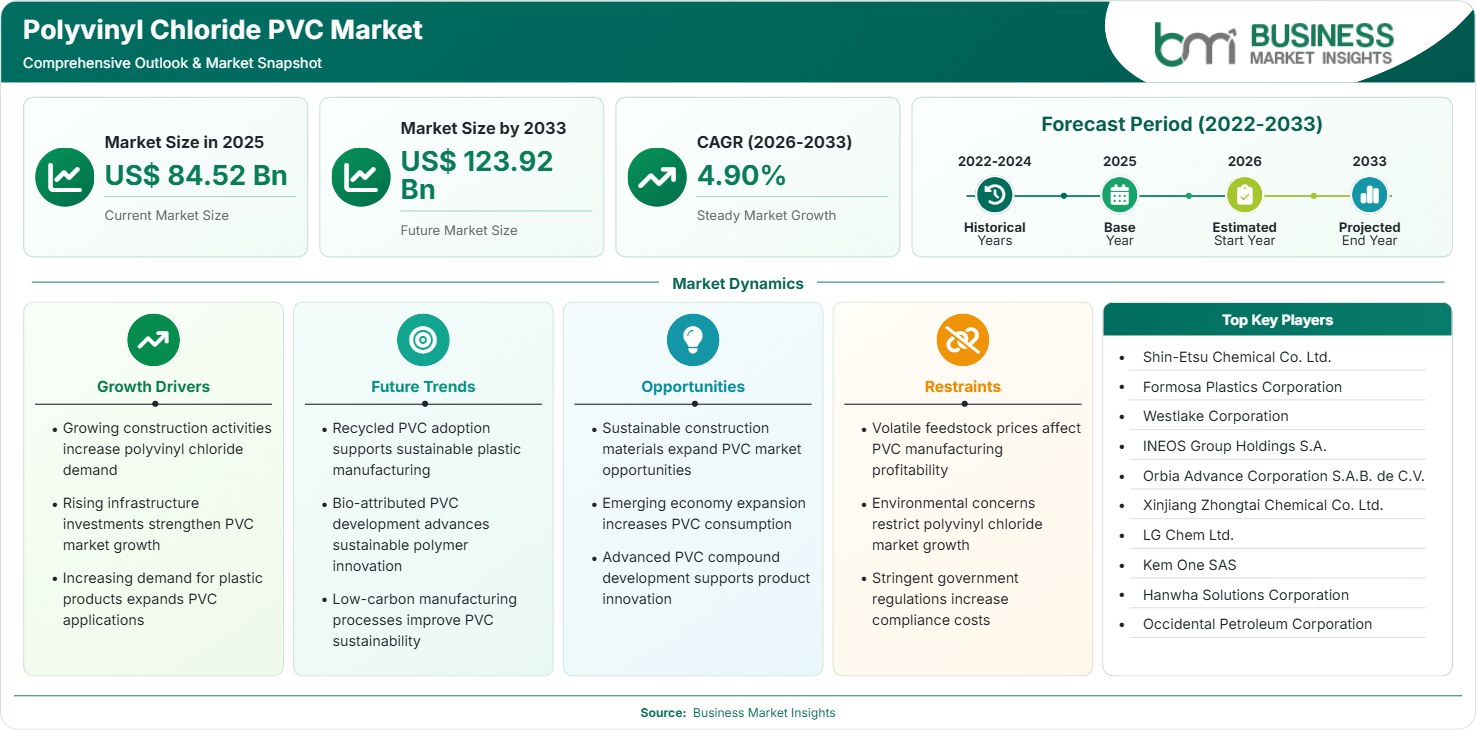
The Polyvinyl Chloride PVC Market size was valued at US$ 84.52 billion in 2025 and is projected to reach US$ 123.92 billion by 2033, registering a CAGR of 4.90% during 2026–2033. The constant growth of the market is attributed to rising construction activities, increased infrastructural developments, and the growing demand for durable plastic materials across several industries. Polyvinyl Chloride continues to be among the most commonly used synthetic polymers because of its affordability, toughness, resistance to chemicals, durability, and versatility in several applications such as pipes, fittings, profiles, films, sheets, cables, flooring, and packaging solutions.

Urbanization, construction development, and infrastructural upgrading through investments by governments all around the world continue to aid in the consumption of PVC. There is a growing trend amongst PVC producers to develop advanced forms of PVC, production technologies, recycling methods, and compound properties that comply with various regulations and meet consumer needs. There have been consistent innovations in rigid and flexible PVC materials that enhance the adoption of PVC.

Report Coverage
  • Product Type: Rigid and Flexible
  • Application: Pipe & Fittings, Profiles, Film & Sheet, Wire & Cables, Flooring, Others
  • End Use: Building & Construction, Packaging, Automotive, Electrical & Electronics, Others
US$ 84.52 Bn Market size in 2025
US$ 123.92 Bn Market Size by 2033
4.90% CAGR, 2026 - 2033
2026-2033 Forecast Period

01 AI Overview

Polyvinyl Chloride PVC Market Summary

  • North America Region: North America accounted for 23%–26% of global revenue in 2025 and is projected to register a CAGR of 4.5%–5.0% during 2026–2033. Strong construction activities, infrastructure renovation projects, expanding housing development, and increasing demand for durable piping systems continue supporting regional growth. The United States contributes approximately 82%–85% of regional revenue and is expected to register a CAGR of 4.6%–5.1% owing to rising construction investments and industrial PVC applications.
  • Fastest Growing Region: Asia Pacific represented 47%–50% of global revenue in 2025 and is projected to register the highest CAGR of 5.3%–5.8% during the forecast period. Rapid urbanization, infrastructure expansion, industrial development, and increasing construction activities across emerging economies continue accelerating regional demand.
  • Leading Segment: Rigid PVC accounted for 57%–60% of market revenue in 2025 and is projected to register a CAGR of 4.8%–5.3% during the assessment period owing to extensive use in pipes, fittings, construction profiles, and infrastructure applications.
  • High Growth Segment: Automotive represented 12%–15% of total market revenue in 2025 and is projected to expand at a CAGR of 5.2%–5.7% driven by increasing use of lightweight plastic components, interior applications, electrical systems, and vehicle manufacturing requirements.
  • Key Market Opportunity: Sustainable PVC development, recyclable materials, advanced PVC compounds, and increasing construction demand in emerging economies continue creating significant long-term opportunities for manufacturers.
  • Major Market Players: Shin-Etsu Chemical Co. Ltd., Formosa Plastics Corporation, Westlake Corporation, INEOS Group Holdings S.A., Orbia Advance Corporation S.A.B. de C.V., Xinjiang Zhongtai Chemical Co. Ltd., LG Chem Ltd., Kem One SAS, Hanwha Solutions Corporation, Occidental Petroleum Corporation
02 Strategic Insights

Polyvinyl Chloride PVC Market: Strategic Insights

Polyvinyl Chloride PVC Market Strategic Framework
FREE PDF
Request your free sample
Request free sample
03 Stakeholder View

Key Takeaways

  • The market continues benefiting from expanding construction activities, infrastructure development, urbanization trends, and increasing demand for versatile plastic materials.
  • The strongest Polyvinyl Chloride PVC Market Growth opportunities continue emerging from sustainable building materials, emerging economy expansion, advanced PVC compounds, and recycling technologies.
  • Rigid PVC remains the leading product category due to extensive application in pipes, fittings, profiles, and construction-related products.
  • Asia Pacific continues maintaining market leadership owing to rapid infrastructure development, manufacturing expansion, and increasing construction investments.
  • Manufacturers are increasingly focusing on sustainable PVC solutions, improved recycling systems, and innovative compounds to address environmental concerns.
  • Companies investing in advanced manufacturing technologies, sustainable product development, and application-specific PVC solutions are expected to strengthen their competitive positioning.
04 Geographic Outlook

Polyvinyl Chloride PVC Market Regional Highlights

North America Polyvinyl Chloride PVC Market

North America accounted for 23%–26% of global revenue in 2025 and is projected to register a CAGR of 4.5%–5.0% during 2026–2033. Strong demand from construction, renovation activities, infrastructure modernization, and industrial applications continues supporting regional expansion. The Polyvinyl Chloride PVC Market Share remains significant due to increasing adoption of PVC pipes, profiles, electrical insulation products, and durable construction materials across residential, commercial, and industrial sectors.

  • The United States remains the largest regional market owing to extensive construction activities, replacement of aging infrastructure, and increasing demand for durable piping systems.
  • Canada continues supporting regional growth through residential construction development, infrastructure upgrades, and increasing adoption of energy-efficient building materials.
  • Growing investments in water management infrastructure and utility networks continue strengthening demand for PVC-based piping solutions.
  • Manufacturers continue focusing on sustainable PVC production, recycling technologies, and advanced material formulations to meet evolving environmental standards.

US Polyvinyl Chloride PVC Market

The United States accounted for approximately 82%–85% of North American revenue in 2025 and is projected to register a CAGR of 4.6%–5.1% during the forecast period. Expanding residential construction, commercial development, infrastructure renewal, and industrial applications continue driving PVC consumption. Increasing investments in water infrastructure, electrical systems, and energy-efficient construction further support demand for PVC products.

  • Growing housing development and renovation activities continue increasing demand for PVC pipes, flooring, profiles, and construction materials.
  • Infrastructure modernization initiatives support replacement of aging water distribution systems with durable PVC piping solutions.
  • Increasing demand for lightweight and corrosion-resistant materials strengthens PVC adoption across industrial applications.

Europe Polyvinyl Chloride PVC Market

Europe represented 22%–25% of global revenue in 2025 and is expected to expand at a CAGR of 4.3%–4.8% during 2026–2033. Strong construction standards, renovation activities, sustainability initiatives, and demand for energy-efficient building materials continue supporting regional growth. Germany remains the largest regional market, while the United Kingdom is expected to register the fastest growth with a CAGR of 4.9%–5.4% owing to increasing construction modernization and infrastructure investments.

  • Germany continues leading regional demand through strong construction activities, industrial manufacturing, and advanced building material adoption.
  • The United Kingdom supports market expansion through housing development, infrastructure improvements, and renovation projects.
  • France continues contributing to PVC demand through construction, packaging, electrical, and industrial applications.
  • European manufacturers are increasingly investing in PVC recycling technologies and sustainable compound development.
  • Regulatory focus on circular economy practices continues encouraging innovation in environmentally responsible PVC products.

Asia Pacific Polyvinyl Chloride PVC Market

Asia Pacific accounted for 47%–50% of global revenue in 2025 and is projected to register the highest CAGR of 5.3%–5.8% during the forecast period. Rapid urbanization, industrialization, infrastructure development, and expanding construction activities continue positioning the region as the largest growth contributor. China remains the leading regional market, while India is projected to register the fastest growth with a CAGR of 5.8%–6.3% due to increasing infrastructure investments and construction expansion.

  • China continues dominating regional consumption through large-scale construction projects, manufacturing capacity, and extensive PVC production facilities.
  • India continues experiencing strong demand through urban development programs, housing projects, smart infrastructure initiatives, and industrial expansion.
  • Japan maintains stable demand through renovation activities, advanced manufacturing, and high-quality construction applications.
  • Southeast Asian economies continue increasing PVC consumption through infrastructure development, industrial investments, and growing urban populations.
  • Regional manufacturers continue expanding production capacity to support increasing domestic and export demand.

Rest of World Polyvinyl Chloride PVC Market

The Rest of World accounted for 6%–8% of global revenue in 2025 and is projected to register a CAGR of 4.7%–5.2% during 2026–2033. South & Central America together with the Middle East & Africa continue benefiting from infrastructure development, construction activities, and increasing demand for durable building materials.

Growing investments in housing, water infrastructure, industrial facilities, and commercial construction continue creating favorable opportunities for PVC manufacturers across emerging economies.

  • Brazil remains the leading South & Central American market through expanding construction activities, infrastructure projects, and industrial applications.
  • The United Arab Emirates continues strengthening demand through commercial construction, urban development, and infrastructure expansion.
  • Saudi Arabia supports PVC consumption through large-scale construction projects and economic diversification initiatives.
  • South Africa continues recording gradual growth through infrastructure improvements, housing development, and industrial modernization.
  • International PVC manufacturers continue expanding regional distribution networks to support growing construction and industrial demand.
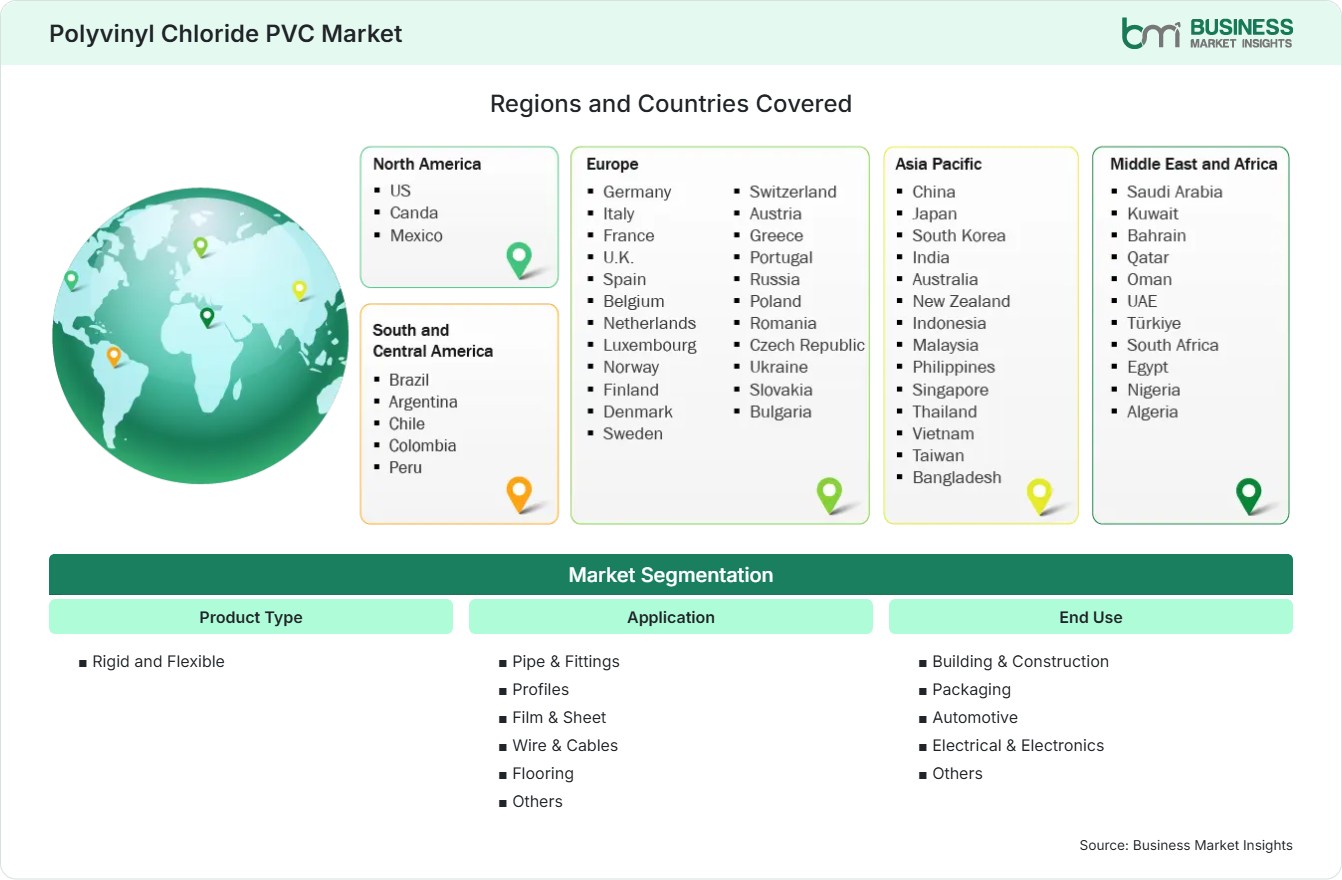
Global Market Geography
FREE PDF
Request your free sample
Request free sample
05 Segment Analysis

Polyvinyl Chloride PVC Market Segmentation

Product Type

The Product Type segment accounted for 57%–60% of market revenue in 2025 and is projected to register a CAGR of 4.8%–5.3% during the forecast period. Increasing demand for durable, cost-effective, and versatile polymer solutions across construction, infrastructure, electrical, and industrial applications continues supporting growth across rigid and flexible PVC products. The Polyvinyl Chloride PVC Market Trends indicate rising adoption of advanced PVC formulations, recyclable materials, and application-specific compounds to improve performance and sustainability.

  • Rigid: Rigid PVC remains the leading product category owing to extensive usage in pipes, fittings, profiles, construction panels, window frames, and infrastructure applications. Its high strength, durability, corrosion resistance, and low maintenance requirements continue supporting widespread adoption in building and construction projects.
  • Flexible: Flexible PVC continues witnessing steady growth due to increasing applications in cables, flooring, films, sheets, medical products, automotive interiors, and consumer goods. Improved flexibility, lightweight characteristics, and processing advantages continue supporting adoption across diverse industries.

Application

The Application segment represented 42%–45% of total market revenue in 2025 and is expected to expand at a CAGR of 4.9%–5.4% throughout the assessment period. Growing infrastructure development, increasing demand for efficient utility systems, and expanding industrial applications continue driving PVC consumption across multiple application areas. The Polyvinyl Chloride PVC Market Scope continues expanding as manufacturers develop specialized PVC solutions for construction, electrical, packaging, and transportation requirements.

  • Pipe & Fittings: Pipe and fittings remain the dominant application segment due to widespread use in water supply, sewage systems, irrigation networks, drainage solutions, and industrial piping applications. PVC pipes are preferred due to corrosion resistance, durability, lightweight characteristics, and cost advantages.
  • Profiles: PVC profiles continue gaining adoption in windows, doors, construction components, and architectural applications owing to weather resistance, low maintenance requirements, and long service life.
  • Film & Sheet: PVC films and sheets support applications across packaging, agriculture, protective coverings, and industrial products due to flexibility, transparency options, and processing versatility.
  • Wire & Cables: PVC remains widely used for electrical insulation and cable protection due to strong insulation properties, durability, and resistance to environmental conditions.
  • Flooring: PVC flooring continues expanding across residential, commercial, healthcare, and industrial buildings due to affordability, design flexibility, and easy maintenance.
  • Others: Additional applications including medical products, automotive components, consumer goods, and specialty industrial products continue contributing to overall market growth.

End Use

The End Use segment accounted for 48%–51% of market revenue in 2025 and is projected to register a CAGR of 5.0%–5.5% during 2026–2033. Increasing construction activities, infrastructure investments, industrial expansion, and growing demand for lightweight plastic components continue strengthening PVC consumption across end-use industries.

  • Building & Construction: Building and construction remains the largest end-use industry due to extensive utilization of PVC pipes, profiles, flooring, roofing materials, and construction components. Increasing urbanization and infrastructure development continue supporting long-term demand.
  • Packaging: Packaging applications continue benefiting from PVC films, sheets, and containers used for product protection, flexibility, and durability across consumer and industrial sectors.
  • Automotive: Automotive applications are expanding through increasing use of PVC in interior components, wire coatings, seals, flooring materials, and lightweight vehicle systems.
  • Electrical & Electronics: Electrical and electronics applications continue supporting demand through PVC insulation materials, cable protection solutions, and electrical components.
  • Others: Healthcare, agriculture, industrial equipment, and consumer applications continue contributing to market expansion through specialized PVC product adoption.
06 Market Forces

Polyvinyl Chloride PVC Market Dynamics

Key Market Drivers

Growing construction activities increase polyvinyl chloride demand

Increasing residential, commercial, and industrial construction activities continue driving demand for PVC products used in pipes, fittings, profiles, flooring, cables, and building components. Rapid urbanization, population growth, and rising demand for affordable infrastructure solutions are encouraging broader adoption of PVC-based construction materials. The material’s durability, corrosion resistance, lightweight properties, and cost efficiency make it suitable for large-scale construction applications worldwide.

Rising infrastructure investments strengthen PVC market growth

Growing government and private sector investments in water management systems, transportation infrastructure, urban development, and utility networks continue creating strong demand for PVC products. Infrastructure modernization projects increasingly utilize PVC piping systems and construction materials due to their long service life, reduced maintenance requirements, and installation efficiency.

Increasing demand for plastic products expands PVC applications

Rising consumption of plastic products across packaging, automotive, electrical, consumer goods, and industrial sectors continues expanding PVC application opportunities. Manufacturers are developing customized PVC compounds with improved strength, flexibility, and sustainability characteristics to meet diverse industry requirements.

Key Market Opportunities

Sustainable construction materials expand PVC market opportunities

Growing focus on sustainable building practices is creating opportunities for recyclable PVC products, environmentally improved formulations, and circular economy-based material solutions. Manufacturers are investing in recycling infrastructure and advanced processing technologies to improve the sustainability profile of PVC products used in construction applications.

Emerging economy expansion increases PVC consumption

Rapid industrialization, urban development, housing expansion, and infrastructure investments across emerging economies continue creating significant opportunities for PVC manufacturers. Increasing demand for affordable construction materials and utility infrastructure is expected to support long-term consumption growth.

Advanced PVC compound development supports product innovation

Continuous development of high-performance PVC compounds is creating opportunities for manufacturers to expand applications across automotive, electrical, healthcare, and industrial sectors. Innovations focused on improved durability, recyclability, thermal performance, and processing efficiency are strengthening product adoption.

Market Restraints and Challenges

Volatile feedstock prices affect PVC manufacturing profitability

Factor: Polyvinyl chloride production depends heavily on key raw materials such as ethylene and chlorine, which are influenced by fluctuations in crude oil prices, energy costs, supply-demand variations, and global market conditions. Changes in feedstock pricing directly impact production economics across the PVC value chain.

Impact: Rising and unpredictable raw material costs can increase manufacturing expenses, create pricing pressure, and affect profit margins for PVC producers. Companies are focusing on supply chain optimization, operational efficiency improvements, and advanced production technologies to reduce cost volatility and maintain competitiveness.

Environmental concerns restrict polyvinyl chloride market growth

Factor: Environmental concerns associated with PVC production, chemical additives, waste management, and recycling challenges continue influencing industry development. Regulatory authorities are implementing stricter sustainability requirements related to plastic usage, emissions reduction, and end-of-life material management.

Impact: Increasing regulatory pressure requires manufacturers to invest in sustainable production methods, recycling technologies, eco-friendly additives, and improved waste management systems. While these initiatives support long-term sustainability, they may increase production costs and require significant technological investments.

07 Company Analysis

Competitive Landscape

Competition within the polyvinyl chloride industry is driven by production capacity, raw material integration, technological innovation, sustainability initiatives, and product development capabilities. The Polyvinyl Chloride PVC Market Analysis indicates that leading manufacturers continue focusing on advanced PVC compounds, recycling technologies, specialty formulations, and application-specific solutions to strengthen their positions across construction, automotive, packaging, electrical, and industrial sectors.

Company Name

Overview

Products and Services relevant to this market

Shin-Etsu Chemical Co. Ltd.

Global chemical manufacturer with significant PVC production capabilities and advanced polymer technologies.

PVC resins, specialty PVC compounds, industrial polymers, and chemical solutions for construction and industrial applications.

Formosa Plastics Corporation

Major global producer of petrochemicals and PVC materials.

PVC resins, vinyl chloride monomer, plastic materials, pipes, profiles, and industrial polymer solutions.

Westlake Corporation

International manufacturer of chemicals and performance materials.

PVC resins, specialty polymers, building materials, vinyl products, and industrial chemical solutions.

INEOS Group Holdings S.A.

Global chemical company producing a wide range of petrochemical and polymer products.

PVC resins, vinyl chloride products, specialty polymers, and chemical intermediates.

Orbia Advance Corporation S.A.B. de C.V.

Global provider of polymer solutions and advanced materials.

PVC compounds, building materials, infrastructure solutions, pipes, fittings, and specialty polymer products.

Xinjiang Zhongtai Chemical Co. Ltd.

Chinese chemical manufacturer specializing in chlor-alkali and PVC production.

PVC resins, chlor-alkali products, chemical materials, and industrial polymer solutions.

LG Chem Ltd.

Leading chemical company providing advanced materials and polymer solutions.

PVC materials, specialty compounds, industrial polymers, and performance materials.

Kem One SAS

European PVC producer specializing in vinyl products and sustainable polymer solutions.

PVC resins, vinyl chloride products, specialty PVC grades, and industrial applications.

Hanwha Solutions Corporation

Global chemical and materials company serving multiple industries.

PVC products, chemical materials, polymer solutions, and industrial applications.

Occidental Petroleum Corporation

Major chemical producer with vinyl and chlor-alkali operations.

PVC-related chemical materials, chlorine derivatives, vinyl products, and industrial chemical solutions.


10 Trust & Transparency

Research Methodology

The market analysis combines proprietary research with secondary data from government agencies, company disclosures, regulatory filings, industry databases and expert interviews. Market estimates are validated through data triangulation, cross-market benchmarking and analyst review.

View Full Research Methodology

11 Questions Answered

Frequently Asked Questions

How do market forecasts support strategic planning?

Polyvinyl Chloride PVC Market Forecasts help manufacturers, investors, chemical companies, and industry stakeholders evaluate future demand patterns, optimize production strategies, identify growth opportunities, and support long-term business decisions.

What does the market report include?

The Polyvinyl Chloride PVC Market Report provides comprehensive insights covering market size, competitive landscape, segmentation analysis, regional outlook, industry trends, technological developments, investment opportunities, and future growth prospects.

What factors are driving PVC market expansion?

Increasing construction activities, infrastructure investments, rising plastic product demand, urbanization, and industrial development continue supporting global PVC consumption.

Which application segment is expected to witness significant growth?

Pipe & fittings are expected to maintain strong growth owing to increasing water infrastructure projects, urban development, replacement of aging pipelines, and rising demand for durable utility systems.

Which product type dominates the Polyvinyl Chloride PVC Market?

Rigid PVC represents the leading product type due to extensive utilization in pipes, fittings, profiles, construction materials, and infrastructure applications. Its durability, strength, and cost efficiency continue supporting widespread adoption.

Access the Full Polyvinyl Chloride PVC Market Report

Get segment-level forecasts, regional estimates, competitive benchmarking, company profiles and downloadable Excel datasets.

Access the full Polyvinyl Chloride PVC Market Report
350 pages PDF & Excel | 2026-08-04