
Polyvinyl Alcohol Market Outlook: Size, Share, Trends, Growth Analysis, Competitive Landscape & Forecast, 2026-2033

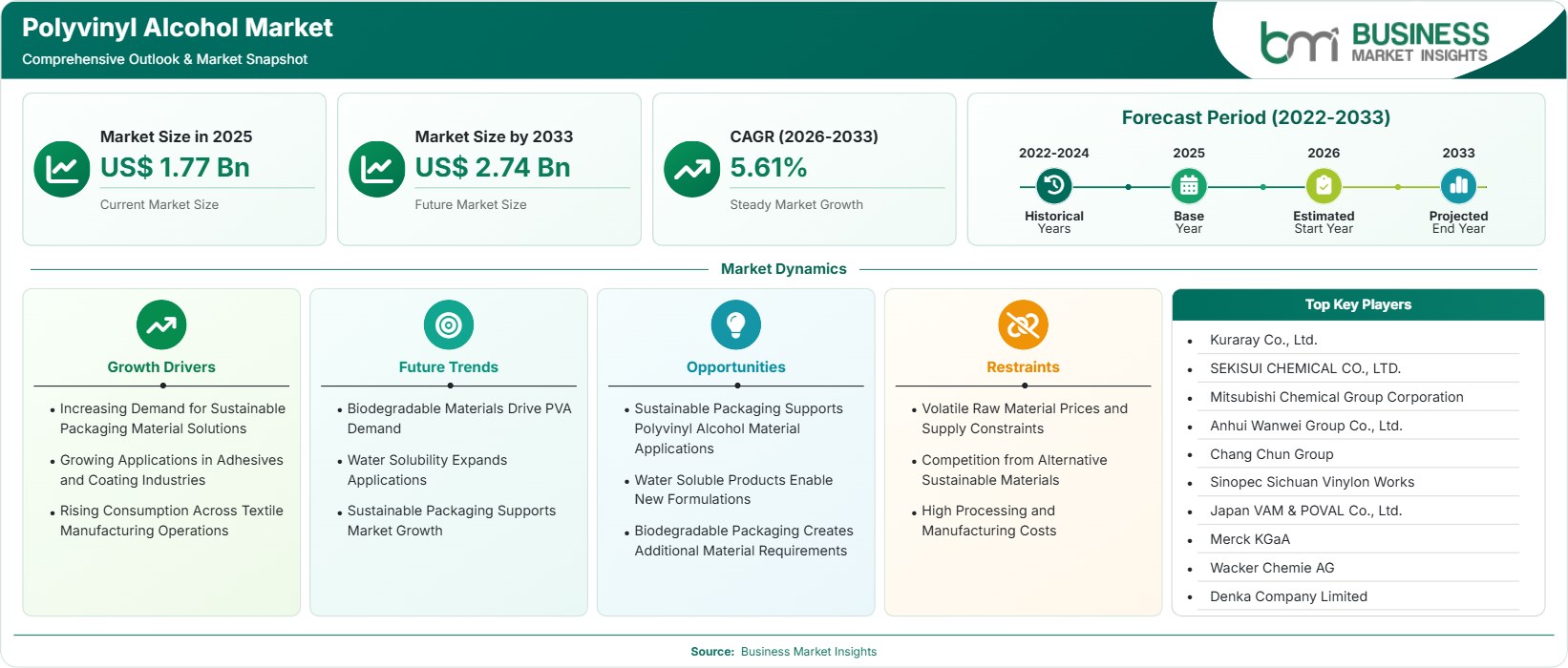
The Polyvinyl Alcohol Market size was valued at US$ 1.77 Billion in 2025 and is projected to reach US$ 2.74 Billion by 2033, growing at a CAGR of 5.61% during 2026–2033, supported by sustainable packaging adoption, expanding construction chemicals demand, water-soluble film innovation, and increasing utilization across paper, textile, and adhesive applications.

Report Coverage
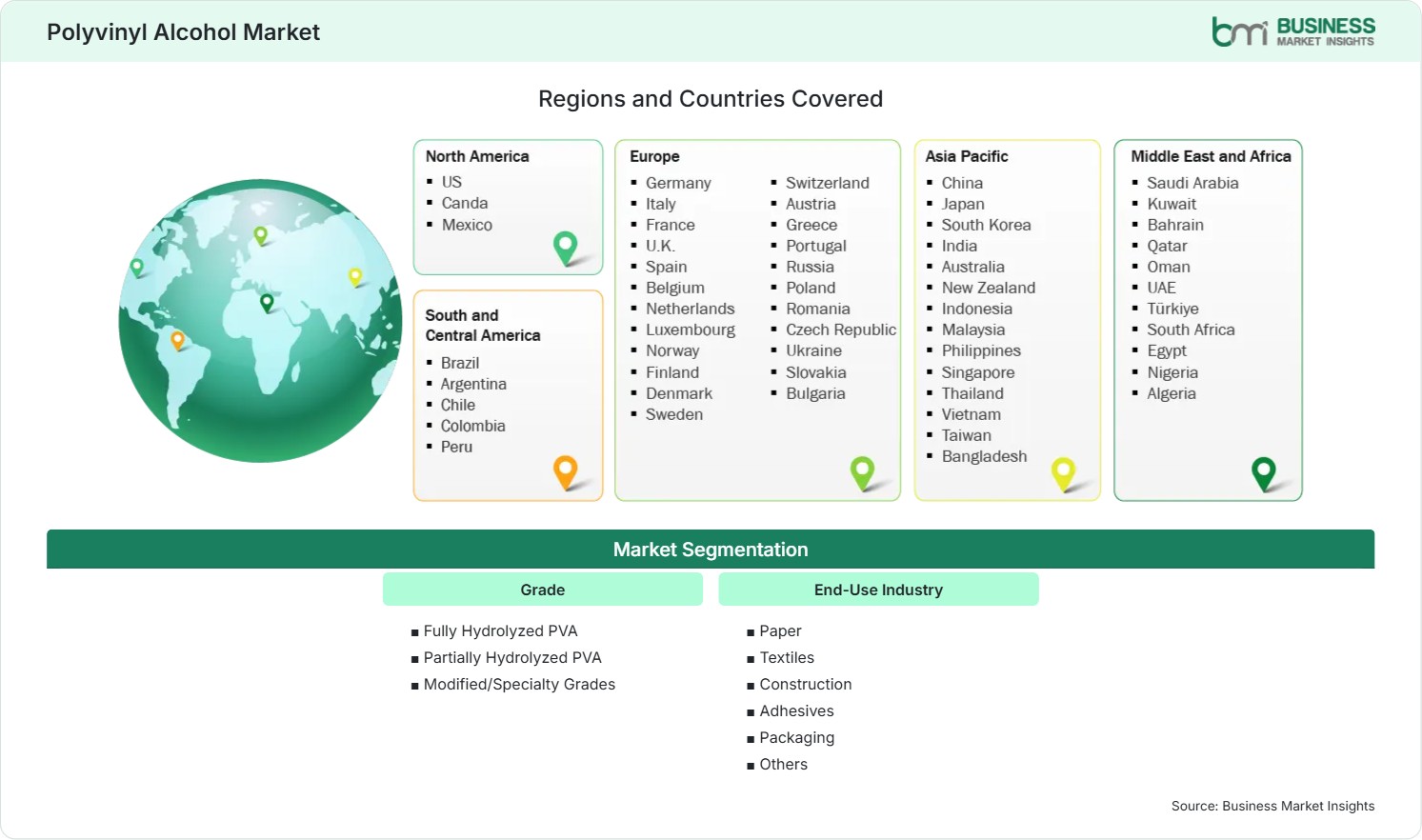
  • Grade: Fully Hydrolyzed PVA, Partially Hydrolyzed PVA, Modified/Specialty Grades
  • End-Use Industry: Paper, Textiles, Construction, Adhesives, Packaging, Others
US$ 1.77 Bn Market size in 2025
US$ 2.74 Bn Market Size by 2033
5.61% CAGR, 2026 - 2033
2026-2033 Forecast Period

AI Overview

Polyvinyl Alcohol Market Summary

  • North America Region: North America holds a market share of 22%–25% in 2025, growing with a CAGR of 4.8%–5.2% during 2026–2033. Demand is supported by construction additives, detergent pods, specialty coatings, sustainable packaging initiatives, advanced manufacturing investments, regulatory support, innovation partnerships, and performance-material requirements across industrial sectors. US benefits from strong specialty materials demand and detergent-film consumption, advancing at approximately 5.0%–5.4% CAGR.
  • Fastest Growing Region: Asia Pacific accounts for 42%–46% share in 2025 and expands at 6.3%–6.8% CAGR through 2033. Growth is driven by industrialization, packaging conversion, textile production expansion, infrastructure investments, domestic manufacturing incentives, export competitiveness, and increasing consumption of specialty polymers.
  • Leading Segment: Fully Hydrolyzed PVA represents 44%–48% share in 2025 and advances at 5.2%–5.7% CAGR. Adoption benefits from superior tensile strength, film-forming performance, chemical resistance, expanding paper coatings usage, industrial processing requirements, and demand for durable specialty formulations.
  • High Growth Segment: Packaging captures 17%–21% share in 2025 while growing at 6.6%–7.1% CAGR. Expansion reflects rising sustainability targets, water-soluble films, detergent-unit packaging demand, circular-economy initiatives, e-commerce protective solutions, environmental compliance requirements, and material substitution opportunities.
  • Key Market Opportunity: Development of biodegradable water-soluble films for consumer goods, agrochemicals, healthcare packaging, and industrial applications creates attractive long-term revenue streams while aligning with sustainability and regulatory objectives worldwide.
  • Major Market Players: Kuraray Co., Ltd.; SEKISUI CHEMICAL CO., LTD.; Mitsubishi Chemical Group Corporation; Anhui Wanwei Group Co., Ltd.; Chang Chun Group; Sinopec Sichuan Vinylon Works; Japan VAM & POVAL Co., Ltd.; Merck KGaA; Wacker Chemie AG; Denka Company Limited.
Strategic Insights

Polyvinyl Alcohol Market: Strategic Insights

Polyvinyl Alcohol Market Strategic Framework
FREE PDF
Request your free sample
Request free sample
Stakeholder View

Key Takeaways

  • The value chain remains strongly integrated around vinyl acetate monomer availability, hydrolysis technology expertise, specialty grade formulation capabilities, and distribution networks serving paper, packaging, textile, and construction industries.
  • Water-soluble packaging formats and sustainable coating technologies offer the strongest medium-term upside as regulatory pressure encourages replacement of less environmentally attractive materials.
  • Product innovation increasingly focuses on customized hydrolysis levels, higher film strength, improved moisture control, and compatibility with emerging industrial processing systems.
  • Asia Pacific presents the most compelling investment proposition due to concentrated manufacturing activity, growing domestic consumption, and capacity expansion across multiple downstream industries.
  • Industry participants continue pursuing strategic collaborations, regional expansions, and application-development partnerships to secure market access and improve specialty-product margins.
  • Demand diversification across construction chemicals, packaging films, and paper processing helps mitigate sector-specific volatility and strengthens long-term market resilience.
Geographic Outlook

Polyvinyl Alcohol Market Regional Highlights

North America Polyvinyl Alcohol Market

North America accounts for 22%–25% of global demand in 2025 and is expected to expand at a 4.8%–5.2% CAGR through 2033. The region benefits from advanced specialty chemicals manufacturing, detergent-film adoption, and sustainable packaging initiatives. The Polyvinyl Alcohol Market share continues to benefit from innovative end-users, as well as consumption in the field of construction chemicals and processing paper. Environmentally friendly substances become an important regulatory point, which promotes the development of special grades with improved properties.

  • Sustainable packaging programs continue stimulating demand for high-performance water-soluble films across consumer and industrial applications.
  • Construction additives adoption increases as infrastructure modernization projects seek improved material durability and application performance.
  • Paper and coating manufacturers emphasize specialty formulations that improve process efficiency and product quality.
  • Research partnerships between producers and end users accelerate commercialization of advanced grades with tailored properties.

US Polyvinyl Alcohol Market

The United States represents approximately 74%–78% of regional consumption and advances at a 5.0%–5.4% CAGR. The demand is driven by packaged consumer goods, construction materials, industrial coatings, and specialized adhesives. The ability to produce an innovative framework and downstream industries that exist support further growth in the industry. There has been an increasing trend in which the market players focus on value-added specialty grades.

  • Detergent-unit packaging demand supports ongoing adoption of water-soluble film technologies.
  • Specialty adhesives manufacturers increase utilization in performance-focused industrial applications.
  • Investment in advanced materials research supports development of differentiated product grades.
  • Domestic manufacturing programs strengthen resilient supply chains and regional sourcing strategies.

Europe Polyvinyl Alcohol Market

Europe holds 19%–22% Polyvinyl Alcohol Market share in 2025 and is forecast to grow at 4.9%–5.4% CAGR through 2033. Regulations on sustainability, activities in the circular economy, and existing capacities in specialty chemicals will continue to play a major role. Germany remains the leading demander in the region, whereas Eastern Europe represents the most promising area for growth. The region focuses on environmentally friendly materials and high-end applications.

  • Germany remains the leading national market, supported by advanced chemicals manufacturing and industrial innovation.
  • Poland and selected Eastern European countries exhibit stronger growth rates due to expanding industrial investments.
  • Regulatory emphasis on sustainable materials encourages specialty product development and adoption.
  • Packaging innovation programs strengthen demand for high-performance film solutions.
  • Construction renovation activity supports consumption of performance-enhancing additives.

Asia Pacific Polyvinyl Alcohol Market

Asia Pacific represents 42%–46% of global demand in 2025 and records the highest growth at 6.3%–6.8% CAGR. China remains the dominant consuming and producing nation, while India demonstrates the strongest expansion profile. Strong manufacturing ecosystems, infrastructure development, packaging growth, and textile production underpin regional demand. Export-oriented industries and ongoing capacity additions reinforce the region's position as the primary growth engine.

  • China leads consumption through extensive packaging, construction, and industrial manufacturing activities.
  • India records the fastest expansion owing to industrialization and infrastructure development programs.
  • Regional capacity additions improve supply availability and support downstream industry growth.
  • Textile and paper sectors remain significant demand generators across developing economies.
  • Export competitiveness sustains investment in specialty chemical production facilities.

Rest of World Polyvinyl Alcohol Market

Rest of World contributes 11%–14% share in 2025 and expands at 5.4%–5.9% CAGR during the forecast period. South and Central America benefit from packaging and consumer-products manufacturing development. In the Middle East and Africa, diversification strategies and industrial investments support specialty-material demand. Brazil leads Latin American consumption, while Saudi Arabia represents a key growth market driven by industrial expansion and value-chain development.

  • Brazil remains the largest regional market due to expanding packaging and manufacturing activities.
  • Saudi Arabia benefits from industrial diversification and chemicals-sector investments.
  • Consumer-goods production growth supports wider adoption of specialty film and adhesive products.
  • Infrastructure and construction projects create opportunities for performance-enhancing material applications.
  • Distribution network development improves accessibility across emerging industrial markets.
Global Market Geography
FREE PDF
Request your free sample
Request free sample
Segment Analysis

Polyvinyl Alcohol Market Segmentation

Grade

This segment accounted for approximately 52%–56% share in 2025 and is projected to expand at 5.5%–6.0% CAGR. Product differentiation is increasingly based on hydrolysis levels, mechanical properties, dissolution characteristics, and application-specific performance requirements. The Polyvinyl Alcohol Market scope continues broadening through specialty formulations supporting sustainability, packaging innovation, and industrial process optimization.

  • Fully Hydrolyzed PVA: Strong adoption across paper coatings, construction formulations, and industrial applications where higher strength, chemical resistance, and durable film characteristics are required.
  • Partially Hydrolyzed PVA: Widely utilized in adhesives, textile processing, and coating solutions because of enhanced solubility, processing flexibility, and balanced performance characteristics.
  • Modified/Specialty Grades: Demand increases for tailored formulations featuring controlled dissolution, improved barrier performance, and customized properties supporting advanced industrial and packaging requirements.

End-Use Industry

End-use industries represent 44%–48% share of revenue in 2025 and are forecast to grow at 5.8%–6.3% CAGR. Industry demand patterns are shaped by sustainability goals, manufacturing activity, packaging innovations, and infrastructure development. The Polyvinyl Alcohol Market trends increasingly reflect application diversification beyond traditional paper and textile sectors.

  • Paper: Used in coatings and surface treatment applications to improve printability, strength, and processing performance across specialty paper grades.
  • Textiles: Supports sizing operations and fiber-processing activities requiring film-forming characteristics and reliable performance during manufacturing.
  • Construction: Utilized in mortars, cement additives, and specialty formulations designed to enhance adhesion, durability, and application efficiency.
  • Adhesives: Growing usage in industrial and consumer adhesive products due to strong bonding capabilities and formulation flexibility.
  • Packaging: Rapidly expanding adoption in water-soluble films, sustainable packaging concepts, and specialty protective applications across multiple industries.
Market Forces

Polyvinyl Alcohol Market Dynamics

Key Market Drivers

Rising Demand for Sustainable Packaging Materials

Growing regulatory attention toward waste reduction and sustainability is boosting demand for water-soluble and environmentally favorable packaging solutions. Consumer goods manufacturers have come to assess options that can help them achieve the circular economy goals. Packaging continues to be one of the fastest-growing segments of the application, especially within detergents and specialized consumer goods. The increase in demand will be driven by brands’ sustainable agenda and investments in new materials. This trend promotes greater adoption in developed and emerging economies, while opening up business prospects for value-added producers. Companies keep developing new grades with better film properties.

Expansion of Construction Chemicals Consumption

Global infrastructure investment and urban development continue supporting consumption of specialty additives and performance-enhancing materials. Construction formulations benefit from improved adhesion, strength, and process performance offered by PVA-based products. Emerging economies will continue to play an important role given the fast pace at which residential, commercial, and infrastructure development is taking place. There are long-term urbanization dynamics that are driving demand for cement admixtures, repair products, and construction chemicals. Manufacturers are working closely with formulation experts to create application-specific products that improve performance and meet engineering needs.

Growing Industrial Utilization in Paper and Textile Processing

Paper and textile manufacturers increasingly prioritize process efficiency, product quality, and material performance. The PVA product line facilitates coating applications, sizing, and special treatments that will contribute to the achievement of operational success. In contemporary manufacturing settings, there is a need for materials that can offer reliability while at the same time upholding the green concept. The increased production levels in Asia and other manufacturing hubs have increased the demand. Modernization in the paper and textile industries facilitates the use of higher grades with specific functionalities.

Key Market Opportunities

Commercialization of Advanced Water-Soluble Film Technologies

Advanced water-soluble films provide a lucrative option for manufacturers looking to diversify into more profitable uses. Needs range from detergents to healthcare, farming, and industrial packing. Advances in products in terms of strength, dissolution properties, and overall performance may help realize increased acceptance by the market. Sustainability is becoming a key issue, and this sector is being watched closely by investors. Polyvinyl Alcohol Market Forecasts indicate that specialty films will command increased spending on R&D, technology alliances, and application development. Firms that can manage performance, regulation, and competitiveness will be well-placed to take advantage of the new growth opportunities.

Expansion Across Healthcare and Pharmaceutical Applications

Healthcare industries continue exploring advanced polymers for drug delivery systems, coating technologies, and specialty packaging applications. Product quality standards create opportunities to differentiate products for high-performance use. Pharmaceutical production capability developments in developing nations further increase the pool of demand to be addressed. Manufacturers that possess good regulatory knowledge and quality management will have good positioning. Long-term growth expectations in healthcare spending and innovation activities suggest promising future prospects for application outside industrial usage.

Emerging Market Manufacturing Localization

Governments increasingly encourage domestic manufacturing capabilities through industrial development programs and investment incentives. Specialty chemicals used as input will be in demand due to localization efforts in countries in Asia, the Middle East, and Latin America. Production plants within the region will minimize transport risks and enhance the reliability of the supply chain. Market players who utilize geographically diverse manufacturing and distribution plans can take advantage of rising regional demand and become responsive to customers.

Market Restraints and Challenges

Raw Material Price Volatility and Margin Pressure

Factor: Dependence on vinyl acetate monomer and related upstream feedstocks exposes manufacturers to raw-material price fluctuations.

Impact: Uncertainties in production expenses may squeeze profit margins, create difficulties in the implementation of pricing policies, and negatively affect the bottom line in product categories that are based on commodities. Companies find it hard to remain cost-competitive when energy and petrochemical market conditions fluctuate. Small players may find themselves under increased pressure because of a lack of purchasing power. Nevertheless, there is a certain degree of security provided by specialty goods.

Performance Limitations in Certain High-Moisture Environments

Factor: Water sensitivity can limit suitability in some applications requiring extended exposure to moisture or demanding environmental conditions.

Impact: End users can choose competing polymers if there is a mismatch between performance and durability demands. Companies have to spend a lot on developing the technology for modification and formulating new compounds. Yet, such developments lead to additional expenses and longer commercialization times. Competing with alternative polymers is an important factor to keep in mind.

Company Analysis

Competitive Landscape

The competitive structure reflects strong participation from Japanese, Chinese, European, and multinational specialty chemical producers. The Polyvinyl Alcohol Market analysis highlights a focus on specialty grades, regional expansion, application development, and sustainability-driven innovation.

Company Name

Overview

Products and Services relevant to this market

Kuraray Co., Ltd.

Global specialty chemicals leader and one of the largest PVA suppliers.

PVA resins, specialty grades, films, industrial materials, technical support.

SEKISUI CHEMICAL CO., LTD.

Major producer with deep expertise in advanced polymer technologies.

PVA resins, specialty polymers, film solutions, industrial materials.

Mitsubishi Chemical Group Corporation

Diversified chemicals producer serving multiple industrial sectors.

Functional polymers, specialty materials, performance chemical solutions.

Anhui Wanwei Group Co., Ltd.

Large Chinese producer with extensive manufacturing capabilities.

PVA products, chemical materials, industrial polymer offerings.

Chang Chun Group

Integrated petrochemical and specialty materials manufacturer.

PVA grades, intermediates, adhesive and coating materials.

Sinopec Sichuan Vinylon Works

Key Chinese supplier with significant production infrastructure.

PVA resins, vinylon-related products, industrial materials.

Japan VAM & POVAL Co., Ltd.

Specialized producer focused on PVA technologies and applications.

PVA grades, customized solutions, technical development support.

Merck KGaA

Global science and technology company serving advanced industries.

Specialty chemicals, laboratory-grade materials, industrial formulations.

Wacker Chemie AG

European specialty chemicals producer with global presence.

Polymer materials, dispersions, specialty chemical solutions.

Denka Company Limited

Japanese manufacturer focused on value-added material technologies.

Functional polymers, specialty resins, industrial performance materials.

Trust & Transparency

Research Methodology

The market analysis combines proprietary research with secondary data from government agencies, company disclosures, regulatory filings, industry databases and expert interviews. Market estimates are validated through data triangulation, cross-market benchmarking and analyst review.

View Full Research Methodology

Questions Answered

Frequently Asked Questions

Why is this Polyvinyl Alcohol Market Report useful for stakeholders?

The Polyvinyl Alcohol Market Report provides insights into regional demand patterns, segment opportunities, competitive positioning, technology developments, and investment priorities that support strategic planning and business expansion.

What factors influence producer competitiveness?

Access to raw materials, specialty-grade expertise, production scale, customer partnerships, technical service capabilities, and geographic reach are among the most important competitive differentiators.

How does Asia Pacific influence industry development?

The region combines large-scale manufacturing, significant downstream consumption, expanding infrastructure investment, and ongoing capacity additions, making it the primary engine of global demand expansion.

What makes fully hydrolyzed grades commercially important?

They provide stronger film performance, improved chemical resistance, and suitability for demanding industrial applications, supporting extensive utilization across paper, coatings, and construction-related formulations.

Which industry generates the strongest demand for PVA materials?

Packaging, paper processing, construction chemicals, and textile applications collectively represent the largest demand base, with packaging emerging as the most rapidly expanding application area because of sustainability initiatives.

Access the Full Polyvinyl Alcohol Market Report

Get segment-level forecasts, regional estimates, competitive benchmarking, company profiles and downloadable Excel datasets.

Access the full Polyvinyl Alcohol Market Report
350 pages PDF & Excel | 2026-09-04