
Dimethyl Carbonate (DMC) Market Outlook: Size, Share, Trends, Growth Analysis, Competitive Landscape & Forecast, 2026-2033

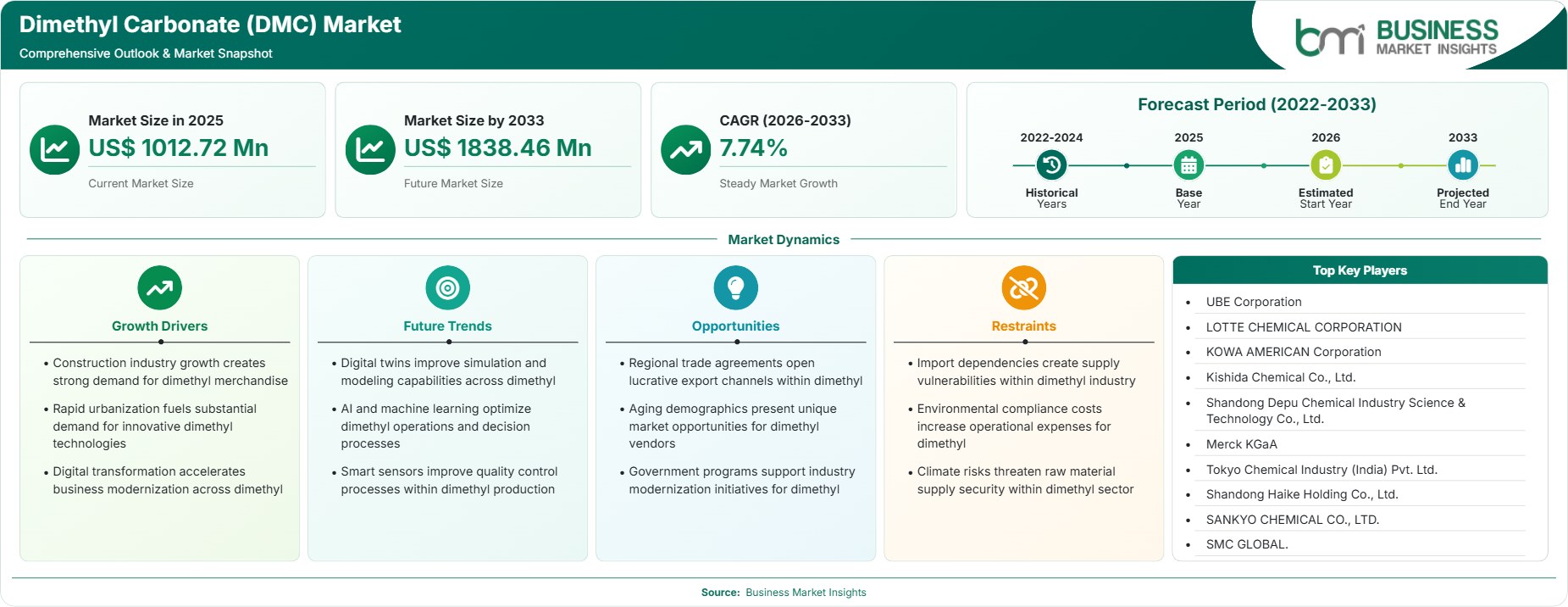
The Dimethyl Carbonate Market size was valued at US$ 1012.72 Million in 2025 and is projected to reach US$ 1838.46 Million by 2033, growing at a CAGR of 7.74% during 2026–2033. Rising demand for lithium-ion batteries, sustainable chemical synthesis, polycarbonate production expansion, and increasing adoption of environmentally friendly solvents continue creating long-term growth opportunities across industrial and advanced manufacturing applications.

Report Coverage
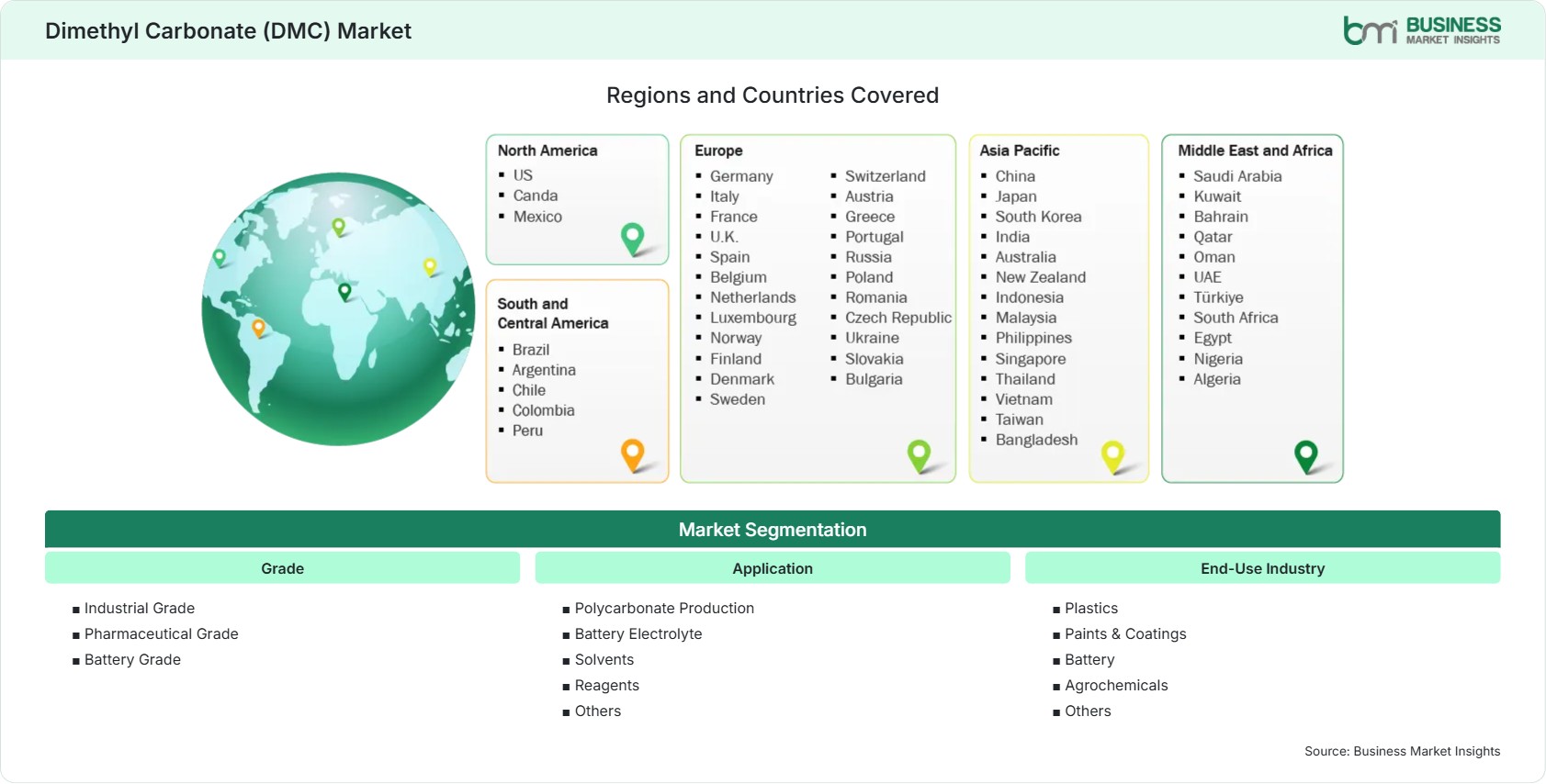
  • Grade: Industrial Grade, Pharmaceutical Grade, Battery Grade
  • Application: Polycarbonate Production, Battery Electrolyte, Solvents, Reagents, Others
  • End-Use Industry: Plastics, Paints & Coatings, Battery, Agrochemicals, Others
US$ 1012.72 Mn Market size in 2025
US$ 1838.46 Mn Market Size by 2033
7.74% CAGR, 2026 - 2033
2026-2033 Forecast Period

AI Overview

Dimethyl Carbonate (DMC) Market Summary

  • North America Region: North America holds 24%–27% market share in 2025, growing with a 6.8%–7.3% CAGR during 2026–2033. Strong battery manufacturing investments, sustainable chemical regulations, and expanding specialty chemicals production continue supporting industrial demand while accelerating innovation across high-value downstream applications. The U.S. market benefits from expanding electric vehicle battery investments, advanced specialty chemical production, and domestic supply chain localization, advancing at an estimated 6.9%–7.4% CAGR through 2033.
  • Fastest Growing Region: Asia Pacific holds 42%–45% market share in 2025, expanding with a 8.6%–9.2% CAGR during 2026–2033. Rapid battery manufacturing expansion, increasing polycarbonate production, supportive industrial policies, and rising electronics manufacturing investments continue strengthening regional production capacity and export competitiveness.
  • Leading Segment: Application – Polycarbonate Production accounts for 34%–37% market share in 2025 and advances at a 7.1%–7.8% CAGR through 2033. Growing engineering plastics demand, lightweight automotive materials, and sustainable production technologies continue increasing consumption across diversified industrial manufacturing sectors globally.
  • High Growth Segment: Grade – Battery Grade represents 19%–22% market share in 2025 while registering a 9.2%–9.8% CAGR during 2026–2033. Expanding lithium-ion battery manufacturing, electric mobility adoption, energy storage deployment, and electrolyte quality improvements continue driving premium-grade product utilization worldwide.
  • Key Market Opportunity: Increasing localization of battery material supply chains, investment in green chemical production, advanced electrolyte formulations, and sustainable manufacturing technologies creates attractive long-term opportunities across automotive, electronics, and industrial chemical industries globally.
  • Major Market Players: UBE Corporation, LOTTE CHEMICAL CORPORATION, KOWA AMERICAN Corporation, Kishida Chemical Co., Ltd., Shandong Depu Chemical Industry Science & Technology Co., Ltd., Merck KGaA, Tokyo Chemical Industry (India) Pvt. Ltd., Shandong Haike Holding Co., Ltd., SANKYO CHEMICAL CO., LTD., and SMC GLOBAL.
Strategic Insights

Dimethyl Carbonate (DMC) Market: Strategic Insights

Dimethyl Carbonate (DMC) Market Strategic Framework
FREE PDF
Request your free sample
Request free sample
Stakeholder View

Key Takeaways

  • Supply chain resilience is becoming a defining competitive factor as manufacturers increasingly integrate upstream feedstock sourcing with downstream purification capabilities, reducing procurement risks while improving product consistency for battery, pharmaceutical, and specialty chemical customers.
  • Battery electrolyte applications present one of the strongest long-term commercial opportunities as electric mobility, renewable energy storage systems, and advanced lithium-ion technologies continue increasing demand for ultra-high-purity chemical intermediates with consistent quality specifications.
  • Innovation is increasingly centered on green synthesis technologies, advanced catalytic processes, lower-carbon manufacturing methods, and higher product purity, enabling manufacturers to comply with tightening environmental regulations while improving production efficiency and profitability.
  • Asia Pacific remains the most compelling investment destination because of its integrated battery manufacturing ecosystem, expanding engineering plastics production, competitive chemical manufacturing infrastructure, and supportive industrial policies encouraging capacity expansion across multiple downstream sectors.
  • Strategic partnerships between chemical manufacturers, battery producers, automotive companies, and technology developers are accelerating product innovation while supporting long-term supply agreements that improve revenue visibility and strengthen market positioning throughout the value chain.
  • Digital manufacturing technologies, predictive maintenance systems, and process automation are improving production consistency, reducing operating costs, and enhancing product traceability, enabling suppliers to meet increasingly stringent quality requirements across global industrial and specialty chemical applications.
Geographic Outlook

Dimethyl Carbonate (DMC) Market Regional Highlights

North America Dimethyl Carbonate Market

North America accounts for 24%–27% of the global Dimethyl Carbonate Market share in 2025 and is projected to expand at a 6.8%–7.3% CAGR during 2026–2033. The regional demand is being propelled by increased investments in electric vehicle batteries, the use of sustainable solvents, and production of specialty chemicals. The U.S. is leading the regional consumption because of integrated battery material manufacturing and plastics demand while Canada is improving its competitiveness based on mineral processing for batteries and government-driven clean manufacturing policies.

  • Battery gigafactory investments across the United States and Canada continue increasing demand for high-purity battery-grade dimethyl carbonate used in lithium-ion electrolytes, encouraging domestic chemical manufacturing while reducing dependence on imported specialty chemicals and intermediates.
  • Environmental regulations promoting low-toxicity solvents are accelerating replacement of conventional hazardous chemicals in coatings, pharmaceuticals, and specialty synthesis, supporting broader commercial adoption across diversified industrial applications and improving sustainability performance throughout manufacturing operations.
  • Polycarbonate manufacturers continue expanding production capacities to satisfy lightweight automotive and electronics demand, creating consistent consumption opportunities for dimethyl carbonate as a sustainable intermediate while strengthening regional chemical value chains.
  • Public and private investments targeting localized battery supply chains encourage collaborations between chemical producers, automotive manufacturers, and material suppliers, supporting technological innovation, production efficiency improvements, and resilient industrial ecosystems throughout North America.
  • Research institutions and industrial laboratories continue developing advanced catalytic production technologies that improve process efficiency, lower emissions, and enhance product purity, enabling manufacturers to address increasingly demanding industrial specifications and environmental compliance requirements.

US Dimethyl Carbonate Market

The United States represents approximately 74%–77% of North American Dimethyl Carbonate Market demand in 2025 while recording a 6.9%–7.4% CAGR through 2033. Investments in battery making, semiconductors, specialty chemicals, and engineering plastics contribute to domestic consumption. Incentives by the government for green manufacturing, along with the investments being made by the private sector in building batteries' supply chains locally, will further improve the abilities of domestic production while providing more possibilities of pure dimethyl carbonate use.

  • Federal clean energy incentives encourage battery manufacturing expansion, increasing procurement of premium battery-grade dimethyl carbonate for electrolyte production while supporting domestic chemical manufacturing competitiveness and reducing external sourcing risks.
  • Advanced pharmaceutical manufacturing increasingly utilizes high-purity reagents and environmentally compatible synthesis materials, creating additional commercial opportunities for producers capable of meeting stringent quality and regulatory standards.
  • Rising investments in lightweight automotive materials and engineering plastics continue stimulating polycarbonate manufacturing, supporting consistent downstream demand while improving sustainability through recyclable material development and energy-efficient production processes.
  • Continuous innovation in specialty chemicals, supported by university research partnerships and industrial R&D, enhances product quality, manufacturing efficiency, and application diversity across multiple high-value industrial sectors.

Europe Dimethyl Carbonate Market

Europe contributes 22%–25% of global Dimethyl Carbonate Market revenue in 2025 and is forecast to register a 6.7%–7.2% CAGR during 2026–2033. Regional expansion is driven by stringent environmental legislation encouraging green chemistry, rising electric vehicle production, and increasing investments in sustainable industrial manufacturing. Germany remains the largest national market because of its advanced chemical and automotive industries, while Poland records one of the fastest growth trajectories through expanding battery manufacturing and industrial investments.

  • Germany leads regional consumption through integrated automotive, engineering plastics, and specialty chemical industries, supporting stable demand for high-quality dimethyl carbonate across multiple downstream manufacturing sectors.
  • France continues expanding sustainable chemical manufacturing supported by circular economy policies, encouraging environmentally responsible solvent usage and greater investment in advanced production technologies with reduced carbon intensity.
  • Poland experiences one of Europe's fastest expansion rates, supported by battery manufacturing investments, foreign direct investment, and industrial modernization initiatives strengthening regional chemical supply chains.
  • European producers increasingly prioritize renewable feedstocks, cleaner catalytic technologies, and energy-efficient production processes, improving competitiveness while aligning operations with ambitious climate neutrality objectives.
  • Regulatory emphasis on reducing hazardous solvent usage accelerates substitution with environmentally compatible alternatives, strengthening commercial opportunities across coatings, pharmaceuticals, electronics, and specialty synthesis applications.

Asia Pacific Dimethyl Carbonate Market

Asia Pacific commands 42%–45% of global Dimethyl Carbonate Market revenue in 2025 while achieving the highest regional expansion at a 8.6%–9.2% CAGR through 2033. China dominates production capacity because of its integrated chemical manufacturing ecosystem and battery supply chain leadership. Japan and South Korea maintain strong positions through high-value specialty chemicals and battery technologies, while India emerges as a rapidly expanding market driven by industrialization, electronics manufacturing, and clean mobility initiatives.

  • China remains the leading producer and consumer through extensive battery manufacturing, engineering plastics production, and integrated petrochemical infrastructure supporting large-scale commercial operations and export competitiveness.
  • India demonstrates one of the fastest industrial expansion rates as government initiatives encourage domestic battery manufacturing, specialty chemicals production, and electric mobility investments, creating substantial opportunities for future demand growth.
  • Japan continues emphasizing premium-quality battery materials and advanced chemical technologies, enabling manufacturers to serve high-performance industrial, electronics, and pharmaceutical applications requiring stringent quality specifications.
  • South Korea strengthens regional competitiveness through expanding lithium-ion battery production, advanced electronics manufacturing, and global partnerships supporting innovation across energy storage technologies and specialty chemical applications.
  • Southeast Asian economies continue attracting foreign investment into electronics manufacturing and industrial chemicals, broadening regional production capabilities while supporting diversified downstream demand across multiple industrial sectors.

Rest of World Dimethyl Carbonate Market

The Rest of World region accounts for 9%–12% of global Dimethyl Carbonate Market demand in 2025 and is projected to expand at a 7.2%–7.8% CAGR through 2033. South & Central America benefit from increasing industrial chemical investments and expanding coatings production, while the Middle East & Africa experience gradual growth through petrochemical diversification and downstream manufacturing initiatives. Brazil leads Latin America, whereas Saudi Arabia records the strongest growth potential through strategic investments in specialty chemical manufacturing and industrial diversification.

  • Brazil remains the leading South & Central American market due to expanding industrial manufacturing, automotive production, and increasing adoption of environmentally sustainable chemical intermediates across coatings and plastics industries.
  • Mexico benefits from growing automotive manufacturing and cross-border industrial integration, supporting increasing demand for engineering plastics and specialty chemical feedstocks throughout regional manufacturing supply chains.
  • Saudi Arabia accelerates investment in downstream petrochemical diversification, supporting future production of advanced chemical intermediates while reducing dependence on traditional hydrocarbon exports through value-added manufacturing.
  • The United Arab Emirates continues promoting industrial diversification, logistics infrastructure, and specialty chemical investments, creating favorable conditions for expanding regional chemical production and distribution networks.
  • Growing renewable energy deployment, industrial modernization, and manufacturing diversification across emerging economies collectively support sustained long-term consumption of high-performance specialty chemicals, strengthening future regional market opportunities.
Global Market Geography
FREE PDF
Request your free sample
Request free sample
Segment Analysis

Dimethyl Carbonate (DMC) Market Segmentation

Grade

The Grade segment accounted for 31%–34% of the global market in 2025 and is projected to expand at a 7.8%–8.4% CAGR through 2033. Product purity requirements continue differentiating industrial, pharmaceutical, and battery-grade materials according to downstream performance specifications. The Dimethyl Carbonate Market scope continues expanding as manufacturers increase investments in high-purity production technologies to address growing demand from advanced batteries, specialty chemicals, and pharmaceutical synthesis.

  • Industrial Grade: Widely utilized in coatings, chemical synthesis, solvents, and polymer manufacturing because of cost efficiency, broad industrial compatibility, and increasing replacement of conventional hazardous organic solvents across manufacturing industries.
  • Pharmaceutical Grade: Produced with stringent purity specifications to support pharmaceutical intermediates, laboratory synthesis, and specialty formulations where regulatory compliance, contamination control, and consistent product quality remain essential purchasing considerations.
  • Battery Grade: High-purity material increasingly adopted in lithium-ion battery electrolyte formulations because superior electrochemical stability, reduced impurities, and enhanced conductivity improve battery efficiency, operational safety, and long-term energy storage performance.

Application

Application represented the largest commercial category, accounting for 35%–38% of global revenue in 2025 while advancing at a 7.6%–8.2% CAGR through 2033. Expanding engineering plastics, battery manufacturing, and specialty chemical production continue strengthening consumption across diversified industrial sectors. Dimethyl Carbonate Market trends increasingly reflect the transition toward environmentally compatible intermediates replacing conventional toxic solvents in numerous industrial manufacturing processes.

  • Polycarbonate Production: Maintains the largest application share because lightweight engineering plastics remain essential across automotive, consumer electronics, medical devices, and construction industries requiring durable, transparent, and recyclable materials.
  • Battery Electrolyte: Experiences rapid commercial adoption as lithium-ion battery manufacturers increase production capacity for electric vehicles, renewable energy storage systems, and portable electronics requiring premium electrolyte formulations.
  • Solvents: Environmental compatibility and lower toxicity support expanding adoption in coatings, cleaning agents, industrial formulations, and specialty manufacturing processes where regulatory compliance increasingly influences purchasing decisions.
  • Reagents: Frequently applied in organic synthesis, laboratory research, and specialty chemical production because of excellent methylating and carbonylating properties supporting efficient chemical reactions with improved environmental performance.

End-Use Industry

The End-Use Industry segment contributed 29%–32% of total Dimethyl Carbonate Market revenue during 2025 and is anticipated to register a 7.5%–8.1% CAGR through 2033. Industrial diversification continues supporting balanced consumption across plastics, coatings, batteries, and agrochemicals. Expanding sustainable manufacturing practices and growing investment in advanced material production continue improving long-term commercial prospects across multiple downstream industries.

  • Plastics: Engineering plastics manufacturers remain leading consumers because polycarbonate production requires environmentally sustainable intermediates supporting lightweight products for automotive, electronics, healthcare, and consumer goods manufacturing.
  • Paints & Coatings: Demand continues increasing as manufacturers replace conventional solvents with environmentally responsible alternatives that improve formulation performance while supporting compliance with evolving environmental regulations worldwide.
  • Battery: Battery manufacturers increasingly prioritize high-purity dimethyl carbonate to improve electrolyte stability, charging efficiency, thermal performance, and operational reliability across electric mobility and stationary energy storage applications.
  • Agrochemicals: Specialty chemical manufacturers utilize dimethyl carbonate during intermediate synthesis and formulation development where cleaner production pathways and reduced environmental impact enhance manufacturing sustainability.
Market Forces

Dimethyl Carbonate (DMC) Market Dynamics

Key Market Drivers

Expansion of Global Lithium-Ion Battery Manufacturing

The rapid shift towards electric vehicles and renewables storage systems is driving an ever-increasing need for high-quality battery electrolytes. Electric vehicle manufacturing and investment in battery gigafactories are happening in Asia Pacific, Europe, and North America, thus creating steady demand for battery-grade dimethyl carbonate. Better formulation of battery electrolyte leads to better safety, conductance, and performance of batteries. Dimethyl Carbonate Market growth is also fuelled by local batteries manufacturing chains, government incentives, and long-term purchasing deals made between the chemical companies and battery makers.

Growing Demand for Sustainable Chemical Intermediates

With regulations in place that prevent hazardous materials, it is becoming more important for businesses to switch to cleaner substances. Dimethyl carbonate presents itself as being highly biodegradable, having low toxicity, and easier handling than most other chemicals. Green chemistry initiatives promoted by industrial organizations continue encouraging investment in environmentally compatible production technologies. The additional pledges by multinational companies to support sustainability will help boost their business practices in addition to helping them achieve regulatory compliance and lowering carbon emissions due to growing customer demand for lower-emission materials in manufacturing.

Increasing Polycarbonate Consumption Across Industries

Polycarbonate remains one of the largest downstream applications because lightweight, impact-resistant engineering plastics continue replacing conventional materials across transportation, electronics, medical devices, and construction. Increased output of vehicles driven by electricity adds to the demand for sophisticated polymers that can facilitate the production of light weight vehicles. Development in products and recycling adds to long term consumption patterns. Increased industrial output in developing nations is encouraging increased investment in fully-integrated chemical plants that will produce high quality intermediaries for engineering plastics.

Key Market Opportunities

Localization of Battery Material Supply Chains

Governments and manufacturers increasingly prioritize regional battery supply chains to improve strategic resilience and reduce import dependence. Dimethyl Carbonate Market Forecasts indicate more opportunities for investments of those manufacturers who have set up local manufacturing facilities close to the gigafactories. Collaborations among chemical companies, car makers, and battery manufacturers provide more business visibility in the future alongside facilitating technology transfer and increasing production. The incentives from the region and good industrial policies make more attractive conditions for investments of the manufacturers to capitalize on the high demands from the market.

Development of High-Purity Specialty Grades

Growing pharmaceutical manufacturing, semiconductor fabrication, and advanced battery technologies continue increasing demand for ultra-high-purity dimethyl carbonate. Companies that can offer products with high purity specification levels are better equipped to leverage their pricing power and reach applications of high value. Technological advancements and continuous refinement in purification techniques, analytical quality control, and process automation help create premium level products while at the same time decreasing the variability in production processes.

Expansion Across Emerging Industrial Economies

Rapid industrialization in India, Southeast Asia, Latin America, and selected Middle Eastern economies creates significant opportunities for producers seeking diversified revenue streams. Investment in automotive assembly plants, specialty chemicals production facilities, renewable energy, electronics, and engineering plastics is on the rise, resulting in higher consumption in the region. Investments in industrial upgrading, foreign direct investments, and domestic manufacturing efforts promote higher capacity alongside downstream demand. Companies setting up distribution networks within the region and developing technical skills will gain from this trend in the industry.

Market Restraints and Challenges

Feedstock Price Volatility and Production Cost Pressure

Factor: The fluctuation of costs associated with methanol and the other petrochemicals used as feedstocks cause uncertainties in manufacturing economies.

Impact: Producers face the challenge of margins due to the fact that material cost forms a considerable part of their total production costs. Instability in prices for energy, transport rates, and shortages create further difficulties in terms of purchasing and storage planning. Nowadays, more and more manufacturers strive to achieve long-term purchasing contracts, efficiency in production, and a combination of production for less sensitivity to commodity prices.

Strict Product Purity and Regulatory Compliance Requirements

Factor: High levels of purity are essential for battery, pharmaceutical, and specialty chemical applications, and this is ensured through compliance with regulations as well as the quality assurance process.

Impact: Manufacturers require huge investments in modern cleaning techniques, analysis, environmental control, and certifications in order to qualify for participation in premium markets. Small manufacturers will face various obstacles that will restrict their growth into premium products because of increased environmental regulations that lead to higher costs of doing business internationally.

Company Analysis

Competitive Landscape

The competitive environment is characterized by technology-driven differentiation, production capacity expansion, and strategic investments in high-purity manufacturing. Dimethyl Carbonate Market analysis indicates that leading companies are prioritizing battery-grade product development, sustainable production technologies, integrated supply chains, and regional capacity expansion to strengthen long-term competitiveness. Product quality, purification capabilities, regulatory compliance, and strategic partnerships with battery and engineering plastics manufacturers remain the primary competitive differentiators.

Company Name

Overview

Products and Services Relevant to this Market

UBE Corporation (Japan)

Global chemical manufacturer with strong expertise in performance chemicals, battery materials, and advanced industrial intermediates serving automotive and electronics industries.

High-purity dimethyl carbonate, battery materials, specialty chemicals, engineering materials, and industrial chemical solutions.

LOTTE CHEMICAL CORP. (South Korea)

Diversified petrochemical producer with integrated manufacturing capabilities and extensive presence across Asian chemical markets.

Petrochemicals, specialty chemicals, battery materials, engineering plastics feedstocks, and chemical intermediates.

KOWA AMERICAN Corporation (U.S.)

U.S.-based specialty chemical supplier serving pharmaceutical, industrial, and research markets through high-quality chemical distribution.

Specialty chemicals, laboratory reagents, dimethyl carbonate, industrial solvents, and custom chemical solutions.

Kishida Chemical Co., LTD. (Japan)

Japanese specialty chemical company supplying laboratory reagents and high-purity industrial chemicals for research and manufacturing applications.

Reagents, analytical chemicals, pharmaceutical-grade chemicals, and specialty laboratory materials including dimethyl carbonate.

Shandong depu chemical industry science&technology co.,ltd (China)

Chinese manufacturer specializing in carbonate chemicals and industrial intermediates with growing export capabilities.

Dimethyl carbonate, carbonate derivatives, industrial solvents, and specialty chemical intermediates.

Merck KGaA (Germany)

International science and technology company serving life science, electronics, and healthcare industries through premium specialty chemicals.

High-purity reagents, laboratory chemicals, pharmaceutical intermediates, and electronic materials.

Tokyo Chemical Industry (India) Pvt. Ltd. (India)

Supplier of research chemicals and laboratory reagents supporting pharmaceutical, academic, and industrial research activities.

High-purity dimethyl carbonate, specialty reagents, analytical chemicals, and laboratory solutions.

Shandong Haike Holding Co., Ltd (China)

Integrated chemical enterprise with significant production capabilities across petrochemicals and battery material value chains.

Dimethyl carbonate, electrolyte solvents, petrochemical products, and battery-related specialty chemicals.

SANKYO CHEMICAL CO., LTD. (Japan)

Manufacturer focused on industrial chemicals and specialty solvents serving diversified manufacturing sectors.

Specialty solvents, industrial chemicals, cleaning formulations, and chemical intermediates.

SMC GLOBAL (U.S.)

Chemical supplier serving industrial manufacturing through specialty chemical sourcing, distribution, and customized supply solutions.

Industrial chemicals, specialty solvents, chemical distribution services, and technical supply support.

Trust & Transparency

Research Methodology

The market analysis combines proprietary research with secondary data from government agencies, company disclosures, regulatory filings, industry databases and expert interviews. Market estimates are validated through data triangulation, cross-market benchmarking and analyst review.

View Full Research Methodology

Questions Answered

Frequently Asked Questions

How does this Dimethyl Carbonate Market Report support business decisions?

The report provides strategic evaluation of market size, competitive positioning, regional opportunities, segmentation trends, investment priorities, technology developments, and future demand outlook to support expansion, product development, and investment planning.

Which end-use industries create the greatest long-term opportunities?

Battery manufacturing, engineering plastics, specialty chemicals, pharmaceuticals, and environmentally friendly coatings represent the most attractive long-term demand centers as industrial sustainability initiatives continue expanding worldwide.

Which region is expected to record the fastest growth?

Asia Pacific is projected to remain the fastest-growing regional market due to expanding battery manufacturing, integrated chemical production, supportive industrial policies, and continuous investment in electric mobility infrastructure.

Which application dominates the market?

Polycarbonate production remains the leading application because engineering plastics continue witnessing strong demand from automotive, electronics, construction, and healthcare industries requiring lightweight, durable, and recyclable materials.

What is driving demand for the Dimethyl Carbonate Market?

Growing lithium-ion battery production, increasing polycarbonate manufacturing, green chemistry initiatives, and replacement of hazardous solvents with environmentally compatible alternatives are the primary factors supporting sustained global demand.

Access the Full Dimethyl Carbonate (DMC) Market Report

Get segment-level forecasts, regional estimates, competitive benchmarking, company profiles and downloadable Excel datasets.

Access the full Dimethyl Carbonate (DMC) Market Report
350 pages PDF & Excel | 2026-08-31