
Autonomous Vehicle Chips Market Outlook: Size, Share, Trends, Growth Analysis, Competitive Landscape & Forecast, 2026-2033

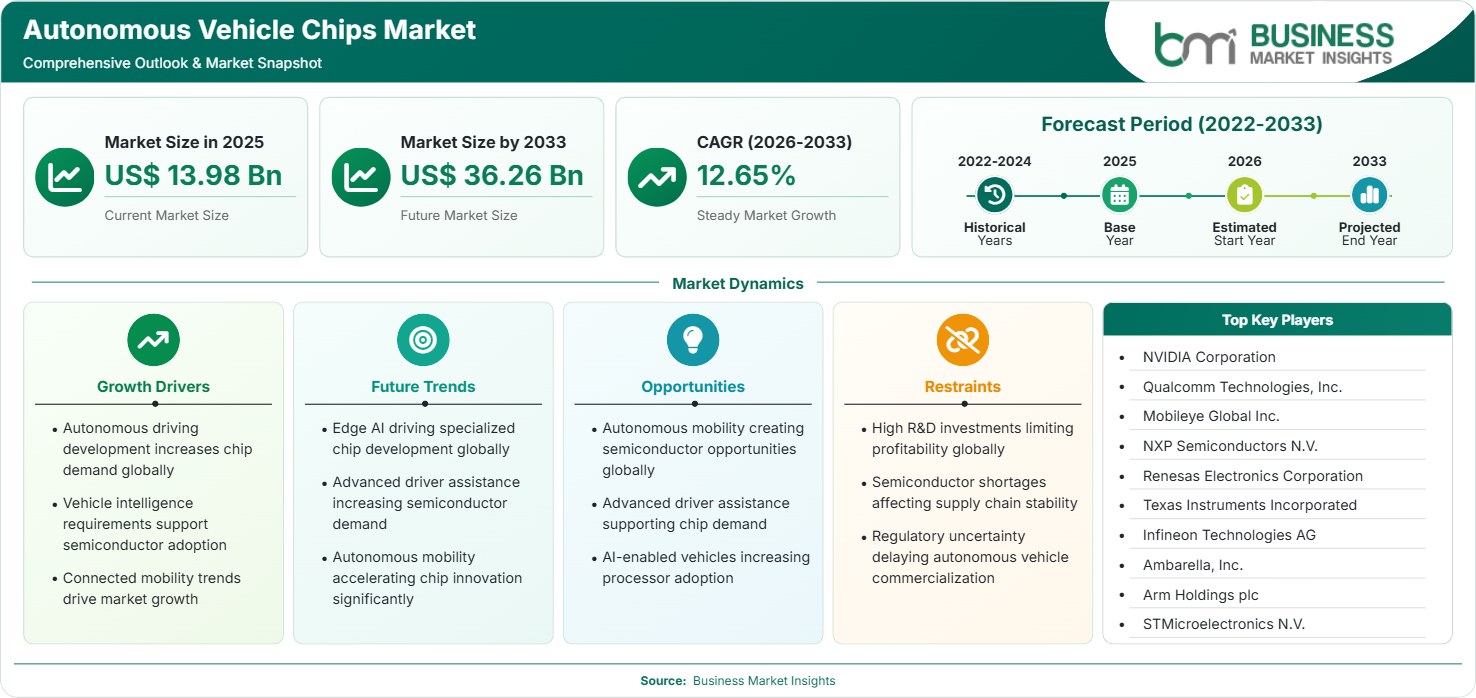
The Autonomous Vehicle Chips Market size was valued at US$ 13.98 Billion in 2025 and is projected to reach US$ 36.26 Billion by 2033, growing at a CAGR of 12.65% during 2026–2033, driven by AI computing, ADAS adoption, sensor fusion, software-defined vehicles, electrification, and autonomous mobility investment.

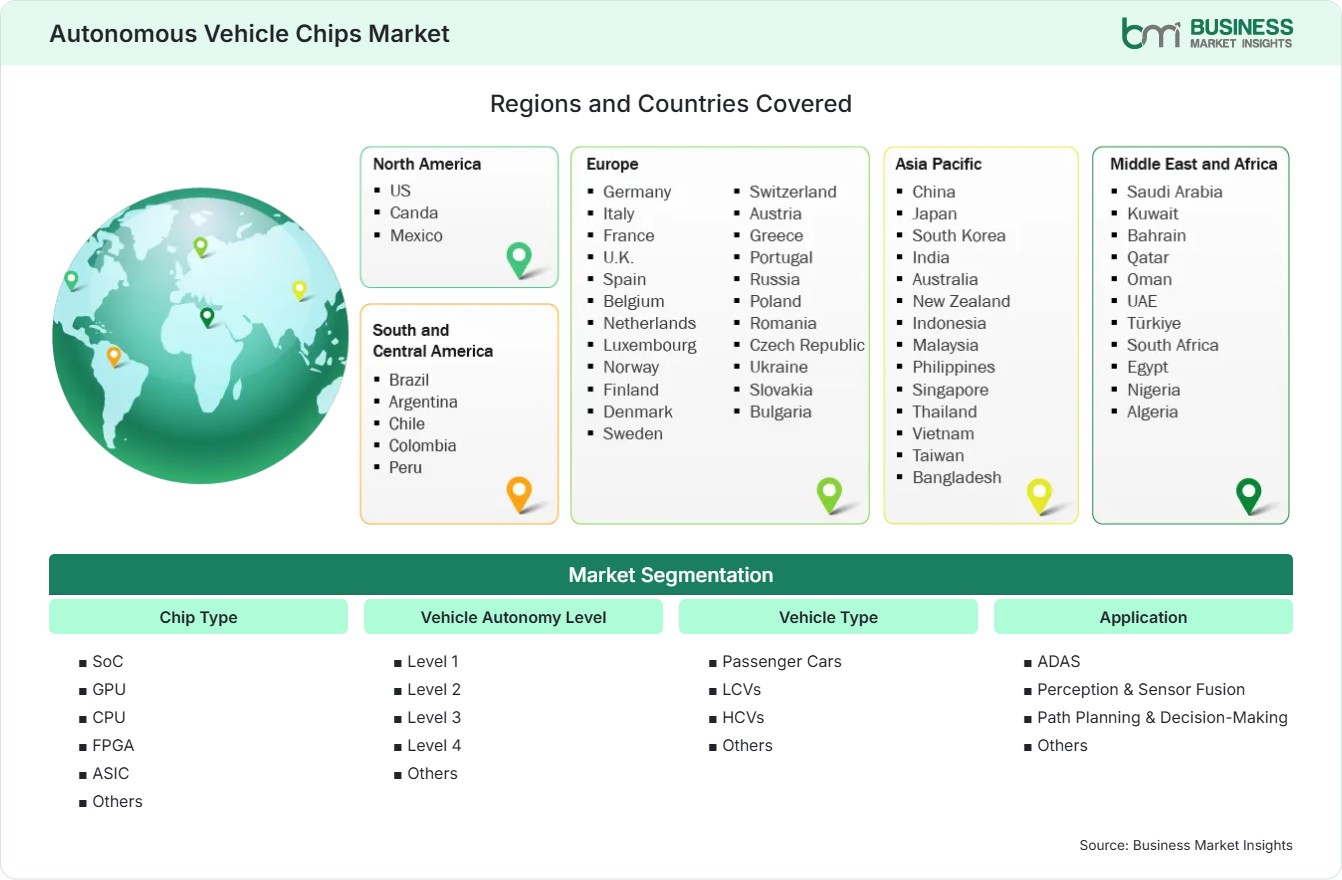
Report Coverage
  • Chip Type: SoC, GPU, CPU, FPGA, ASIC, Others
  • Vehicle Autonomy Level: Level 1, Level 2, Level 3, Level 4, Others
  • Vehicle Type: Passenger Cars, LCVs, HCVs, Others
  • Application: ADAS, Perception & Sensor Fusion, Path Planning & Decision-Making, Others
US$ 13.98 Bn Market size in 2025
US$ 36.26 Bn Market Size by 2033
12.65% CAGR, 2026 - 2033
2026-2033 Forecast Period

AI Overview

Autonomous Vehicle Chips Market Summary

  • North America Region: North America holds a market share of 28%–31% in 2025, growing at a CAGR of 11.8%–12.6%, supported by AI compute investment, premium ADAS deployment, autonomous testing, semiconductor capabilities, and software-defined vehicle development. The US remains the principal market, supported by automaker and technology partnerships, expanding Level 2+ deployments, and continued investment in autonomous vehicle computing platforms, with a CAGR of 11.5%–12.4% during 2026–2033.
  • Fastest Growing Region: Asia Pacific holds an Autonomous Vehicle Chips Market share of 38%–42% in 2025, growing at a CAGR of 13.8%–14.8%, supported by electric vehicle production, domestic semiconductor development, intelligent vehicle adoption, expanding ADAS penetration, and large-scale autonomous driving programs.
  • Leading Segment: System-on-Chip (SoC) holds a market share of 48%–52% in 2025, growing at a CAGR of 12.0%–12.8%, supported by integrated AI acceleration, sensor processing, power efficiency, centralized computing, functional safety, and software-defined vehicle architectures.
  • High Growth Segment: Level 4 (High Automation) holds a market share of 10%–14% in 2025, growing at a CAGR of 16.0%–18.0%, supported by robotaxis, autonomous freight, centralized computing, advanced perception, high-performance AI accelerators, and commercial autonomous mobility programs.
  • Key Market Opportunity: Rising deployment of centralized vehicle computers creates opportunities for chipmakers to combine AI acceleration, perception, planning, safety, networking, and power management into scalable platforms serving multiple automation levels and vehicle classes.
  • Major Market Players: NVIDIA Corporation; Qualcomm Technologies, Inc.; Mobileye Global Inc.; NXP Semiconductors N.V.; Renesas Electronics Corporation; Texas Instruments Incorporated; Infineon Technologies AG; Ambarella, Inc.; Arm Holdings plc; STMicroelectronics N.V.
Strategic Insights

Autonomous Vehicle Chips Market: Strategic Insights

Autonomous Vehicle Chips Market Strategic Framework
FREE PDF
Request your free sample
Request free sample
Stakeholder View

Key Takeaways

  • The focus on value is shifting from single processors to integrated computing platforms that combine silicon, software, sensor interfaces, safety features, networking capabilities, development tools, and support throughout the product's lifecycle. Instead of merely competing on processing performance, chip suppliers are now competing on the extent of their ecosystems.
  • The Level 2+ and Level 3 systems offer the most extensive near-term commercialization potential, whereas the Level 4 applications involve greater compute intensity and a higher amount of silicon per vehicle. Centralized architectures can support both premium passenger cars and autonomous commercial fleets.
  • AI accelerators, along with heterogeneous computing, neural processing, high-bandwidth memory architectures, sensor-fusion engines, and domain-specific accelerators, are becoming more important. Energy efficiency is becoming increasingly important because compute-intensive autonomy must operate within the limited thermal and power budgets available in automobiles.
  • The Asia Pacific region features large volumes of vehicle production, fast adoption of electric vehicles, well-developed domestic technology ecosystems, and increasingly widespread deployment of intelligent driving. China is especially significant since both the uptake of electric vehicles and the development of autonomous driving are taking place on a large scale. The IEA stated that electric vehicles made up almost 55% of car sales in China in 2025.
  • More of the strategic capital is now being directed towards AI silicon, autonomous-driving software, centralized vehicle architectures, radar processing, and semiconductor partnerships. The approach to investment is changing to focus on vertically integrated platforms that link chip design with software, simulation, sensing, and vehicle deployment.
  • Because chip selection has an impact on sensor architecture, software portability, functional-safety validation, vehicle networking, and long-term upgradeability, semiconductor suppliers are now increasingly required to have direct relationships with automakers and Tier 1 suppliers.
Geographic Outlook

Autonomous Vehicle Chips Market Regional Highlights

North America Autonomous Vehicle Chips Market

North America held 28%–31% Autonomous Vehicle Chips Market share in 2025 and is projected to grow at 11.8%–12.6% CAGR through 2033. The region benefits from established semiconductor capabilities, autonomous vehicle development, premium ADAS adoption, AI infrastructure, and deep relationships among automakers, chip designers, mobility providers, and software companies.

  • The need for high-performance computing is maintained by autonomous testing and commercial deployment programs, particularly for systems that are able to deal with perception, planning, mapping, and redundant safety tasks at the same time.
  • Semiconductor companies are able to take advantage of existing AI ecosystems and the large number of software developers available, which in turn enables the quick optimization of neural networks, perception pipelines, and autonomous-driving workloads.
  • More premium passenger cars are fitted with central ADAS computers, leading to a greater demand for high-performance SoCs that include acceleration, cybersecurity, functional safety, and multi-sensor connectivity.
  • The fact is that autonomous trucking and logistics offer another area of demand since long-duration operations demand reliable computing, redundant sensing, and efficient thermal management in harsh operating environments.

US Autonomous Vehicle Chips Market

The US accounted for 76%–80% of the North American Autonomous Vehicle Chips Market demand in 2025 and is projected to grow at 11.5%–12.4% CAGR during 2026–2033. Demand is supported by technology companies, semiconductor designers, automakers, autonomous mobility developers, and commercial fleet operators.

  • The need for central computing platforms is growing because of software-defined vehicle development, since these platforms must be able to receive continuous software updates and, at the same time, support a number of different vehicle functions without requiring major hardware redesign.
  • The demand created by autonomous freight and robotaxi projects requires computing architectures that are optimized for continuous perception, route planning, redundancy, simulation, and the remote monitoring of fleets.
  • The development of advanced automotive silicon is well established due to domestic capabilities in semiconductors and artificial intelligence, and it is sped up by partnerships with car manufacturers.

Europe Autonomous Vehicle Chips Market

Europe held 23%–26% Autonomous Vehicle Chips Market share in 2025 and is projected to grow at 12.1%–12.9% CAGR through 2033. Germany remains the leading country because of its automotive manufacturing base and premium vehicle concentration.

  • European car manufacturers are stressing the importance of centralized electronic systems, combined ADAS features, and greater levels of automation, thus meeting the demand for scalable automotive processors and those that are safety-certified.
  • Because of higher safety standards and the fact that vehicle evaluation schemes are constantly changing, car manufacturers are being prompted to incorporate reliable capabilities in the areas of perception, processing, redundancy, and monitoring onto their vehicle platforms.
  • Germany has deep relationships among its car manufacturers, first-tier suppliers, semiconductor companies, and engineering firms, which speed up the process of qualifying advanced automotive computing architectures.
  • New autonomous mobility initiatives in the United Kingdom and in the Nordic countries are opening up possibilities that go beyond their usual use in passenger cars and are now extending to include shuttles, logistics, and transportation within controlled areas.

Asia Pacific Autonomous Vehicle Chips Market

Asia Pacific held 38%–42% Autonomous Vehicle Chips Market share in 2025 and is projected to record 13.8%–14.8% CAGR through 2033, making it the fastest-growing regional market. China remains the leading market, while Japan and South Korea retain strong semiconductor and automotive ecosystems.

  • Because China has a large-scale capacity for manufacturing electric vehicles and, at the same time, quickly introduced intelligent-driving features, there has been a great demand for AI system-on-chips, accelerators, sensor processors, and central vehicle computers.
  • South Korea has the expertise in semiconductors, advanced electronics manufacturing, and automotive technology, which enables the incorporation of high-performance processing into next-generation vehicles.
  • Japan provides opportunities via its established automobile manufacturers, its sophisticated sensing technologies, its expertise in robotics, and its growing focus on software-defined vehicle development, especially in the areas of premium vehicles and safety features.
  • As the supply chains for electric vehicles grow and smart vehicle technologies become more widely available, markets in Southeast Asia are appearing as further locations for manufacturing and for the deployment of such vehicles.

Rest of World Autonomous Vehicle Chips Market

The rest of the world held 6%–9% Autonomous Vehicle Chips Market share in 2025 and is projected to grow at 10.5%–11.5% CAGR through 2033. South and Central America are developing demand through EV adoption, connected vehicles, and advanced safety features.

  • Brazil gains from the expansion of electrification and the growth of connected mobility, which in turn provides a solid basis for wider acceptance of advanced driver assistance computing and automotive semiconductor technologies.
  • Mexico offers opportunities as a result of its integration into North American automotive manufacturing, especially regarding vehicles that are fitted with ever more advanced electronic architectures and ADAS functions.
  • In the Gulf countries, initiatives aimed at achieving autonomous mobility are being carried out as part of smart-city projects, which in turn lead to a demand for high-performance computing in the areas of perception, localization, planning, and vehicle control.
  • In South Africa and in a number of Middle Eastern markets, there are longer-term opportunities due to the increasing penetration of premium vehicles, the development of connected infrastructure, and the modernization of commercial fleets.
Global Market Geography
FREE PDF
Request your free sample
Request free sample
Segment Analysis

Autonomous Vehicle Chips Market Segmentation

Chip Type

System-on-Chip (SoC) represented the leading chip category with 48%–52% Autonomous Vehicle Chips Market share in 2025 and is projected to grow at 12.0%–12.8% CAGR through 2033. Integrated processing reduces system complexity, improves power efficiency, and enables centralized perception and decision workloads across increasingly software-defined vehicle platforms.

  • System-on-Chip (SoC): Integrated CPU, GPU, AI acceleration, memory interfaces, and safety functions simplify vehicle computing architectures while supporting multi-sensor perception, centralized ADAS, and software-defined vehicle workloads.
  • GPU (Graphics Processing Unit): Parallel processing supports neural-network inference, perception, visualization, simulation, and sensor-fusion workloads, making GPUs important for high-compute autonomous-driving systems.
  • CPU (Central Processing Unit): CPUs coordinate operating systems, control functions, vehicle applications, and safety workloads, providing deterministic processing and system-management capabilities alongside specialized accelerators.
  • FPGA: Programmable logic supports flexible sensor processing, prototyping, hardware acceleration, and application-specific workloads where vehicle manufacturers require adaptable processing architectures.
  • ASIC: Customized accelerators deliver optimized performance, power efficiency, and predictable workloads for high-volume applications requiring specialized autonomous-driving inference or signal-processing functions.

Vehicle Autonomy Level

Level 2 represented the broadest adoption base, while Level 4 is the high-growth category, with 10%–14% Autonomous Vehicle Chips Market share in 2025 and 16.0%–18.0% CAGR through 2033. Higher automation requires greater compute density, sensor redundancy, and safety processing.

  • Level 1 (Driver Assistance): Basic assistance functions require relatively limited processing but provide an entry point for camera, radar, braking, and driver-monitoring technologies.
  • Level 2 (Partial Automation): Combined steering and longitudinal control increases requirements for multi-sensor perception, sensor fusion, driver monitoring, and real-time decision processing.
  • Level 3 (Conditional Automation): Conditional automation increases compute requirements because systems must manage environmental perception, fallback conditions, redundancy, and transition-of-control scenarios.
  • Level 4 (High Automation): Robotaxis, autonomous shuttles, and freight applications require substantial AI compute for perception, localization, planning, redundancy, and operational-domain management.

Vehicle Type

Passenger Cars represented the dominant vehicle category, supported by higher production volumes and rapid ADAS integration. Commercial vehicles provide attractive growth opportunities because autonomous freight and logistics applications require high-value sensing and compute architectures for sustained operation.

  • Passenger Cars: High production volumes and expanding ADAS availability make passenger vehicles the largest application base for autonomous-driving processors, particularly integrated SoCs and AI accelerators.
  • Light Commercial Vehicles (LCVs): Delivery fleets and urban logistics applications increasingly require driver assistance, automated parking, perception, and route optimization capabilities.
  • Heavy Commercial Vehicles (HCVs): Autonomous trucking and fleet safety applications require high-performance perception, redundancy, thermal efficiency, and reliable computing for long-duration operation.

Application

ADAS remained the largest application area, while Path Planning & Decision-Making provides substantial upside as vehicles move toward higher automation. Increasing sensor complexity requires integrated computing for perception, fusion, localization, planning, and vehicle control.

  • ADAS: Advanced safety functions, including automatic emergency braking, adaptive cruise control, lane support, and automated parking, drive broad semiconductor adoption across passenger and commercial vehicles.
  • Perception & Sensor Fusion: Combining camera, radar, lidar, ultrasonic, and vehicle-state information increases compute requirements and encourages specialized acceleration for real-time environmental understanding.
  • Path Planning & Decision-Making: Higher automation requires increasingly sophisticated prediction, planning, localization, and policy computation, supporting demand for high-performance AI and heterogeneous processors.
Market Forces

Autonomous Vehicle Chips Market Dynamics

Key Market Drivers

AI Compute Is Moving Toward Centralized Vehicle Architectures

The shift from numerous distributed controllers toward centralized or zonal computing is increasing semiconductor value per vehicle. Modern autonomous-driving platforms combine CPU, GPU, neural acceleration, safety processing, memory, networking, and sensor interfaces within coordinated architectures. These developments reinforce the Autonomous Vehicle Chips Market growth because higher automation requires greater processing density without proportional increases in vehicle power consumption. Centralized architectures also simplify software deployment, reduce duplicated hardware, and enable automakers to consolidate functions. As vehicles process increasingly rich sensor data, performance per watt and functional safety become core chip-selection criteria.

ADAS Penetration Is Expanding the Addressable Semiconductor Base

The expansion of ADAS from premium vehicles into mainstream models is creating a broader semiconductor demand base. Camera processing, radar interpretation, driver monitoring, automatic braking, lane functions, and automated parking increasingly require dedicated compute rather than conventional control electronics. Qualcomm states its Snapdragon Ride Pilot can scale ADAS functions across entry-level safety applications and highway or urban driving scenarios, while Mobileye has announced large-scale EyeQ6H deployment programs for hands-free highway systems. The combination of regulatory safety requirements, consumer expectations, software updates, and automaker differentiation is strengthening Autonomous Vehicle Chips Market trends around scalable silicon, efficient AI inference, integrated sensing, and consolidated electronic control architectures.

Electrification Is Raising Electronic and Computing Content

Electric vehicles create favorable conditions for advanced semiconductor adoption because vehicle architectures increasingly depend on electronic control, centralized computing, connectivity, thermal management, and software. IEA data show global electric car sales exceeded 20 million in 2025, representing one-quarter of new car sales, while China exceeded half of its annual car sales being electric. The resulting convergence of electrification and software-defined architectures supports the Autonomous Vehicle Chips Market growth by increasing demand for energy-efficient processors, integrated accelerators, secure communications, and centralized controllers. Chip suppliers able to optimize compute performance against vehicle power, heat, safety, and cost constraints are positioned to address increasingly complex vehicle architectures.

Key Market Opportunities

Centralized Sensor Processing Can Reduce System Complexity

The possibility arises of redesigning the way vehicles gather sensor data by processing the raw or higher-fidelity sensor information at a central location. With traditional edge processing, it is necessary to have dedicated processors in many of the radar and sensor modules, which in turn increases the number of hardware components, the cost, the volume, and power consumption. In 2026, NVIDIA showed a central radar processing architecture in which the radar signal chains were processed on the central vehicle computing system, achieving a radar unit cost that was more than 30% lower and approximately 20% less volume and system power in the case that was demonstrated.

Autonomous Commercial Fleets Can Increase Compute Value per Vehicle

It is an attractive opportunity to have commercial autonomous fleets since the operating economics can make it possible to use a higher amount of semiconductor content than that used in conventional passenger vehicles. Vehicle types such as robotaxis, autonomous delivery vehicles, mining vehicles, logistics platforms, and long-haul trucks need constant perception, localization, planning, connectivity, diagnostics, and safety monitoring. Fleet operators also benefit from using standardized hardware platforms that enable software improvements to be applied across multiple vehicles. The fact that NVIDIA announced in 2026 about Level 4-ready vehicle platforms and partnerships in autonomous mobility shows how a growing ecosystem is developing around production-focused autonomous computing.

Scalable Silicon Platforms Can Address Multiple Automation Tiers

More car manufacturers are demanding vehicle architectures that enable them to cover a number of different vehicle types without having to create entirely separate electronic platforms. By adopting a scalable System-on-Chip (SoC) strategy, producers can use the same software frameworks while varying the level of computing power, the number of sensors, the amount of memory, and the configuration of the accelerators according to the vehicle's tier. This opens up the possibility for chip suppliers to design a range of products rather than just individual processors. Qualcomm's Snapdragon Ride architecture is an example of this method, consisting of scalable SoC platforms tailored to different ADAS and automated-driving workloads. These types of architectures can cut down on redundant development and help achieve faster vehicle launches. The potential benefit is especially significant given that software-defined vehicles lead to longer product lifecycles and a greater dependence on over-the-air upgrades.

Market Restraints and Challenges

Semiconductor Qualification and Functional Safety Complexity

The automotive chips have to meet strict requirements regarding reliability, functional safety, cybersecurity, temperature tolerance, lifecycle, and validation before they can be included in production programs. As a result, the qualification process leads to longer development times, higher engineering costs, greater testing demands, and higher supplier switching costs. The difficulty of this situation is increased by advanced autonomous systems since failures in them can simultaneously affect perception, decision-making, braking, steering, and the fallback mechanisms.

Compute Cost, Power Consumption, and Thermal Constraints

The greater the level of automation, the more intensive the AI inference, sensor processing, memory bandwidth, and the need for redundancy become, leading to higher semiconductor power usage and increased system complexity. As a result, a surplus of computing power can raise the demands for thermal management, the vehicle's energy consumption, the cost of the hardware, and the complexity of the packaging. It is for this reason that autonomous driving processors have to achieve a high level of performance while operating within the limited power constraints available in automobiles.

Company Analysis

Competitive Landscape

The competitive environment is shaped by semiconductor scale, AI acceleration capability, automotive qualification, software ecosystems, sensor-processing expertise, and automaker relationships. Autonomous Vehicle Chips Market analysis indicates increasing competition between integrated SoC providers and specialist suppliers, with differentiation shifting toward performance per watt, safety certification, software portability, centralized architectures, and ecosystem support.

Company Name

Overview

Products and Services relevant to this market

NVIDIA Corporation

AI computing company with a broad automotive platform spanning advanced ADAS, autonomous driving, simulation, and centralized vehicle computing.

DRIVE AGX Orin, DRIVE AGX Thor, DRIVE Hyperion, automotive AI software, simulation, and autonomous-driving development platforms.

Qualcomm Technologies, Inc.

Semiconductor and wireless technology provider expanding its automotive portfolio through scalable AI-enabled computing architectures.

Snapdragon Ride SoCs, Snapdragon Ride Pilot, AI perception, automated-driving software, connectivity, and automotive compute platforms.

Mobileye Global Inc.

Autonomous-driving technology specialist with extensive deployment of computer-vision and ADAS solutions across global vehicle programs.

EyeQ SoCs, Surround ADAS, SuperVision, Chauffeur, REM mapping, and autonomous-driving software technologies.

NXP Semiconductors N.V.

Automotive semiconductor supplier focused on processing, networking, radar, safety, and software-defined vehicle architectures.

S32 processors, S32R radar processors, automotive MCUs, networking, sensing, security, and CoreRide platforms.

Renesas Electronics Corporation

Semiconductor manufacturer providing automotive processing and control technologies for ADAS and software-defined vehicles.

R-Car automotive SoCs, automotive MCUs, AI acceleration, vehicle control, and zonal architecture solutions.

Texas Instruments Incorporated

Analog and embedded-processing supplier with broad automotive semiconductor capabilities across sensing, power, and processing.

Automotive processors, radar sensing, power management, microcontrollers, interface products, and ADAS components.

Infineon Technologies AG

Automotive semiconductor supplier with strengths in microcontrollers, power, sensing, security, and vehicle electronics.

AURIX microcontrollers, automotive power semiconductors, sensors, security components, and ADAS-related processing technologies.

Ambarella, Inc.

Edge AI semiconductor specialist focused on efficient computer vision and perception processing for vehicles.

CV3-AD SoCs, neural processing, computer vision, sensor fusion, and L2+ through L4 autonomous-driving compute.

Arm Holdings plc

Processor architecture and semiconductor IP provider supplying foundational compute architectures used across automotive applications.

Automotive CPU IP, safety-certified compute architecture, Mali GPU technologies, system IP, and software ecosystem support.

STMicroelectronics N.V.

Semiconductor manufacturer serving automotive electronics with processing, sensing, power, connectivity, and embedded technologies.

Automotive MCUs, processors, sensors, imaging technologies, connectivity, power products, and ADAS-related semiconductor solutions.

Trust & Transparency

Research Methodology

The market analysis combines proprietary research with secondary data from government agencies, company disclosures, regulatory filings, industry databases and expert interviews. Market estimates are validated through data triangulation, cross-market benchmarking and analyst review.

View Full Research Methodology

Questions Answered

Frequently Asked Questions

What does the Autonomous Vehicle Chips Market Report cover?

The Autonomous Vehicle Chips Market Report evaluates chip types, vehicle autonomy levels, vehicle categories, applications, regional demand patterns, competitive positioning, technology developments, growth drivers, opportunities, restraints, and recent company developments through the forecast period.

What is the role of software in semiconductor differentiation?

Software increasingly determines how effectively automotive processors can be deployed. Development kits, AI frameworks, perception libraries, safety tools, simulation environments, middleware, and update mechanisms can reduce integration time and help automakers reuse computing platforms across multiple vehicle programs.

How does radar processing affect autonomous-driving chip design?

Advanced radar generates increasingly rich information that can be processed centrally or at the sensor edge. Centralized approaches can reduce duplicated electronics and allow AI systems to access richer radar representations, potentially improving perception while lowering component count and power requirements.

Why are SoCs becoming important for autonomous-driving systems?

SoCs consolidate multiple processing functions into a smaller hardware footprint. Integrating CPU, GPU, AI acceleration, memory interfaces, safety mechanisms, and connectivity can reduce system complexity while improving power efficiency and enabling centralized vehicle computing.

What factors determine the processor requirements of autonomous vehicles?

Processor requirements depend on automation level, sensor count, sensor resolution, AI workload, redundancy architecture, operating environment, safety requirements, and software design. Higher automation generally requires greater computing capability because perception, prediction, localization, planning, and vehicle-control functions must operate concurrently with safety monitoring.

Access the Full Autonomous Vehicle Chips Market Report

Get segment-level forecasts, regional estimates, competitive benchmarking, company profiles and downloadable Excel datasets.

Access the full Autonomous Vehicle Chips Market Report
350 pages PDF & Excel | 2026-10-26
Similar Research

Related Market Reports