Market Summary
Executive Summary and Global Market Analysis
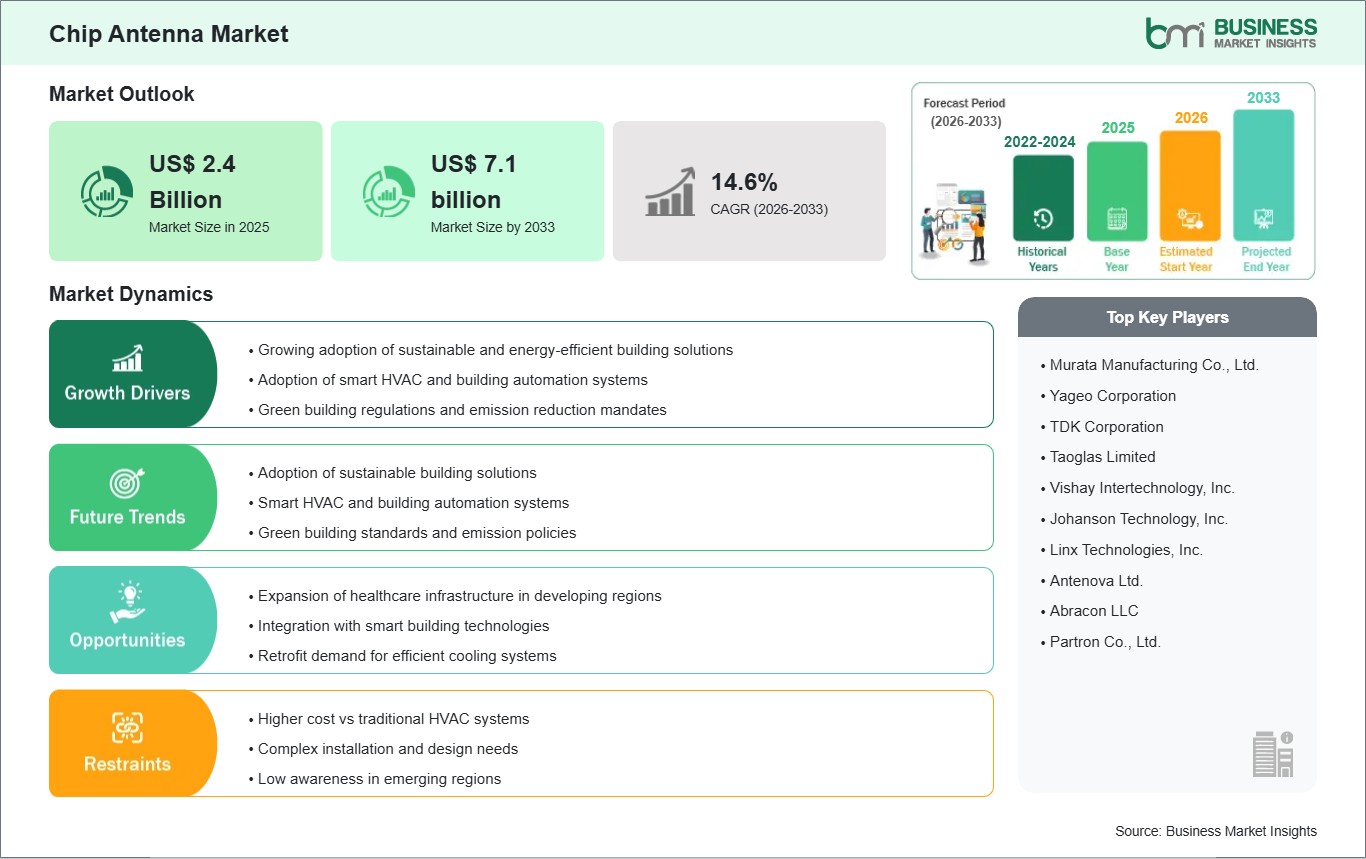
Chip antennas are compact radio‑frequency (RF) components integrated into printed circuit boards (PCBs) to enable wireless communication in electronic devices. Designed for space‑constrained applications, chip antennas support protocols such as WLAN/Wi‑Fi, Bluetooth, GPS/GNSS, and dual/multi‑band standards, delivering efficient signal transmission while minimizing device footprint. These antennas are increasingly critical in modern electronics due to the rising adoption of connected devices requiring reliable and high‑speed connectivity.
The global chip antenna market is experiencing robust growth driven by the exponential proliferation of Internet of Things (IoT) devices, rapid deployment of 5G networks, and increasing integration of wireless connectivity in consumer electronics and automotive systems. As of the latest industry estimates, the market is projected to grow significantly from its current valuation—reaching multi‑billion‑dollar scale by the end of the decade at a strong compound annual growth rate (CAGR). This growth reflects the expanding demand for miniaturized, multi‑band, and high‑performance antenna solutions capable of supporting advanced wireless communication standards.
Segment Analysis
Chip Antenna Market Segmentation
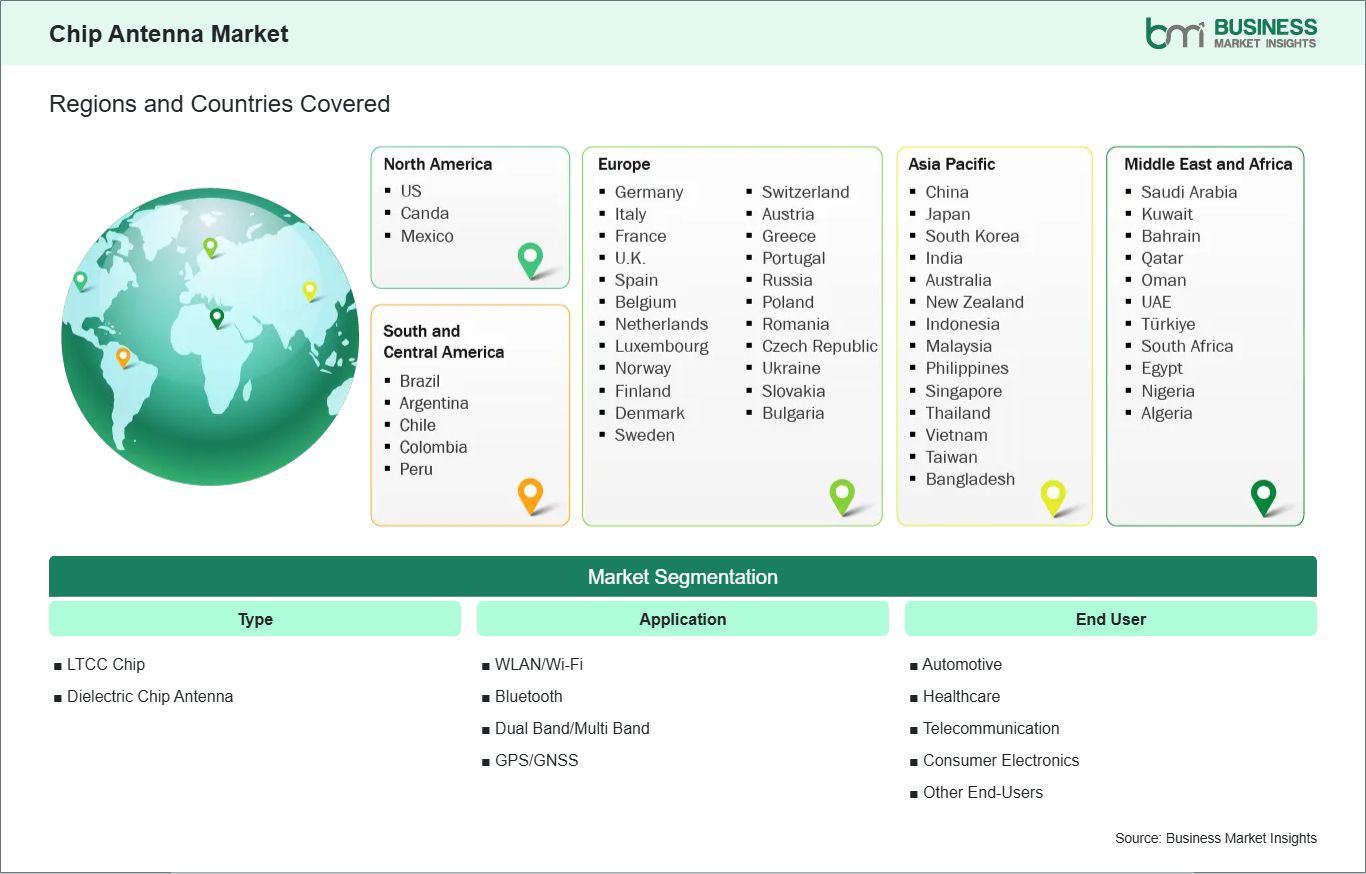
Key segments that contributed to the derivation of the chip antenna market analysis are type, application, and end user.
- By type, the market is segmented into LTCC chip and dielectric chip antenna. The LTCC chip segment held the largest share of the market in 2025.
- By application, the market is segmented into WLAN/Wi‑Fi, bluetooth, dual band/multi band, and GPS/GNSS. The WLAN/Wi‑Fi segment held the largest share of the market in 2025.
- By end user, the market is segmented into automotive, healthcare, telecommunication, consumer electronics, and others. The consumer electronics segment held the largest share of the market in 2025.
Market Forces
Chip Antenna Market Drivers and Opportunities
Rising Demand for Connected Devices and Wireless Communication
The global surge in connected devices and wireless technologies is a key driver of the chip antenna market. Chip antennas are widely integrated into smartphones, wearables, smart home devices, and IoT applications due to their compact size, multi-band capabilities, and reliable signal performance. Increasing adoption of high-speed wireless standards such as Wi‑Fi 6, Bluetooth Low Energy (BLE), and GPS/GNSS in consumer electronics, automotive telematics, and industrial IoT is accelerating demand for efficient chip antenna solutions worldwide.
Expansion of 5G Networks and IoT Ecosystems
The rapid deployment of 5G networks and growth of IoT ecosystems are creating significant market opportunities for chip antenna manufacturers. Chip antennas enable high-frequency, multi-band connectivity required for 5G-enabled smartphones, autonomous vehicles, smart infrastructure, and industrial automation devices. Rising investments in smart cities, telecommunication infrastructure, and connected automotive systems are further driving the adoption of advanced chip antennas, positioning the market for strong global growth.
Size and Share Analysis
Chip Antenna Market Size and Share Analysis
By type, the chip antenna market is segmented into LTCC Chip and Dielectric Chip Antenna. The LTCC Chip segment held a significant share of the market in 2025. LTCC chip antennas are widely used in smartphones, wearables, automotive telematics, and IoT devices due to their compact size, multi-band capabilities, and reliable signal performance. Their ability to support high-frequency communication and integration into space-constrained PCBs drives growth in this type segment globally.
By application, the market is segmented into WLAN/Wi‑Fi, Bluetooth, Dual Band/Multi Band, and GPS/GNSS. The WLAN/Wi‑Fi segment held the largest share of the market in 2025. WLAN/Wi‑Fi connectivity is increasingly required in consumer electronics, smart home devices, and enterprise networking solutions, making chip antennas essential for delivering high-speed, low-latency wireless communication. Rising adoption of connected devices is the primary factor driving growth in this application segment worldwide.
By end user, the market is segmented into Automotive, Healthcare, Telecommunication, Consumer Electronics, and Others. The Consumer Electronics segment held the largest share of the market in 2025. Chip antennas are extensively integrated into smartphones, tablets, laptops, and wearable devices to ensure compact design and efficient wireless performance, fueling adoption in this end-user segment globally.
Report Coverage
Chip Antenna Market Report Coverage and Deliverables
The "Chip Antenna Market Size and Forecast (2022-2033)" report provides a detailed analysis of the market covering below areas:
- Chip antenna market size and forecast at global, regional, and country levels for all the key market segments covered under the scope
- Chip antenna market trends, as well as market dynamics such as drivers, restraints, and key opportunities
- Chip antenna market analysis covering key market trends, global and regional framework, major players, regulations, and recent market developments
- Industry landscape and competition analysis covering market concentration, heat map analysis, prominent players, and recent developments for the chip antenna market
- Detailed company profiles, including SWOT analysis
Geographic Insights
Chip Antenna Market Geographic Insights
The geographical scope of the chip antenna market report is divided into five regions: North America, Asia Pacific, Europe, Middle East & Africa, and South & Central America. The chip antenna market in Asia-Pacific is expected to grow significantly during the forecast period.
Asia-Pacific has emerged as a key region for the chip antenna market, driven by strong adoption of smartphones, wearable devices, automotive telematics, and IoT-enabled electronics. Countries such as China, Japan, India, South Korea, and Australia are at the forefront of this growth, supported by rapid industrialization, high consumer electronics penetration, and large-scale deployment of wireless communication infrastructure. The rising focus on connected devices, 5G adoption, and smart city initiatives is further boosting the adoption of chip antennas across the region.
In addition, Asia-Pacific benefits from a robust electronics manufacturing ecosystem, advanced semiconductor production capabilities, and supportive government policies promoting digitalization and technology adoption. Investments in high-speed wireless networks, autonomous vehicles, and smart home systems are accelerating the integration of compact, high-performance chip antennas in consumer, automotive, and industrial applications. The increasing demand for multi-band, efficient, and space-saving wireless components is expected to sustain strong market growth in Asia-Pacific over the coming years.
Industry Activity
Recent Developments
The chip antenna market is evaluated by gathering qualitative and quantitative data post primary and secondary research, which includes important corporate publications, association data, and databases. A few of the key developments in the chip antenna market are:
- In June 2025, KYOCERA AVX offers a variety of extremely compact and high-performance internal, on-board, multiprotocol, 2.4GHz antennas ideal for use in system-in-package (SiP) applications — the demand for which is surging. These solutions are all RoHS-compliant and packaged on tape and reel for automated pick and place assembly.
- In December 2025, Taoglas announced the expansion of its embedded antenna portfolio with a new range of Low Temperature Co-fired Ceramic (LTCC) chip antennas optimized for Wi-Fi 6/7, Ultra-Wideband (UWB), and ISM connectivity. The new ILA.257, ILA.68, and ILA.89 deliver exceptional performance in ultra-compact packages - with minimal keep out area - designed for next-generation IoT, consumer, industrial, and wearable applications where space, efficiency, and reliability are critical.
Trust & Transparency
Research Methodology
The market analysis combines proprietary research with secondary data from government agencies, company disclosures, regulatory filings, industry databases and expert interviews. Market estimates are validated through data triangulation, cross-market benchmarking and analyst
review.
View Full Research Methodology
Key Sources Referred:
World Bank - Global Trade IndicatorsWorld Trade Organization (WTO)International Monetary Fund (IMF)International Trade Administration (ITA)Company websiteCompany annual reportsCompany investor presentations