
Gnss Chip Market Outlook: Size, Share, Trends, Growth Analysis, Competitive Landscape & Forecast, 2026-2033

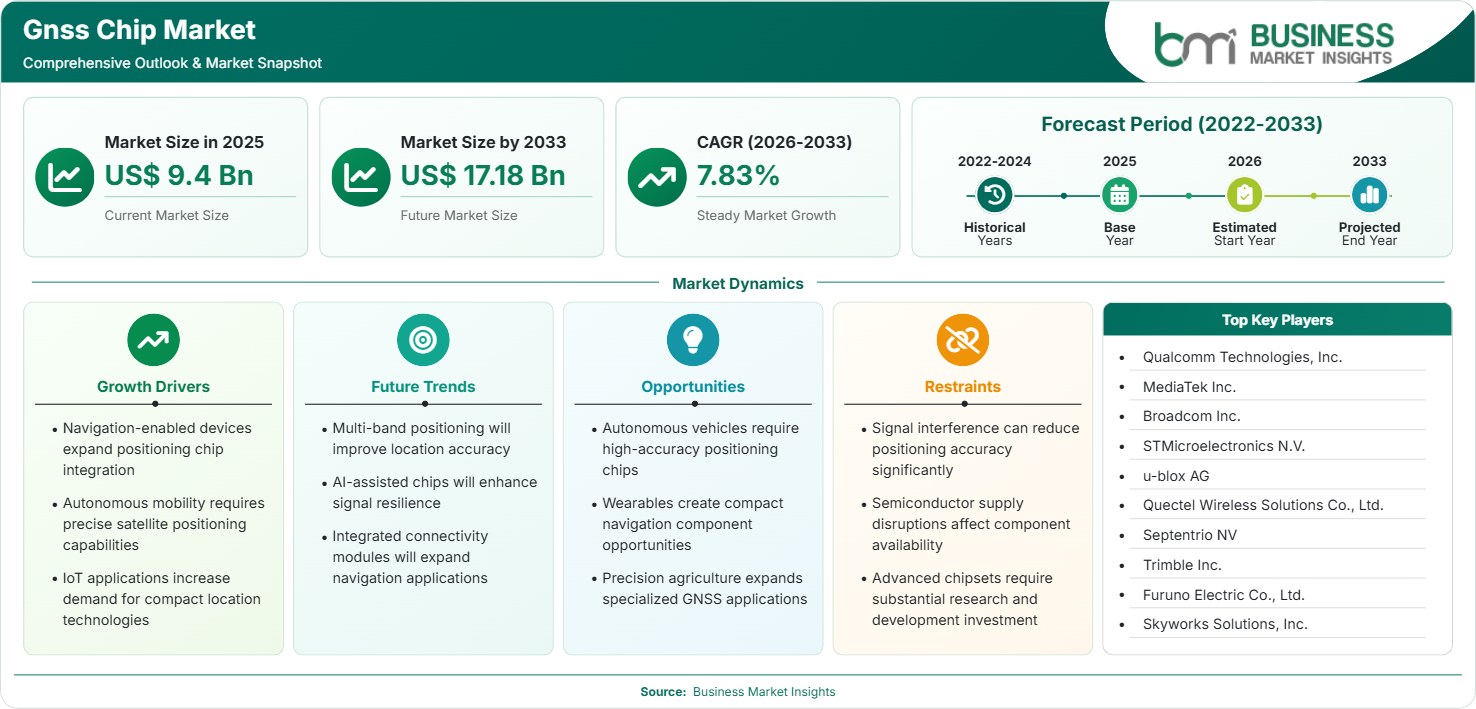
The GNSS Chip Market size was valued at US$ 9.4 Billion in 2025 and is projected to reach US$ 17.18 Billion by 2033, growing at a CAGR of 7.83% during 2026–2033, driven by multi-band positioning, automotive automation, drone deployment, resilient timing, and connected-device localization opportunities.

Report Coverage
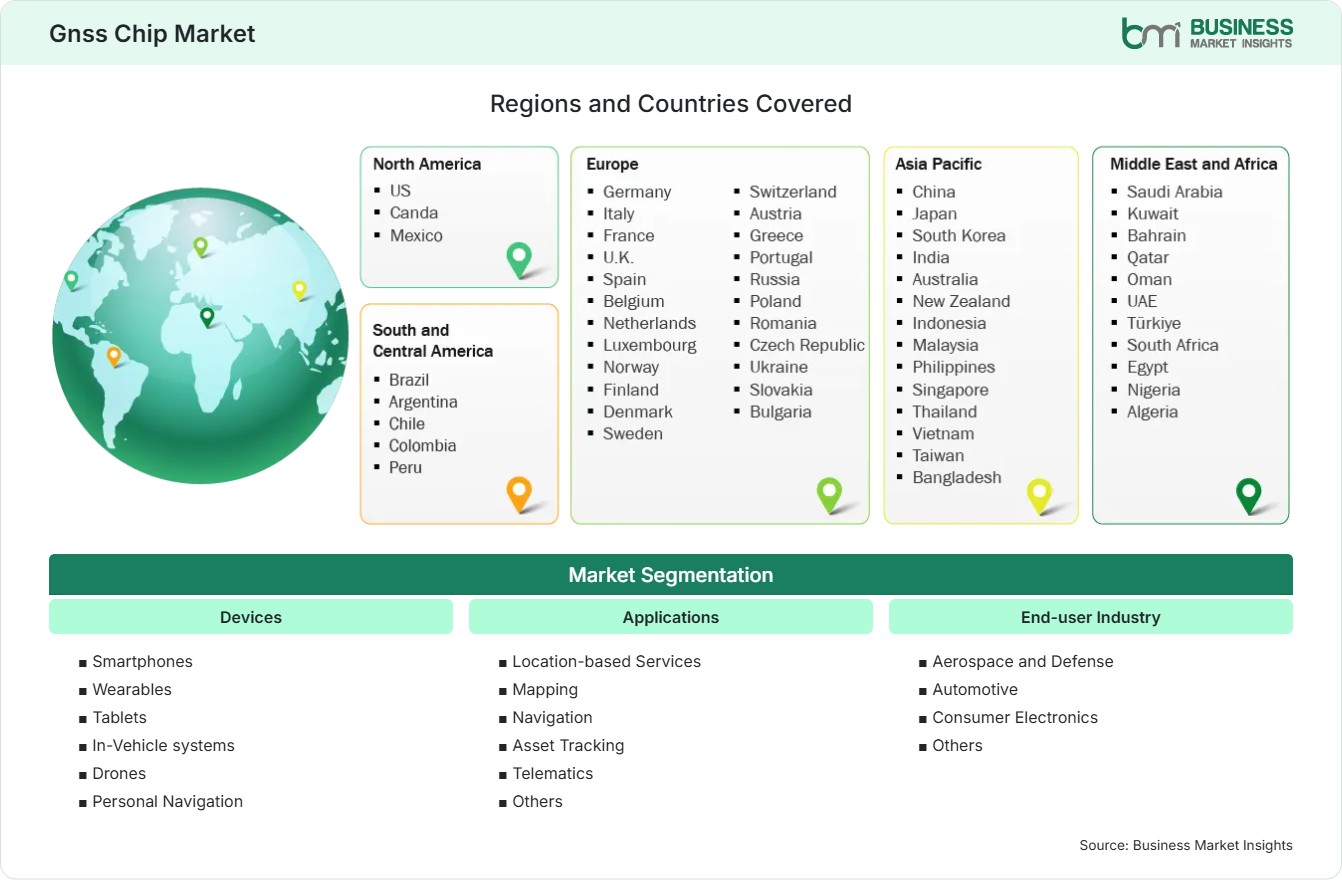
  • Devices: Smartphones, Wearables, Tablets, In-Vehicle systems, Drones, Personal Navigation
  • Applications: Location-based Services, Mapping, Navigation, Asset Tracking, Telematics, Others
  • End-user Industry: Aerospace and Defense, Automotive, Consumer Electronics, Others
US$ 9.4 Bn Market size in 2025
US$ 17.18 Bn Market Size by 2033
7.83% CAGR, 2026 - 2033
2026-2033 Forecast Period

AI Overview

Gnss Chip Market Summary

  • North America Region: North America holds a 24%–27% share in 2025, growing at a 7.2%–7.8% CAGR through 2033, influenced by defense modernization, ADAS deployment, drone programs, 5G timing, secure positioning, and precision logistics investments. US demand remains anchored by automotive electronics, defense procurement, wearable platforms, and location-enabled connected devices.
  • Fastest Growing Region: Asia Pacific commands a 41%–44% share in 2025, with a 7.9%–8.5% CAGR through 2033, supported by smartphone manufacturing, BeiDou integration, NavIC adoption, automotive localization, industrial tracking, and precision-agriculture investments across emerging economies.
  • Leading Segment: Smartphones represent a 53%–57% GNSS Chip Market share in 2025, advancing at a 7.1%–7.6% CAGR through 2033, supported by dual-band upgrades, location-based services, integrated connectivity, handset replacement cycles, and increasingly sophisticated on-device positioning requirements.
  • High Growth Segment: Drones hold a smaller 4%–7% share in 2025, while expanding at a 7.5%–7.9% CAGR through 2033, driven by autonomous inspection, precision agriculture, delivery trials, surveying, mapping, and compact multi-frequency positioning.
  • Key Market Opportunity: High-precision positioning creates attractive whitespace as centimeter-level capabilities migrate from professional equipment toward vehicles, drones, robotics, construction machinery, logistics trackers, wearables, and infrastructure synchronization applications.
  • Major Market Players: Qualcomm Technologies, Inc.; MediaTek Inc.; Broadcom Inc.; STMicroelectronics N.V.; u-blox AG; Quectel Wireless Solutions Co., Ltd.; Septentrio NV; Trimble Inc.; Furuno Electric Co., Ltd.; Skyworks Solutions, Inc.
Strategic Insights

Gnss Chip Market: Strategic Insights

Gnss Chip Market Strategic Framework
FREE PDF
Request your free sample
Request free sample
Stakeholder View

Key Takeaways

  • Supply-chain value is migrating from standalone receiver silicon toward integrated positioning platforms combining GNSS, inertial sensing, connectivity, correction services, cybersecurity, and application software.
  • The strongest incremental opportunity lies in drones, automotive telematics, robotics, precision construction, industrial tracking, and timing systems where accuracy and resilience command higher value than basic positioning.
  • Product roadmaps are moving toward simultaneous multi-constellation, multi-frequency reception, embedded memory, anti-jamming, anti-spoofing, dead reckoning, and software-defined positioning to improve performance without proportionate hardware complexity.
  • Asia Pacific offers the most compelling manufacturing and demand combination because smartphone production, domestic satellite ecosystems, electric-vehicle adoption, and industrial automation reinforce one another.
  • Investment priorities are shifting toward specialist positioning software, correction services, resilient PNT, sensor fusion, and automotive-grade receivers, creating partnership and acquisition opportunities beyond conventional semiconductor consolidation.
Geographic Outlook

Gnss Chip Market Regional Highlights

North America GNSS Chip Market

North America represented a 24%–27% share in 2025 and is projected to record a 7.2%–7.8% CAGR through 2033. Demand centers on automotive ADAS, aerospace, defense, drones, connected wearables, logistics, and network synchronization. The United States dominates regional procurement, while Canada contributes through precision positioning, aerospace, mining, and autonomous systems. GNSS Chip Market share remains supported by premium silicon adoption, resilient positioning requirements, and established semiconductor design capabilities.

  • Defense programs favor anti-jamming, authenticated signals, and resilient positioning architectures, increasing demand for specialized receivers that maintain performance when conventional satellite signals are degraded or deliberately disrupted.
  • Automotive suppliers are integrating GNSS with inertial sensors, cameras, and connectivity modules, expanding silicon content per vehicle and supporting longer qualification cycles for safety-sensitive positioning components.
  • Drone commercialization creates demand for compact multi-frequency receivers, particularly in inspection, mapping, infrastructure monitoring, agriculture, and logistics where autonomous flight requires continuous positioning confidence.
  • Timing applications benefit from expanding 5G infrastructure, data centers, and distributed networks requiring precise synchronization, creating higher-value opportunities beyond consumer navigation.

US GNSS Chip Market

The US accounts for around 70%-75% of demand in North America and is expected to register a CAGR of 7.3%-7.9% during 2023-2033. The GNSS Chip Market growth can be attributed to the resilience of the military, connected vehicles, modernization of the aerospace segment, autonomous technologies, and technological logistics. Investment in domestic semiconductors and resilience in positioning drives demand for secure, interference-tolerant architectures.

  • Automotive technology companies increasingly combine GNSS with inertial and vision systems, supporting high-value positioning requirements for advanced driver assistance and autonomous driving development.
  • Aerospace and defense procurement prioritizes resilience against jamming and spoofing, encouraging specialized architectures and increasing demand for secure timing and navigation technologies.
  • Commercial drone programs and precision logistics expand the addressable market for lightweight, low-power receivers capable of maintaining accurate positioning in complex operating environments.

Europe GNSS Chip Market

The Europe GNSS Chip Market accounted for around 21%-24% in 2025 and is expected to continue growing at a CAGR of 7.0%-7.6% through 2033. Germany & France take the lead in automotive and aerospace applications; the UK, Italy, and Spain provide electronics and navigation applications. The German market has grown by around 7.2%-7.8% CAGR, and the French market by around 7.4%-8.0%, supported by positioning in Galileo, automotive electronics, industrial automation, and aerospace.

  • Galileo strengthens regional demand for multi-constellation receivers and encourages European manufacturers to support sovereign positioning requirements across transportation and critical infrastructure.
  • Automotive production remains a major design-win channel as electric and software-defined vehicles increase requirements for accurate navigation, telematics, emergency services, and sensor fusion.
  • Aerospace applications benefit from sustained air-travel activity, with IATA reporting 5.3% global passenger-demand growth during 2025, supporting navigation and tracking equipment replacement.
  • Industrial automation and construction applications increasingly value centimeter-level positioning, creating opportunities for specialist suppliers offering correction services and ruggedized receiver platforms.

Asia Pacific GNSS Chip Market

Asia Pacific GNSS Chip Market is forecast to capture a share of 41%-44% by 2025 and is predicted to be the fastest-growing region, with a CAGR of 7.9%-8.5% during 2023-2033. China has remained dominant in regional volume, while other nations in APAC, such as India, Japan, South Korea, and Southeast Asia, have driven incremental growth. Growth in China is expected at an 8.1%–8.7% CAGR, and in India at 8.5%–9.2%, reflecting manufacturing scale and satellite-program investment.

  • China combines large smartphone production with BeiDou adoption, automotive localization, industrial automation, and domestic positioning technology, creating unusually broad demand across device and application categories.
  • India is building demand around NavIC-enabled devices, connected transportation, agriculture, logistics, and public infrastructure, creating opportunities for regionalized receiver designs and local ecosystem partnerships.
  • Japan and South Korea provide premium automotive, robotics, wearable, and electronics applications where low power, multi-band capability, and compact packaging support higher silicon value.
  • Southeast Asian manufacturing expansion adds incremental demand as electronics and automotive supply chains diversify, creating new design-win opportunities for module and chipset suppliers.

Rest of World GNSS Chip Market

South and Central America are expected to contribute 6%-8% of total global demand, led by Brazil, with regional growth of 6.8%-7.4% through 2033. Demand will be driven by use cases such as agriculture, logistics, mapping, construction, and fleet management, where GNSS improves operational transparency and equipment efficiency.

The Middle East and Africa region accounts for about 4%-5% and is expected to grow at 6.6%-7.2%. The main countries driving demand in this segment are Saudi Arabia, the UAE, and South Africa, with use cases including smart infrastructure, aerospace, mining, transportation, and defense.

  • Brazil’s large agricultural sector creates demand for precision guidance, machinery tracking, mapping, and asset monitoring, favoring higher-accuracy receivers over basic consumer navigation solutions.
  • Gulf economies are deploying smart-city, logistics, aviation, and autonomous-mobility projects that require dependable positioning, creating opportunities for multi-frequency and resilient PNT technologies.
  • South Africa’s mining, surveying, agriculture, and transport applications provide specialist demand for rugged receivers, correction services, and high-accuracy positioning platforms.
  • Regional infrastructure investment creates opportunities for suppliers capable of combining GNSS with cellular connectivity, inertial sensing, cloud platforms, and remote fleet-management software.
Global Market Geography
FREE PDF
Request your free sample
Request free sample
Segment Analysis

Gnss Chip Market Segmentation

Devices

The Devices category is the main source of revenue, with smartphone share at 53%-57% in 2025, and it is growing at a 7.1%-7.6% CAGR through 2033. The GNSS Chip Market size is increasing due to the integration of positioning into consumer, automotive, aerial, and personal electronic devices.

  • Smartphones: High-volume integration keeps smartphones dominant as dual-band positioning, emergency location, mapping, ride-hailing, gaming, and augmented-reality applications increase receiver sophistication.
  • Wearables: Smartwatches and fitness devices prioritize ultra-low-power positioning, compact silicon, and assisted GNSS to extend battery life while supporting outdoor tracking and health applications.
  • Tablets: Tablets use GNSS for navigation, field-service workflows, mapping, education, logistics, and enterprise mobility, with demand influenced by cellular-connected device adoption.
  • In-Vehicle systems: Automotive receivers gain value from navigation, telematics, ADAS, emergency services, and sensor fusion, while safety qualification creates longer product lifecycles and stronger supplier relationships.
  • Drones: Autonomous inspection, agriculture, mapping, and delivery applications increase demand for lightweight multi-frequency receivers capable of maintaining accuracy under strict power and payload constraints.
  • Personal Navigation: Dedicated navigation devices serve specialized transport, recreation, marine, and professional users, with differentiation increasingly based on accuracy, durability, connectivity, and software functionality.

Applications

The Applications category remains diverse, with navigation accounting for 41%-43% in 2025 and overall growth of 7.3%-7.8% through 2033. The GNSS Chip Market is moving towards a higher-value-added focus on position tracking, telemetry, and synchronization.

  • Location-based Services: Location-aware commerce, mobility, emergency services, social platforms, and contextual applications sustain high device volumes while increasing expectations for fast and accurate positioning.
  • Mapping: Surveying, construction, logistics, digital twins, and geographic information systems require increasingly precise coordinates, encouraging adoption of multi-frequency receivers and correction-enabled positioning.
  • Navigation: Navigation remains the largest application because smartphones, vehicles, aviation systems, marine equipment, and personal devices continuously require reliable position, velocity, and time information.
  • Asset Tracking: Connected logistics, industrial equipment, containers, and high-value assets create recurring demand for compact receivers integrated with cellular, Bluetooth, satellite, and low-power communication technologies.
  • Telematics: Vehicle telematics combines location with diagnostics, connectivity, insurance analytics, fleet optimization, and safety services, increasing demand for automotive-grade positioning and sensor-fusion capabilities.
  • Others (Timing and Synchronization): Timing and synchronization support telecommunications, energy infrastructure, financial systems, and data centers, creating premium demand for precise time outputs and resilient architectures.

End-user Industry

The end-user requirement is driven by consumer electronics, constituting around 34%-37% share of the revenue of the 2025 GNSS Chip Market, while the segment is expected to grow at about 7.2%-7.7% during 2033. The automotive and aerospace sectors increase the value of silicon due to safety, accuracy, and security.

  • Aerospace and Defense: Aviation, unmanned systems, military navigation, and resilient PNT applications require anti-jamming, secure signals, high availability, and multi-sensor architectures.
  • Automotive: Electric, connected, and software-defined vehicles require accurate positioning for navigation, telematics, ADAS, emergency functions, and automated-driving architectures, supporting longer design cycles.
  • Consumer Electronics: Smartphones, wearables, tablets, and personal devices provide the largest volume pool, with competitive pricing encouraging greater integration, lower power consumption, and smaller package footprints.
  • Others (Construction): Construction increasingly uses precise positioning for machine control, surveying, grading, mapping, and digital site management, supporting premium GNSS solutions with correction capabilities.
Market Forces

Gnss Chip Market Dynamics

Key Market Drivers

Multi-frequency positioning becomes a mainstream product requirement

Multi-frequency reception is transitioning from specialized equipment to cars, UAVs, smartphones, and industrial tracking solutions, enabled by the use of multiple frequencies that minimize ionospheric and multipath errors. The new generation of commercial receivers uses two, three, and even four frequency bands integrated into a single small chip, simplifying circuit board design while increasing reliability in urban canyons. The new generation of the Teseo VI series from STMicroelectronics in 2025 integrates both quad-band and multi-constellation reception on a single chip. The architecture of the Qualcomm X105 in 2026 demonstrates the trend toward greater precision with lower energy requirements. This trend is supported by the growth in silicon content per design and not only by volume increase. GNSS Chip Market trends therefore increasingly favor receiver architectures combining multi-band processing, inertial fusion, embedded memory, and security features within automotive and mobile system constraints.

Connected mobility expands positioning silicon content

The rise in electric and software vehicles has increased the number of functions that rely on accurate location information. According to the IEA, in 2025, more than 20 million electric cars were sold globally, accounting for about one-quarter of new car sales and expanding the electric vehicle fleet. GNSS is used for purposes such as navigation, telematics, emergency features, route optimization for charging, fleet analysis, and autonomous driving. Programs in the automotive industry take longer to qualify than consumer applications, resulting in design values beyond the first-time platform choice. This means that players having automotive-grade qualifications, safety certification, cybersecurity solutions, dead reckoning, and longevity have a competitive advantage.

Resilient positioning becomes a procurement priority

Jamming and spoofing risks are increasing the commercial value of detection, mitigation, authentication, and sensor-fusion technologies. The air navigation service providers, military entities, infrastructure managers, and automotive manufacturers all require a positioning system that is capable of detecting signal problems and switching to another sensor and correction. Over 1,000 cases of interference have been recorded by aviation authorities in Europe in 2024, illustrating the consequences of unreliable satellite signal performance. The message for chip makers is clear: anti-jamming front-ends, spoofing protection, authorized services, inertial fusion, and software-defined positioning have become product features. Those who can provide such features while consuming little power and processor capacity will have a niche in the market.

Key Market Opportunities

Precision positioning moves into mass-market devices

Centimeter-level positioning is being migrated from surveying hardware to drones, robotics, automotive, agriculture, and selected consumer devices. The release of ZED-X20P by U-blox in 2025, offering centimeter-level positioning globally at a much lower cost than professional-grade equipment, demonstrates the commercialization of technology. It is not just receiver chips; correction services, antennas, firmware, cloud-based positioning, and sensor fusion could also generate recurring revenue per unit. Vendors that reduce calibration complexity and deliver usable accuracy without expensive external infrastructure can expand the addressable market considerably. GNSS Chip Market Forecasts therefore, increasingly depend on the conversion of professional-grade positioning capabilities into scalable commercial products with simpler integration, lower power budgets, and software-supported performance upgrades.

Automotive software-defined positioning creates recurring value

Software-defined vehicles create opportunities to update positioning behavior throughout a vehicle lifecycle rather than freezing receiver functionality at production. The introduction of firmware innovations will enable the implementation of functionality for constellations, interference, dead reckoning, correction services, and positioning algorithms without changing the full electronic platform. This provides a higher-value proposition for the relationship between semiconductor providers and automobile OEMs, since the effectiveness of silicon now depends on an upgradable software package. The greatest potential lies in platforms that integrate GNSS, inertial sensing, vehicle dynamics, cellular communication, and cloud correction capabilities. These platforms will be able to meet the needs of navigation, parking assistance, ADAS localization, insurance telematics, and fleet services using the same hardware.

Timing diversification broadens the addressable market

Networks, data centers, power utilities, industrial networks, and financial systems need accurate time synchronization despite having little or no need for navigation. With the deployment of 5G networks, the demand for synchronization and frequency accuracy also increases, and data center providers use precise timing for network management and integrity. Thus, timing receivers will allow diversification of GNSS manufacturers, not within the volume-oriented smartphone industry. There is an especially promising market for a combination of GNSS with holdover oscillators, interference detection, and multiple timing inputs. Suppliers who sell the resilience of timing as infrastructure technology rather than as receivers will be able to enter more sustainable projects and contract-based services with high margins and lower volatility in the consumer electronics market.

Market Restraints and Challenges

Factor: Signal interference and cybersecurity complexity

Factor: The GNSS signal is inherently weak at the receiver and can be affected by deliberate jamming, unintentional interference, spoofing, atmospheric effects, and urban multipath. Impact: Mitigation will incur additional expense on hardware, software, testing, certification, and processing. There may be a need for automotive/aerospace applications to have redundant sensors, secure firmware, authenticated services, and interference-monitoring capabilities, which will increase development costs and certification delays. This requirement can be especially challenging for small consumer electronics, where additional RF filtering, processing capacity, and memory will affect the bill-of-materials cost and battery life. Thus, suppliers find themselves caught between the need for robustness and cost.

Factor: Semiconductor cost pressure and supply-chain concentration

Factor: GNSS Chip Market suppliers remain exposed to semiconductor fabrication capacity, advanced packaging, RF component availability, and geographic concentration in electronics manufacturing. Impact: Shortages, logistics problems, export controls, or price changes in components can affect production planning and customer qualification plans. Integrating GNSS functions into smartphones’ system-on-chip solutions affects prices because GNSS is integrated with cellular, Wi-Fi, Bluetooth, and application processors, rather than being bought as a separate component. The task for specialized suppliers is to demonstrate the benefits of paying higher prices through improved accuracy, security, automotive qualifications, software, or corrections. The problem becomes more acute when a company is trying to enter high-volume consumer designs while investing in its specialized, high-precision architectures.

Company Analysis

Competitive Landscape

The GNSS Chip Market analysis indicates a moderately consolidated competitive structure, with integrated semiconductor companies controlling high-volume consumer designs while specialist suppliers differentiate through precision, automotive qualification, industrial ruggedness, and correction-enabled positioning.

Company Name

Overview

Products and Services relevant to this market

Qualcomm Technologies, Inc.

Major wireless semiconductor supplier with GNSS integrated into mobile and automotive platforms, emphasizing power efficiency, precision, connectivity, and multi-frequency positioning.

Snapdragon positioning technologies, integrated GNSS receivers, modem-RF platforms, automotive positioning, multi-frequency GNSS, and location software.

MediaTek Inc.

Taiwan-based fabless semiconductor company serving smartphones, automotive electronics, tablets, and connected devices through highly integrated system platforms.

Dimensity platforms, integrated GNSS, smartphone positioning, automotive computing platforms, connectivity, and location-processing technologies.

Broadcom Inc.

Diversified semiconductor supplier with strong positioning capabilities across mobile, wearable, consumer, infrastructure, and specialized electronics applications.

GNSS receiver ICs, multi-band positioning, low-power location solutions, timing components, connectivity silicon, and integrated wireless platforms.

STMicroelectronics N.V.

European semiconductor supplier with substantial automotive and industrial positioning expertise, emphasizing precise, secure, multi-constellation receiver architectures.

Teseo GNSS ICs and modules, quad-band receivers, dead reckoning, automotive positioning, timing, anti-jamming, and sensor-fusion solutions.

u-blox AG

Swiss positioning specialist serving automotive, industrial, and consumer customers with scalable modules and high-precision receiver platforms.

GNSS chipsets, modules, high-precision positioning, correction services, automotive receivers, timing solutions, and short-range connectivity.

Quectel Wireless Solutions Co., Ltd.

Connectivity and module supplier integrating GNSS into broad cellular, IoT, automotive, and tracking product portfolios.

GNSS modules, cellular-GNSS combinations, automotive positioning, IoT tracking, telematics modules, and connected-device solutions.

Septentrio NV

Specialist positioning company focused on high-precision, interference-resilient GNSS for professional, industrial, autonomous, and infrastructure applications.

Multi-frequency GNSS receivers, anti-jamming technology, autonomous positioning, surveying solutions, machine control, and industrial receivers.

Trimble Inc.

Precision technology company combining GNSS hardware with correction services and application software across construction, agriculture, transportation, and geospatial markets.

GNSS receivers, correction services, positioning software, machine control, surveying, mapping, construction, and precision agriculture technologies.

Furuno Electric Co., Ltd.

Japanese electronics company with established expertise in navigation and positioning for marine, aviation, industrial, and specialized applications.

GNSS receivers, marine navigation systems, timing products, positioning equipment, integrated navigation electronics, and professional solutions.

Skyworks Solutions, Inc.

Semiconductor supplier with RF expertise supporting wireless and positioning ecosystems, particularly where RF integration and signal integrity are critical.

RF front-end components, connectivity technologies, GNSS-related RF solutions, filters, amplifiers, and wireless infrastructure components.

Trust & Transparency

Research Methodology

The market analysis combines proprietary research with secondary data from government agencies, company disclosures, regulatory filings, industry databases and expert interviews. Market estimates are validated through data triangulation, cross-market benchmarking and analyst review.

View Full Research Methodology

Questions Answered

Frequently Asked Questions

Who should purchase the GNSS Chip Market Report?

The Market Report is particularly relevant to semiconductor manufacturers, GNSS module suppliers, automotive electronics companies, investors, technology strategists, OEM procurement teams, and companies evaluating positioning technology partnerships.

What role do correction services play in positioning?

Correction services improve raw satellite positioning by compensating for errors affecting receiver measurements. Their integration with chips and modules allows suppliers to combine hardware, software, connectivity, and recurring service revenue.

How does GNSS support telecommunications infrastructure?

GNSS provides accurate timing references used to synchronize telecommunications equipment. As networks become denser and more distributed, timing quality becomes important for maintaining coordinated operation across radio equipment and network nodes.

Why are drones becoming an important positioning application?

Drones require accurate positioning within tight weight and energy constraints. Inspection, mapping, delivery, agriculture, and surveying applications increasingly require stable centimeter-level positioning, making compact multi-frequency receivers commercially attractive.

What makes multi-frequency GNSS valuable for automotive systems?

Multi-frequency reception improves positioning reliability in urban environments by reducing errors caused by ionospheric effects and multipath. It also supports more precise localization for ADAS, telematics, automated parking, and future automated-driving functions.

Access the Full Gnss Chip Market Report

Get segment-level forecasts, regional estimates, competitive benchmarking, company profiles and downloadable Excel datasets.

Access the full Gnss Chip Market Report
350 pages PDF & Excel | 2026-10-05
Similar Research

Related Market Reports