Autonomous Defense Platforms Market Regional Highlights
North America Autonomous Defense Platforms Market
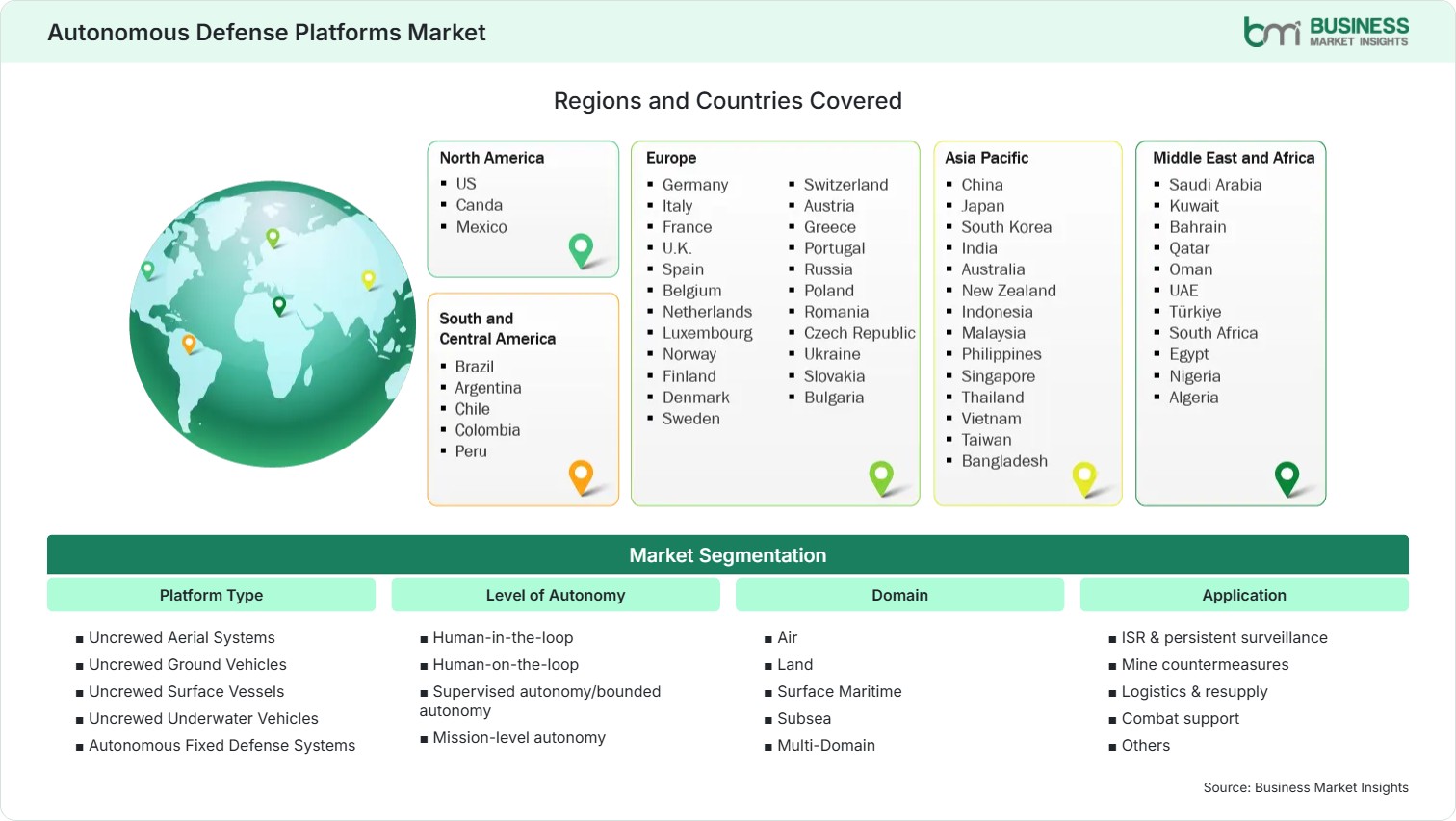
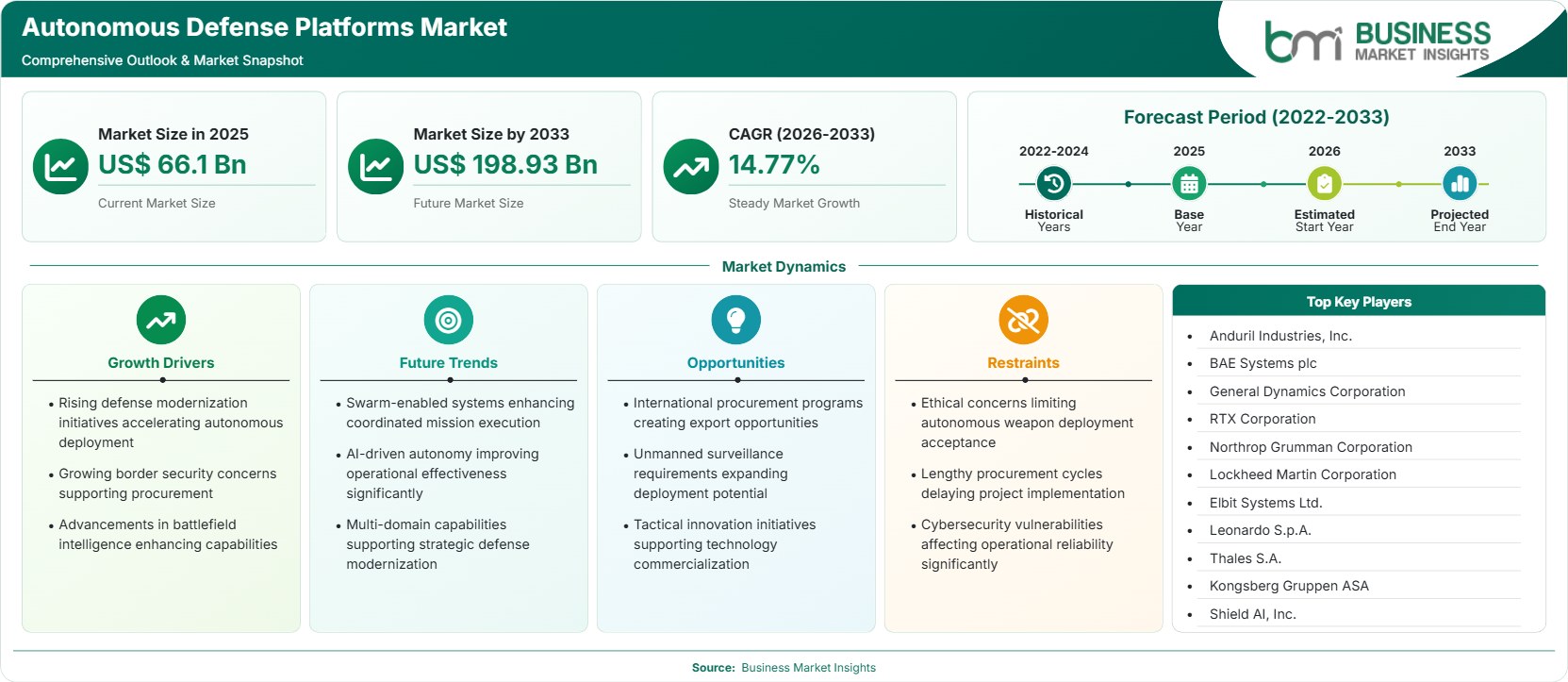
The Autonomous Defense Platforms Market in North America is projected to hold a market share of 34%–37% in 2025, with a projected CAGR of 13%–15% through 2033. The major drivers include having strong defense budget, matured aerospace industry, testability, and development of AI technology. However, despite being the dominant market in North America, the USA is not the only player showing interest in autonomous platforms, as Canada has demonstrated growing interest in autonomous surveillance, Arctic surveillance, and maritime security. Modern procurement focuses on modularity, autonomy, and technology. There is also an opportunity for venturing into the market.
- Autonomous aircraft are gaining importance as collaborative combat aircraft programs emphasize distributed sensing, mission autonomy, and force multiplication alongside crewed aircraft.
- Ground autonomy is expanding through logistics, reconnaissance, route clearance, and optionally crewed vehicle concepts designed to reduce personnel exposure in contested environments.
- Maritime programs increasingly emphasize autonomous surveillance, mine countermeasures, persistent sensing, and underwater operations where endurance and reduced crew requirements create operational advantages.
- Investment in defense AI, edge computing, and secure networking supports the integration of autonomy software across multiple vehicle classes and mission environments.
US Autonomous Defense Platforms Market
The United States accounted for roughly 72%–76% of the Americas’ share in 2025 and is projected to grow at a CAGR of 13.5%–15% through 2033. The strengths that the nation possesses include its presence of established defense primes, specialists in autonomy development, military testing, and large scale technology procurement. Collaborative combat aircraft, autonomous maritime, tactical intelligence, and robotic ground vehicles are all programs that are helping in the commercialization of technologies. Another advantage the United States enjoys is the presence of an advanced ecosystem of defense technologies, backed by venture capital.
- The Department of Defense ecosystem is increasingly testing autonomy as a standalone software capability, supporting faster updates without redesigning complete aircraft or vehicles.
- Collaborative combat aircraft programs create demand for mission autonomy capable of operating alongside crewed aircraft and adapting to changing battlefield conditions.
- Autonomous ground systems are increasingly relevant to logistics and tactical mobility, where robotic vehicles can reduce exposure during resupply and reconnaissance missions.
- The domestic ecosystem combines established primes with specialist companies, encouraging partnerships that accelerate AI, autonomy, sensors, and command-system integration.
Europe Autonomous Defense Platforms Market
The Europe region had a 27%-30% market share in 2025 and is expected to register a CAGR of 14.5%-16% in the Autonomous Defense Platforms Market until 2033. Demand from Germany, the UK, France, Italy, and Poland is one of the major sources of demand, whereas Ukraine's battlefield experience continues to impact procurement strategies for unmanned systems and autonomy. Strengthening defense investment in the European region aids in modernization in air, land, maritime, and electronic warfare segments. NATO's 5% defense investment target through 2035 provides a favorable policy headwind for the region.
- The United Kingdom is strengthening AI and autonomy investment, with defense planning increasingly emphasizing secure software, data exploitation, and autonomous systems across operational domains.
- Germany and Poland are prioritizing land-force modernization, surveillance, counter-drone capabilities, and scalable uncrewed systems as regional security requirements intensify.
- France and Italy provide strong aerospace and naval engineering capabilities, supporting development of autonomous aircraft, maritime platforms, sensors, and integrated command architectures.
- European suppliers increasingly emphasize sovereign technology, open architectures, and interoperability to reduce dependence on individual foreign technology providers.
Asia Pacific Autonomous Defense Platforms Market
The Asia Pacific holds a market share of 22%-25% in 2025 and is projected to maintain its market leadership, with the highest CAGR of 17%-19% between 2026-2033. China, Japan, South Korea, India, and Australia are major end-user nations, with India and Australia displaying an increased demand for maritime surveillance, autonomous aircraft, and defense solutions. The diversity of geography, extensive maritime borders, border security requirements, and increased military spending necessitate autonomous and persistent platforms.
- India is expanding autonomous aviation and AI capabilities, including acquisition of V-BAT aircraft and Hivemind autonomy software from Shield AI for Army applications.
- Australia offers strong opportunities for autonomous maritime surveillance, undersea systems, long-range sensing, and integration of uncrewed platforms into distributed defense architectures.
- Japan and South Korea are increasing interest in autonomous aircraft, naval systems, surveillance platforms, and AI-enabled command capabilities amid changing regional security requirements.
- China remains a major technology and manufacturing force in drones, robotics, sensors, and autonomous systems, intensifying regional competitive pressure.
Rest of World Autonomous Defense Platforms Market
South and Central America combined accounted for 6%–8% of the Autonomous Defense Platforms Market in 2025, with opportunities in border and maritime surveillance, as well as logistics applications, from countries such as Brazil, Colombia, Chile, and Mexico. Rising demand for affordable solutions and persistent surveillance and homeland security missions that can be accomplished with autonomous platforms without additional staffing are among the driving factors.
Middle East and Africa contributed approximately 5%–6% in 2025 and will grow at a 15%–17% CAGR between 2026 and 2033. Some of the growth-driving countries include Saudi Arabia, the UAE, Israel, and selected African countries that are enhancing autonomous platforms for border protection, maritime surveillance, counter-drone, and battlefield intelligence.
- Israel remains a major innovation center for autonomous defense technologies, combining AI, robotics, sensing, unmanned aircraft, and battlefield-derived autonomy expertise.
- Gulf states are increasingly evaluating autonomous systems for persistent surveillance, critical-infrastructure protection, maritime security, and force modernization.
- Brazil offers regional opportunities for autonomous surveillance and border monitoring, particularly across large land and maritime areas.
- African defense users can benefit from autonomous systems that provide persistent coverage while reducing operating burdens in remote environments.