
Automotive Wiper Market Outlook: Size, Share, Trends, Growth Analysis, Competitive Landscape & Forecast, 2026-2033

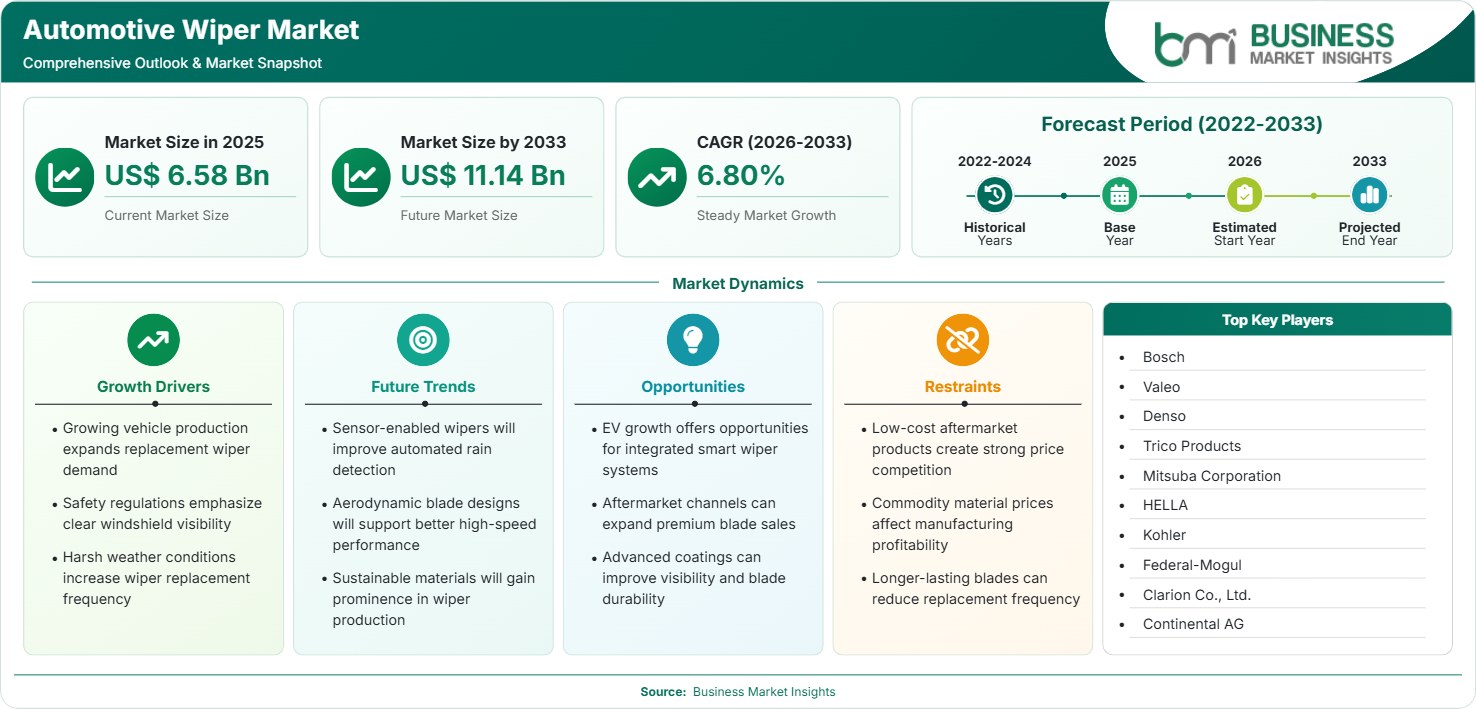
The Automotive Wiper Market size was valued at USD 6.58 Billion in 2025 and is projected to reach USD 11.14 Billion by 2033, growing at a CAGR of 6.80% during 2026–2033. Rising vehicle production, increasing replacement demand from aging vehicle fleets, growing emphasis on driving safety, and advancements in blade materials are supporting market growth. Opportunities are emerging from premium flat-blade technologies, smart wiper systems, and expanding aftermarket sales channels.

Report Coverage
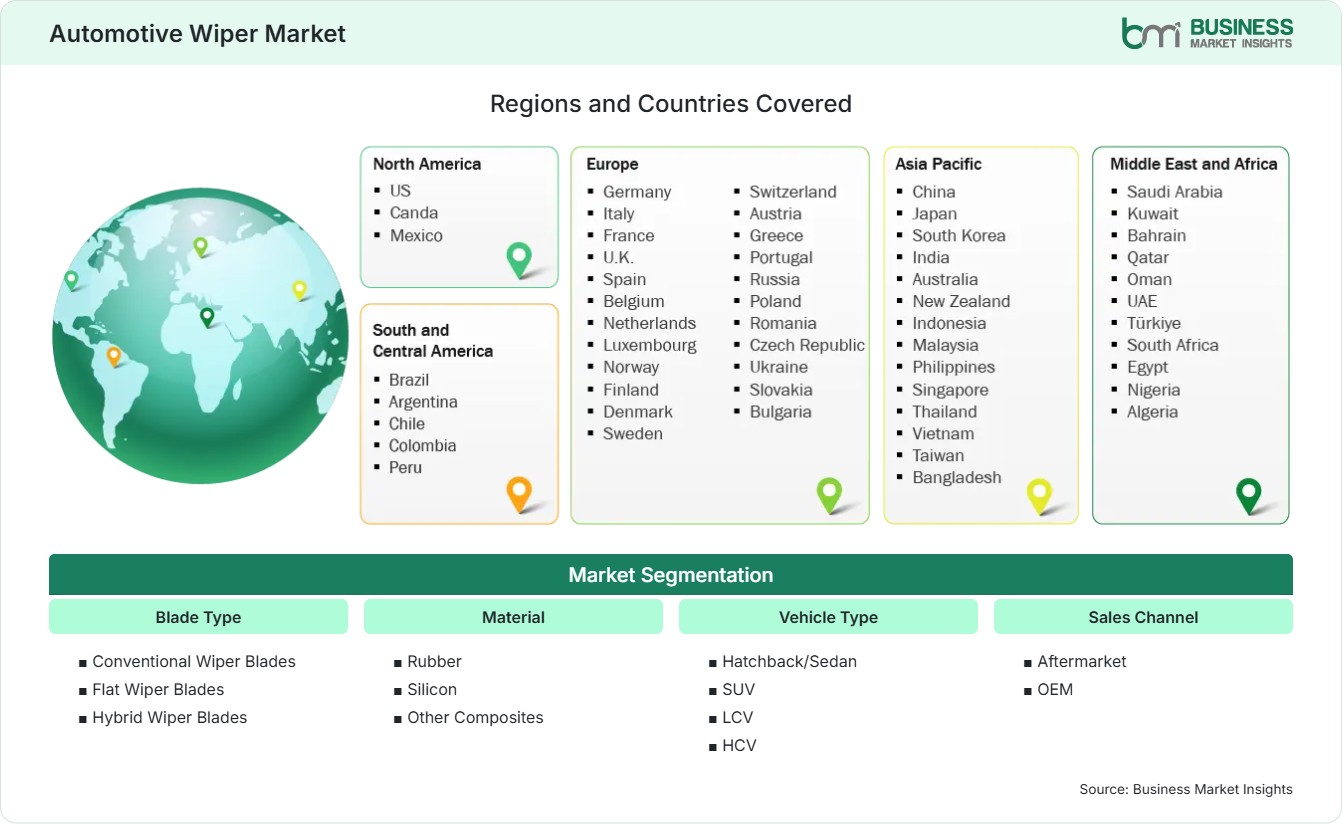
  • Blade Type: Conventional Wiper Blades, Flat Wiper Blades, Hybrid Wiper Blades
  • Material: Rubber, Silicon, Other Composites
  • Vehicle Type: Hatchback/Sedan, SUV, LCV, HCV
  • Sales Channel: Aftermarket, OEM
US$ 6.58 Bn Market size in 2025
US$ 11.14 Bn Market Size by 2033
6.80% CAGR, 2026 - 2033
2026-2033 Forecast Period

01 AI Overview

Automotive Wiper Market Summary

  • North America Region: North America holds 26%–30% share in 2025 and is projected to grow at 6.1%–6.8% CAGR during 2026–2033. Vehicle parc expansion, adverse weather conditions, strong aftermarket demand, and increasing adoption of premium blade technologies support consumption. The U.S. dominates regional demand, supported by large vehicle ownership levels and replacement cycles, expanding at 6.3%–7.0% CAGR.
  • Fastest Growing Region: Asia Pacific accounts for 36%–40% share in 2025 and is expected to advance at 7.8%–8.5% CAGR during 2026–2033. Rising vehicle production, urbanization, improving road infrastructure, and increasing passenger vehicle ownership accelerate market expansion.
  • Leading Segment: Conventional Wiper Blades represent 42%–46% share in 2025 and are projected to grow at 6.2%–6.9% CAGR. Broad compatibility, cost efficiency, and widespread OEM adoption support segment leadership.
  • High Growth Segment: SUV vehicles account for 29%–33% share in 2025 while expanding at 7.5%–8.3% CAGR. Increasing SUV sales globally and larger windshield dimensions continue supporting demand growth.
  • Key Market Opportunity: Integration of aerodynamic blade designs, sensor-assisted wiping technologies, and premium silicone materials offers manufacturers opportunities to enhance durability, performance, and consumer value.
  • Major Market Players: Robert Bosch GmbH, Valeo SA, DENSO Corporation, Trico Products Corporation, Mitsuba Corporation, HELLA GmbH & Co. KGaA, Kohler Co., Federal-Mogul LLC, Clarion Co., Ltd., Continental AG.
02 Strategic Insights

Automotive Wiper Market: Strategic Insights

Automotive Wiper Market Strategic Framework
FREE PDF
Request your free sample
Request free sample
03 Stakeholder View

Key Takeaways

  • The market value chain increasingly integrates raw material suppliers, blade manufacturers, OEMs, distributors, and aftermarket retailers focused on quality, performance, and efficiency.
  • SUV and premium passenger vehicle segments provide significant upside due to rising production volumes and consumer preference for higher-performance wiper systems.
  • Product development efforts are shifting toward silicone blades, hybrid configurations, and intelligent wiping technologies designed to improve durability and visibility.
  • Asia Pacific remains the most attractive regional investment destination due to expanding vehicle production and growing automotive ownership levels.
  • Strategic partnerships between OEMs and component manufacturers are driving innovation in premium blade systems and integrated vehicle technologies.
  • Aftermarket replacement demand remains a critical revenue contributor owing to periodic blade replacement requirements and vehicle maintenance practices.
04 Geographic Outlook

Automotive Wiper Market Regional Highlights

North America Automotive Wiper Market

North America accounted for 26%–30% Automotive Wiper Market share in 2025 and is expected to expand at 6.1%–6.8% CAGR through 2033. Demand is supported by strong vehicle ownership levels, mature automotive aftermarket infrastructure, and frequent replacement cycles caused by seasonal weather conditions. Vehicle owners increasingly favor premium blade technologies offering improved durability and visibility performance. Manufacturers benefit from established distribution networks and growing adoption of advanced silicone and hybrid blade technologies.

  • Seasonal snow, rain, and temperature fluctuations increase blade wear and support recurring replacement demand across passenger and commercial vehicle fleets.
  • Automotive retailers continue expanding premium product portfolios featuring enhanced durability, quieter operation, and improved aerodynamic performance.
  • Vehicle owners increasingly prioritize maintenance-driven replacements as awareness of safety and visibility requirements grows.
  • OEM adoption of advanced blade technologies supports demand for higher-value products throughout the region.
  • E-commerce automotive parts distribution continues improving accessibility and availability of replacement blade products.

US Automotive Wiper Market

The United States represents 78%–82% of North American demand and is projected to grow at 6.3%–7.0% CAGR through 2033. A large vehicle parc, strong aftermarket channels, and routine maintenance culture support stable demand across multiple vehicle categories.

  • Passenger vehicle owners replace blades regularly due to weather-related deterioration and performance degradation.
  • Automotive service centers remain influential product distribution channels throughout the replacement market.
  • Premium silicone blade adoption continues increasing among consumers seeking longer operational life.
  • SUV ownership trends support higher-value blade demand because of larger windshield configurations.

Europe Automotive Wiper Market

Europe held 24%–28% share in 2025 and is anticipated to expand at 6.4%–7.1% CAGR during the forecast period. Advanced automotive manufacturing capabilities, stringent safety requirements, and widespread adoption of premium vehicle technologies support market development. Germany remains the leading market, while Poland exhibits strong growth potential.

  • Germany leads regional demand through its substantial automotive production base and strong vehicle ownership levels.
  • Poland is projected to achieve 7.1%–7.8% CAGR supported by manufacturing investments and vehicle fleet expansion.
  • Premium vehicle segments encourage adoption of advanced flat and hybrid blade technologies.
  • Vehicle safety standards continue supporting demand for high-performance visibility systems.
  • Strong aftermarket distribution networks improve replacement product penetration throughout the region.

Asia Pacific Automotive Wiper Market

Asia Pacific accounted for 36%–40% share in 2025 and is projected to expand at 7.8%–8.5% CAGR, making it the fastest-growing regional market. Rising automotive production, increasing disposable incomes, and growing vehicle ownership continue supporting demand. The strongest Automotive Wiper Market growth momentum is observed in rapidly industrializing economies where passenger and commercial vehicle sales remain robust. Automotive manufacturers continue increasing local production capacities to meet growing domestic and export demand.

  • China remains the largest regional market supported by extensive automotive manufacturing activity and vehicle sales.
  • India is projected to achieve 8.3%–9.0% CAGR due to rising vehicle ownership and expanding aftermarket infrastructure.
  • Passenger vehicle demand continues increasing across urban and semi-urban markets.
  • Automotive components localization initiatives are strengthening regional supply chains.
  • Growth in e-commerce automotive parts sales improves consumer access to replacement products.

Rest of World Automotive Wiper Market

Rest of World accounted for 8%–12% share in 2025 and is expected to grow at 6.6%–7.3% CAGR through 2033. Demand is supported by increasing vehicle registrations, fleet modernization initiatives, and expansion of automotive aftermarket activities across Latin America, the Middle East, and Africa.

  • Brazil remains the largest Latin American market driven by growing passenger and commercial vehicle fleets.
  • Saudi Arabia continues investing in transportation infrastructure and automotive sector development initiatives.
  • Rising vehicle ownership supports greater replacement demand throughout developing economies.
  • Expansion of organized aftermarket retail channels improves product availability and consumer awareness.
  • Harsh climatic conditions in several regions accelerate blade replacement frequency and support recurring demand.
Global Market Geography
FREE PDF
Request your free sample
Request free sample
05 Segment Analysis

Automotive Wiper Market Segmentation

Blade Type

The blade type segment remains a key determinant of performance, replacement frequency, and consumer preference across passenger and commercial vehicles. Conventional Wiper Blades accounted for 42%–46% share in 2025 and are projected to expand at 6.2%–6.9% CAGR through 2034. The Automotive Wiper Market scope continues to evolve as manufacturers improve aerodynamic performance, durability, noise reduction, and all-weather functionality to meet changing vehicle requirements and consumer expectations.

  • Conventional Wiper Blades: Widely adopted due to affordability, compatibility with multiple vehicle categories, simple installation, and established aftermarket availability supporting replacement demand.
  • Flat Wiper Blades: Increasingly preferred for improved aerodynamics, enhanced windshield contact, quieter operation, and superior performance during high-speed driving and adverse weather conditions.
  • Hybrid Wiper Blades: Combine structural benefits of conventional and flat blade technologies, offering better durability, appearance, and wiping efficiency across varying road conditions.

Material

Material innovation continues influencing blade efficiency, lifecycle performance, and replacement intervals. Rubber accounted for 58%–62% share in 2025 and is expected to grow at 6.4%–7.1% CAGR through the forecast period. Emerging Automotive Wiper Market trends indicate increasing adoption of advanced materials designed to improve weather resistance, durability, and windshield cleaning effectiveness.

  • Rubber: Remains the industry standard due to cost efficiency, flexibility, dependable wiping performance, and broad compatibility across vehicle platforms.
  • Silicon: Gains traction through superior durability, UV resistance, smoother operation, and extended service life compared with traditional blade materials.
  • Other Composites: Support premium product development through enhanced wear resistance, structural stability, and improved operational longevity in demanding environments.

Vehicle Type

Vehicle category demand continues shaping product specifications and replacement patterns throughout the industry. Hatchback/Sedan vehicles represented 38%–42% share in 2025 and are forecast to expand at 6.3%–7.0% CAGR through 2034. Growth is supported by large global vehicle populations and recurring maintenance requirements.

  • Hatchback/Sedan: Generate substantial replacement demand due to extensive global ownership and routine maintenance cycles.
  • SUV: Require larger blade systems and increasingly support premium product adoption owing to growing global vehicle sales.
  • LCV: Demand durable wiping solutions capable of maintaining operational reliability under intensive daily usage conditions.
  • HCV: Utilize heavy-duty blade technologies designed to withstand long-distance operations and challenging environmental conditions.

Sales Channel

Sales channel performance is influenced by vehicle production levels, service requirements, and consumer replacement behavior. Aftermarket accounted for 54%–58% share in 2025 and is projected to advance at 7.0%–7.7% CAGR through the forecast period. Recurring replacement needs and expanding retail access continue strengthening aftermarket demand.

  • Aftermarket: Benefits from periodic blade replacement requirements, broad product availability, competitive pricing options, and extensive retail distribution networks.
  • OEM: Supported by vehicle production growth and increasing integration of advanced wiping systems into newly manufactured vehicles.
06 Market Forces

Automotive Wiper Market Dynamics

Key Market Drivers

Growing vehicle production expands replacement wiper demand

Vehicle production globally remains a constant source of demand for OE and aftermarket wiper systems. With an increase in passenger car ownership, commercial fleets, and automotive production activities, there will be a constant installation demand. Each new car must have visibility systems in place. The increase in vehicle fleets around the world will also drive replacement demand due to the fact that wiper blades wear out. The Automotive Wiper Market growth outlook remains closely linked to automotive production performance, vehicle parc expansion, and growing consumer awareness regarding maintenance practices that improve road safety and driving visibility.

Safety regulations emphasize clear windshield visibility

Government regulations and automotive safety standards increasingly emphasize visibility performance under challenging operating conditions. Improvements in windshield wipers have been achieved by vehicle manufacturers so as to ensure compliance with regulations and improve the safety of drivers. Effective functioning of windshield wipers is important for retaining visibility when there is rain, snow, dust storms, or other such harsh weather conditions. As active safety technology becomes increasingly popular among both regulators and consumers, vehicle manufacturers keep working to improve designs and efficiency of wipers. These efforts facilitate the adoption of superior wipers as well as replacement demand.

Harsh weather conditions increase wiper replacement frequency

Environmental conditions such as extreme temperatures, snow, rainfall, dust exposure, and ultraviolet radiation contribute to blade deterioration and reduced wiping effectiveness. Vehicle owners who operate vehicles in harsh environments may change blades more frequently in order to ensure visibility and safety. Producers keep inventing new materials that can withstand harsh environmental effects and have a long lifespan. An increased awareness about the connection between blade quality and safety on the road contributes to the replacement practice. Given that climatic fluctuations affect blade durability in many places, this recurring need becomes an important revenue source for business.

Key Market Opportunities

EV growth offers opportunities for integrated smart wiper systems

Electrification trends within the automotive industry are creating opportunities for advanced visibility technologies. Electrical vehicles are now moving towards improving aerodynamic designs, integrating intelligent sensors, and delivering better driving experiences. Systems that adjust themselves to weather conditions improve their performance while meeting the vehicle's efficiency goals. Combining these systems with advanced driver-assistance systems also provides some space for innovating. With the increasing popularity of electrical vehicles across the world, differentiating visibility solutions can be developed for electrical vehicles.

Aftermarket channels can expand premium blade sales

Consumers increasingly seek products offering improved durability, quieter performance, and better visibility compared with conventional alternatives. Premium replacement blades featuring silicone technologies, advanced coatings, and aerodynamic designs are gaining acceptance across multiple vehicle categories. Expanding e-commerce sales channels and specialized automotive retailers improve market reach and product awareness. Automotive Wiper Market Forecasts indicate growing demand for premium aftermarket products as vehicle owners prioritize performance, convenience, and longer replacement intervals. Manufacturers capable of differentiating products through technology and branding can capitalize on this opportunity.

Advanced coatings can improve visibility and blade durability

Material and coating innovations continue creating opportunities for product differentiation across OEM and aftermarket segments. Improvements in surface treatment increase the water-repellent ability of the blades, decrease friction, and enhance windshield cleaning efficiency. Surface treatments play a major role in extending service life and creating a good user experience in harsh environments. Manufacturers investing in surface treatments can benefit from a competitive advantage through premium pricing policies. Further advancements in material science may lead to development of new-generation blades.

Market Restraints and Challenges

Low-cost aftermarket products create strong price competition

Factor: Numerous regional and unorganized suppliers offer inexpensive replacement products that compete aggressively on price rather than technology or durability. Impact: Established manufacturers may face margin pressure and reduced pricing flexibility, particularly within cost-sensitive markets. Consumers often select products based on upfront affordability instead of lifecycle performance, creating challenges for premium brands. Competitive pricing environments can also affect investment returns associated with innovation and product development. Consequently, differentiation through quality, durability, and brand value remains critical for maintaining market position.

Commodity material prices affect manufacturing profitability

Factor: Raw materials such as rubber, silicone compounds, specialty coatings, and metallic components experience periodic cost fluctuations influenced by supply chain conditions and broader economic factors. Impact: Manufacturing costs can rise unexpectedly, reducing profitability and complicating long-term pricing agreements. Suppliers may encounter challenges in passing higher costs to customers within competitive market environments. Volatile input expenses therefore influence procurement planning, inventory management, and strategic investment decisions. Effective cost control and supply chain optimization remain essential for sustaining profitability and operational resilience.

07 Company Analysis

Competitive Landscape

The Automotive Wiper Market analysis highlights competition driven by blade durability, aerodynamic performance, advanced material technologies, OEM partnerships, aftermarket distribution strength, and innovation in smart visibility systems. Companies continue focusing on silicone blade development, hybrid configurations, and premium replacement products to strengthen market positioning.

Company Name

Overview

Products and Services Relevant to This Market

Robert Bosch GmbH

Global automotive technology leader with extensive expertise in vehicle safety and visibility components.

Conventional, flat, and hybrid wiper blades, OEM systems, premium aftermarket visibility products.

Valeo SA

Major automotive supplier focused on driving assistance and vehicle performance innovations.

Advanced wiper systems, blade technologies, OEM windshield cleaning solutions, replacement products.

DENSO Corporation

Leading automotive component manufacturer serving global passenger and commercial vehicle markets.

Wiper systems, motor assemblies, blade components, integrated visibility technologies.

Trico Products Corporation

Specialized manufacturer with a long-standing presence in windshield wiper technology.

Conventional blades, premium beam blades, hybrid blades, aftermarket replacement products.

Mitsuba Corporation

Automotive systems supplier known for motion-control and visibility-related technologies.

Wiper systems, motors, linkage assemblies, vehicle visibility components.

HELLA GmbH & Co. KGaA

Global automotive technology company specializing in safety and electronic solutions.

Visibility systems, wiper components, sensor integration technologies, OEM applications.

Kohler Co.

Diversified industrial manufacturer with automotive-related component capabilities and engineering expertise.

Vehicle component solutions, industrial systems, selected automotive applications.

Federal-Mogul LLC

Established automotive supplier serving OEM and aftermarket sectors globally.

Replacement automotive components, maintenance products, aftermarket distribution solutions.

Clarion Co., Ltd.

Automotive technology company supporting vehicle system integration and component innovation.

Automotive electronics and selected vehicle system integration solutions.

Continental AG

Global automotive technology leader with strong OEM relationships and advanced mobility solutions.

Intelligent wiper systems, sensor-enabled components, visibility technologies, automotive electronics.

10 Trust & Transparency

Research Methodology

The market analysis combines proprietary research with secondary data from government agencies, company disclosures, regulatory filings, industry databases and expert interviews. Market estimates are validated through data triangulation, cross-market benchmarking and analyst review.

View Full Research Methodology

11 Questions Answered

Frequently Asked Questions

What does an Automotive Wiper Market Report include?

An Market Report typically includes market sizing, segmentation analysis, regional outlooks, competitive benchmarking, technology developments, growth opportunities, restraints, and strategic industry insights.

How do silicone blades differ from rubber blades?

Silicone blades generally offer longer operational life, improved resistance to UV exposure, smoother wiping performance, and enhanced durability compared with conventional rubber alternatives.

Why is the aftermarket segment important?

Wiper blades require periodic replacement because of wear caused by weather exposure, friction, and environmental conditions, creating recurring demand within the aftermarket.

Which blade type leads the market?

Conventional wiper blades lead due to broad vehicle compatibility, cost-effectiveness, widespread OEM adoption, and strong availability across global aftermarket distribution channels.

What are automotive wipers used for?

Automotive wipers remove rain, snow, debris, and contaminants from windshields to maintain driver visibility and support safe vehicle operation under varying weather conditions.

Access the Full Automotive Wiper Market Report

Get segment-level forecasts, regional estimates, competitive benchmarking, company profiles and downloadable Excel datasets.

Access the full Automotive Wiper Market Report
350 pages PDF & Excel | 2026-08-19