
Automotive Turbocharger Market Outlook: Size, Share, Trends, Growth Analysis, Competitive Landscape & Forecast, 2026-2033

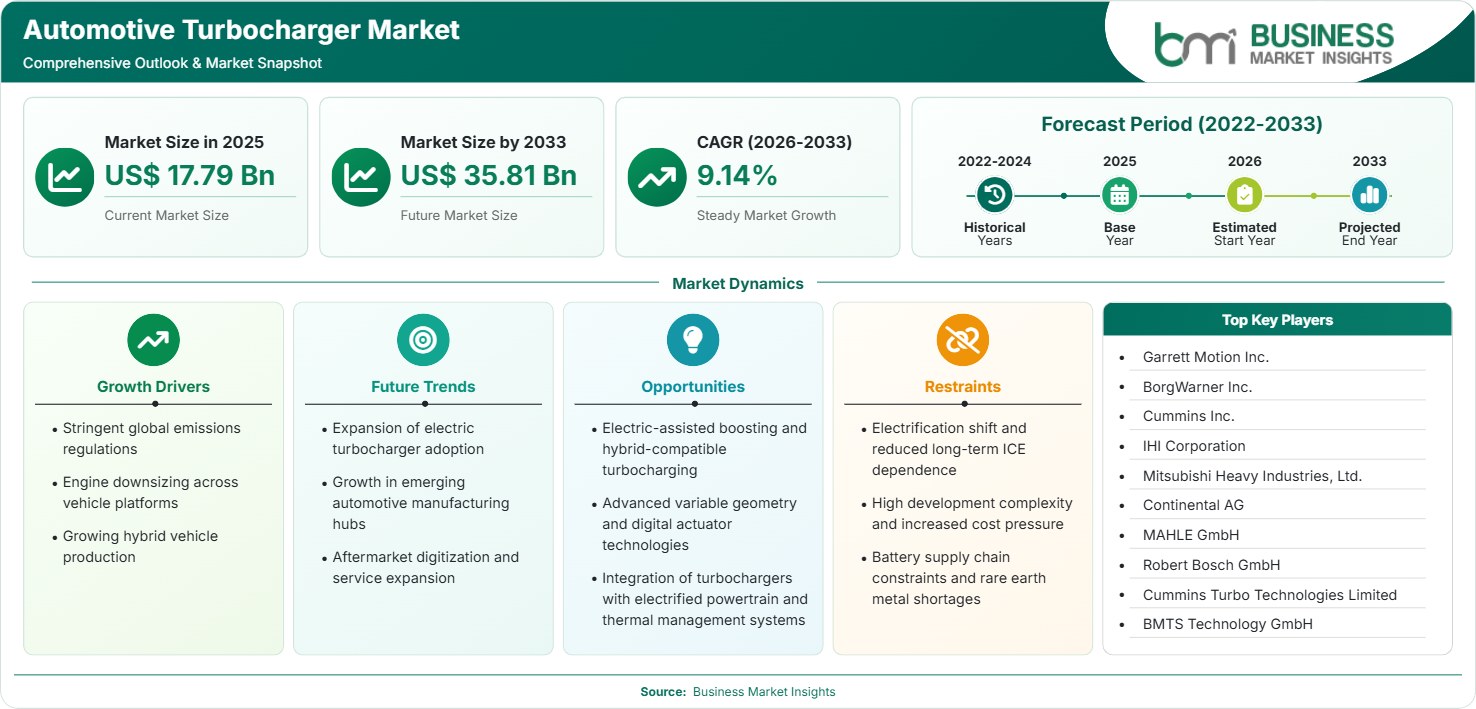
The Automotive Turbocharger Market size was valued at US$ 17.79 Billion in 2025 and is projected to reach US$ 35.81 Billion by 2033, growing at a CAGR of 9.14% during 2026–2033. Demand is supported by engine downsizing, tighter emissions regulations, hybrid powertrain integration, fuel-efficiency requirements, commercial vehicle upgrades, and accelerating adoption of electric-assisted turbocharging technologies.

Report Coverage
  • Technology Type: Variable Geometry Turbocharger, Wastegate Turbocharger, Electric Turbocharger
  • Fuel Type: Gasoline, Diesel
  • Vehicle Type: Passenger Car, Light Commercial Vehicle, Heavy Commercial Vehicle
US$ 17.79 Bn Market size in 2025
US$ 35.81 Bn Market Size by 2033
9.14% CAGR, 2026 - 2033
2026-2033 Forecast Period

AI Overview

Automotive Turbocharger Market Summary

  • North America Region: Holds a market share of 22%–25% in 2025, growing with a CAGR of 8.1%–8.8% during 2026–2033, driven by pickup truck demand, fleet efficiency programs, stricter fuel economy standards, hybrid vehicle expansion, commercial vehicle replacement cycles, localized manufacturing investments, aftermarket development, and advanced boosting technologies adoption. US market benefits from strong OEM demand, engine downsizing, and an expected CAGR of 8.3%–9.0%.
  • Fastest Growing Region: Asia Pacific holds a market share of 38%–41% in 2025, expanding at a CAGR of 10.2%–11.0% during 2026–2033, supported by vehicle production growth, emission compliance upgrades, expanding middle-class vehicle ownership, manufacturing investments, export-oriented assembly capacity, hybrid vehicle penetration, and supplier localization.
  • Leading Segment: Passenger Car accounts for 62%–65% share in 2025 and advances at a CAGR of 8.8%–9.5%, supported by widespread turbocharged gasoline engine adoption, fuel-efficiency targets, compact engine architectures, hybrid integration requirements, premium vehicle demand, and automaker efforts to reduce fleet emissions.
  • High Growth Segment: Electric Turbocharger represents 12%–15% share in 2025 and records a CAGR of 15.0%–17.0%, driven by improved transient response, premium vehicle deployment, electrified powertrain architectures, performance enhancement requirements, emissions compliance strategies, and rapid innovation across component ecosystems.
  • Key Market Opportunity: Electrified boosting systems create opportunities across hybrids and advanced combustion engines by improving efficiency, reducing turbo lag, supporting emissions compliance, enabling premium performance differentiation, and attracting long-term OEM investments globally.
  • Major Market Players: Garrett Motion Inc., BorgWarner Inc., Cummins Inc., IHI Corporation, Mitsubishi Heavy Industries, Ltd., Continental AG, MAHLE GmbH, Robert Bosch GmbH, Cummins Turbo Technologies Limited, and BMTS Technology GmbH.
Strategic Insights

Automotive Turbocharger Market: Strategic Insights

Automotive Turbocharger Market Strategic Framework
FREE PDF
Request your free sample
Request free sample
Stakeholder View

Key Takeaways

  • The value chain is increasingly integrated, with OEMs, engine manufacturers, electronic control suppliers, and turbocharger specialists collaborating to optimize efficiency, durability, and emissions performance.
  • Electric-assisted turbocharging and hybrid-compatible boosting systems offer the strongest revenue upside due to accelerating electrification and performance requirements.
  • R&D budgets are shifting toward digital actuator controls, advanced materials, and electrically driven compressor architectures that improve responsiveness and efficiency.
  • Asia Pacific presents the strongest investment case due to vehicle production concentration, supplier localization, and expanding emission-regulation enforcement.
  • Strategic acquisitions and technology partnerships continue reshaping competition as suppliers seek stronger OEM relationships and electrification capabilities.
  • Commercial vehicle modernization programs provide stable long-term demand through fleet replacement and fuel-consumption reduction initiatives.
Geographic Outlook

Automotive Turbocharger Market Regional Highlights

North America Automotive Turbocharger Market

North America accounted for approximately 22%–25% of the Automotive Turbocharger Market share in 2025 and is forecast to expand at 8.1%–8.8% CAGR through 2033. Demand is supported by widespread use of turbocharged gasoline engines in pickup trucks, SUVs, and commercial fleets. Emissions regulations and fuel economy standards continue encouraging engine downsizing strategies. Suppliers are increasing regional production capabilities to strengthen supply resilience while hybrid powertrain adoption creates new opportunities for advanced boosting technologies within established automotive manufacturing ecosystems.

  • Fleet operators prioritize fuel savings and power density improvements, supporting turbocharger deployment across commercial transportation applications.
  • OEM investments target advanced thermal management and electronic control systems to improve efficiency and emissions outcomes.
  • Aftermarket demand remains strong due to vehicle parc expansion and replacement requirements.
  • Hybrid vehicle growth creates demand for next-generation electrically assisted boosting solutions.

US Automotive Turbocharger Market

The United States represents roughly 75%–80% of North American revenue and advances at 8.3%–9.0% CAGR. Strong light truck production, emissions compliance initiatives, and growing adoption of boosted gasoline engines sustain demand. Domestic manufacturing investments support supplier expansion while fleet modernization programs improve demand visibility through the forecast period. Advanced engine platforms increasingly incorporate high-performance boosting systems to balance fuel economy, torque delivery, and regulatory requirements within highly competitive vehicle categories.

  • Pickup trucks remain a major deployment platform for advanced turbocharging technologies.
  • Hybridization programs create additional demand across passenger and commercial vehicle applications.
  • Strong aftermarket channels improve recurring revenue opportunities.
  • Manufacturing investments support domestic production and supply-chain resilience.

Europe Automotive Turbocharger Market

Europe captures approximately 26%–29% share in 2025 with a projected 8.5%–9.2% CAGR. The region benefits from stringent emissions standards and advanced engineering capabilities. Germany remains the leading country, while Eastern European manufacturing hubs show notable expansion. Premium vehicle manufacturers continue investing in high-efficiency powertrains, supporting demand for advanced boosting technologies. Despite EV growth, hybrid vehicles and efficient combustion engines maintain a substantial role across regional transportation systems.

  • Germany leads regional demand with strong premium automotive production.
  • Poland and the Czech Republic benefit from growing component manufacturing investments.
  • Hybrid vehicle adoption supports advanced turbocharger integration.
  • Regulatory pressure encourages continuous technology upgrades.
  • Premium vehicle segments accelerate electric turbocharger adoption.

Asia Pacific Automotive Turbocharger Market

Asia-Pacific contributes 38%-41% in 2025 and has the highest growth rate, at 10.2%-11.0%. China dominates in terms of production capacity, whereas India has the highest growth rate among the major markets. Rising numbers of vehicles, industrial investments, and regulatory emissions norms drive the market. Suppliers in the region continue to expand their capacity for both domestic and export markets. Government initiatives supporting efficient transportation technologies further strengthen adoption across passenger vehicles and commercial transportation applications.

  • China remains the largest production and consumption center globally.
  • India records among the strongest growth rates due to expanding automotive output.
  • Supplier localization improves pricing competitiveness and supply efficiency.
  • Commercial vehicle demand supports diesel turbocharger deployment.
  • Export-oriented manufacturing strengthens regional investment attractiveness.

Rest of World Automotive Turbocharger Market

Rest of World contributes approximately 10%–13% share and is expected to expand at 8.8%–9.6% CAGR. South and Central America benefit from commercial vehicle replacement demand and improving industrial activity. The Middle East and Africa region increasingly adopts fuel-efficient vehicle technologies as transportation infrastructure expands. Brazil remains the leading Latin American market, while Gulf countries display growing demand for performance and utility vehicles incorporating advanced engine technologies.

  • Brazil leads regional automotive production and component demand.
  • Mexico benefits from export-focused manufacturing integration.
  • Gulf markets support premium performance vehicle demand.
  • Infrastructure expansion increases commercial transportation requirements.
  • Fuel-efficiency regulations encourage broader adoption of boosting technologies.
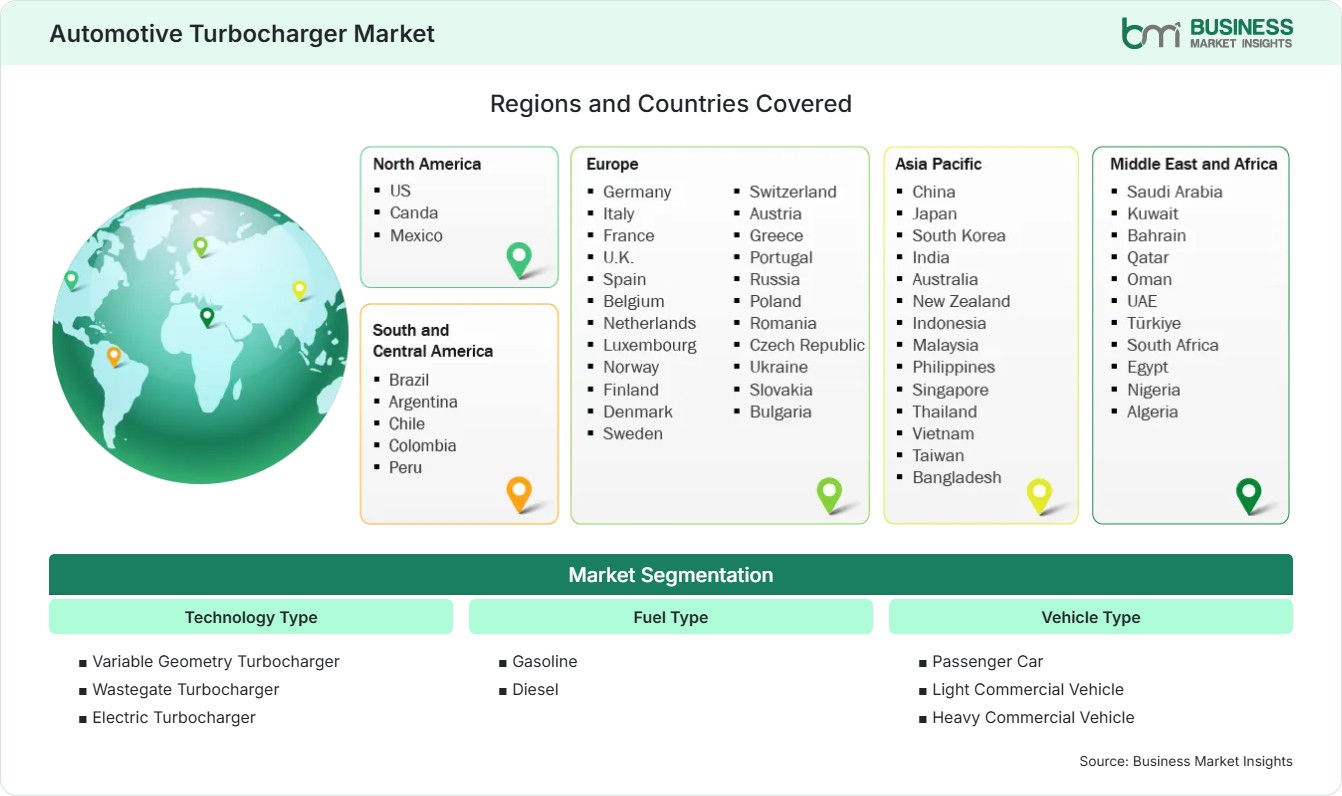
Global Market Geography
FREE PDF
Request your free sample
Request free sample
Segment Analysis

Automotive Turbocharger Market Segmentation

Technology Type

Technology Type accounted for the largest revenue concentration, with variable geometry technologies maintaining leadership. The segment benefits from emissions compliance requirements, improved engine efficiency, and broader OEM adoption. Automotive Turbocharger Market scope continues expanding through electrified boosting innovations. The segment held around 45%–48% share in 2025 and is expected to grow at 9.5%–10.2% CAGR.

  • Variable Geometry Turbocharger: Widely adopted for improving low-speed torque, optimizing fuel efficiency, and supporting emissions reduction across passenger and commercial vehicle platforms.
  • Wastegate Turbocharger: Maintains strong presence in cost-sensitive vehicle platforms due to proven reliability, straightforward architecture, and broad compatibility with gasoline engines.
  • Electric Turbocharger: Gains momentum through hybrid integration, faster response characteristics, premium vehicle applications, and expanding investment in electrified powertrain technologies.

Fuel Type

Fuel Type Segmentation takes into consideration changing consumer preferences and regulations. Gasoline-powered turbocharged automobiles have been leading the global market, whereas diesel remains significant in transportation. This segment accounted for around 34% - 37% market share in 2025 and is expected to grow at a CAGR of 8.6% - 9.2%.

  • Gasoline: Benefits from engine downsizing strategies, hybrid vehicle integration, and broad deployment across mass-market passenger vehicle categories.
  • Diesel: Continues serving commercial fleets requiring durability, torque performance, and fuel efficiency across logistics and heavy-duty transportation applications.

Vehicle Type

Vehicle Type will remain the key driver of demand due to the rising adoption of boosting technologies across automobile companies' vehicle lineups. Trends from the Automotive Turbocharger Market suggest increased application in passenger cars and hybrids. The market accounts for around 62%-65% in 2025 and grows at 8.8%-9.5% CAGR.

  • Passenger Car: Drives volume demand through fuel-efficiency targets, accelerating hybrid penetration, and growing consumer preference for smaller high-output engines.
  • Light Commercial Vehicle: Benefits from urban logistics growth, fleet modernization initiatives, and improving fuel economy requirements.
  • Heavy Commercial Vehicle: Supports stable demand as operators prioritize operating cost reductions, emissions compliance, and long-distance transportation efficiency.
Market Forces

Automotive Turbocharger Market Dynamics

Key Market Drivers

Stringent Global Emissions Regulations

Emission standards continue to become more stringent in North America, Europe, China, India, and other major automobile manufacturing nations. Turbocharging allows manufacturers to reduce engine size without sacrificing power, thereby improving fuel economy and reducing CO₂ emissions. Efficient technologies that meet regulatory requirements are driving increased use of turbocharging in both passenger cars and commercial vehicles. The Automotive Turbocharger Market growth is highly associated with compliance technology applications. Manufacturers adopt more sophisticated boosting systems that bridge the gap between combustion-engine and electric-drive technologies. This dynamic supports strong replacement demand and continued OEM integration across diverse vehicle classes worldwide.

Engine Downsizing Across Vehicle Platforms

Downsizing engines continues to be an important strategy for automakers seeking efficiency improvements without compromising performance. The use of turbochargers ensures that small engines produce more power density and torque. The need for consumers to save fuel and the regulatory environment promote faster adoption. Operators of commercial vehicles also gain from better economic performance and reduced emissions intensity. The Automotive Turbocharger Market trends now include adoption across mass-market vehicle segments, not just premium segments. This results in a large target market for the suppliers and parts manufacturers.

Growing Hybrid Vehicle Production

Hybrid vehicles continue creating substantial opportunities for advanced boosting systems. Manufacturers utilize turbochargers to improve efficiency and performance in downsized engines integrated with electric propulsion systems. Demand for responsive and efficient powertrains supports the development of electric-assisted architectures. The combination of emissions compliance requirements and consumer preference for improved driving dynamics strengthens technology adoption. Growing hybrid production volumes across Asia Pacific, Europe, and North America are driving higher installation rates while creating long-term opportunities for differentiated premium solutions.

Key Market Opportunities

Expansion of Electric Turbocharger Adoption

The use of electric turbochargers is growing as automotive companies seek to reduce turbo lag and enhance efficiency. Electric turbochargers are widely adopted in the premium/performance automotive category, but their adoption will expand during the forecast period. In Automotive Turbocharger Market Forecasts, there is increased focus on electric turbochargers due to the significant profits they can generate. This is because electric turbochargers can be easily integrated into hybrid vehicles, thereby enhancing the value proposition. Suppliers able to scale manufacturing and secure OEM partnerships may capture premium margins and long-term production contracts.

Growth in Emerging Automotive Manufacturing Hubs

India, Vietnam, Thailand, Mexico, Indonesia, and other nations continue to provide attractive destinations for investments in auto manufacturing. Increased capacity in vehicle assembly creates a greater need for local component systems, such as boosting technology. An increase in the number of cars, export-oriented manufacturing, and more up-to-date regulations enhance market prospects. Regional manufacturing centers set up by suppliers enjoy lower costs, better customer relations, and greater responsiveness. These factors create compelling opportunities for both established multinational companies and specialized regional participants.

Aftermarket Digitization and Service Expansion

An increasing number of turbochargers in use creates additional service and replacement needs. The use of digital diagnostics, predictive maintenance solutions, and fleet management systems enables the provision of after-sales services. Suppliers have an opportunity to earn recurring revenues through after-sales services, remanufactured products, and performance enhancement solutions. Customers in commercial fleets emphasize improved uptime and reduced costs. Advanced monitoring capabilities improve maintenance planning while strengthening customer retention and long-term profitability.

Market Restraints and Challenges

Electrification Shift and Reduced Long-Term ICE Dependence

The global transition toward battery electric vehicles (BEVs) presents a significant long-term challenge for the conventional turbocharger industry. As EV adoption accelerates across major automotive markets, demand for internal combustion engine (ICE) components is expected to gradually decline, reducing the addressable market for turbochargers. While hybrid vehicles continue to support near- and medium-term demand, the long-term outlook remains uncertain. Companies with heavy reliance on traditional turbocharger products face revenue concentration risks and may need to diversify into electrification technologies, power electronics, thermal-management systems, and other advanced mobility solutions to sustain growth and competitiveness.

High Development Complexity and Increased Cost Pressure

Advanced turbocharging technologies require substantial investments in materials engineering, thermal management systems, electronic controls, and extensive validation testing to meet stringent performance and reliability standards. At the same time, OEMs demand lower costs while expecting higher efficiency, durability, and emissions compliance. This creates significant margin pressure for suppliers, particularly when scaling next-generation electric turbocharger programs. Smaller companies often struggle to match the research and development budgets of larger competitors. Additionally, regulatory compliance, manufacturing optimization, and long qualification cycles increase barriers to entry and make commercialization more complex and costly.

Company Analysis

Competitive Landscape

Automotive Turbocharger Market analysis reflects competition centered on technology innovation, OEM relationships, manufacturing scale, and electrified boosting capabilities.

Company Name

Overview

Products and Services relevant to this market

Garrett Motion Inc.

Global turbocharging specialist serving passenger and commercial vehicle manufacturers worldwide.

Variable geometry turbochargers, electric turbochargers, aftermarket solutions, engineering services.

BorgWarner Inc.

Major propulsion technology supplier with extensive OEM relationships.

Turbochargers, e-boosting systems, emissions technologies, powertrain solutions.

Cummins Inc.

Diversified engine and power solutions company with strong commercial vehicle presence.

Turbochargers, diesel technologies, engine systems, aftermarket support.

IHI Corporation

Japanese industrial manufacturer with established automotive turbocharger portfolio.

Passenger vehicle turbochargers, commercial vehicle solutions, engineering technologies.

Mitsubishi Heavy Industries, Ltd.

Large industrial group supplying advanced boosting technologies globally.

Turbochargers, engine components, performance enhancement systems.

Continental AG

Mobility technology provider expanding powertrain efficiency offerings.

Electronic controls, turbocharger-related technologies, vehicle systems.

MAHLE GmbH

Automotive component specialist focused on efficient powertrain solutions.

Turbo systems, thermal management, filtration technologies.

Robert Bosch GmbH

Global automotive technology leader supporting engine efficiency innovation.

Electronic controls, sensors, powertrain technologies, software integration.

Cummins Turbo Technologies Limited

Specialized turbocharging division focused mainly on commercial applications.

Heavy-duty turbochargers, performance upgrades, engineering support.

BMTS Technology GmbH

German turbocharging expert serving global vehicle manufacturers.

Passenger and commercial vehicle turbocharger systems.

Trust & Transparency

Research Methodology

The market analysis combines proprietary research with secondary data from government agencies, company disclosures, regulatory filings, industry databases and expert interviews. Market estimates are validated through data triangulation, cross-market benchmarking and analyst review.

View Full Research Methodology

Questions Answered

Frequently Asked Questions

What does this Automotive Turbocharger Market Report emphasize for investors?

The Market Report emphasizes electrified boosting technologies, emerging manufacturing hubs, OEM partnerships, and aftermarket service opportunities as critical value-creation areas.

How does hybridization influence industry demand?

Hybrid powertrains rely on efficient combustion engines alongside electric systems, creating strong demand for advanced boosting technologies that enhance efficiency and driving performance.

Which region offers the strongest long-term investment potential?

Asia Pacific provides the most compelling opportunity due to automotive production concentration, growing vehicle ownership, localization initiatives, and increasingly stringent emissions regulations.

What makes electric turbochargers attractive to manufacturers?

Electric turbochargers reduce turbo lag, improve responsiveness, support hybrid architectures, and help manufacturers achieve efficiency and performance objectives simultaneously.

Which application generates the highest demand for turbochargers?

Passenger cars generate the greatest demand due to high production volumes, fuel-efficiency requirements, hybrid integration, and widespread engine downsizing strategies adopted by global automakers.

Access the Full Automotive Turbocharger Market Report

Get segment-level forecasts, regional estimates, competitive benchmarking, company profiles and downloadable Excel datasets.

Access the full Automotive Turbocharger Market Report
350 pages PDF & Excel | 2026-08-31