
Automotive Transmission Market Outlook: Size, Share, Trends, Growth Analysis, Competitive Landscape & Forecast, 2026-2033

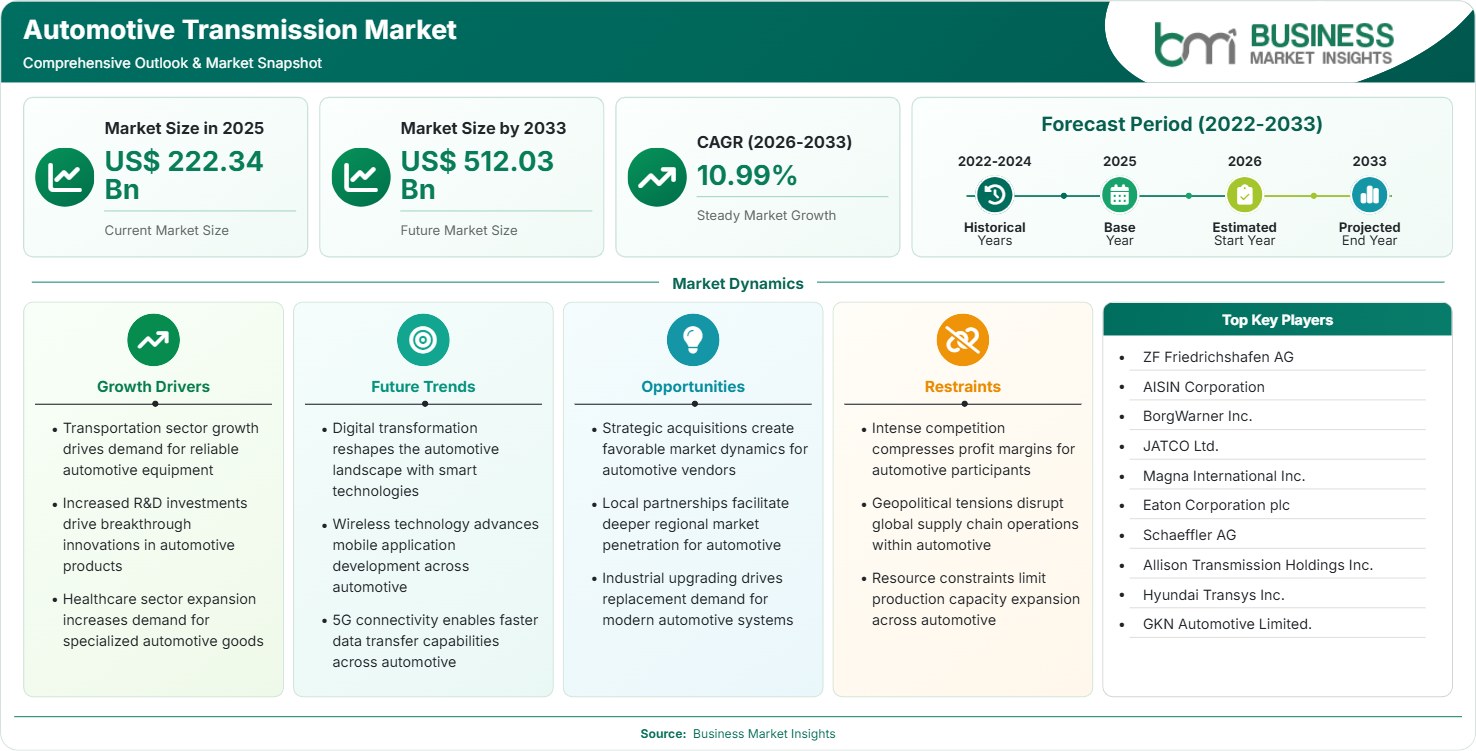
The Automotive Transmission Market size was valued at US$ 222.34 Billion in 2025 and is projected to reach US$ 512.03 Billion by 2033, growing at a CAGR of 10.99% during 2026–2033, driven by transmission electrification, rising automatic vehicle penetration, hybrid powertrain adoption, software-defined drivetrains, aftermarket demand, and investments in high-efficiency gearbox technologies across passenger and commercial vehicle platforms.

Report Coverage
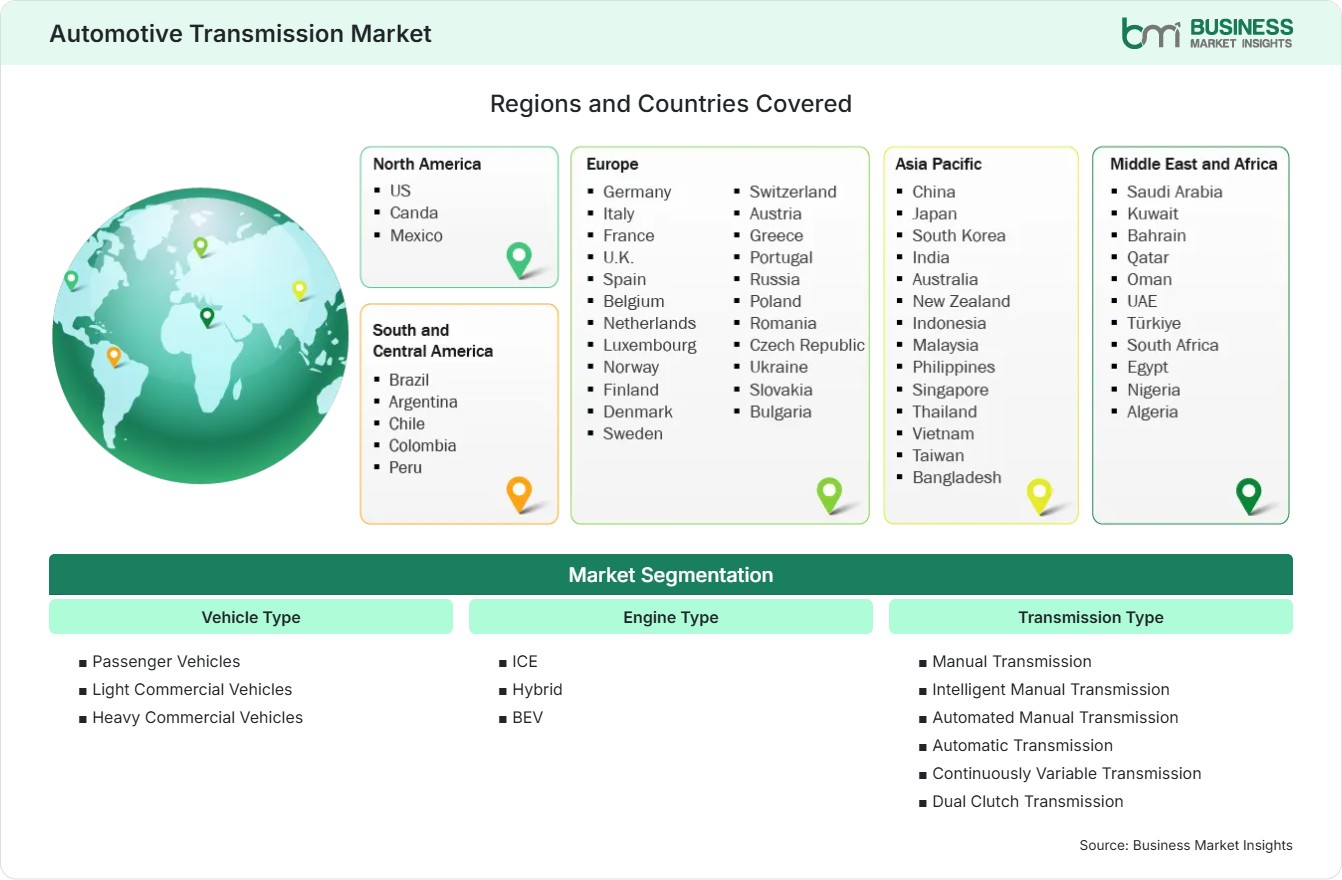
  • Vehicle Type: Passenger Vehicles , Light Commercial Vehicles, Heavy Commercial Vehicles
  • Engine Type: ICE, Hybrid, BEV
  • Transmission Type: Manual Transmission , Intelligent Manual Transmission , Automated Manual Transmission , Automatic Transmission , Continuously Variable Transmission , Dual Clutch Transmission
US$ 222.34 Bn Market size in 2025
US$ 512.03 Bn Market Size by 2033
10.99% CAGR, 2026 - 2033
2026-2033 Forecast Period

AI Overview

Automotive Transmission Market Summary

  • North America Region: North America holds a market share of 24%–27% in 2025, growing with a CAGR of 9.2%–10.0% through 2033. Demand is driven by pickup trucks, SUVs, hybridization, fleet modernization, advanced automatic gearboxes, commercial vehicle upgrades, fuel-economy standards, software-enabled transmissions, manufacturing localization, aftermarket expansion, and premium vehicle adoption. US market benefits from strong truck demand and transmission innovation, advancing at 9.4%–10.2% CAGR.
  • Fastest Growing Region: Asia Pacific holds a market share of 38%–41% in 2025 and advances at 12.3%–13.1% CAGR. Vehicle production scale, hybrid growth, EV integration, domestic manufacturing capacity, export competitiveness, supplier expansion, policy support, technology localization, affordability improvements, and mobility demand accelerate adoption.
  • Leading Segment: Passenger Vehicles account for 62%–66% of the Automotive Transmission Market share in 2025 and expand at 10.5%–11.3% CAGR. Urbanization, consumer comfort preferences, increasing automatic transmission penetration, premiumization, hybrid vehicle adoption, digital controls, efficiency improvements, higher vehicle ownership, and replacement demand support leadership.
  • High Growth Segment: BEV accounts for 16%–19% share in 2025 and expands at 14.2%–15.0% CAGR. Growth stems from electric mobility investments, e-axle integration, drivetrain simplification, emissions regulations, battery advancements, production incentives, software optimization, manufacturing scale-up, commercial electrification, and technological innovation.
  • Key Market Opportunity: Expansion of hybrid and electric drivetrain architectures creates opportunities for suppliers developing integrated e-transmissions, multi-speed electric gearboxes, power electronics integration, localized manufacturing, and next-generation software-controlled efficiency solutions.
  • Major Market Players: ZF Friedrichshafen AG, AISIN Corporation, BorgWarner Inc., JATCO Ltd., Magna International Inc., Eaton Corporation plc, Schaeffler AG, Allison Transmission Holdings Inc., Hyundai Transys Inc., GKN Automotive Limited.
Strategic Insights

Automotive Transmission Market: Strategic Insights

Automotive Transmission Market Strategic Framework
FREE PDF
Request your free sample
Request free sample
Stakeholder View

Key Takeaways

  • The ecosystem is becoming increasingly software-centric, with transmission suppliers integrating sensors, electronic control units, predictive shifting algorithms, and cloud-based diagnostics alongside conventional mechanical components.
  • Passenger vehicles remain the largest revenue contributor, while battery electric vehicle applications offer the strongest medium-term upside through demand for integrated reduction gear systems and e-drive modules.
  • Innovation is shifting toward multi-functional drivetrain architectures that combine transmission systems, electric motors, inverters, and thermal management units in compact packages.
  • Asia Pacific presents the most compelling regional investment environment due to its concentration of vehicle assembly capacity, component suppliers, and government-supported electrification programs.
  • Strategic acquisitions increasingly focus on power electronics, hybrid drivetrains, e-axles, and software capabilities as suppliers broaden technology portfolios beyond conventional gearboxes.
  • Commercial fleet operators are creating demand for automated manual transmissions and intelligent transmission management systems that optimize fuel consumption and reduce lifecycle operating costs.
Geographic Outlook

Automotive Transmission Market Regional Highlights

North America Automotive Transmission Market

North America accounted for 24% to 27% of worldwide revenues in 2025 and is projected to grow at a CAGR of 9.2% to 10.0% until 2033. The growing need for pickup trucks, SUVs, and commercial vehicles provides impetus for the application of advanced automatic transmissions. OEMs are constantly upgrading their conventional manual transmission systems to electronic ones. The Automotive Transmission Market share is driven by investments in manufacturing facilities in the US and Mexico, and by the production of hybrid vehicles, which contributes additional demand for high-efficiency gearbox platforms and localized supply chains.

  • Pickup and SUV dominance continues stimulating demand for high-torque automatic transmissions, particularly eight-speed and ten-speed systems across mainstream and premium vehicle categories.
  • Fleet operators increasingly deploy automated manual transmission technologies to improve fuel efficiency, reduce driver fatigue, and support predictive maintenance programs.
  • Hybrid vehicle manufacturing expansion encourages adoption of integrated transmission architectures designed for improved energy recovery and optimized power delivery.
  • Regional suppliers emphasize nearshoring and localization strategies to strengthen resilience against supply disruptions and logistics volatility.

US Automotive Transmission Market

The United States accounts for 76%–80% of North American demand and is projected to grow at 9.4%–10.2% CAGR. Automotive Transmission Market growth benefits from continued production of light trucks and strong consumer preference for automatic transmissions. Increased adoption of hybrid powertrains, investment in EV manufacturing, and modernization of commercial fleets support technology upgrades. Domestic suppliers and global manufacturers continue expanding engineering capabilities focused on intelligent drivetrain systems, software calibration, and improved fuel efficiency performance.

  • Demand for hybrid pickups and SUVs is increasing requirements for multi-mode transmission architectures integrating electric propulsion functionality.
  • Commercial fleet electrification programs support adoption of specialized reduction gear systems and digitally managed driveline solutions.
  • Advanced manufacturing facilities enhance domestic transmission component sourcing and reduce dependency on overseas supply chains.
  • Premium vehicle demand supports deployment of dual-clutch and high-performance automatic transmission technologies.

Europe Automotive Transmission Market

Europe accounted for 22%-25% of the share in 2025 and is forecast to grow at a CAGR of 9.8%-10.6%. The stringent emission regulations favor the implementation of fuel-efficient transmission systems in passenger cars and commercial vehicles. Germany dominates the regional market, and Eastern Europe continues to attract investments due to its manufacturing capability. France and Spain are supporting the production of hybrid cars, while Italy favors the transmission system of premium vehicle drivetrain demand. Electrification initiatives drive increasing adoption of integrated transmission and e-drive systems.

  • Germany leads regional revenue generation due to its concentration of premium automakers and transmission technology developers.
  • Poland, Hungary, and Slovakia attract supplier investments through competitive production costs and expanding vehicle assembly activities.
  • Hybrid vehicle penetration supports demand for electronically controlled automatic and dual-clutch transmission platforms.
  • Sustainability targets encourage manufacturers to reduce drivetrain losses and improve overall vehicle efficiency.
  • Premium automotive brands prioritize software-integrated transmissions delivering enhanced driving performance and responsiveness.

Asia Pacific Automotive Transmission Market

The Asia Pacific region holds the highest market share, ranging between 38% and 41% by 2025, and registers the highest CAGR of 12.3% to 13.1%. Countries such as China, Japan, India, and South Korea lead the region in manufacturing capabilities owing to well-established automobile manufacturing industries. An increase in vehicle ownership and urbanization, along with rising domestic manufacturing, drives demand for the product. The region is a leader in the use of both traditional and advanced drivetrain technologies.

  • China represents the largest national market due to extensive vehicle manufacturing capacity and rapid electrification investments.
  • India shows one of the strongest expansion trajectories, supported by rising automatic vehicle penetration and growing middle-class purchasing power.
  • Japan remains an innovation center for CVT, hybrid transmission, and drivetrain control technologies.
  • South Korean manufacturers advance integrated e-drive and transmission development for global automotive platforms.
  • Regional production scale strengthens cost competitiveness and encourages technology localization initiatives.

Rest of World Automotive Transmission Market

Rest of World contributes 10%–13% of demand and is forecast to grow at 10.5%–11.3% CAGR. South and Central America benefit from the gradual modernization of vehicle fleets and the expanding adoption of automatic transmissions.

The Middle East and Africa regions rely on infrastructure development, growth in commercial transport, and vehicle imports. Brazil is the main consumer in South America, whereas Saudi Arabia and the UAE are attracting investments tied to industrial diversity and mobility projects.

  • Brazil remains the leading South American market, driven by sizable vehicle production and rising adoption of automatic transmissions.
  • Mexico serves as a manufacturing and export hub supporting both regional and global vehicle programs.
  • GCC countries create opportunities for premium vehicles equipped with advanced automatic drivetrain systems.
  • Growing logistics sectors stimulate demand for commercial vehicles utilizing automated transmission technologies.
  • Infrastructure expansion supports fleet replacement activity and broader vehicle ownership growth.
Global Market Geography
FREE PDF
Request your free sample
Request free sample
Segment Analysis

Automotive Transmission Market Segmentation

Vehicle Type

The vehicle type segment captured a considerable share of market demand, with passenger vehicles accounting for 62% to 66% of the market by 2025 and growing at a CAGR of 10.5% to 11.3%. The Automotive Transmission Market scope is widening as consumers become more inclined towards comfort, efficiency, and innovative mobility solutions. Commercial vehicle operators are increasingly adopting automation technologies to enhance their performance.

  • Passenger Vehicles (Class A): Compact urban vehicles increasingly integrate automated and CVT systems to improve fuel economy, driving comfort, and compliance with emissions requirements.
  • Passenger Vehicles (Class B): Growing ownership levels and demand for affordable automatic vehicles support adoption of efficient transmission technologies across mass-market passenger cars.
  • Passenger Vehicles (Class C): Mid-sized vehicles increasingly incorporate advanced automatic and dual-clutch systems balancing efficiency, performance, and everyday drivability requirements.
  • Passenger Vehicles (Class D): Premium features and enhanced driving dynamics encourage greater deployment of intelligent and electronically controlled transmission solutions.
  • Passenger Vehicles (Class E): Luxury vehicle manufacturers emphasize smooth gear transitions, performance optimization, and integration with hybrid propulsion architectures.
  • Passenger Vehicles (Class M): Multi-purpose vehicles utilize transmission technologies optimized for passenger comfort, cargo flexibility, and mixed driving environments.
  • SUV: Strong global SUV demand drives adoption of high-torque automatic transmissions and hybrid-compatible driveline systems supporting varied terrain capabilities.
  • Light Commercial Vehicles: Fleet modernization and e-commerce logistics growth stimulate adoption of durable, fuel-efficient, and automated transmission technologies.
  • Heavy Commercial Vehicles: Automated manual transmission deployment increases as operators seek lower operating costs, reduced emissions, and enhanced vehicle productivity.

Engine Type

Engine Type segmentation is an outcome of changing trends in propulsion modes. While ICE-based technologies will continue to dominate the market at 58%–62% in 2025, there is increasing traction for electrification-based propulsion systems. Automotive Transmission Market trends show an increasing preference for solutions applicable to hybrid and electric technologies.

  • ICE: Internal combustion vehicles continue generating substantial transmission demand through global production volumes and established manufacturing infrastructure.
  • Hybrid: Hybrid powertrains require specialized transmission architectures enabling seamless transitions between electric and combustion operation while maximizing efficiency.
  • BEV: Battery electric vehicles encourage deployment of reduction gears and integrated e-drive systems emphasizing efficiency, compactness, and software control.

Transmission Type

Transmission Type still plays a crucial role in product innovations. Automatic Transmission dominates, with a share of 42%-46% in 2025 and a CAGR of 11.4%-12.2%, as consumers prioritize convenience and performance. Companies keep on improving electronics, shifting quality, energy efficiency, and compatibility with hybrid transmissions. The increasing popularity of automatic cars in developing countries also boosts demand.

  • Manual Transmission: Cost-effective solutions remain relevant in value-focused markets where affordability and mechanical simplicity influence purchasing decisions.
  • Intelligent Manual Transmission: Electronic control integration enhances efficiency while preserving familiar driving characteristics for selected commercial and passenger applications.
  • Automated Manual Transmission: Commercial fleet operators increasingly adopt AMTs for fuel savings, maintenance optimization, and improved driver productivity.
  • Automatic Transmission: Advanced multi-speed systems remain preferred for comfort, performance, and compatibility with evolving vehicle architectures.
  • Continuously Variable Transmission: CVTs maintain relevance through smooth power delivery, fuel efficiency improvements, and strong adoption in compact vehicles.
  • Dual Clutch Transmission: Performance-oriented applications utilize dual-clutch systems to achieve rapid shifts, improved acceleration, and enhanced drivetrain efficiency.
Market Forces

Automotive Transmission Market Dynamics

Key Market Drivers

Rising Adoption of Automatic and Intelligent Transmissions

Consumer tastes are increasingly shifting towards the automatic driving experience in both developed and developing nations. According to data from leading automakers, automatic transmissions have a larger market share than manual transmissions in most developed nations, whereas emerging economies are witnessing a rapid shift from manual to automatic transmissions. The use of highly efficient software helps improve fuel economy and meet emissions standards. Automotive companies have begun adopting automatic transmissions in their models, especially SUVs and luxury cars. Growth in the Automotive Transmission Market is driven by this shift in trends, creating demand for advanced gearbox manufacturing capacity, electronic controls, and transmission calibration services.

Expansion of Hybrid Vehicle Manufacturing Worldwide

Hybrid manufacturing continues to grow in North America, Europe, and Asia-Pacific as authorities seek to meet their emissions targets while consumers look for practical forms of electrification. According to the IEA electrification trends, the hybrid powertrain is gaining attention as an investment avenue due to its efficiency and use of current technology. Hybrid transmissions require the integration of electric motors and power management systems. Manufacturers with hybrid transmission platforms stand to benefit from broader applicability across various OEMs. This technological transition generates sustained demand for innovation, engineering services, and advanced manufacturing capabilities throughout the value chain.

Increasing Vehicle Production in Asia Pacific

Asia Pacific continues to be at the forefront of automobile manufacturing and component production. Taken together, China, India, Japan, and South Korea contribute significantly to global vehicle production. Growth in the size of the middle-class population, along with urbanization and export-based manufacturing, drives up demand for various types of transmissions. Regional companies are starting to focus on CVT, DCT, AMT, and electric drivetrain technologies. The Automotive Transmission Market shows that regional production scale will remain a decisive factor influencing capacity expansion, supplier partnerships, and long-term competitiveness across global automotive supply networks.

Key Market Opportunities

Integrated E-Transmission and E-Axle Platforms

The shift toward the electrification of transport offers the potential to integrate gears, electric drives, power electronics, and control systems on a single platform. These platforms provide better integration, improve packing, and make it easier to achieve manufacturing economies of scale. Increasingly, carmakers seek suppliers that can provide fully assembled drivetrain modules, not just individual parts. Automotive Transmission Market Forecasts show that investment in integrated e-drives is growing fast as vehicles become increasingly electrified. Suppliers that can integrate mechanics and electronics are likely to secure development agreements and partnerships.

Localization of Transmission Manufacturing

Automotive companies have now shifted towards minimizing their dependency on geographically focused supply chain operations. Recent investments in countries such as India, South-East Asia, Mexico, and Eastern Europe highlight an increased focus on localized component manufacturing. Localized manufacturing offers better responsiveness, reduced logistics costs, and greater resilience to disruptions. Such investments by companies are often encouraged by governments through industrial incentives and infrastructure programs. Localized manufacturing helps transmission production, enabling proximity to customers, faster product customization, and improved competitiveness in rapidly growing automotive markets.

Commercial Vehicle Fleet Modernization

Transportation service providers are upgrading their vehicle fleets to comply with emissions regulations and enhance their operational efficiency. Advanced manual transmissions, hybrid-capable transmissions, and smart driveline controls result in lower fuel consumption and reduced maintenance needs. The development of logistics, e-commerce logistics, and urban freight transport ensures that the need for replacement remains high. Companies producing reliable, smart transmissions for fleets have access to a growing global market for medium and heavy-duty trucks.

Market Restraints and Challenges

High Development Costs for Advanced Drivetrain Technologies

Factor: The development of hybrid-ready transmissions, software-controlled gear systems, and integrated e-drive technologies requires substantial expenditure on engineering, testing, validation, and manufacturing equipment. Impact: Smaller suppliers often face resource constraints that limit innovation pace and market participation. Long development cycles increase commercialization risk, while evolving regulatory requirements may necessitate additional redesign efforts. These challenges can delay product launches and pressure profitability, particularly in highly competitive segments where OEMs continuously demand improved efficiency, lower weight, and greater functionality.

Growing Shift Toward Simpler BEV Drivetrains

Factor: Many battery electric vehicles utilize single-speed reduction gear systems rather than complex multi-speed transmissions. Impact: This architectural simplification can reduce content value per vehicle for suppliers focused on conventional transmission products. As BEV adoption increases, companies dependent on traditional gearbox technologies may face declining demand in specific segments. Suppliers must adapt portfolios toward integrated e-drive modules, software-enabled powertrain systems, and electrification-focused solutions to preserve long-term revenue potential and strategic relevance.

Company Analysis

Competitive Landscape

The Automotive Transmission Market analysis highlights competition focused on electrification readiness, transmission efficiency, software integration, manufacturing scale, and strategic partnerships with global vehicle manufacturers.

Company Name

Overview

Products and Services relevant to this market

ZF Friedrichshafen AG

Global driveline and chassis technology leader serving passenger and commercial vehicle manufacturers across multiple regions.

Automatic transmissions, hybrid transmissions, automated manual transmissions, commercial vehicle drivetrain systems, and e-mobility technologies.

AISIN Corporation

Major automotive supplier with extensive transmission manufacturing footprint and strong OEM relationships worldwide.

Automatic transmissions, CVTs, hybrid transmission systems, e-axles, powertrain modules, and drivetrain technologies.

BorgWarner Inc.

Automotive technology provider focused on drivetrain efficiency, electrification, and transmission component innovation.

Dual-clutch modules, transmission components, e-drive systems, clutch technologies, and hybrid propulsion solutions.

JATCO Ltd.

Specialist transmission manufacturer recognized for large-scale CVT development and production capabilities.

Continuously variable transmissions, automatic transmissions, hybrid-compatible systems, and electrified driveline technologies.

Magna International Inc.

Diversified mobility supplier providing vehicle systems, powertrain solutions, and electrification technologies.

Transmission assemblies, e-drive systems, drivetrain modules, and vehicle integration services.

Eaton Corporation plc

Industrial and mobility technology company serving global commercial vehicle markets.

Automated manual transmissions, transmission components, clutch systems, and fleet efficiency solutions.

Schaeffler AG

Engineering company with expertise in motion technologies, powertrains, and electrified mobility platforms.

Transmission components, bearings, hybrid modules, e-axles, and drivetrain systems.

Allison Transmission Holdings Inc.

Leading supplier focused on commercial vehicle automatic transmission technologies.

Fully automatic transmissions, propulsion solutions, electrified vehicle systems, and aftermarket services.

Hyundai Transys Inc.

South Korean automotive systems supplier serving domestic and international vehicle manufacturers.

Automatic transmissions, dual-clutch transmissions, e-powertrain systems, and drivetrain solutions.

GKN Automotive Limited

Global driveline specialist concentrating on advanced propulsion and mobility technologies.

E-drive systems, transmission technologies, axle solutions, and electrified drivetrain components.

Trust & Transparency

Research Methodology

The market analysis combines proprietary research with secondary data from government agencies, company disclosures, regulatory filings, industry databases and expert interviews. Market estimates are validated through data triangulation, cross-market benchmarking and analyst review.

View Full Research Methodology

Questions Answered

Frequently Asked Questions

What insights does this Automotive Transmission Market Report provide?

This Market Report provides analysis of regional demand patterns, technology evolution, segment performance, competitive positioning, growth opportunities, and strategic developments shaping future industry expansion.

Which region offers the strongest long-term manufacturing potential?

Asia Pacific offers the strongest potential due to vehicle production scale, supplier concentration, government support for electrification, and rising domestic vehicle demand across major economies.

How are commercial vehicles influencing industry development?

Commercial fleets increasingly adopt automated manual and intelligent transmission systems to reduce fuel consumption, improve driver productivity, and meet stricter emissions requirements.

What role do hybrid vehicles play in transmission demand?

Hybrid vehicles require specialized transmission architectures integrating electric motors and power management systems, creating higher value opportunities for suppliers capable of delivering advanced drivetrain solutions.

Which transmission technology is gaining the strongest momentum across passenger vehicles?

Automatic and dual-clutch transmissions are gaining the strongest traction due to consumer demand for convenience, fuel efficiency improvements, and compatibility with hybrid powertrains. Electronic control advancements further strengthen adoption.

Access the Full Automotive Transmission Market Report

Get segment-level forecasts, regional estimates, competitive benchmarking, company profiles and downloadable Excel datasets.

Access the full Automotive Transmission Market Report
350 pages PDF & Excel | 2026-08-31
Similar Research

Related Market Reports