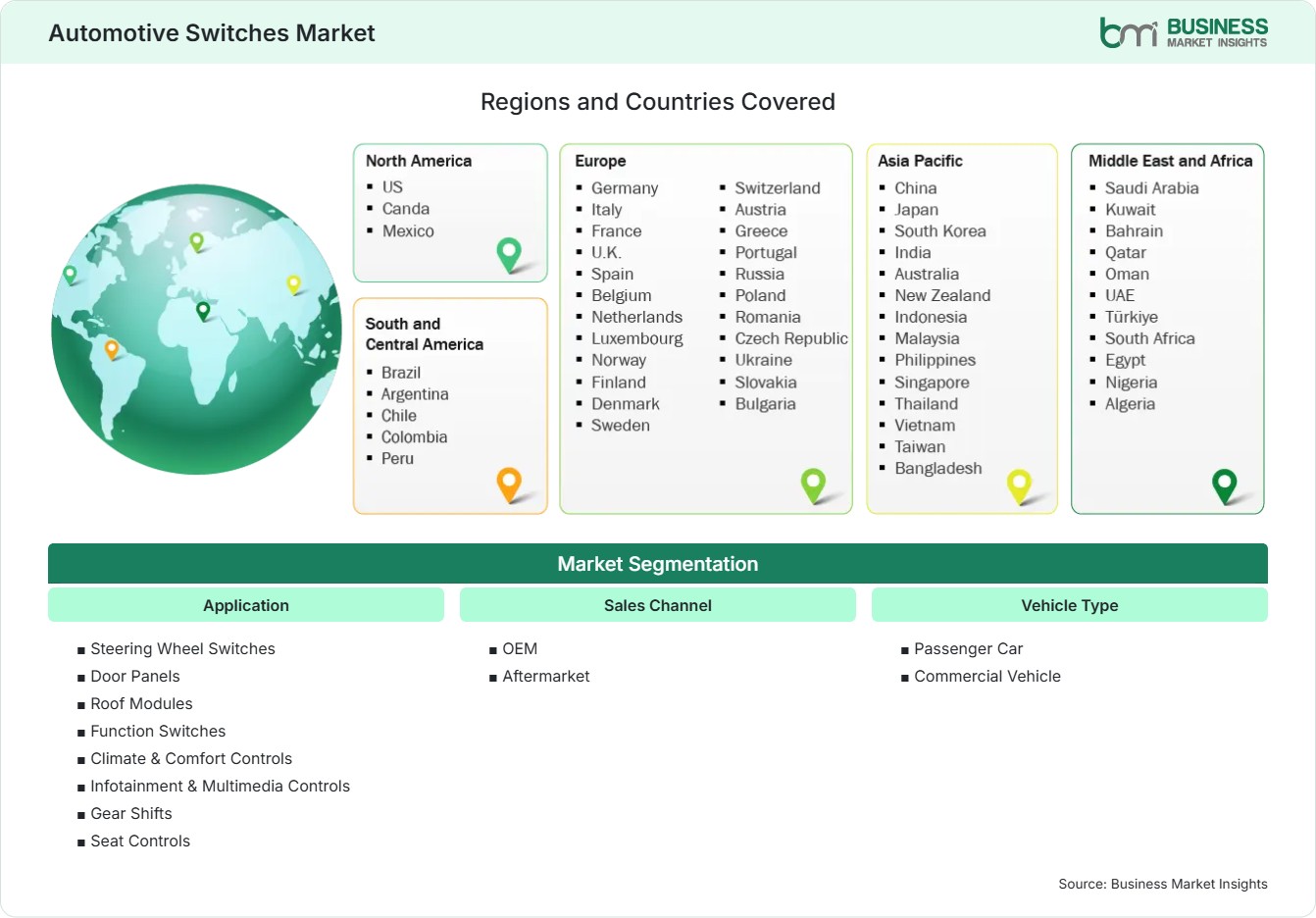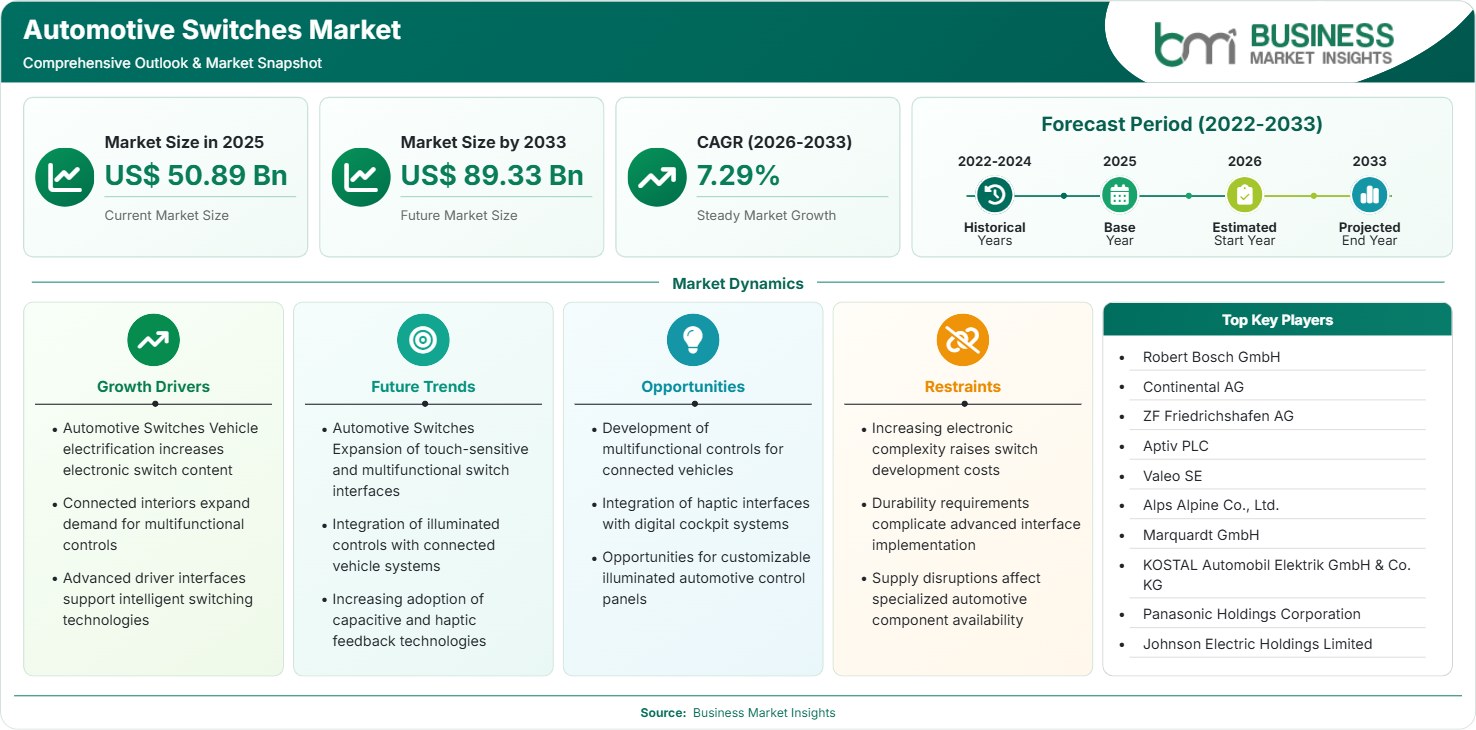
Automotive Switches Market Regional Highlights
North America Automotive Switches Market
North America accounts for a 17%–20% share in 2025, with a 6.8%–7.5% CAGR through 2033. Demand stems from electronic content, premium vehicles, connected cockpits, and electric vehicle production. Market share is aided by existing partnerships with OEMs and technology providers of components. Production in the United States meets regional demand, while Mexico contributes to production capacity. Opportunities in the supply chain lie with control integration, robust switch design, intelligent interiors, and electronic modules for complex passenger and commercial vehicle programs.
- Because premium cars are equipped with ever more advanced steering, climate, seat, and infotainment controls, the cost of the components increases, and this in turn causes suppliers to incorporate illumination, electronics, haptics, and sensing into compact assemblies.
- Since automotive control systems need to be redesigned, there has been a demand for low-power interfaces, simpler wiring, tactile controls, and multifunction switches that are compatible with digitally managed vehicle systems.
- Mexico offers manufacturing advantages due to its well-established automotive supply chains, its close proximity to the North American original equipment manufacturer plants, its favorable labor economics, and its growing abilities in electronics assembly.
- The requirements relating to automotive safety and reliability give preference to suppliers who have validated designs, can provide traceability, have carried out environmental testing, ensure electromagnetic compatibility, and possess well-established production quality systems.
US Automotive Switches Market
The US represents a major portion of regional demand, with 74%–78% of North American Automotive Switches Market share in 2025 and a 6.9%–7.6% CAGR through 2033. The market is driven by premiumization, connected interiors, electric vehicle investments, and an abundance of vehicle parc. The OEM supply chain focuses on quality, platform compatibility, durability, and scalability. Aftermarket demand creates the opportunity to replace switches for use in steering wheels, doors, seats, climate control, and infotainment units.
- Increasingly, US original equipment manufacturers are requiring integrated cockpit controls that combine physical operation with digital interfaces, thus providing opportunities for suppliers who are able to support software-linked functions and configurable electronic architectures.
- The need for replacements is still relevant since older vehicles still have mechanical and electromechanical controls, and the repair networks need compatible parts for the steering, the doors, the HVAC system, the seating, and the convenience features.
- The investment made in the production of electric vehicles helps to establish new specifications for components, especially compact controls, which are designed with simplified electrical architectures and greater electronic functionality.
Europe Automotive Switches Market
Europe holds a 23%–27% share in 2025, growing at a 6.7%–7.4% CAGR through 2033. Germany remains the leading regional manufacturing base, while France, Italy, and Spain sustain sizeable vehicle production. The Automotive Switches Market benefits from premium interiors, stringent quality expectations, electrification, and advanced vehicle platforms.
- German OEMs have engineering ecosystems that enable the production of advanced switches for use in steering, climate control, seating, doors, and infotainment, thereby generating demand for highly integrated and accurately validated components.
- Poland and central Europe gain the advantages of electronics manufacturing, the localization of automotive suppliers, competitive production economics, and their close proximity to major vehicle assembly clusters.
- The policies regarding electrification in Europe promote investment in EV platforms by having the traditional controls be redesigned to suit digital vehicle architectures and to reduce the amount of wiring.
- The trend towards premium products increases the demand for interfaces that are illuminated, tactile, ergonomic, and multifunctional to enable different cabin experiences.
Asia Pacific Automotive Switches Market
Asia Pacific holds a 49%–53% share in 2025, expanding at a 7.8%–8.6% CAGR through 2033. China leads regional volume, while Japan remains important for advanced component engineering. India and Southeast Asia offer faster expansion as manufacturing localization accelerates. The Automotive Switches Market share reflects high vehicle production, expanding EV sales, competitive electronics manufacturing, and rising installation of comfort, infotainment, and safety functions across passenger vehicles.
- China achieves high levels of vehicle production alongside a strong capability in electronics manufacturing, enabling large-scale switching programs and the rapid adoption of multifunction controls in connected and electric vehicles.
- India is building up its automotive electronics ecosystem, which is opening up possibilities for local switch production, for the aftermarket sector, and for export-oriented manufacturing.
- Japan is still a market oriented towards the use of technology, and when choosing suppliers reliability, miniaturization, precision and long-term cycle performance are taken into account.
- Since manufacturers are looking to set up regional supply chains for automotive electronics and interior components, production centres in Southeast Asia offer opportunities for diversification.
Rest of World Automotive Switches Market
Rest of World represents a 4%–7% Automotive Switches Market share in 2025, growing at a 6.4%–7.3% CAGR through 2033. South and Central America benefit from expanding vehicle fleets and manufacturing activity, while the Middle East and Africa demand is supported by commercial vehicles, premium imports, replacement components, and developing service networks.
- Brazil has the most developed manufacturing base in the region and meets the demand from both original equipment manufacturers and the aftermarket for switches in applications involving passenger and commercial vehicles.
- Mexico still holds a strategic importance for supply chains on the continent, as it provides export-oriented production of components and integrates with North American vehicle programs.
- In the Gulf region there is a preference for premium interiors and for replacing components since vehicles there are high in value, the conditions under which they operate are severe, and there is a strong demand for comfort technologies.
- The situation in African markets is more focused on after-market services, which provides opportunities for durable replacement switches and components that are suitable for a range of operating environments.