
Automotive Rubber Seals Market Outlook: Size, Share, Trends, Growth Analysis, Competitive Landscape & Forecast, 2026-2033

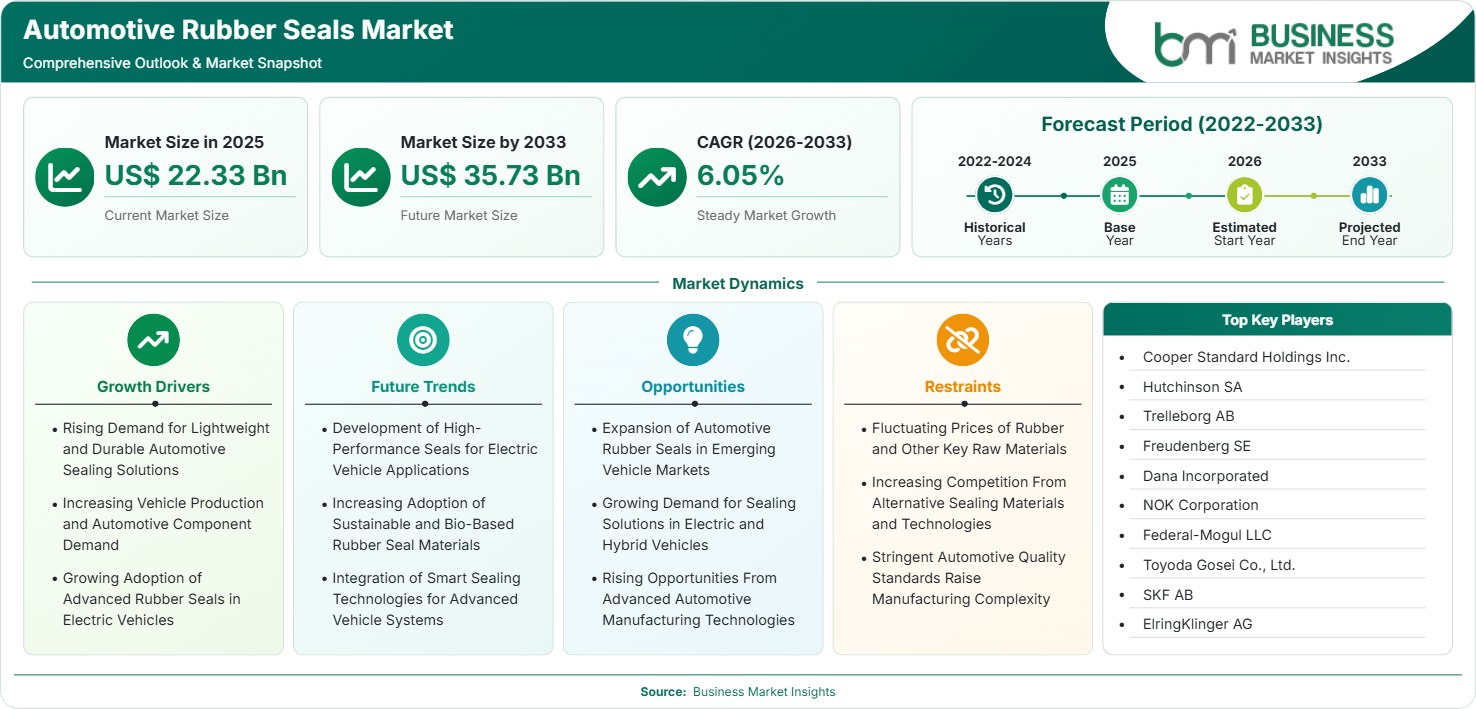
The Automotive Rubber Seals Market size was valued at US$ 22.33 billion in 2025 and is projected to reach US$ 35.73 billion by 2033, growing at a CAGR of 6.05% during 2026–2033, driven by vehicle production, lightweight sealing requirements, electric vehicle adoption, advanced manufacturing, and demand for durable thermal and fluid management systems.

Report Coverage
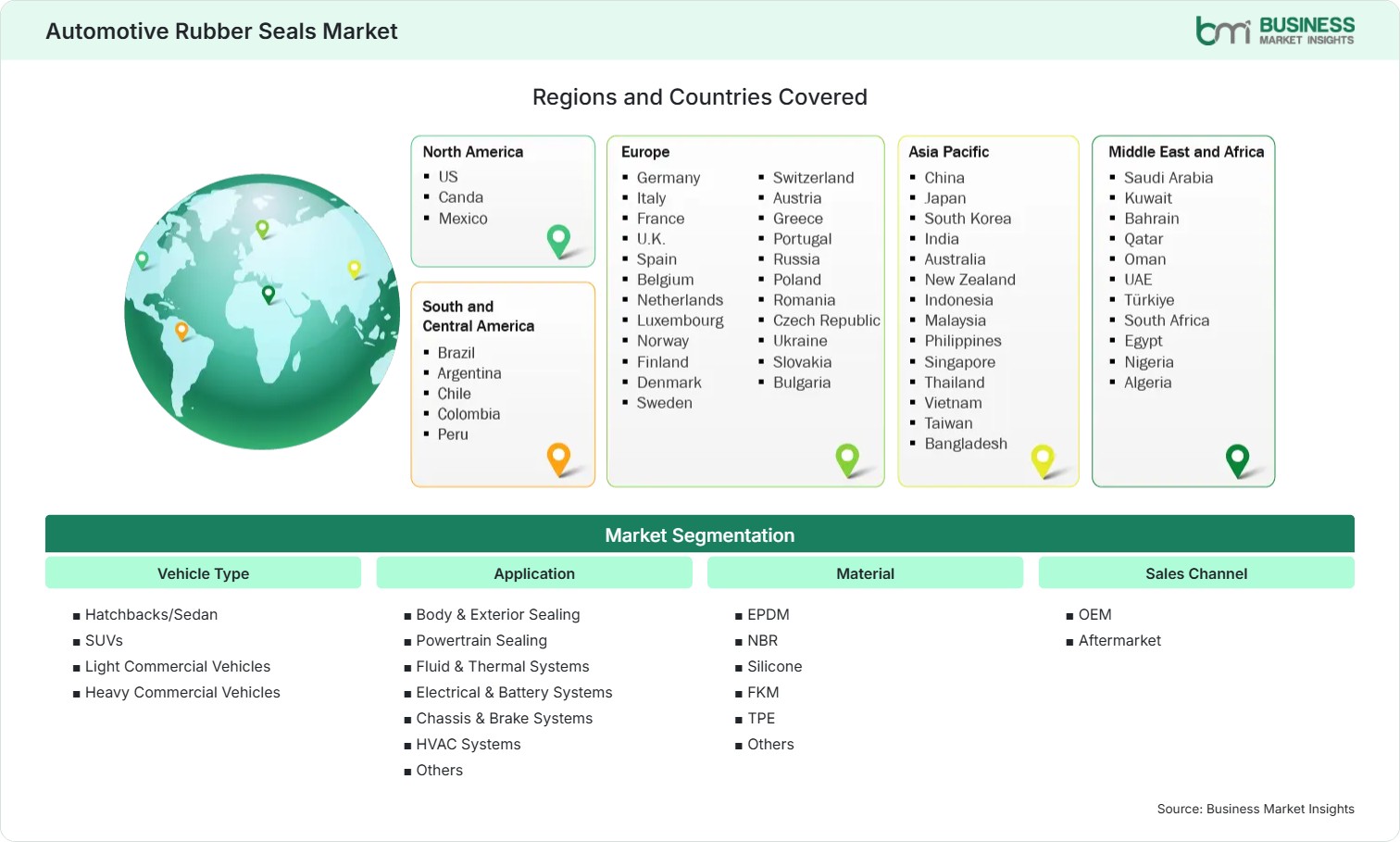
  • Vehicle Type: Hatchbacks/Sedan, SUVs, Light Commercial Vehicles, Heavy Commercial Vehicles
  • Application: Body & Exterior Sealing, Powertrain Sealing, Fluid & Thermal Systems, Electrical & Battery Systems, Chassis & Brake Systems, HVAC Systems, Others
  • Material: EPDM, NBR, Silicone, FKM, TPE, Others
  • Sales Channel: OEM, Aftermarket
US$ 22.33 Bn Market size in 2025
US$ 35.73 Bn Market Size by 2033
6.05% CAGR, 2026 - 2033
2026-2033 Forecast Period

AI Overview

Automotive Rubber Seals Market Summary

  • North America Region: North America held a 24%–28% share in 2025, growing at a CAGR of 5.5%–6.5%, supported by vehicle production, EV manufacturing, stringent sealing performance requirements, and replacement demand. The US market is expanding at a CAGR of 5.7%–6.7%, supported by domestic vehicle manufacturing, EV investments, and increasing demand for durable seals across powertrain, battery, and body applications.
  • Fastest Growing Region: Asia Pacific held a 43%–47% share in 2025, growing at a CAGR of 7.0%–8.0%, driven by high vehicle production, expanding EV manufacturing, automotive component localization, and increasing demand for advanced sealing technologies across China, India, Japan, and South Korea.
  • Leading Segment: Body & Exterior Sealing held a 30%–34% share in 2025, growing at a CAGR of 5.5%–6.5%, supported by rising vehicle production, weather protection requirements, acoustic performance, and increasing demand for durable exterior sealing systems.
  • High Growth Segment: Electrical & Battery Systems held a 9%–13% share in 2025, growing at a CAGR of 9.0%–10.0%, supported by EV battery protection, thermal management, electrical insulation, and growing demand for water and dust-resistant vehicle architectures.
  • Key Market Opportunity: Electric and hybrid vehicle production is creating new sealing requirements around battery packs, charging systems, thermal circuits, electrical connections, and lightweight vehicle structures, expanding opportunities for specialized rubber compounds and engineered sealing profiles.
  • Major Market Players: Cooper Standard Holdings Inc., Hutchinson SA, Trelleborg AB, Freudenberg SE, Dana Incorporated, NOK Corporation, Federal-Mogul LLC, Toyoda Gosei Co., Ltd., SKF AB, and ElringKlinger AG.
Strategic Insights

Automotive Rubber Seals Market: Strategic Insights

Automotive Rubber Seals Market Strategic Framework
FREE PDF
Request your free sample
Request free sample
Stakeholder View

Key Takeaways

  • The value chain comprises artificial rubber and elastomer producers, compound designers, profile producers, seal system providers, auto component makers, OEMs, and aftermarket distributors, while material formulation continues to be a competitive edge.
  • Electrical and battery systems provide the strongest incremental growth opportunity as EV platforms require specialized sealing against water, dust, vibration, thermal cycling, and chemical exposure.
  • Product innovation is moving toward lightweight profiles, advanced EPDM compounds, thermoplastic elastomers, silicone solutions, and application-specific designs that improve durability while reducing material usage.
  • Asia Pacific provides the strongest volume opportunity because of its large automotive manufacturing base, expanding EV production, localized component supply chains, and growing vehicle ownership.
  • Strategic partnerships between sealing specialists, material suppliers, Tier 1 automotive companies, and EV manufacturers are becoming increasingly important for developing application-specific sealing systems.
  • Aftermarket demand remains relevant for aging vehicle fleets, but OEM programs provide stronger opportunities for suppliers capable of meeting long qualification cycles and increasingly stringent performance requirements.
Geographic Outlook

Automotive Rubber Seals Market Regional Highlights

North America Automotive Rubber Seals Market

North America accounted for a 24%–28% share in 2025 and is projected to grow at a CAGR of 5.5%–6.5% through 2033. The region benefits from established automotive manufacturing capabilities, expanding electric vehicle production, and demand for advanced sealing systems. Automotive Rubber Seals Market share is supported by the US, which represents the largest regional opportunity. Increasing EV investments are creating new requirements for battery and electrical sealing applications.

  • Vehicle manufacturing: Established automotive production and replacement demand continue supporting consumption of sealing systems across body, powertrain, HVAC, chassis, and fluid management applications.
  • EV manufacturing: Increasing electric vehicle production is creating demand for specialized seals that protect battery enclosures, charging systems, electrical connections, and thermal management components.
  • Performance requirements: Vehicle manufacturers increasingly require seals capable of maintaining performance under temperature variation, vibration, moisture, chemicals, and prolonged environmental exposure.
  • Aftermarket demand: A substantial installed vehicle base supports replacement requirements for weatherstripping, engine seals, HVAC components, and other rubber sealing products across passenger and commercial vehicles.

US Automotive Rubber Seals Market

The US represented a 21%–25% share in 2025 and is expected to expand at a CAGR of 5.7%–6.7% through 2033. Domestic vehicle production, EV manufacturing investment, and demand for advanced automotive components support regional growth. The US Automotive Rubber Seals Market share is increasingly influenced by electrification, as battery systems and electrical architectures introduce new requirements for protection against moisture, dust, vibration, and thermal stress.

  • EV investment: Expanding EV manufacturing capacity is increasing opportunities for specialized sealing products used in battery systems, thermal circuits, electrical connectors, and charging infrastructure.
  • OEM demand: Automotive OEMs increasingly seek lightweight and durable sealing components that can improve vehicle performance while meeting demanding environmental and acoustic requirements.
  • Component innovation: Suppliers are developing specialized elastomer formulations and engineered profiles designed to withstand higher temperatures, chemical exposure, vibration, and changing vehicle architectures.
  • Replacement market: Aging vehicles and continued maintenance requirements provide steady aftermarket demand for body, powertrain, HVAC, and fluid sealing components.

Europe Automotive Rubber Seals Market

Europe automotive rubber seals market held a 21%–25% share in 2025 and is projected to grow at a CAGR of 5.0%–6.0% through 2033. Germany leads regional demand, while France and Italy remain important automotive manufacturing centers. Germany is projected to grow at a CAGR of 5.2%–6.2%, while France is expected to expand at 5.0%–6.0%. Vehicle electrification, sustainability requirements, and advanced automotive manufacturing are shaping regional demand.

  • Germany's automotive manufacturing ecosystem supports demand for sophisticated sealing systems across passenger vehicles, commercial vehicles, EVs, and advanced powertrain architectures.
  • France's transition toward vehicle electrification is creating opportunities for specialized sealing systems used in batteries, electrical systems, thermal management, and charging-related components.
  • Italy's established automotive component industry provides opportunities for sealing manufacturers serving OEMs, Tier 1 suppliers, and specialized vehicle applications.
  • European sustainability priorities are encouraging manufacturers to improve material efficiency, extend product durability, and investigate lower-impact materials and manufacturing processes.

Asia Pacific Automotive Rubber Seals Market

Asia Pacific represented a 43%–47% share in 2025 and Asia Pacific Automotive Rubber Seals Market forecast to grow at a CAGR of 7.0%–8.0% through 2033. China dominates regional demand, while India represents a high-growth opportunity. China is projected to grow at a CAGR of 7.0%–8.0%, whereas India is expected to expand at 8.0%–9.0%. High vehicle production, EV manufacturing, and component localization support regional expansion.

  • China's large vehicle manufacturing base generates substantial demand for sealing products across passenger cars, commercial vehicles, EVs, and automotive component supply chains.
  • India's expanding automotive production and increasing EV adoption are creating opportunities for suppliers offering cost-effective, durable, and application-specific rubber sealing systems.
  • Japan and South Korea provide strong demand through established automotive OEMs, advanced component manufacturing, and sophisticated EV and hybrid vehicle development.
  • Southeast Asian production hubs are attracting automotive manufacturing investments, creating opportunities for sealing suppliers as regional component supply chains become increasingly localized.

Rest of World Automotive Rubber Seals Market

South and Central America Automotive Rubber Seals Market accounted for a 7%–9% share in 2025 and are projected to grow at a CAGR of 4.5%–5.5% through 2033, led by Brazil and Mexico. Middle East and Africa represented a 5%–7% share and are expected to grow at a CAGR of 4.0%–5.0%, with Saudi Arabia and the UAE offering emerging opportunities.

  • Brazil's automotive manufacturing and replacement vehicle markets support demand for sealing components across passenger vehicles, commercial vehicles, powertrain systems, and body applications.
  • Mexico's integration with North American automotive supply chains creates opportunities for manufacturers supplying OEM and Tier 1 customers with localized sealing components.
  • Saudi Arabia's industrial diversification and emerging automotive manufacturing initiatives may increase future demand for locally supplied components, including specialized sealing products.
  • The UAE's commercial vehicle, logistics, and aftermarket sectors support demand for replacement seals, particularly across fleet operations exposed to demanding operating conditions.
Global Market Geography
FREE PDF
Request your free sample
Request free sample
Segment Analysis

Automotive Rubber Seals Market Segmentation

Vehicle Type

Hatchbacks/Sedan held a 45%–49% share in 2025 and are projected to grow at a CAGR of 5.5%–6.5% during 2026–2033. SUVs are gaining share as global consumer preferences shift toward larger vehicles, while commercial vehicles require durable sealing systems for demanding operating conditions. Automotive Rubber Seals Market growth continues expanding as electrification introduces new requirements across passenger and commercial vehicle architectures.

  • Hatchbacks/Sedan: High production volumes support demand for body, exterior, HVAC, powertrain, and electrical seals, while electrified passenger models create additional battery-related opportunities.
  • SUVs: Increasing SUV production drives demand for larger and more complex sealing profiles across doors, windows, tailgates, body openings, HVAC, and underbody applications.
  • Light Commercial Vehicles (LCVS): LCVs require durable sealing solutions for frequent operation, cargo protection, HVAC systems, and powertrain components, supporting demand across OEM and replacement channels.
  • Heavy Commercial Vehicles (HCVs): HCV applications emphasize long service life and resistance to vibration, temperature, chemicals, and demanding operating conditions across powertrain and chassis systems.

Application

Body & Exterior Sealing held a 30%–34% share in 2025 and is projected to grow at a CAGR of 5.5%–6.5% during 2026–2033. Electrical and battery systems are expanding faster as EV adoption increases. Thermal, fluid, HVAC, chassis, and brake applications provide additional opportunities as manufacturers seek improved durability, noise control, weather resistance, and system protection.

  • Body & Exterior Sealing: Seals protect vehicle interiors from water, dust, wind, and noise while supporting door, window, trunk, hood, and exterior body applications.
  • Powertrain Sealing: Powertrain seals prevent leakage and contamination across engines, transmissions, drivetrains, and related components operating under temperature and pressure variations.
  • Fluid & Thermal Systems: Sealing systems support coolant, lubricant, and thermal circuits, helping maintain system integrity across conventional and electrified vehicle architectures.
  • Electrical & Battery Systems: EVs require specialized seals for battery enclosures, connectors, charging components, and electrical systems exposed to moisture, dust, vibration, and thermal cycling.
  • Chassis & Brake Systems: Seals protect braking and chassis components against contaminants while supporting reliable operation under vibration, mechanical stress, and environmental exposure.
  • HVAC Systems: HVAC seals prevent air and refrigerant leakage, supporting climate control efficiency and occupant comfort across conventional and electric vehicles.
  • Others: Additional applications include steering, suspension, fuel systems, and specialized vehicle components requiring protection from contamination, leakage, vibration, or environmental exposure.

Material

EPDM held a 42%–46% global Automotive Rubber Seals Market share in 2025 and is projected to grow at a CAGR of 5.5%–6.5% during 2026–2033. EPDM remains widely used for exterior sealing because of weather resistance, while silicone, FKM, NBR, and TPE serve specialized temperature, chemical, fluid, and lightweighting requirements.

  • EPDM (Ethylene Propylene Diene Monomer): EPDM provides strong resistance to weathering, ozone, and temperature variation, making it widely suitable for doors, windows, body openings, and exterior sealing.
  • NBR (Nitrile Butadiene Rubber): NBR offers strong resistance to oils and fuels, supporting applications involving automotive fluids, powertrain systems, and selected under-hood sealing requirements.
  • Silicone: Silicone performs effectively across broad temperature ranges and supports demanding applications requiring thermal stability, flexibility, and long-term performance.
  • FKM (Fluoroelastomer): FKM provides strong resistance to high temperatures, chemicals, and aggressive fluids, making it suitable for demanding powertrain and specialized automotive applications.
  • TPE (Thermoplastic Elastomer): TPE combines rubber-like flexibility with thermoplastic processing advantages, supporting lightweight designs, recyclability considerations, and efficient automotive profile manufacturing.
  • Others: Additional materials serve specialized sealing requirements where specific combinations of chemical resistance, temperature stability, flexibility, durability, or cost performance are required.

Sales Channel

OEM held a 74%–78% share in 2025 and is projected to grow at a CAGR of 5.8%–6.8% during 2026–2033. OEM demand benefits from new vehicle production and increasing component integration, while aftermarket sales remain supported by vehicle aging and replacement requirements.

  • OEM: OEM channels dominate through direct supply relationships with vehicle manufacturers and Tier 1 suppliers, requiring strict quality, durability, validation, and delivery standards.
  • Aftermarket: The aftermarket serves replacement requirements for worn or damaged seals across body, HVAC, powertrain, fluid, and other vehicle applications.
Market Forces

Automotive Rubber Seals Market Dynamics

Key Market Drivers

Rising Demand for Lightweight and Durable Automotive Sealing Solutions

The automobile industry continues to reduce weight of cars, while simultaneously requesting seals which will be able to function in more severe conditions for more time. Manufacturers are creating materials which are thinner, light-weighted and durable due to new elastomers used and design improvements. Light-weighting is especially significant because carmakers are trying to increase fuel economy and the range of travel of their products. Besides, seals should endure heat/cold cycles, vibration, humidity, ozone, chemicals and compression cycles. This combination of requirements is encouraging innovation in EPDM, TPE, silicone, and specialized compounds.

Increasing Vehicle Production and Automotive Component Demand

Automotive manufacturing is constantly driving demand for sealing systems used in body, power train, HVAC, chassis, and fluid applications. An increase in car production drives an increase in the amount of rubber seals per car manufactured, while more intricate designs might lead to increased numbers and types of seals needed. SUVs manufacturing, commercial vehicles manufacturing, and automotive manufacturing in developing markets are providing new opportunities in terms of volume. This supports demand for both standardized sealing products and application-specific engineered solutions.

Growing Adoption of Advanced Rubber Seals in Electric Vehicles

EV architectures necessitate the addition of battery packs, high voltage electronics, charging systems, and advanced thermal management circuits which need specific protection measures. There is an increasing need for seals that offer protection against water, dust, vibration, contact with coolants, and thermal cycling while ensuring the integrity of electrical insulation and mechanical enclosure. The design of EVs further require for sealing products that help with light weighting and miniaturization. Battery enclosures and electrical connectors are new fields of application compared to traditional powertrains. Companies with the ability to test materials in high voltage and thermal applications can position themselves in EV platform development programs and establish long-term relationships with OEMs.

Key Market Opportunities

Expansion of Automotive Rubber Seals in Emerging Vehicle Markets

Emerging automotive markets provide opportunities in automotive rubber seals market as vehicle production, ownership, and component manufacturing expand. Growing local production in India, Southeast Asia, Latin America, and selected Middle Eastern markets is increasing demand for sealing products across passenger and commercial vehicles. Suppliers can benefit by establishing regional manufacturing and distribution capabilities that reduce logistics costs and improve responsiveness to OEM customers. Localization also creates opportunities to develop products adapted to regional climate conditions and vehicle platforms.

Growing Demand for Sealing Solutions in Electric and Hybrid Vehicles

The rise of electric vehicles and hybrid cars is opening up opportunities for advanced sealing technology in areas such as batteries, electrical connections, thermal systems, charging systems, and electronic controls. Such systems will require sealants that can handle factors like humidity, dust, coolants, vibrations, and changes in temperature. Companies can take advantage of growth opportunities through the creation of unique chemical formulations and sealing profiles targeted to electrified platforms. Collaboration with battery makers, Tier 1 suppliers, and automakers could ensure early design-in wins.

Rising Opportunities from Advanced Automotive Manufacturing Technologies

Advanced manufacturing technologies are creating opportunities to improve the consistency, complexity, and customization of automotive sealing products. Automated extrusion, precision molding, digital process monitoring, and advanced quality control can support tighter tolerances and more complex profiles. Manufacturers can also use simulation and digital engineering to optimize sealing performance before physical production. These capabilities are valuable as vehicle architectures become more compact and electrified systems require precise enclosure protection.

Market Restraints and Challenges

Fluctuating Prices of Rubber and Other Key Raw Materials

Factor: Prices of natural rubber, synthetic elastomers, specialty chemicals, carbon black, and other inputs can fluctuate because of energy costs, supply disruptions, weather conditions, and changes in global demand. Impact: Volatile input costs can compress manufacturer margins and make long-term pricing difficult, particularly under fixed OEM supply contracts. Producers may need to renegotiate pricing or absorb cost increases when contracts do not provide adequate adjustment mechanisms. Companies with diversified sourcing, efficient inventory management, and strong procurement capabilities can reduce exposure.

Increasing Competition from Alternative Sealing Materials and Technologies

Factor: The automotive industry is beginning to consider thermoplastics, innovative polymers, adhesives, liquid seals, and sealing systems as alternatives to traditional rubber elements. Impact: There will be less opportunity for growth due to competition in certain applications where there will be advantages in reduced weight, simpler assembly, better recyclability, or component integration. Electric vehicles will speed up the process as automotive companies begin to change their systems and require fewer parts. Rubber seal producers have to prove their superior longevity, cost-effectiveness, and durability.

Company Analysis

Competitive Landscape

The Automotive Rubber Seals Market analysis reflects competition among global sealing specialists, diversified automotive suppliers, elastomer technology companies, and component manufacturers. Competitive positioning depends on material expertise, profile design, OEM qualification, manufacturing scale, geographic reach, and the ability to develop application-specific products.

Company Name

Overview

Products and Services relevant to this market

Cooper Standard Holdings Inc.

Automotive supplier specializing in sealing, fluid handling, and body systems for global vehicle manufacturers.

Body sealing, weatherstrips, fluid handling systems, EV sealing, and engineered automotive rubber components.

Hutchinson SA

Global automotive supplier with extensive expertise in sealing, vibration control, and fluid management technologies.

Automotive seals, weatherstripping, battery sealing, thermal management, and elastomer-based components.

Trelleborg AB

Engineered polymer company serving automotive and industrial markets with advanced sealing technologies.

Automotive sealing systems, elastomer profiles, fluid seals, polymer solutions, and engineered components.

Freudenberg SE

Diversified technology group with strong expertise in sealing and automotive material solutions.

Automotive seals, elastomer components, sealing profiles, vibration control, and specialized polymer technologies.

Dana Incorporated

Automotive supplier focused on drivetrain, thermal management, and sealing technologies for conventional and electrified vehicles.

Sealing products, thermal management systems, drivetrain components, and EV-related sealing technologies.

NOK Corporation

Japanese manufacturer specializing in sealing products and precision components for automotive applications.

Oil seals, O-rings, automotive sealing systems, precision rubber components, and fluid sealing solutions.

Federal-Mogul LLC

Automotive component supplier with historical expertise across sealing and powertrain-related systems.

Engine seals, gaskets, powertrain sealing components, and automotive aftermarket sealing products.

Toyoda Gosei Co., Ltd.

Japanese automotive supplier producing rubber and plastic components for vehicle manufacturers.

Weatherstrips, automotive sealing products, rubber components, interior and exterior polymer systems.

SKF AB

Global engineering company providing bearings, seals, lubrication, and rotating equipment technologies.

Automotive seals, oil seals, sealing systems, elastomer solutions, and related engineering services.

ElringKlinger AG

Automotive supplier specializing in sealing, thermal shielding, battery components, and lightweight solutions.

Gaskets, sealing systems, battery components, thermal management, and electrification-related sealing technologies.

Trust & Transparency

Research Methodology

The market analysis combines proprietary research with secondary data from government agencies, company disclosures, regulatory filings, industry databases and expert interviews. Market estimates are validated through data triangulation, cross-market benchmarking and analyst review.

View Full Research Methodology

Questions Answered

Frequently Asked Questions

Which automotive applications offer the strongest future opportunities?

Electrical and battery systems offer strong future potential because EV adoption is creating new sealing requirements.

Why is the aftermarket important for rubber seal manufacturers?

The aftermarket provides recurring demand because seals deteriorate through aging, compression, temperature exposure, and environmental conditions.

What is driving demand for advanced sealing materials in automotive rubber seals market report?

Vehicle manufacturers increasingly require materials that combine lightweighting, durability, temperature resistance, chemical resistance, and long service life.

How are EVs changing automotive sealing requirements?

EVs introduce battery packs, high-voltage systems, charging interfaces, and thermal management circuits requiring specialized sealing against water, dust, vibration, coolant, and temperature cycling.

Why is EPDM widely used in automotive sealing?

EPDM offers strong resistance to ozone, weathering, moisture, and temperature variation, making it suitable for exterior applications such as door seals, window seals, weatherstrips, and body openings.

Access the Full Automotive Rubber Seals Market Report

Get segment-level forecasts, regional estimates, competitive benchmarking, company profiles and downloadable Excel datasets.

Access the full Automotive Rubber Seals Market Report
350 pages PDF & Excel | 2026-08-06
Similar Research

Related Market Reports