
Rubber Track Market Outlook: Size, Share, Trends, Growth Analysis, Competitive Landscape & Forecast, 2026-2033

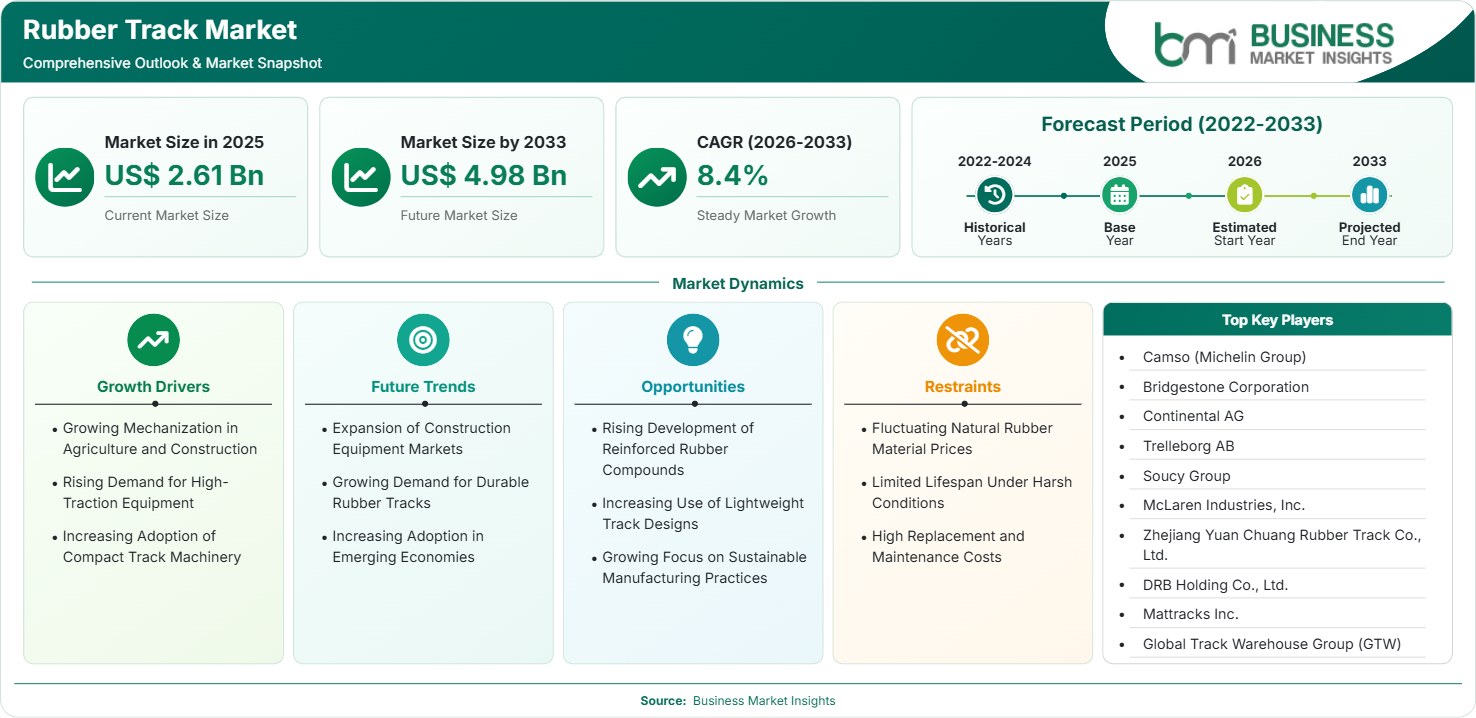
The Rubber Track Market size was valued at USD 2.61 Billion in 2025 and is projected to reach USD 4.98 Billion by 2033, growing at a CAGR of 8.4% during 2026–2033. Market expansion is driven by increasing mechanization in agriculture and construction, rising demand for high-traction equipment, and growing adoption of compact track machinery. Opportunities are emerging through reinforced rubber compounds, lightweight track designs, and sustainable manufacturing practices.

Report Coverage
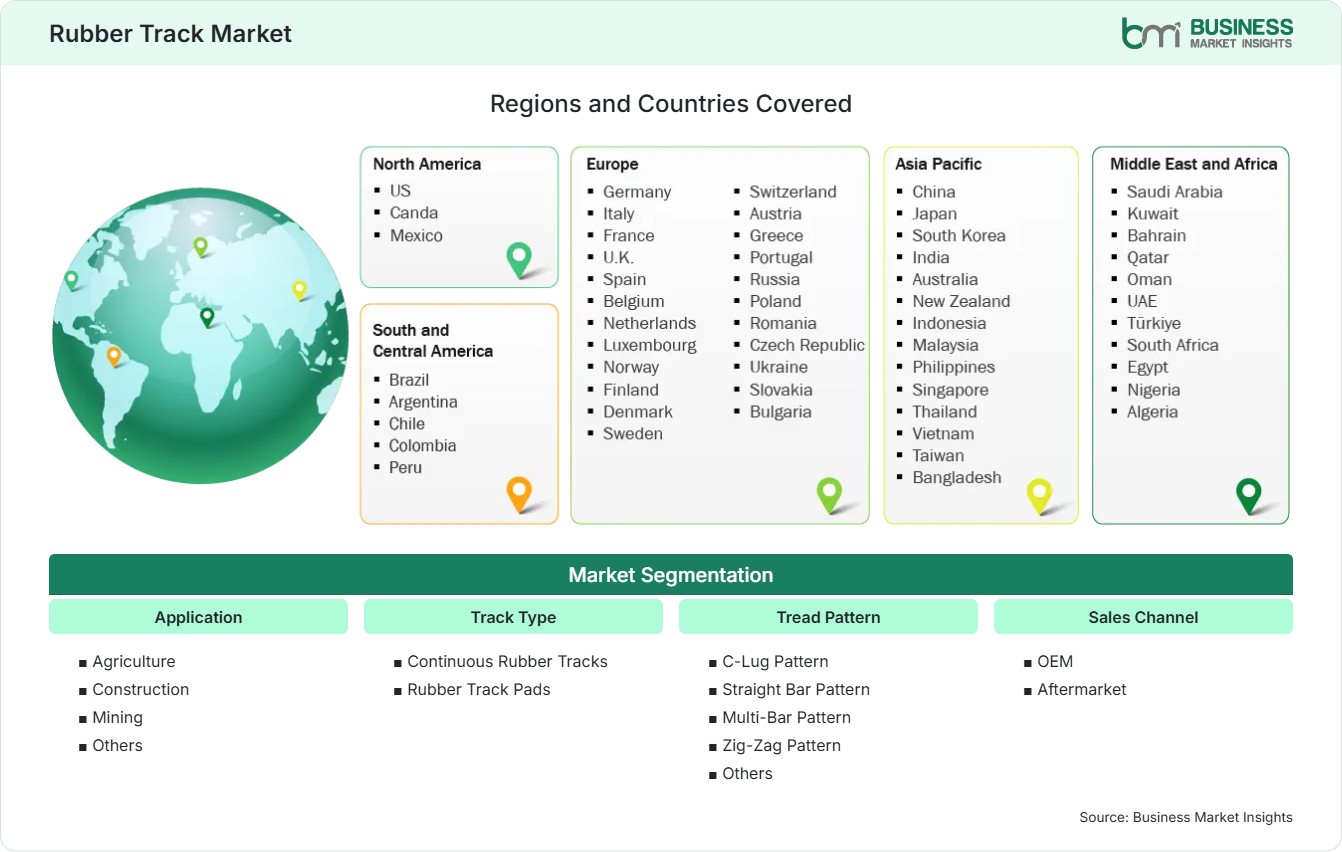
  • Application: Agriculture, Construction, Mining, Others
  • Track Type: Continuous Rubber Tracks, Rubber Track Pads
  • Tread Pattern: C-Lug Pattern, Straight Bar Pattern, Multi-Bar Pattern, Zig-Zag Pattern, Others
  • Sales Channel: OEM, Aftermarket
US$ 2.61 Bn Market size in 2025
US$ 4.98 Bn Market Size by 2033
8.4% CAGR, 2026 - 2033
2026-2033 Forecast Period

AI Overview

Rubber Track Market Summary

  • North America Region: North America holds 34%–37% market share in 2025 and is projected to grow at a CAGR of 7.9%–8.4% during 2026–2033. Strong agricultural mechanization, infrastructure investments, and replacement demand for compact equipment support market expansion. The U.S. market continues benefiting from fleet modernization and aftermarket demand, registering a CAGR of 8.0%–8.5% through the forecast period.
  • Fastest Growing Region: Asia Pacific accounts for 28%–31% market share in 2025 and is expected to expand at a CAGR of 9.2%–9.8% during 2026–2033. Rapid construction activity, farm mechanization, domestic equipment manufacturing, and government infrastructure programs continue accelerating adoption across emerging economies.
  • Leading Segment: Agriculture represents 42%–45% market share in 2025 while advancing at a CAGR of 8.1%–8.6%. Higher demand for soil-friendly mobility, reduced ground pressure, and improved traction during field operations continue to support segment leadership.
  • High Growth Segment: Aftermarket accounts for 38%–41% market share in 2025 and is forecast to grow at a CAGR of 9.0%–9.6% through 2033. Frequent replacement cycles, expanding installed equipment bases, and increasing maintenance requirements are strengthening long-term demand.
  • Key Market Opportunity: Continuous innovation in reinforced elastomer materials, lightweight composite track construction, recyclable rubber formulations, and predictive maintenance technologies is creating attractive opportunities for manufacturers serving agriculture, construction, and mining equipment.
  • Major Market Players: Michelin Group (Camso), Bridgestone Corporation, Continental AG, Trelleborg AB, Soucy Group, McLaren Industries, Inc., Zhejiang Yuan Chuang Rubber Track Co., Ltd., DRB Holding Co., Ltd., Mattracks Inc., and Global Track Warehouse Group (GTW).
Strategic Insights

Rubber Track Market: Strategic Insights

Rubber Track Market Strategic Framework
FREE PDF
Request your free sample
Request free sample
Stakeholder View

Key Takeaways

  • The value chain is becoming increasingly integrated as rubber compound suppliers, reinforcement material manufacturers, OEMs, and aftermarket distributors collaborate to improve product durability, supply chain efficiency, and lifecycle performance for heavy-duty tracked equipment.
  • The strongest growth opportunities are concentrated in compact construction equipment and high-horsepower agricultural machinery, where operators increasingly prefer rubber tracks over conventional tires to improve traction, reduce soil compaction, and enhance productivity.
  • Innovation is focused on reinforced rubber compounds, advanced steel-cord integration, lightweight composite structures, optimized tread geometries, and predictive maintenance technologies that extend service life while lowering operating costs.
  • Asia Pacific presents the most attractive long-term investment opportunity due to expanding infrastructure projects, increasing farm mechanization, rising domestic equipment manufacturing, and supportive government initiatives promoting modern agricultural and construction machinery.
  • Strategic partnerships between OEMs and track manufacturers, investments in automated production facilities, and expansion of global aftermarket distribution networks are strengthening competitive positioning while improving product availability across high-growth regions.
  • Sustainability is emerging as a key differentiator, with manufacturers investing in recyclable rubber materials, energy-efficient production technologies, and environmentally responsible sourcing to comply with evolving environmental regulations and customer expectations.
Geographic Outlook

Rubber Track Market Regional Highlights

North America Rubber Track Market

North America accounted for approximately 34%–37% of global revenue in 2025 and is projected to expand at a CAGR of 7.9%–8.4% during 2026–2033. The Rubber Track Market share remains the highest globally owing to extensive mechanized farming, strong construction equipment demand, and a mature aftermarket ecosystem. Equipment fleet modernization and replacement demand continue supporting stable market expansion across the region.

  • High adoption of compact track loaders, skid steer loaders, and agricultural tractors continues driving replacement demand for premium rubber tracks with enhanced durability and traction performance.
  • Federal infrastructure investments and commercial construction activity encourage equipment fleet expansion, increasing OEM installations and aftermarket replacement opportunities across construction applications.
  • Advanced manufacturing capabilities and established dealer networks enable rapid product availability while supporting adoption of high-performance reinforced rubber track technologies.
  • Increasing preference for low-ground-pressure equipment in agriculture promotes wider deployment of rubber track systems that minimize soil compaction and improve operational efficiency.
  • Continuous investment in sustainable manufacturing and advanced elastomer technologies strengthens product innovation while improving service life and reducing lifecycle costs.

US Rubber Track Market

The United States represented 27%–30% of global revenue in 2025 and is expected to register a CAGR of 8.0%–8.5% through 2033. Strong agricultural mechanization, infrastructure upgrades, mining activity, and a large installed base of compact construction machinery continue supporting both OEM and aftermarket demand.

  • Expanding adoption of precision agriculture encourages investment in tracked machinery capable of improving field productivity while reducing soil disturbance.
  • Growth in residential, commercial, and transportation infrastructure projects increases utilization of compact tracked construction equipment across diverse applications.
  • A well-established aftermarket distribution network supports timely replacement, maintenance, and customization of rubber tracks for multiple equipment categories.
  • Continuous technological advancements in reinforced track materials improve durability, operational efficiency, and total cost of ownership for equipment operators.

Europe Rubber Track Market

Europe held approximately 24%–27% of the global market in 2025 and is forecast to grow at a CAGR of 7.8%–8.3% through 2033. Increasing sustainable farming practices, advanced agricultural equipment adoption, and infrastructure modernization continue supporting regional demand. Germany leads regional revenue, while Poland is projected to record the fastest growth with a CAGR of 8.8%–9.3%.

  • Modern agricultural practices continue increasing demand for tracked tractors and harvesting equipment that improve efficiency while preserving soil quality.
  • Infrastructure renovation projects support higher utilization of compact tracked construction machinery across urban and transportation developments.
  • OEMs continue introducing lightweight and fuel-efficient tracked equipment to comply with stringent environmental regulations and customer productivity requirements.
  • Expanding aftermarket service networks improve product accessibility while supporting long-term replacement demand across agricultural and industrial sectors.
  • Research into recyclable elastomers and sustainable manufacturing processes encourages product innovation throughout the European value chain.

Asia Pacific Rubber Track Market

Asia Pacific accounted for 28%–31% of global revenue in 2025 and is expected to record the fastest Rubber Track Market growth with a CAGR of 9.2%–9.8% through 2033. China remains the largest regional market, while India is anticipated to register the highest growth at a CAGR of 9.8%–10.4%, supported by rapid industrialization, infrastructure expansion, and increasing mechanization.

  • Rising government investments in transportation, irrigation, and smart agriculture continue stimulating demand for tracked machinery across multiple industries.
  • Domestic equipment manufacturers are expanding production capacity, increasing regional demand for OEM-installed rubber tracks and replacement components.
  • Rapid urbanization and mining development create sustained demand for compact tracked equipment operating in challenging terrain conditions.
  • Increasing adoption of technologically advanced farming equipment strengthens long-term replacement opportunities across the agricultural sector.
  • Competitive manufacturing costs and expanding export capabilities position the region as a major production hub for global rubber track suppliers.

Rest of World Rubber Track Market

Rest of World represented 9%–11% of global revenue in 2025 and is anticipated to expand at a CAGR of 8.3%–8.9% during the forecast period.

South & Central America continue experiencing steady demand driven by agricultural expansion, mining investments, and mechanized farming, with Brazil leading regional growth at a CAGR of 8.5%–9.0%.

The Middle East & Africa benefit from infrastructure development, mining operations, and government-supported agricultural modernization. Saudi Arabia is projected to achieve the highest regional CAGR of 8.9%–9.4% through 2033.

  • Mining expansion across Latin America increases utilization of tracked heavy equipment capable of operating efficiently under demanding environmental conditions.
  • Government initiatives supporting food security and mechanized agriculture encourage wider adoption of tracked machinery across emerging economies.
  • Infrastructure and industrial development projects increase deployment of compact tracked construction equipment in urban and remote locations.
  • Growing aftermarket networks improve availability of replacement tracks and maintenance services, supporting equipment reliability and operational continuity.
  • Rising investments in sustainable industrial equipment create opportunities for manufacturers offering durable, lightweight, and environmentally responsible rubber track solutions.
Global Market Geography
FREE PDF
Request your free sample
Request free sample
Segment Analysis

Rubber Track Market Segmentation

Application

The Application segment represents the largest revenue contributor, driven by expanding use of tracked equipment across agriculture, construction, and mining industries. This segment accounted for approximately 42%–45% market share in 2025 and is projected to grow at a CAGR of 8.2%–8.7% through 2033. Increasing equipment utilization, fleet modernization, and higher operational efficiency requirements continue expanding the Rubber Track Market scope across multiple end-use sectors.

  • Agriculture: Agricultural machinery remains the largest application owing to increasing mechanization, precision farming adoption, and demand for reduced soil compaction. Rubber tracks enhance traction, minimize field damage, and improve operational efficiency across tractors, combines, and harvesting equipment.
  • Construction: Construction applications continue expanding due to growing deployment of compact track loaders, excavators, and crawler equipment. Superior stability, flotation, and maneuverability on uneven terrain make rubber tracks suitable for urban infrastructure and residential projects.
  • Mining: Mining operators increasingly utilize tracked machinery for material handling and excavation in challenging environments. Rubber tracks improve equipment mobility, reduce ground disturbance, and support efficient operations in surface mining and quarrying activities.

Track Type

Track Type remains a critical product differentiation segment as manufacturers focus on improving durability, wear resistance, and operational performance. The segment contributed approximately 36%–39% market share in 2025 and is anticipated to register a CAGR of 8.5%–9.0% during the forecast period. Continuous product innovation and higher replacement demand continue supporting growth across both OEM and aftermarket channels.

  • Continuous Rubber Tracks: These tracks dominate demand because of their superior durability, excellent traction, lower vibration levels, and ability to distribute equipment weight evenly across soft and uneven terrain.
  • Rubber Track Pads: Rubber track pads are increasingly adopted for construction and roadwork applications where surface protection, reduced noise, and improved operator comfort are essential during equipment operation.

Tread Pattern

Tread pattern selection significantly influences traction performance, equipment stability, wear characteristics, and operating efficiency across different terrain conditions. The segment accounted for nearly 18%–21% market share in 2025 and is expected to grow at a CAGR of 8.3%–8.8% through 2033. Advancements in tread engineering continue improving productivity while extending service life for heavy-duty equipment.

  • C-Lug Pattern: Designed for agricultural applications requiring superior traction and efficient self-cleaning characteristics, improving performance on muddy fields while reducing slippage during intensive farming operations.
  • Straight Bar Pattern: Widely used in construction machinery operating on hard surfaces, offering balanced traction, improved durability, and uniform wear under demanding working conditions.
  • Multi-Bar Pattern: Provides enhanced stability and smoother operation across mixed terrain applications, making it suitable for versatile construction, landscaping, and utility equipment.
  • Zig-Zag Pattern: Optimized for applications requiring enhanced grip, reduced vibration, and improved maneuverability, particularly in environments involving frequent directional changes and variable ground conditions.

Sales Channel

The Sales Channel segment continues evolving with OEM partnerships and expanding aftermarket service networks supporting long-term market development. This segment represented approximately 39%–42% market share in 2025 and is forecast to grow at a CAGR of 8.6%–9.1% through 2033. Increasing replacement frequency, broader dealer networks, and digital parts distribution platforms continue strengthening Rubber Track Market trends across global equipment fleets.

  • OEM: Original equipment manufacturers continue integrating high-performance rubber tracks into new machinery, ensuring optimized compatibility, factory-certified quality, and enhanced equipment reliability for end users.
  • Aftermarket: The aftermarket is experiencing robust expansion due to increasing installed equipment bases, routine replacement requirements, wider product availability, and growing customer preference for cost-effective maintenance solutions.
Market Forces

Rubber Track Market Dynamics

Key Market Drivers

Growing Mechanization in Agriculture and Construction

The increasing use of machines in agriculture and construction sectors is among the key driving forces behind the Rubber Track Market. Agriculturists are switching from regular wheeled machines to tracked machines to increase their productivity, prevent soil compaction and work effectively under varied climatic conditions. Further, construction contractors are buying compact track loaders, excavators, and crawler machines that can work on soft surfaces without damaging them. As per the report published by Food and Agriculture Organization (FAO), the growing mechanization of agriculture in developing nations is contributing towards the increased adoption of equipment. At the same time, the infrastructure spending of the governments around the world is boosting the demand for construction equipment.

Rising Demand for High-Traction Equipment

The demand for high traction equipment is constantly increasing in such fields as agriculture, mining, logging, and infrastructure works when it becomes necessary for the equipment to operate stably and efficiently under difficult conditions. Rubber tracks have an advantage over tires by providing better ground contact, higher flotation capability, lower vibration levels, and greater manoeuvrability. The equipment owners are seeking for the solutions that would decrease the down time of the equipment operation, as well as increase the efficiency of the fuel use and operator comfort. The popularity of compact construction equipment and precision agriculture equipment ensures the continuing demand for advanced rubber tracks.

Increasing Adoption of Compact Track Machinery

Compact track machinery is experiencing high adoption owing to the versatility of these machines in various applications such as construction in urban areas, landscaping, farming, utility maintenance, and material handling. Contractors have shown preference for compact track machinery because these machines provide more traction, less ground pressure, and better performance in tight spaces than wheel-mounted machinery. The rubber track market growth is aided by the increasing demand for rental equipment and upgrading of infrastructures, which require compact machines to work throughout the year.

Key Market Opportunities

Rising Development of Reinforced Rubber Compounds

Ongoing developments in elastomer technology present possibilities for producing more durable rubber tracks that are also highly resistant to heat, flexible, and capable of carrying loads better. Compounds reinforced through the use of modern polymers, steel cords, and synthetic fibers increase durability while reducing wear. Those companies that focus on material development are very likely to be able to distinguish themselves through their product range as far as high-performing materials that can be used in agriculture, construction, and mining are concerned.

Increasing Use of Lightweight Track Designs

The development of light-weight rubber tracks is another potential avenue due to their ability to increase fuel economy, lower equipment weight, and increase maneuverability without reducing operational capabilities. Modern machinery producers are cooperating with producers of advanced composite materials to produce stronger but lighter components. Such development allows machinery operators to decrease operating expenses without decreasing productivity in different types of terrains. Further involvement of OEMs in the production of light-weight track systems will generate additional income streams for companies developing new products.

Growing Focus on Sustainable Manufacturing Practices

Sustainability efforts have been transforming the approach to production methods in the rubber sector because of the use of recyclable materials and energy-saving production methods, as well as environmentally sound production practices. Regulatory focus on cutting down emissions and waste creation has spurred efforts towards adopting more sustainable manufacturing processes. This optimistic scenario, as seen in Rubber Track Market Forecasts, shows that companies able to balance sustainability requirements with durable products will be gaining competitive advantages.

Market Restraints and Challenges

Fluctuating Natural Rubber Material Prices

Factor: The cost of natural rubber is significantly affected by climatic conditions, political factors, disruption in the supply chain, productivity from plantations, and movements in the global commodity market. Impact: The volatility in the cost of raw materials impacts margin adversely and affects the overall procurement planning as well as the pricing aspect of the products in the OEM and aftermarket segments. The challenge for manufactures remains to offer competitive pricing along with high-quality products.

Limited Lifespan Under Harsh Conditions

Factor: Constant exposure to abrasion due to rough surfaces, sharp rocks, harsh temperatures, excessive weight, and chemical aggression contributes to faster wear of rubber tracks, although constant advancements have been made in material science. Impact: The lower lifespan leads to increased maintenance needs, downtime, and increased costs of replacing the rubber track for end users in harsh mining, construction, and industrial applications. This prompts buyers to look into the lifecycle costs before investing in superior rubber tracks, thereby putting pressure on manufacturers.

Company Analysis

Competitive Landscape

The competitive landscape is characterized by continuous investments in advanced rubber formulations, automated manufacturing, and strategic collaborations with original equipment manufacturers (OEMs). Rubber Track Market analysis indicates that leading companies are strengthening their global presence through product innovation, expansion of aftermarket distribution networks, and sustainable manufacturing initiatives to address evolving customer requirements across agriculture, construction, and mining applications.

Company Name

Overview

Products and Services Relevant to this Market

Michelin Group (Camso)

Global leader in off-road mobility solutions with extensive expertise in engineered rubber track technologies.

Continuous rubber tracks, OEM track systems, agricultural tracks, construction tracks, aftermarket replacement solutions.

Bridgestone Corporation

Diversified tire and rubber manufacturer offering durable track systems for heavy-duty equipment worldwide.

Rubber tracks, crawler systems, agricultural equipment tracks, compact construction tracks, replacement products.

Continental AG

International automotive and industrial technology company with advanced elastomer engineering capabilities.

High-performance rubber tracks, industrial track solutions, reinforced compounds, mobility technologies, OEM support.

Trelleborg AB

Global engineered polymer solutions provider serving agricultural and industrial equipment manufacturers.

Agricultural rubber tracks, engineered polymer components, specialty track systems, mobility solutions.

Soucy Group

Canadian manufacturer specializing in innovative rubber track technologies for off-road vehicles.

Continuous rubber tracks, undercarriage systems, OEM engineering, agricultural and construction track solutions.

McLaren Industries, Inc.

U.S.-based manufacturer serving construction, forestry, and industrial equipment markets.

Rubber tracks, over-the-tire track systems, aftermarket replacement products, undercarriage components.

Zhejiang Yuan Chuang Rubber Track Co., Ltd.

Chinese manufacturer supplying rubber track products for global agricultural and construction machinery markets.

Rubber tracks, compact equipment tracks, crawler tracks, OEM and replacement solutions.

DRB Holding Co., Ltd.

South Korean manufacturer producing industrial rubber products and engineered track systems.

Rubber tracks, industrial track solutions, heavy equipment tracks, reinforced rubber products.

Mattracks Inc.

Manufacturer specializing in rubber track conversion systems for utility and specialty vehicles.

Track conversion systems, all-terrain rubber tracks, utility vehicle mobility solutions.

Global Track Warehouse Group (GTW)

Global distributor specializing in replacement undercarriage components for heavy equipment.

Aftermarket rubber tracks, undercarriage components, replacement parts, maintenance support services.

Industry Activity

Recent Developments

July 2026

Continental sells ContiTech to lone star funds and become a pure-play tire manufacturer. Continental will also continue to strengthen its capital structure. Lone Star Funds will take over all of ContiTech’s business operations worldwide.

May 2026

Titan International expanding its product portfolio with the launch of Titan Rubber Tracks, marking its entry into the rubber track market, a move long anticipated by customers. Titan Rubber Tracks represent a new product category for the brand, extending its trusted capabilities beyond wheels and tires.

December 2025

Bridgestone Corporation announced the expansion of its flagship Potenza ultra-high performance tire line with the introduction of the Potenza RE-71RZ extreme summer performance tire, engineered specifically for grassroots racing.

April 2024

ZC Rubber Showcases construction tire portfolio at INTERMAT 2024. The ZHONGCE Rubber Group stand in hall 5A Stand number B076 is displayed a wide variety of products including tires from our WESTLAKE & TIANLI ranges and tracks from YONGGU ranges.

Trust & Transparency

Research Methodology

The market analysis combines proprietary research with secondary data from government agencies, company disclosures, regulatory filings, industry databases and expert interviews. Market estimates are validated through data triangulation, cross-market benchmarking and analyst review.

View Full Research Methodology

Questions Answered

Frequently Asked Questions

What does a market report typically include?

A comprehensive Rubber Track Market Report provides market size estimates, growth forecasts, regional analysis, competitive benchmarking, segmentation, emerging technology trends, recent developments, and strategic recommendations for industry stakeholders.

What are the major opportunities for manufacturers?

Manufacturers can benefit from developing reinforced rubber compounds, lightweight track designs, recyclable materials, and sustainable manufacturing technologies that improve product performance and environmental compliance.

Which application segment accounts for the largest market share?

The agriculture segment holds the largest share owing to increasing adoption of tracked tractors, harvesters, and other machinery that improve productivity while minimizing soil compaction.

Which region dominates the Market?

North America leads the global market due to its highly mechanized agricultural sector, mature construction equipment industry, strong OEM presence, and extensive aftermarket replacement network.

What is driving demand in the Rubber Track Market?

Growing mechanization across agriculture and construction, increasing demand for high-traction equipment, expanding infrastructure projects, and wider adoption of compact tracked machinery are the primary factors supporting market growth.

Access the Full Rubber Track Market Report

Get segment-level forecasts, regional estimates, competitive benchmarking, company profiles and downloadable Excel datasets.

Access the full Rubber Track Market Report
350 pages PDF & Excel | 2026-08-03