
Automotive Piston Pin Market Outlook: Size, Share, Trends, Growth Analysis, Competitive Landscape & Forecast, 2022-2033

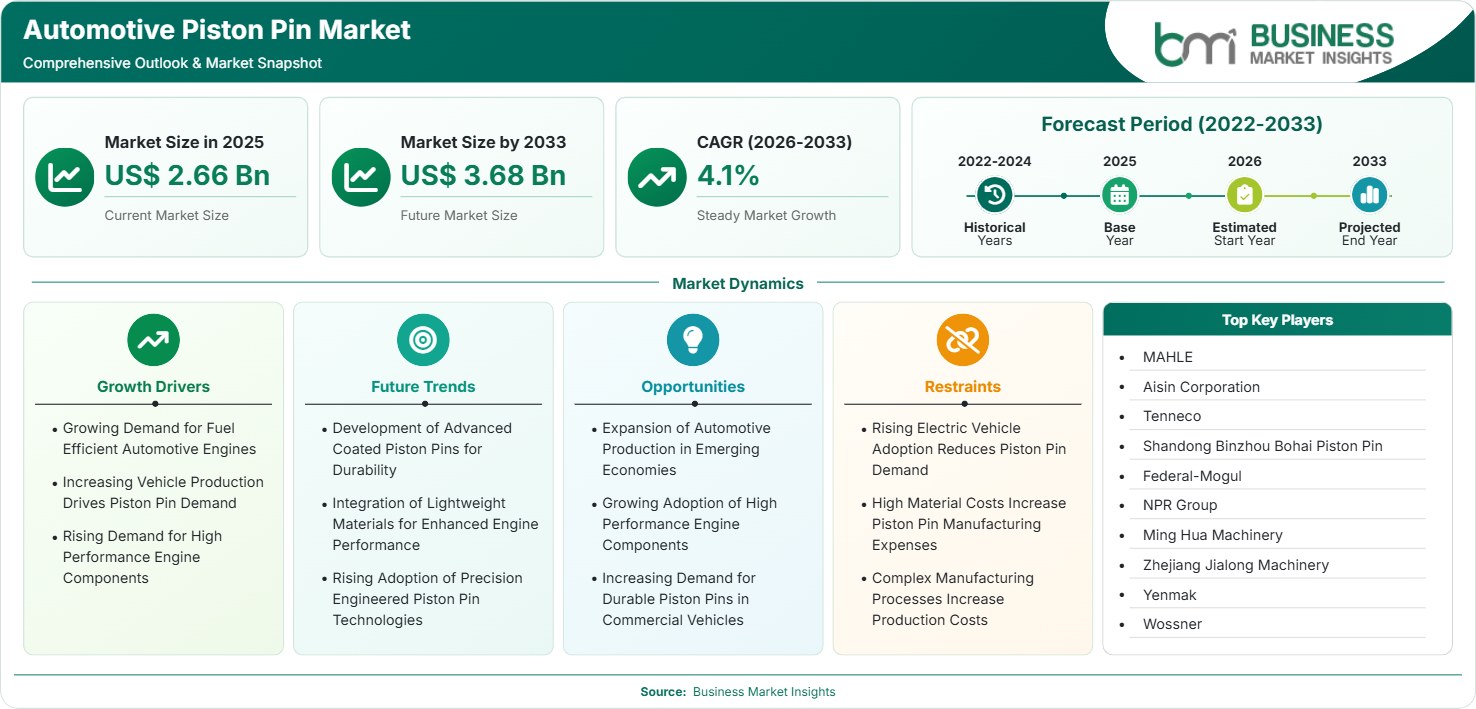
The Automotive Piston Pin Market size was valued at US$ 2.66 billion in 2025 and is projected to reach US$ 3.68 billion by 2033, growing at a CAGR of 4.14% during 2026–2033, driven by demand for fuel-efficient engines, rising vehicle production, high-performance powertrains, and opportunities in emerging automotive manufacturing economies.

Report Coverage
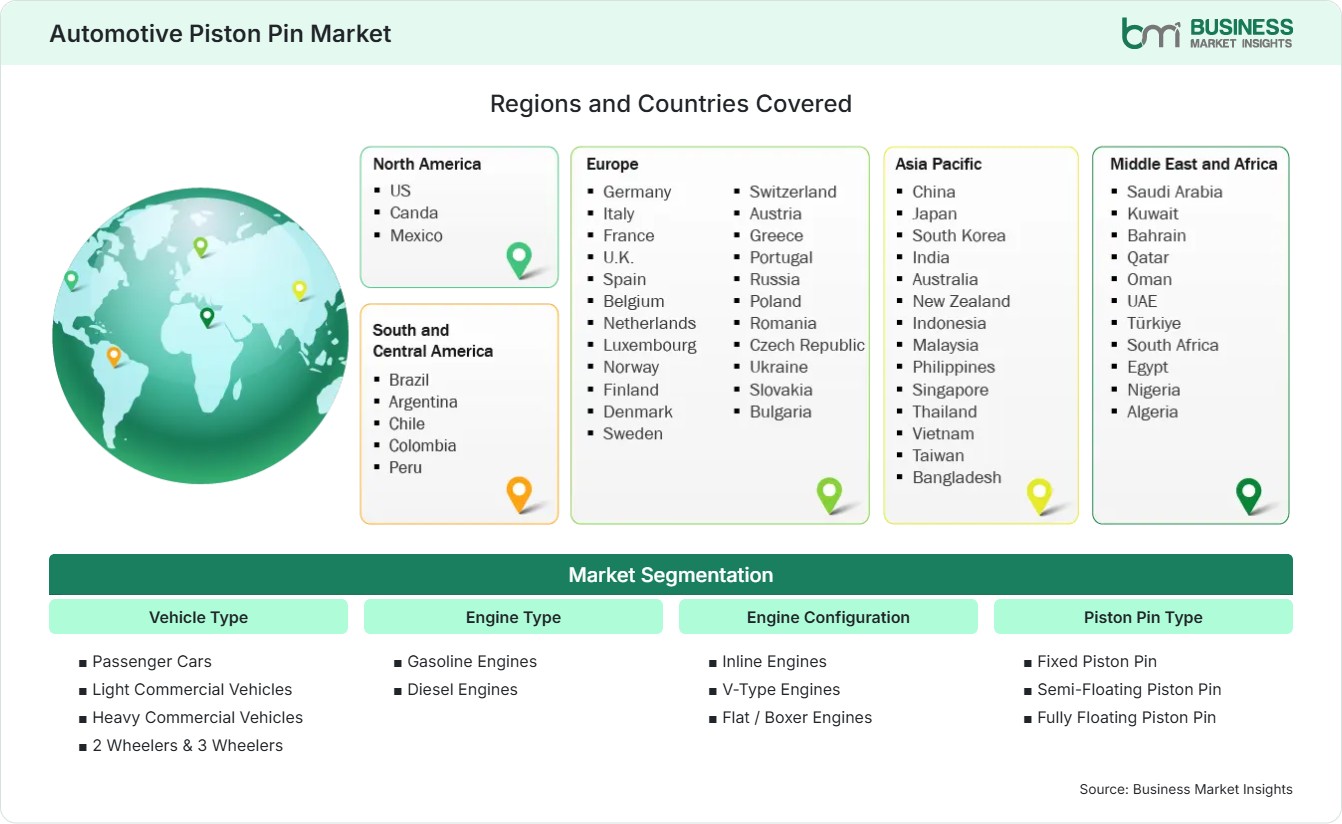
  • Vehicle Type: Passenger Cars, Light Commercial Vehicles, Heavy Commercial Vehicles, 2 Wheelers & 3 Wheelers
  • Engine Type: Gasoline Engines , Diesel Engines
  • Engine Configuration: Inline Engines, V-Type Engines, Flat / Boxer Engines
  • Piston Pin Type: Fixed Piston Pin, Semi-Floating Piston Pin, Fully Floating Piston Pin
US$ 2.66 Bn Market size in 2025
US$ 3.68 Bn Market Size by 2033
4.1% CAGR, 2026 - 2033
2026-2033 Forecast Period

01 AI Overview

Automotive Piston Pin Market Summary

  • North America Region: North America held an estimated 18%–21% share in 2025 and is projected to grow at a 3.0%–4.0% CAGR, supported by replacement demand, commercial fleets, hybrid powertrains, and advanced engine components. The U.S. Automotive Piston Pin Market is advancing at a 3.0%–4.0% CAGR, supported by a large vehicle base, aftermarket activity, and continued hybrid and internal combustion engine production.
  • Fastest Growing Region: Asia Pacific held an estimated 48%–52% share in 2025 and is projected to expand at a 5.0%–6.0% CAGR, driven by vehicle manufacturing, commercial fleet expansion, rising mobility, supplier localization, and demand for efficient and durable powertrain components.
  • Leading Segment: Passenger Cars represented an estimated 55%–59% share in 2025 and is projected to grow at a 3.8%–4.8% CAGR, supported by high production volumes, engine downsizing, hybridization, and demand for lightweight, wear-resistant components.
  • High Growth Segment: Fully Floating Piston Pin represented an estimated 47%–51% share in 2025 and is projected to grow at a 4.8%–5.8% CAGR, benefiting from reduced friction, improved load distribution, durability, and performance-oriented engine designs.
  • Key Market Opportunity: Emerging automotive production hubs, commercial vehicle modernization, lightweight materials, and advanced surface treatments are creating opportunities for suppliers offering durable piston pins with improved fatigue resistance.
  • Major Market Players: MAHLE GmbH, Aisin Corporation, Tenneco Inc., Shandong Binzhou Bohai Piston Pin Co., Ltd., Federal-Mogul LLC, NPR Group, Ming Hua Machinery Co., Ltd., Zhejiang Jialong Machinery Co., Ltd., Yenmak Motor Parçaları San. ve Tic. A.Ş., Wössner GmbH.
02 Strategic Insights

Automotive Piston Pin Market: Strategic Insights

Automotive Piston Pin Market Strategic Framework
FREE PDF
Request your free sample
Request free sample
03 Stakeholder View

Key Takeaways

  • The value chain spans specialty steel producers, forging companies, precision machinists, heat-treatment providers, engine manufacturers, Tier 1 suppliers, and aftermarket distributors. Manufacturing consistency, cost control, and engineering collaboration remain essential for securing long-term programs.
  • Passenger vehicles provide the largest demand pool, while commercial vehicles offer attractive opportunities for premium suppliers because heavy loads and high utilization increase requirements for durability and fatigue resistance.
  • Innovation is moving toward lightweight designs, high-strength steels, advanced surface treatments, and tighter manufacturing tolerances. Suppliers improving durability without increasing weight or production complexity can strengthen their position.
  • Asia Pacific offers the strongest investment case due to large vehicle production volumes, expanding supplier ecosystems, rising mobility, and increasing localization. China, India, Japan, and Southeast Asia remain strategically important.
  • The shift toward electrification creates a long-term structural challenge, but hybrid vehicles and the large installed base of internal combustion vehicles provide an extended opportunity for original equipment and aftermarket suppliers.
04 Geographic Outlook

Automotive Piston Pin Market Regional Highlights

North America Automotive Piston Pin Market

North America held an estimated 18%–21% share in 2025 and is projected to expand at a 3.0%–4.0% CAGR through 2033. Demand benefits from a large vehicle parc, commercial transportation, established manufacturing capabilities, and replacement activity. The Automotive Piston Pin Market share remains supported by hybrid and performance-oriented engines, although increasing battery-electric vehicle adoption is gradually limiting long-term demand.

  • Replacement demand remains important because North America's large installed vehicle base supports recurring requirements for engine components, particularly among aging vehicles and high-mileage commercial fleets.
  • Commercial trucks provide stable demand because operators prioritize engine durability and reliability under high loads and extended operating cycles.
  • Hybrid powertrains provide transitional opportunities because internal combustion engines remain integral to many hybrid vehicles despite growing electrification.
  • Advanced manufacturing capabilities encourage investment in precision machining, surface treatment, and material optimization for demanding engine applications.

US Automotive Piston Pin Market

The U.S. represented an estimated 15%–18% share in 2025 of the Automotive Piston Pin Market and is forecast to grow at a 3.0%–4.0% CAGR through 2033. Demand is supported by a large passenger vehicle base, commercial transportation, and aftermarket activity. Domestic manufacturers continue improving engine efficiency and durability, while hybridization extends opportunities for component suppliers despite rising battery-electric vehicle penetration.

  • The aftermarket remains significant because owners and fleet operators continue maintaining internal combustion vehicles, particularly where repairs remain economical compared with replacement.
  • Heavy-duty transportation supports demand as trucks operate under high loads and long annual mileage, increasing requirements for reliable and wear-resistant engine components.
  • Hybrid vehicle production creates near-term opportunities because hybrid powertrains retain internal combustion engines, although battery-electric adoption will gradually constrain long-term demand.

Europe Automotive Piston Pin Market

Europe held an estimated 19%–22% share in 2025 and is projected to grow at a 2.5%–3.5% CAGR through 2033. Germany remains the leading Automotive Piston Pin Market, while Poland and the Czech Republic offer manufacturing opportunities. Electrification and emissions regulations create pressure, but hybrid vehicles, commercial transportation, and replacement demand continue supporting the regional outlook.

  • Germany remains a major automotive engineering hub, supporting demand for precision-engineered components and advanced piston pin technologies.
  • Poland is strengthening its automotive supply chain position, creating opportunities for component manufacturers serving vehicle production and export-oriented operations.
  • The Czech Republic benefits from established vehicle production and supplier networks, supporting localized demand for precision-machined engine components.
  • Hybrid powertrains provide transitional demand as automakers maintain combustion capabilities alongside expanding electrified vehicle portfolios.
  • European suppliers are emphasizing lightweight materials and surface engineering to extend component life while supporting efficiency requirements.

Asia Pacific Automotive Piston Pin Market

Asia Pacific represented an estimated 48%–52% share in 2025 and is projected to grow at a 5.0%–6.0% CAGR through 2033. China and Japan lead the regional Automotive Piston Pin Market, while India and Indonesia provide faster growth opportunities. Vehicle production, expanding commercial fleets, supplier localization, and rising mobility underpin the region's strong outlook.

  • China remains a dominant automotive manufacturing base, supporting substantial demand across passenger vehicles, commercial vehicles, and aftermarket channels.
  • India offers strong growth as vehicle production, mobility, and commercial transportation expand, supporting demand for durable and cost-efficient engine components.
  • Japan's mature automotive industry sustains demand for precision components, while hybrid vehicle production extends the role of internal combustion technologies.
  • Indonesia benefits from rising vehicle ownership and transportation activity, creating opportunities across passenger vehicles, commercial fleets, and replacement markets.
  • Regional manufacturers are investing in localized production and automation to improve competitiveness while meeting increasingly stringent quality requirements.

Rest of World Automotive Piston Pin Market

South and Central America accounted for an estimated 6%–8% share in 2025 and is projected to grow at a 3.5%–4.5% CAGR through 2033. Brazil and Mexico lead demand, supported by vehicle production and aftermarket activity. The Middle East and Africa represented an estimated 5%–7% share and are projected to grow at a 3.0%–4.0% CAGR, with Saudi Arabia, the UAE, and South Africa offering opportunities.

  • Brazil's automotive industry and large vehicle population support replacement demand, while local manufacturing capabilities create opportunities for regional supplier partnerships.
  • Mexico benefits from its integrated automotive manufacturing ecosystem and proximity to North American markets, supporting demand for precision components.
  • South Africa remains an important regional automotive manufacturing center, with passenger and commercial vehicle production supporting demand for engine components.
  • Saudi Arabia's transportation activity and commercial fleet requirements provide opportunities for durable engine components in demanding operating environments.
  • The UAE serves as an automotive distribution and aftermarket hub, supporting demand for replacement components through its active vehicle population and import channels.
Global Market Geography
FREE PDF
Request your free sample
Request free sample
05 Segment Analysis

Automotive Piston Pin Market Segmentation

Vehicle Type

Vehicle Type is led by Passenger Cars, which accounted for an estimated 55%–59% share in 2025 and is projected to grow at a 3.8%–4.8% CAGR between 2026–2034. Automotive Piston Pin Market trends reflect high passenger vehicle volumes, engine downsizing, hybridization, and continued replacement demand across established and emerging automotive markets.

  • Passenger Cars: Passenger cars have the largest demand base due to high global production volumes, widespread engine use, and the need for lightweight, durable components.
  • Light Commercial Vehicles (LCVs): LCV demand benefits from urban logistics, e-commerce deliveries, and small business transportation, with operators prioritizing efficient engines and reliable components.
  • Heavy Commercial Vehicles (HCVs): HCV applications require piston pins capable of withstanding high loads, thermal stresses, and extended operating cycles, ensuring premium durability and fatigue resistance.
  • 2 Wheelers & 3 Wheelers: Two-wheelers and three-wheelers remain important across emerging markets, where affordable mobility and high utilization sustain demand for compact, cost-effective engine components.

Engine Type

Engine Type comprises Gasoline Engines, having a market share of around 62% to 66% in 2025 and witnessing growth at a CAGR of 3.5% to 4.5% from 2026 to 2034. The demand will continue to be driven by passenger-car fitment, turbos, hybrids, and further efficiency gains in gasoline-powered applications.

  • Gasoline Engines: Gasoline engines remain widely adopted, while downsizing, turbocharging, direct injection, and hybridization increase the requirements for lightweight, high-strength piston pins.
  • Diesel Engines: Diesel engines remain important in commercial vehicles and heavy-duty applications, where high compression ratios and demanding workloads require robust, durable components.

Engine Configuration

The Engine Configuration segment is dominated by Inline Engines, accounting for approximately 68%–72% market share in 2025, and growing at a CAGR of 3.7%–4.7% from 2025 to 2034. Small size, cost-effectiveness in production, and extensive use in both passenger and commercial cars underpin its market pull, but niche engines retain their relevance in high-end variants.

  • Inline Engines: Inline engines dominate mainstream applications because of compact architecture, manufacturing simplicity, serviceability, and widespread adoption across passenger and commercial powertrains.
  • V-Type Engines: V-type engines remain relevant in high-performance, luxury, and heavy-duty applications where higher displacement and power output require robust piston pin designs.
  • Flat / Boxer Engines: Flat or boxer engines serve specialized architectures where low center of gravity and distinctive packaging advantages justify the configuration.

Piston Pin Type

Piston Pin Type is led by Fully Floating Piston Pin, which accounts for the highest market share among all Piston Pin Types. The segment accounted for an estimated 47%-51% share in 2025 and is expected to grow at a CAGR of 4.8%-5.8% through 2034. Its ability to reduce friction and distribute loads effectively supports adoption in performance-oriented and advanced engine applications.

  • Fixed Piston Pin: Fixed piston pins offer straightforward construction and reliable performance, supporting applications where simplified assembly and cost efficiency remain important.
  • Semi-Floating Piston Pin: Semi-floating designs balance manufacturing complexity and performance, providing practical solutions for engine architectures requiring controlled pin movement and reliable durability.
  • Fully Floating Piston Pin: Fully floating piston pins rotate within the piston and connecting rod, reducing localized wear and supporting demanding engines with higher performance requirements.
06 Market Forces

Automotive Piston Pin Market Dynamics

Key Market Drivers

Growing Demand for Fuel-Efficient Automotive Engines

The increasing demand for fuel efficiency is motivating auto companies to develop engines with components that offer low friction, reduced weight, and improved durability. Turbocharging and downsizing increase mechanical and thermal stresses amid the need for greater efficiency from manufacturers. Such a development is driving suppliers of piston pins to develop products with high-strength alloys, geometric optimization, and advanced surface treatments, driving the Automotive Piston Pin Market growth.

Increasing Vehicle Production Drives Piston Pin Demand

Increased vehicle manufacturing worldwide positively affects demand for piston pins, since every internal combustion engine requires specific parts to operate efficiently under high loads. With an increase in manufacturing volume comes increased OEE potential. The opportunity is especially valid for Asia-Pacific, since the region has many vehicles manufactured and a strong supply chain infrastructure. Increased commercial vehicle manufacturing increases OEE potential because fleet applications demand more robust powertrain components.

Rising Demand for High-Performance Engine Components

For high-performance engines, components that can withstand higher combustion pressures and temperatures, as well as more intensive operating cycles, become essential. The piston pin needs to be durable, fatigue-resistant, offer better wear resistance, and maintain exact dimensions and weight. It applies not only to sports automobiles, but also to turbocharged passenger cars, trucks, and special applications. Special efforts by manufacturers are being made to use advanced steels, heat treatments, surface coatings, and machining techniques. This trend favors the increasing demand for technologically different products.

Key Market Opportunities

Expansion of Automotive Production in Emerging Economies

There is a good chance for emerging nations, driven by vehicle ownership, increased manufacturing capacity, and supplier localization. India, Southeast Asia, Latin America, and certain African markets have potential for sales of original equipment and after-market products. Suppliers may gain from regional manufacturing facilities, partnerships with local engine makers, and products designed for price-sensitive applications. The Automotive Piston Pin Market forecast to grow as internal combustion and hybrid engines continue to meet mobility requirements. Investments in machining and flexible manufacturing facilities can help cut costs.

Growing Adoption of High-Performance Engine Components

With the advent of turbocharging, direct injection, hybrids, and high-output engines, there is an increasing need for piston pins with enhanced fatigue strength and improved wear resistance. This can be taken advantage of by manufacturers with the use of superior materials and coatings that can withstand the increased loads while keeping the added weight to a minimum. Cooperation with vehicle makers and Tier 1 automotive parts manufacturers can help speed up testing and lock in future engine programs. The investment in computer-aided engineering and precision manufacturing will help improve the component's design.

Increasing Demand for Durable Piston Pins in Commercial Vehicles

Commercial vehicle operators prioritize uptime, as component failures can lead to major maintenance expenses and financial losses. This presents a good chance for manufacturers of piston pins, which would be built for long operating times, heavy loads, and harsh temperatures. Heavy trucks, buses, and delivery vehicles may drive demand for high-quality components as the logistics industry grows. Suppliers may compete using better metallurgy, surface hardening, tolerances, and testing in practical situations. Aftermarket sales represent another promising business route since fleet owners need new parts.

Market Restraints and Challenges

Rising Electric Vehicle Adoption Reduces Piston Pin Demand

Factor: Battery-electric vehicles eliminate conventional internal combustion engines and therefore do not require piston pins, posing a long-term structural challenge. Impact: Higher EV uptake will gradually narrow the addressable market, especially as regulations promote powertrain changeover through policy measures. This is cushioned by hybrids, commercial use, developing countries, and the vast number of vehicles in the existing traditional vehicle base. Thus, suppliers need to diversify their product lines or expand into adjacent areas.

High Material Costs Increase Piston Pin Manufacturing Expenses

Factor: Piston pins require high-quality steels and specialized processing to achieve strength, hardness, dimensional accuracy, and fatigue resistance. Impact: Price fluctuations in raw materials will definitely affect production costs and put pressure on supplier margins when costs cannot be passed through to customers. Heat treatment, grinding, coating, and machining of components increase costs. Suppliers could overcome this problem by using process automation, material optimization, procurement arrangements, and increased production yields. Cost pressure is a real challenge for suppliers because car makers want cheaper parts.

07 Company Analysis

Competitive Landscape

The competitive landscape includes global automotive component manufacturers, specialized piston pin producers, and established engine component suppliers. The Automotive Piston Pin Market analysis indicates that competition centers on manufacturing scale, metallurgical expertise, precision machining, quality consistency, customer relationships, and the ability to supply increasingly demanding engine architectures.

Company Name

Overview

Products and Services relevant to this market

MAHLE GmbH

Global automotive supplier with extensive powertrain expertise and relationships across passenger and commercial vehicle manufacturers.

Pistons, piston systems, engine components, powertrain technologies, and precision-engineered piston pin solutions.

Aisin Corporation

Japanese automotive supplier providing powertrain and mobility technologies to major global vehicle manufacturers.

Engine components, powertrain systems, transmission technologies, and precision components supporting combustion applications.

Tenneco Inc.

Global automotive supplier with expertise across powertrain, emissions, ride performance, and aftermarket technologies.

Engine components, powertrain solutions, sealing technologies, aftermarket products, and combustion engine components.

Shandong Binzhou Bohai Piston Pin Co., Ltd.

Specialized Chinese manufacturer focused on piston pins and precision-engineered automotive components.

Automotive piston pins, precision machining, heat-treated components, and engine manufacturing solutions.

Federal-Mogul LLC

Established automotive component supplier with longstanding expertise in engine and powertrain technologies.

Pistons, bearings, engine components, powertrain products, sealing systems, and aftermarket solutions.

NPR Group

Global engine component specialist with expertise in piston systems and precision automotive powertrain products.

Pistons, piston rings, cylinder liners, engine components, and piston-related technologies.

Ming Hua Machinery Co., Ltd.

Machinery and automotive component manufacturer serving specialized engine component requirements and industrial customers.

Piston pins, precision-machined components, engine parts, and customized component solutions.

Zhejiang Jialong Machinery Co., Ltd.

Chinese automotive component manufacturer focused on precision-engineered engine parts and production capabilities.

Piston pins, engine components, precision machining, heat treatment, and manufacturing services.

Yenmak Piston Segman Sanayi VE TIC.A.S

Turkish engine component manufacturer serving automotive aftermarket and powertrain applications internationally.

Pistons, piston pins, cylinder liners, engine components, and replacement parts.

Wössner GmbH

German performance engine component specialist known for high-performance and lightweight piston technologies.

Forged pistons, piston pins, performance engine components, lightweight solutions, and specialized applications.


10 Trust & Transparency

Research Methodology

The market analysis combines proprietary research with secondary data from government agencies, company disclosures, regulatory filings, industry databases and expert interviews. Market estimates are validated through data triangulation, cross-market benchmarking and analyst review.

View Full Research Methodology

11 Questions Answered

Frequently Asked Questions

What does the Automotive Piston Pin Market report indicate about long-term opportunities?

The report indicates that commercial vehicles, performance engines, hybrid powertrains, and replacement markets offer attractive opportunities. Commercial applications prioritize durability, while aftermarket channels can generate recurring revenue from the large installed internal combustion vehicle base.

Will hybrid vehicles sustain piston pin demand?

Hybrid vehicles can extend demand because many architectures continue using internal combustion engines. However, long-term support depends on regional powertrain adoption, hybrid configurations, vehicle production, and the pace of battery-electric vehicle adoption.

How does engine downsizing affect piston pin technology?

Downsizing often increases specific power output through turbocharging and higher cylinder pressures. Piston pins therefore require stronger materials, improved heat treatments, optimized geometries, and advanced surface finishes.

Why are fully floating piston pins widely used in advanced engines?

Fully floating designs allow rotation within the piston and connecting rod, helping distribute wear more evenly. This can reduce localized friction and improve durability under demanding operating conditions.

What factors influence piston pin selection for automotive engines in the Automotive Piston Pin Market?

Engine load, combustion pressure, temperature, piston design, connecting rod configuration, material strength, surface hardness, and lubrication influence selection. Manufacturers also consider weight, fatigue life, manufacturing tolerances, and cost.

Access the Full Automotive Piston Pin Market Report

Get segment-level forecasts, regional estimates, competitive benchmarking, company profiles and downloadable Excel datasets.

Access the full Automotive Piston Pin Market Report
350 pages PDF & Excel | 2026-08-03