
Automotive Mro Market Outlook: Size, Share, Trends, Growth Analysis, Competitive Landscape & Forecast, 2026-2033

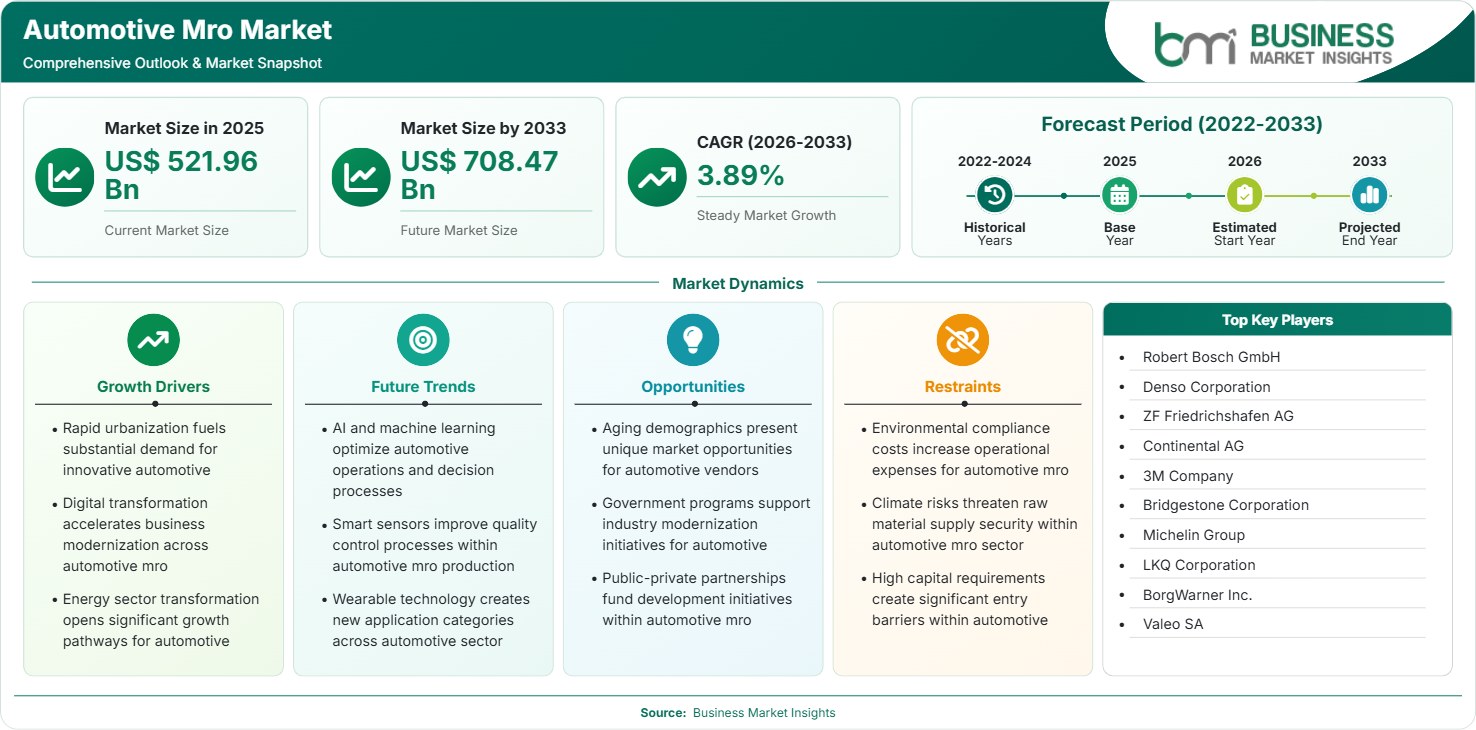
The Automotive MRO Market size was valued at US$ 521.96 Billion in 2025 and is projected to reach US$ 708.47 Billion by 2033, growing at a CAGR of 3.89% during 2026–2033. Market expansion is supported by the increasing global vehicle parc, rising demand for predictive maintenance, rapid digitalization of repair operations, fleet lifecycle optimization, connected vehicle diagnostics, and expanding aftermarket opportunities across emerging automotive economies.

Report Coverage
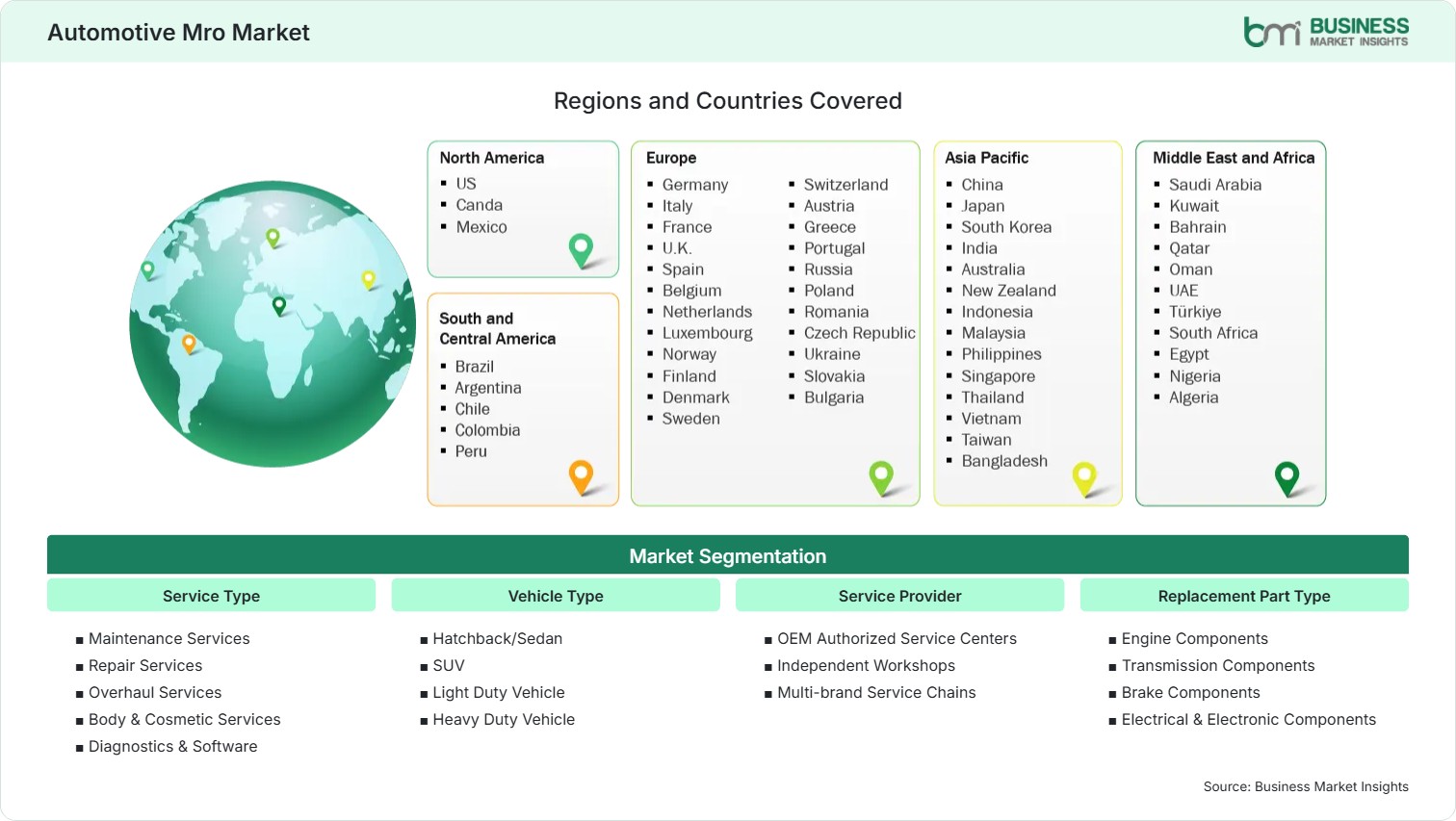
  • Service Type: Maintenance Services, Repair Services, Overhaul Services, Body & Cosmetic Services, Diagnostics & Software
  • Vehicle Type: Hatchback/Sedan, SUV, Light Duty Vehicle, Heavy Duty Vehicle
  • Service Provider: OEM Authorized Service Centers, Independent Workshops, Multi-brand Service Chains
  • Replacement Part Type: Engine Components, Transmission Components, Brake Components, Electrical & Electronic Components
  • Vehicle Age: <3 Years, 4-7 Years, 8-12 Years, Above 12 Years
US$ 521.96 Bn Market size in 2025
US$ 708.47 Bn Market Size by 2033
3.89% CAGR, 2026 - 2033
2026-2033 Forecast Period

AI Overview

Automotive Mro Market Summary

  • North America Region: North America holds an estimated 34%–37% market share in 2025 and is projected to grow at a 3.3%–3.8% CAGR during 2026–2033. Strong commercial fleet maintenance, connected diagnostics, electric vehicle servicing, aging vehicle ownership, and digital workshop adoption continue strengthening regional aftermarket demand. The U.S. remains the regional leader, supported by extensive vehicle ownership, advanced dealership networks, predictive maintenance adoption, and expanding independent repair ecosystems, growing at an estimated 3.4%–3.9% CAGR.
  • Fastest Growing Region: Asia Pacific accounts for approximately 27%–30% market share in 2025 while expanding at a projected 5.0%–5.6% CAGR through 2033. Rising vehicle production, increasing ownership, expanding service infrastructure, fleet modernization, digital diagnostics, and accelerating aftermarket investments continue supporting long-term regional expansion.
  • Leading Segment: Maintenance Services represent approximately 36%–39% of total revenue in 2025 while growing at an estimated 3.5%–4.0% CAGR through 2033. Preventive servicing, scheduled inspections, lubricant replacement, and predictive maintenance technologies continue improving fleet availability, operational efficiency, customer retention, and lifecycle performance.
  • High Growth Segment: Diagnostics & Software Services account for approximately 11%–14% market share in 2025 while expanding at an estimated 6.2%–6.8% CAGR through 2033. Connected vehicles, remote diagnostics, artificial intelligence-enabled fault detection, software calibration, cybersecurity requirements, and over-the-air updates continue accelerating demand.
  • Key Market Opportunity: Fleet operators increasingly prioritize predictive maintenance platforms integrating artificial intelligence, telematics, cloud analytics, and connected diagnostics, creating significant revenue opportunities for digital service providers, OEM workshops, and independent maintenance networks worldwide.
  • Major Market Players: Robert Bosch GmbH, DENSO Corporation, ZF Friedrichshafen AG, Continental AG, 3M Company, Bridgestone Corporation, Michelin Group, LKQ Corporation, BorgWarner Inc., Valeo SA, Schaeffler AG, Tenneco Inc., Aisin Corporation, MAHLE GmbH, and Hitachi Astemo, Ltd.
Strategic Insights

Automotive Mro Market: Strategic Insights

Automotive Mro Market Strategic Framework
FREE PDF
Request your free sample
Request free sample
Stakeholder View

Key Takeaways

  • The market ecosystem is increasingly integrating OEM-authorized service centers, independent workshops, digital diagnostic providers, replacement component manufacturers, fleet operators, software developers, and logistics partners into a highly connected aftermarket value chain.
  • Predictive maintenance platforms, diagnostics software, connected fleet management, and electric vehicle servicing represent the strongest long-term investment opportunities as automotive technologies become increasingly software-centric.
  • Artificial intelligence, cloud-based workshop management systems, remote diagnostics, machine learning, and vehicle telematics are transforming maintenance scheduling, repair accuracy, technician productivity, and customer experience.
  • Asia Pacific presents the strongest regional expansion potential due to rising vehicle ownership, improving disposable income, expanding dealership infrastructure, and increasing investments in digital automotive service capabilities.
  • Strategic acquisitions, aftermarket distribution expansion, and partnerships between OEMs, component suppliers, and technology companies are strengthening supply chains while improving service efficiency and replacement part availability.
  • Sustainability initiatives including remanufactured components, circular economy practices, environmentally compliant repair materials, and energy-efficient workshop operations are becoming major competitive differentiators across the global automotive aftermarket ecosystem.
Geographic Outlook

Automotive Mro Market Regional Highlights

North America Automotive MRO Market

North America accounted for an estimated 34%–37% of the global Automotive MRO Market in 2025 and is projected to expand at a 3.3%–3.8% CAGR during 2026–2033. The region benefits from a large aging vehicle fleet, high vehicle ownership rates, mature aftermarket distribution channels, and widespread adoption of predictive maintenance technologies. Fleet operators continue investing in telematics, digital diagnostics, and preventive maintenance programs to reduce downtime. Growing electric vehicle adoption is also driving demand for specialized maintenance capabilities, battery servicing, and software-based repair solutions.

  • Strong commercial trucking, logistics, and fleet transportation sectors continue generating sustained demand for preventive maintenance, component replacement, and predictive diagnostics, encouraging investment in digital workshop technologies and technician training programs.
  • Independent repair chains and OEM-authorized service centers increasingly deploy AI-enabled diagnostics, cloud-based repair management, and connected vehicle platforms to improve service quality, operational efficiency, and customer retention.
  • Rising adoption of hybrid and electric vehicles requires specialized repair equipment, high-voltage technician certification, battery diagnostics, and software calibration, creating new revenue streams across regional aftermarket networks.
  • Advanced aftermarket supply chains, efficient parts distribution, and established remanufacturing capabilities enable faster repair turnaround times while supporting sustainability objectives and reducing vehicle lifecycle costs.
  • Increasing fleet digitalization and connected mobility solutions strengthen demand for remote monitoring, predictive analytics, and real-time maintenance scheduling across passenger and commercial vehicle segments.

US Automotive MRO Market

The United States represented approximately 79%–82% of North American Automotive MRO Market revenue in 2025 and is expected to register a 3.4%–3.9% CAGR through 2033. Demand remains supported by one of the world's largest vehicle fleets, expanding e-commerce logistics operations, increasing vehicle age, and continuous investments in predictive maintenance technologies. Independent repair facilities and dealership networks are expanding digital capabilities while integrating connected diagnostics and automated workflow management systems.

  • Growing adoption of subscription-based fleet maintenance contracts improves vehicle uptime, lowers operating expenses, and strengthens recurring service revenues for dealerships and independent workshops across commercial transportation industries.
  • Artificial intelligence-assisted diagnostics, remote software updates, and advanced scanning equipment significantly improve repair accuracy while reducing inspection times and labor-intensive maintenance procedures.
  • Expansion of electric vehicle charging infrastructure encourages investment in certified battery maintenance, thermal management servicing, and electronic component diagnostics throughout nationwide service networks.
  • Consolidation among aftermarket distributors and repair chains continues improving inventory availability, procurement efficiency, technician productivity, and nationwide service consistency.

Europe Automotive MRO Market

Europe held an estimated 28%–31% Automotive MRO Market share during 2025 and is forecast to expand at a 3.1%–3.6% CAGR between 2026 and 2033. Strong automotive manufacturing capabilities, stringent vehicle safety regulations, and a well-developed independent workshop ecosystem support long-term demand. Germany remains the leading regional market, while Eastern European countries demonstrate faster expansion through increasing vehicle ownership, fleet modernization, and investment in advanced repair infrastructure.

  • Germany leads regional demand through its extensive premium vehicle base, advanced automotive engineering ecosystem, and continuous investment in connected service technologies supporting workshop modernization.
  • France and the United Kingdom continue expanding aftermarket digitalization through cloud-based repair management, predictive maintenance software, and growing adoption of electric vehicle servicing capabilities.
  • Poland and Romania represent high-growth markets due to expanding automotive ownership, increasing commercial transportation activity, and rising investments in independent repair facilities and technician development.
  • Circular economy initiatives encourage remanufacturing, recycled replacement components, and environmentally sustainable repair practices, strengthening long-term competitiveness throughout European automotive service networks.
  • Increasing regulatory emphasis on emissions compliance and vehicle safety inspections continues supporting demand for diagnostics, calibration services, and electronic system maintenance.

Asia Pacific Automotive MRO Market

Asia Pacific represented approximately 27%–30% of global Automotive MRO Market revenue during 2025 and is anticipated to record the fastest regional expansion at a 5.0%–5.6% CAGR through 2033. Rapid vehicle ownership growth, expanding middle-class populations, increasing commercial transportation activity, and continuous dealership expansion support market development. China leads regional demand, while India and Southeast Asia deliver the strongest long-term growth potential through infrastructure improvements and aftermarket investments.

  • China dominates regional revenue through its extensive automotive production, growing vehicle population, advanced aftermarket distribution networks, and continuous adoption of digital maintenance technologies.
  • India records the fastest expansion as organized service chains, fleet operators, and independent workshops increasingly adopt predictive maintenance, digital diagnostics, and standardized repair procedures.
  • Japan maintains strong aftermarket demand through technologically advanced repair services, aging vehicle ownership, and continuous innovation in intelligent maintenance solutions and workshop automation.
  • Southeast Asian economies continue investing in dealership expansion, logistics fleets, technician development, and digital service ecosystems supporting sustained aftermarket growth.
  • Increasing electric vehicle production across China, South Korea, and Japan accelerates demand for battery diagnostics, software maintenance, and high-voltage repair expertise.

Rest of World Automotive MRO Market

The Rest of World region accounted for approximately 8%–11% of global Automotive MRO Market revenue in 2025 and is projected to grow at a 4.2%–4.8% CAGR through 2033. South & Central America continue benefiting from rising vehicle ownership, expanding replacement parts distribution, and improving dealership infrastructure. Meanwhile, the Middle East & Africa experience increasing investment in commercial transportation, fleet maintenance services, mining vehicles, and construction equipment maintenance, creating sustainable aftermarket opportunities across developing economies.

  • Brazil remains the leading South American market through strong passenger vehicle demand, expanding logistics fleets, and increasing investment in organized automotive repair networks.
  • Mexico continues strengthening regional aftermarket capabilities through automotive manufacturing expansion, cross-border logistics growth, and rising demand for OEM-quality maintenance services.
  • Saudi Arabia and the United Arab Emirates invest significantly in commercial fleet modernization, predictive maintenance technologies, and digital workshop infrastructure supporting transportation diversification initiatives.
  • South Africa remains an important regional aftermarket hub driven by mining equipment maintenance, commercial vehicle servicing, and growing investments in replacement component distribution.
  • Increasing infrastructure development projects throughout emerging economies stimulate long-term demand for heavy-duty vehicle maintenance, engine overhauls, brake servicing, and advanced fleet management solutions.
Global Market Geography
FREE PDF
Request your free sample
Request free sample
Segment Analysis

Automotive Mro Market Segmentation

Service Type

The Service Type segment accounted for the largest proportion of the market, with an estimated 35%–38% share in 2025 and is projected to expand at a 3.8%–4.3% CAGR through 2033. Increasing preventive maintenance requirements, connected vehicle servicing, digital diagnostics, and fleet lifecycle optimization continue driving service demand across passenger and commercial vehicles. The Automotive MRO Market scope continues expanding through integrated maintenance ecosystems and predictive service solutions.

  • Maintenance Services: Preventive inspections, oil replacement, lubrication, filter changes, tire rotation, and scheduled servicing remain fundamental for maximizing vehicle reliability, reducing operating costs, and extending vehicle lifecycle performance.
  • Repair Services: Mechanical and electrical repairs continue experiencing stable demand due to increasing vehicle complexity, higher electronic component integration, and growing consumer preference for cost-effective aftermarket repair solutions.
  • Overhaul Services: Engine, transmission, suspension, and drivetrain overhauls support aging vehicle fleets while helping commercial operators maximize asset utilization and reduce replacement expenditure over extended operating periods.
  • Body & Cosmetic Services: Collision repair, dent removal, painting, refinishing, windshield replacement, and corrosion treatment maintain vehicle aesthetics, resale value, and structural integrity across passenger and fleet vehicles.
  • Diagnostics & Software: Connected diagnostics, software calibration, ECU programming, cybersecurity verification, and predictive maintenance platforms represent the fastest-evolving service category as vehicles become increasingly software-defined.

Vehicle Type

The Vehicle Type segment represented approximately 31%–34% of total market revenue during 2025 and is expected to register a 3.9%–4.4% CAGR through 2033. Growing global vehicle ownership, expanding logistics fleets, increasing commercial transportation, and longer vehicle lifespans continue supporting maintenance demand across every vehicle category while digital servicing capabilities improve operational efficiency.

  • Hatchback/Sedan: High ownership volumes generate consistent maintenance demand through routine servicing, replacement components, brake inspections, suspension maintenance, and periodic diagnostics throughout the vehicle ownership lifecycle.
  • SUV: Rising global SUV sales increase demand for tire replacement, drivetrain servicing, suspension repairs, electronic diagnostics, and advanced safety system calibration across urban and off-road operating environments.
  • Light Duty Vehicle: Delivery fleets, utility vehicles, and business transportation require regular maintenance schedules, predictive diagnostics, and rapid repair services to minimize downtime and maintain operational productivity.
  • Heavy Duty Vehicle: Commercial trucks, buses, construction vehicles, and industrial fleets depend on scheduled overhauls, engine maintenance, transmission servicing, and advanced fleet monitoring systems for continuous operation.

Service Provider

The Service Provider segment accounted for an estimated 29%–32% Automotive MRO Market share in 2025 and is projected to grow at a 3.7%–4.2% CAGR through 2033. Digital workshop management, technician certification, integrated supply chains, and increasing customer preference for professional maintenance services continue strengthening organized service networks across developed and emerging automotive markets.

  • OEM Authorized Service Centers: Manufacturer-certified technicians, genuine replacement components, warranty support, and advanced diagnostic equipment ensure premium service quality while supporting increasingly complex vehicle technologies.
  • Independent Workshops: Competitive pricing, flexible repair capabilities, localized customer relationships, and expanding access to advanced diagnostic equipment enable independent workshops to maintain significant aftermarket relevance.
  • Multi-brand Service Chains: Organized service chains leverage standardized operating procedures, centralized procurement, digital appointment platforms, and nationwide workshop networks to deliver efficient, scalable maintenance solutions.

Replacement Part Type

The Replacement Part Type segment captured approximately 24%–27% of total Automotive MRO Market revenue in 2025 and is anticipated to expand at a 4.0%–4.5% CAGR through 2033. Increasing vehicle age, higher repair frequency, component wear, and expanding aftermarket distribution channels continue strengthening replacement component demand across global automotive maintenance operations.

  • Engine Components: Pistons, valves, filters, spark plugs, gaskets, belts, and lubrication components remain essential for maintaining engine efficiency, emissions compliance, and long-term operational reliability.
  • Transmission Components: Clutches, gears, bearings, torque converters, transmission fluids, and electronic control modules require periodic replacement to ensure smooth drivetrain performance and durability.
  • Brake Components: Brake pads, discs, calipers, hydraulic systems, and electronic braking sensors remain high-volume replacement products due to safety regulations and routine wear during vehicle operation.
  • Electrical & Electronic Components: Sensors, wiring harnesses, ECUs, batteries, infotainment modules, lighting systems, and electronic controllers experience increasing demand as modern vehicles integrate advanced digital technologies.

Vehicle Age

The Vehicle Age segment accounted for approximately 22%–25% of the overall Automotive MRO Market in 2025 and is projected to record a 4.1%–4.6% CAGR through 2033. Increasing average vehicle lifespan, delayed vehicle replacement cycles, and higher maintenance requirements for older automobiles continue driving sustained aftermarket service demand across mature and developing automotive markets.

  • 0–3 Years: Vehicles primarily receive scheduled preventive maintenance, warranty servicing, software updates, and manufacturer-authorized inspections to maintain performance and warranty compliance.
  • 4–7 Years: Demand increases for brake servicing, suspension maintenance, battery replacement, tire changes, and electronic diagnostics as vehicles transition beyond initial ownership periods.
  • 8–12 Years: Aging vehicles require more extensive repairs, drivetrain servicing, engine maintenance, transmission repairs, and replacement component installations to sustain operational reliability.
  • Above 12 Years: Older vehicles generate substantial aftermarket opportunities through major overhauls, engine rebuilding, structural repairs, electrical system replacement, and comprehensive maintenance programs supporting extended vehicle usability.
Market Forces

Automotive Mro Market Dynamics

Key Market Drivers

Growing Global Vehicle Parc and Aging Fleet Expansion

The steadily expanding global vehicle parc and rising average vehicle age continue to generate sustained demand for maintenance, repair, and overhaul services across passenger and commercial vehicles. Based on OICA reports, the world car production figures have been maintaining themselves above 90 million each year while several highly developed countries have reported average age of passenger cars above 12 years. Older cars need more maintenance, replacement of parts, brake inspection, driveshaft maintenance, and engine repairs. In addition, fleet operators have been using their vehicles for longer periods to get better returns on investment. Consequently, Automotive MRO Market growth is increasingly supported by preventive maintenance strategies, digital fleet management, and optimized service scheduling that reduce downtime while improving vehicle reliability and operational efficiency.

Digital Diagnostics and Connected Vehicle Technologies

The rapid adoption of connected vehicles, onboard sensors, cloud computing, and artificial intelligence is fundamentally transforming automotive maintenance operations. Modern vehicles continuously generate operational data that enables predictive diagnostics, remote monitoring, and software-based maintenance planning before mechanical failures occur. Service providers are now spending heavily on new scanning devices, electronic calibration devices, and workshop management platforms using the cloud to increase efficiency and accuracy. Similarly, car manufacturers are expanding their over-the-air software and digital maintenance ecosystem to prevent any service interruptions. Such practices not only lower the cost of maintenance but also help to diagnose more advanced electronic systems for future digital

Expansion of Commercial Fleet and Logistics Operations

Global logistics, e-commerce, public transportation, and industrial transportation sectors continue expanding their commercial vehicle fleets, creating long-term demand for maintenance and overhaul services. There is an increasing trend towards prioritizing predictive maintenance in order to ensure maximum fleet availability and minimize unexpected breakdowns. Trucks, buses, construction machines and other fleet types require routine maintenance such as inspection, lubrication, braking service, new tires installation and engine overhaul in order to remain efficient. Modern fleet management technologies based on telematics help to plan maintenance by monitoring vehicle conditions online. The growing freight transportation, infrastructure development and international transit contribute to the growth of professional fleet maintenance services.

Key Market Opportunities

Artificial Intelligence-Powered Predictive Maintenance Platforms

AI, machine learning, and cloud computing are revolutionizing maintenance planning through the development of proactive service systems that detect breakdowns prior to them happening. Present-day workshops are utilizing vehicle telematics, IoT, and diagnostics systems in order to ensure effective scheduling, reduced cost of labor, and increased customer satisfaction. The manufacturers of cars as well as the service providers are equally dedicated to the development of smart maintenance ecosystems that can accommodate connected cars throughout their lifetimes. Automotive MRO Market Forecasts indicate growing investment opportunities in predictive analytics platforms, automated maintenance scheduling, and digital service management solutions as fleet operators seek higher operational efficiency and lower maintenance expenditure across global transportation networks.

Rapid Growth of Electric Vehicle Service Infrastructure

Global electric vehicle adoption creates substantial opportunities for specialized maintenance providers capable of servicing high-voltage batteries, electric drivetrains, thermal management systems, regenerative braking components, and software-defined vehicle platforms. With growing electric car adoption, service centers are focusing more on providing technicians with certifications, insulating diagnostic devices, monitoring battery conditions, and cyber-security. Additionally, independent garages are setting up specialized electric vehicle service departments to challenge official OEM service chains. Moving towards electric vehicles gives rise to totally new business opportunities in the aftermarket sector.

Expansion of Organized Multi-Brand Service Networks

 Emerging Automotive MRO Market trends indicate that organized multi-brand workshop chains continue expanding across emerging economies where vehicle ownership is increasing faster than dealership infrastructure. This is achieved through standardized processes of operation, centralized purchasing, online scheduling of appointments, inventory management, and advanced CRM systems. The investment in training for technicians, genuine spare parts, and cloud-based workshops management improves service delivery and customer trust. The use of franchisees for maintenance services and collaborations with fleets can offer business prospects that can help with growth in the automobile aftermarket industry.

Market Restraints and Challenges

Increasing Vehicle Technology Complexity Impact: Higher Service Costs

Factor: Modern vehicles incorporate sophisticated electronic control systems, advanced driver assistance technologies, connected communication modules, and software-intensive architectures that significantly increase maintenance complexity.

Impact: In order to ensure quality repairs, service providers have to invest continually in diagnostic equipment, technician training, cybersecurity, and licensing of software. Independent repair shops are faced with budgetary restraints that make it difficult for them to adopt technological advancements and become competitive in their field against OEM-authorized repair centers. Moreover, updates on software, repair information, and calibration also add to the cost of repair services making profitability difficult.

Supply Chain Volatility Impact: Replacement Part Availability

Factor: Global supply chain disruptions continue affecting the timely availability of replacement components, electronic modules, semiconductors, specialty materials, and imported automotive parts.

Impact: Late supply of parts leads to increased time that vehicles remain idle, delays in maintenance activities, higher costs of holding inventory, and low productivity of the workshops. Independent service centers may suffer from longer lead times than authorized networks of Original Equipment Manufacturers (OEMs), resulting in decreased efficiency and customer satisfaction. The effects of inflation, rising costs of transportation, political instability, and changing supply of raw materials all add up to price volatility of the spare parts market.

Company Analysis

Competitive Landscape

The competitive environment is characterized by continuous investments in digital diagnostics, predictive maintenance technologies, connected workshop platforms, remanufacturing capabilities, and aftermarket distribution expansion. The Automotive MRO Market analysis indicates that leading companies are strengthening their global service networks through strategic acquisitions, partnerships with OEMs, investments in AI-enabled maintenance platforms, and expansion of replacement parts portfolios to address evolving vehicle technologies and growing electrification trends.

Company Name

Overview

Products and Services Relevant to this Market

Robert Bosch GmbH

Global automotive technology leader with extensive aftermarket operations, digital service solutions, and a broad network supporting passenger and commercial vehicle maintenance worldwide.

Automotive diagnostics, workshop equipment, braking systems, filters, batteries, sensors, connected repair solutions, replacement parts, and predictive maintenance technologies.

DENSO Corporation

Leading Japanese automotive supplier focusing on advanced mobility technologies, vehicle electronics, thermal systems, and comprehensive aftermarket support across international markets.

Engine management systems, ignition components, HVAC systems, fuel systems, filters, diagnostics, replacement electronics, and maintenance solutions.

ZF Friedrichshafen AG

International driveline and chassis technology company delivering advanced mobility solutions while expanding global aftermarket products and digital fleet maintenance services.

Transmission systems, steering components, suspension systems, braking technologies, commercial vehicle maintenance products, and workshop diagnostic solutions.

Continental AG

German automotive technology company providing intelligent mobility solutions through innovative electronic systems, tires, and comprehensive aftermarket product portfolios.

Tires, braking systems, sensors, ADAS calibration tools, diagnostics equipment, electronic components, belts, and replacement parts.

3M Company

Diversified technology manufacturer supplying repair materials, abrasives, coatings, adhesives, and collision repair solutions for automotive maintenance professionals.

Automotive tapes, abrasives, body repair materials, paint systems, adhesives, protective films, and refinishing products.

Bridgestone Corporation

Global tire manufacturer expanding mobility solutions through tire lifecycle management, fleet services, and predictive maintenance technologies.

Passenger and commercial tires, tire monitoring solutions, fleet management services, retreading, and maintenance support.

Michelin Group

International mobility company providing premium tire technologies and digital fleet optimization services supporting vehicle safety and operational efficiency.

Tires, fleet maintenance services, predictive tire monitoring, mobility solutions, and sustainable tire lifecycle management.

LKQ Corporation

Major aftermarket parts distributor operating extensive distribution networks supplying replacement components for collision repair and mechanical maintenance.

Replacement body parts, mechanical components, recycled automotive parts, remanufactured products, and aftermarket distribution services.

BorgWarner Inc.

Global supplier specializing in propulsion technologies supporting conventional, hybrid, and electric vehicles through advanced aftermarket solutions.

Turbochargers, transmission technologies, thermal systems, drivetrain components, replacement parts, and electrification solutions.

Valeo SA

Automotive technology company developing smart mobility systems with growing investments in connected maintenance and electrified vehicle components.

Lighting systems, thermal management, ADAS components, electrical systems, sensors, and aftermarket replacement products.

Schaeffler AG

Precision engineering company supplying high-performance motion technologies and aftermarket repair solutions across automotive and industrial sectors.

Bearings, clutch systems, engine components, transmission products, repair kits, and workshop technical services.

Tenneco Inc.

Global manufacturer focused on clean air technologies, ride performance, and aftermarket replacement products for multiple vehicle categories.

Shock absorbers, suspension components, exhaust systems, braking products, engine sealing solutions, and replacement components.

Aisin Corporation

Japanese automotive supplier delivering drivetrain technologies and precision components while expanding digital aftermarket service capabilities.

Transmission systems, water pumps, engine components, brake products, drivetrain technologies, and maintenance components.

MAHLE GmbH

Global engineering company specializing in engine systems, filtration technologies, thermal management, and automotive aftermarket solutions.

Filters, pistons, engine components, thermal management systems, electric drive components, diagnostics equipment, and workshop tools.

Hitachi Astemo, Ltd.

Advanced mobility technology company integrating electronics, powertrain, and chassis innovations with expanding aftermarket service offerings worldwide.

Suspension systems, braking technologies, electric powertrain components, sensors, control units, diagnostics, and replacement electronics.

Trust & Transparency

Research Methodology

The market analysis combines proprietary research with secondary data from government agencies, company disclosures, regulatory filings, industry databases and expert interviews. Market estimates are validated through data triangulation, cross-market benchmarking and analyst review.

View Full Research Methodology

Questions Answered

Frequently Asked Questions

What competitive strategies are shaping the industry?

The Automotive MRO Market Report highlights that leading companies are investing in AI-powered diagnostics, digital workshop management, connected fleet solutions, remanufacturing, strategic acquisitions, aftermarket distribution expansion, and partnerships with OEMs to strengthen long-term competitive positioning.

How are electric vehicles influencing aftermarket services?

Electric vehicles are creating demand for specialized battery diagnostics, high-voltage system maintenance, thermal management servicing, software calibration, cybersecurity validation, and technician certification, significantly expanding advanced aftermarket service opportunities.

Which service category is expected to grow the fastest?

Diagnostics and software services are projected to experience the fastest expansion as connected vehicles, software-defined architectures, artificial intelligence, and over-the-air software updates become increasingly common across global vehicle fleets.

Which region leads the market?

North America currently represents the largest regional market due to its mature automotive aftermarket, high vehicle ownership, extensive commercial fleets, advanced workshop infrastructure, and widespread adoption of predictive maintenance technologies.

What is driving demand in the Automotive MRO Market?

Growth is primarily driven by increasing vehicle ownership, aging vehicle fleets, predictive maintenance adoption, connected vehicle technologies, expanding commercial transportation, and growing investments in digital diagnostics and aftermarket service infrastructure.

Access the Full Automotive Mro Market Report

Get segment-level forecasts, regional estimates, competitive benchmarking, company profiles and downloadable Excel datasets.

Access the full Automotive Mro Market Report
350 pages PDF & Excel | 2026-08-17