
Automotive Microcontrollers Market Outlook: Size, Share, Trends, Growth Analysis, Competitive Landscape & Forecast, 2026–2033

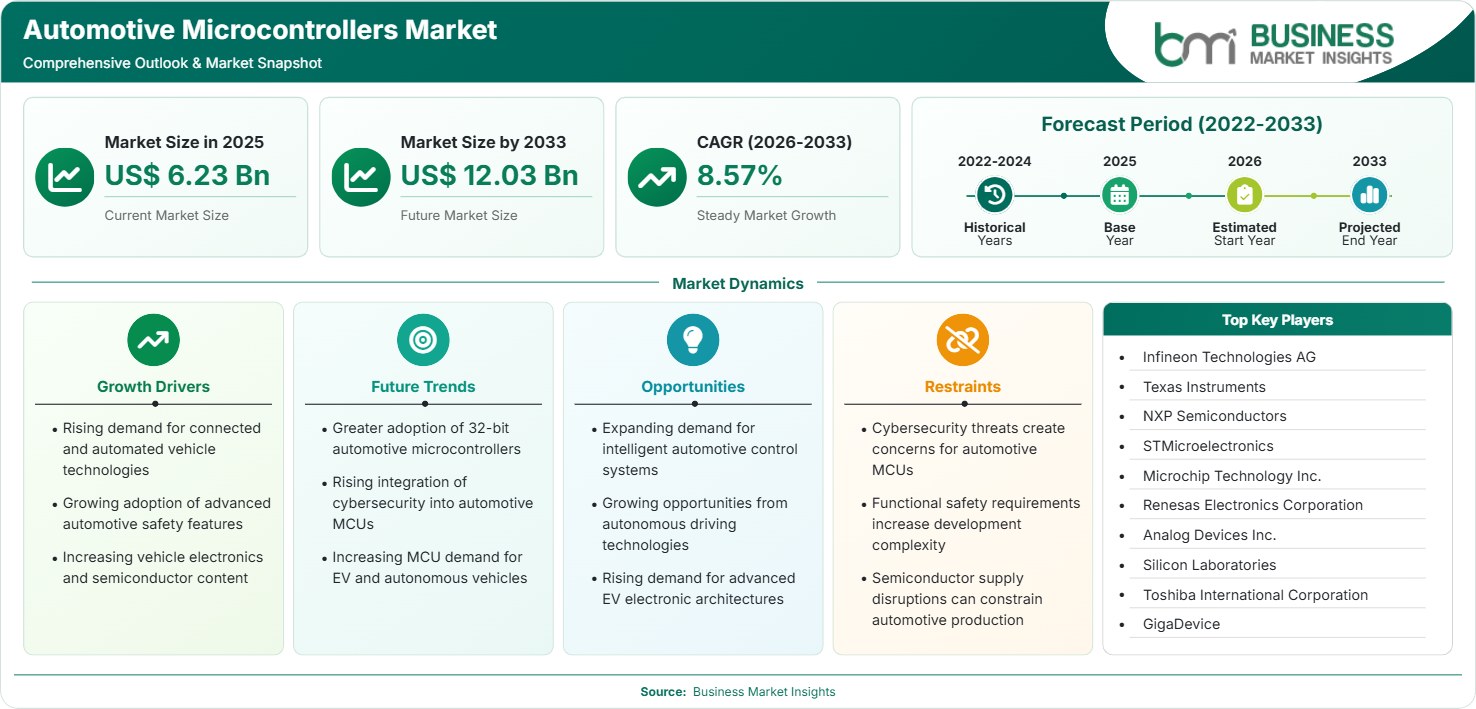
The Automotive Microcontrollers Market size was valued at US$ 6.23 Billion in 2025 and is projected to reach US$ 12.03 Billion by 2033, growing at a CAGR of 8.57% during 2026–2033. Growth is supported by rising vehicle electrification, increasing deployment of advanced driver assistance systems (ADAS), expanding software-defined vehicle architectures, and growing semiconductor content per vehicle. Opportunities are emerging from zonal computing platforms, connected mobility ecosystems, and automotive semiconductor localization investments.

Report Coverage
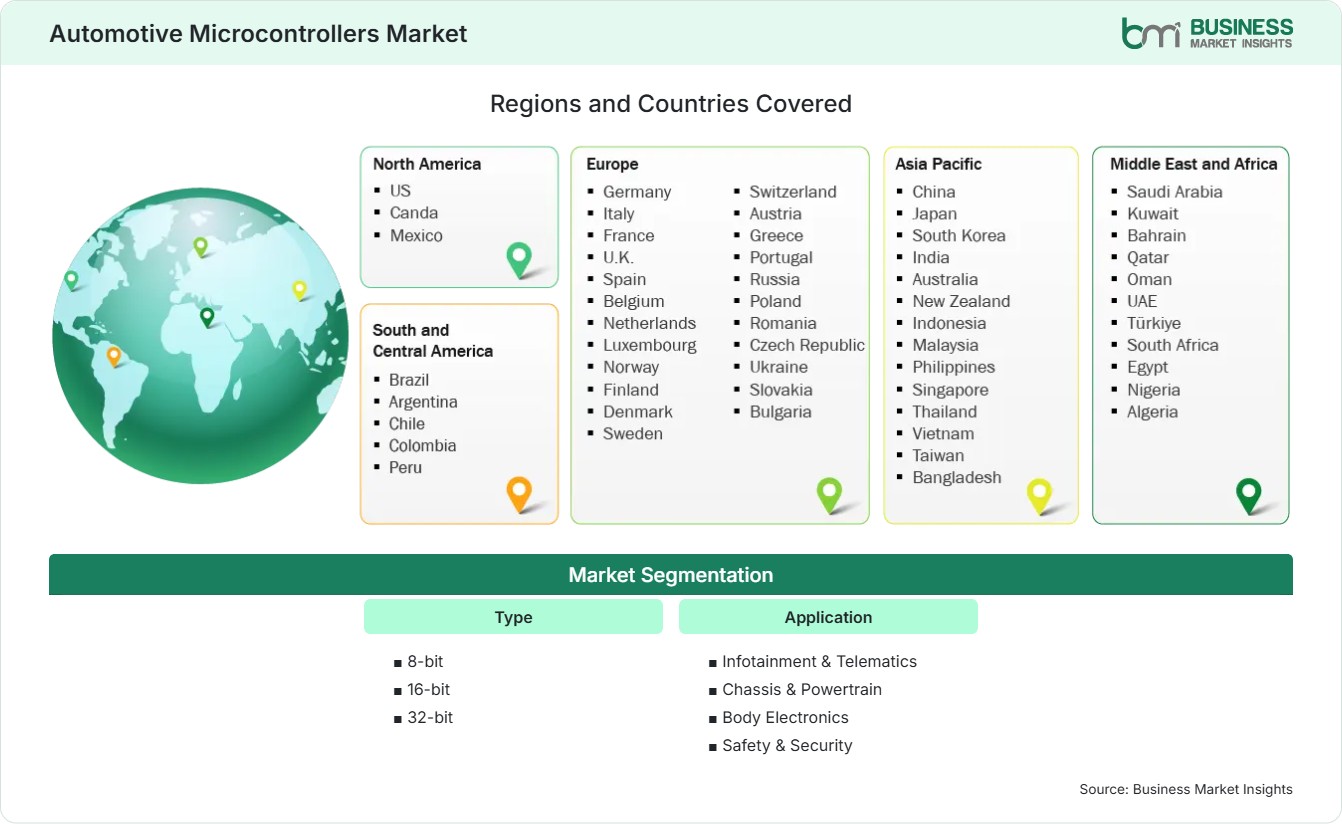
  • Type: 8-bit, 16-bit, 32-bit
  • Application: Infotainment & Telematics, Chassis & Powertrain, Body Electronics, Safety & Security
US$ 6.23 Bn Market size in 2025
US$ 12.03 Bn Market Size by 2033
8.57% CAGR, 2026 - 2033
2026-2033 Forecast Period

AI Overview

Automotive Microcontrollers Market Summary

  • North America Region: North America holds a 28%–31% share in 2025 and is projected to grow at a 7.8%–8.3% CAGR during 2026–2033. Demand is driven by ADAS integration, EV manufacturing investments, functional safety requirements, software-defined vehicle adoption, and advanced electronics deployment across passenger and commercial vehicle segments. The U.S. market benefits from strong automotive technology investments and is expected to expand at a 7.9%–8.4% CAGR.
  • Fastest Growing Region: Asia Pacific accounts for a 39%–42% share in 2025 and is forecast to register a 9.4%–9.9% CAGR through 2033. Expanding EV production, semiconductor manufacturing capacity, connected vehicle adoption, government industrial policies, and growing automotive electronics content continue accelerating regional demand.
  • Leading Segment: The 32-bit segment represents 56%–60% share in 2025 and is expected to advance at a 9.0%–9.5% CAGR during the forecast period. Growth is supported by higher processing requirements for ADAS, electrified powertrains, cybersecurity controls, digital cockpits, and intelligent vehicle networking systems.
  • High Growth Segment: The Safety & Security segment accounts for 22%–26% share in 2025 and is projected to expand at a 10.2%–10.8% CAGR. Regulatory mandates, growing sensor integration, autonomous driving technologies, collision avoidance systems, and cybersecurity requirements continue strengthening adoption across modern vehicle platforms.
  • Key Market Opportunity: Increasing deployment of zonal architectures and centralized vehicle computing platforms creates opportunities for scalable microcontroller solutions supporting software updates, safety applications, advanced connectivity, and power management requirements.
  • Major Market Players: Infineon Technologies AG, Texas Instruments Incorporated, NXP Semiconductors N.V., STMicroelectronics N.V., Microchip Technology Incorporated, Renesas Electronics Corporation, Analog Devices, Inc., Silicon Laboratories Inc., Toshiba Corporation, and GigaDevice Semiconductor Inc.
Strategic Insights

Automotive Microcontrollers Market: Strategic Insights

Automotive Microcontrollers Market Strategic Framework
FREE PDF
Request your free sample
Request free sample
Stakeholder View

Key Takeaways

  • The automotive semiconductor ecosystem is evolving toward deeper collaboration between automakers, Tier-1 suppliers, software developers, and semiconductor manufacturers. Long-term sourcing agreements and localized manufacturing strategies are becoming increasingly important to mitigate supply disruptions and improve production visibility.
  • Safety and security applications present one of the strongest growth opportunities due to increasing adoption of ADAS functions, electronic braking systems, airbag controls, driver monitoring systems, and cybersecurity-enabled vehicle platforms.
  • Research and development investments are increasingly focused on 32-bit architectures, functional safety compliance, energy-efficient processing, and software-defined vehicle platforms capable of supporting advanced computing workloads and over-the-air updates.
  • Asia Pacific offers the most compelling growth opportunity due to its concentration of EV production, automotive electronics manufacturing, semiconductor ecosystem development, and supportive government policies promoting industrial expansion and technology innovation.
  • Automotive semiconductor vendors are expanding partnerships with automakers, software providers, and cloud technology companies to strengthen product ecosystems, accelerate development timelines, and improve compatibility with future mobility technologies.
  • Functional safety expertise, cybersecurity integration capabilities, software ecosystem development, and scalable controller architectures are emerging as critical differentiators for suppliers competing in technologically advanced vehicle platforms.
Geographic Outlook

Automotive Microcontrollers Market Regional Highlights

North America Automotive Microcontrollers Market

North America accounted for 28%–31% of Automotive Microcontrollers Market share in 2025 and is projected to expand at a 7.8%–8.3% CAGR during 2026–2033. The high penetration rate of ADAS systems, robust efforts towards electric vehicle transformation, and connected car platforms is a strength of this region. Centralized computing and cyber secure electronic systems are key priorities for the automotive manufacturers. Semiconductor localization programs and advanced manufacturing support provided by governments are making the supply chain even stronger. The region’s competitive advantage is the presence of automotive OEMs and semiconductor companies.

  • The manufacturing of electric vehicles increases the need for controllers for battery management, heat management, onboard charging, and powertrain optimization in passenger and commercial vehicles.
  • Advanced driver assistance systems become standard features in mid-range vehicles, hence creating increased demand for processing units for sensor fusion and vehicle decision-making operations.
  • Government-sponsored semiconductors manufacturing projects are motivating investment in local manufacturing capabilities, which not only helps in reducing supply chain dependence but also in the development of automotive electronics technologies.
  • Connected mobility solutions, including over-the-air software updates and vehicle-to-everything communication, are driving adoption of high-performance embedded controllers across next-generation vehicle architectures.
  • Increasing focus on software-defined vehicles is enabling deployment of scalable controller platforms designed to support future functionality upgrades without extensive hardware redesign requirements.

US Automotive Microcontrollers Market

The United States represented approximately 78%–82% of North American revenue in 2025 and is anticipated to register a 7.9%–8.4% CAGR through 2033. The demand for the product is bolstered by high levels of investments in electric vehicles production, self-driving cars, automotive software, and semiconductors manufacturing. In addition, there is an increased collaboration between automakers and technology firms to build intelligent mobility solutions. The country’s innovative environment, with the help of automotive research centers and semiconductors design, has continued to drive advancements in microcontrollers.

  • Substantial investments in EV assembly plants are boosting the demand for powertrain control systems, battery management electronics, and certified automotive-grade microcontrollers.
  • Deployment of autonomous vehicles through pilot projects is spurring demand for efficient computing technologies that can handle ever more sophisticated sensor and vehicle intelligence systems.
  • Investments in chip fabrication and packaging factories are building up supply chain robustness, while driving innovations in the local automotive electronics ecosystem.
  • Connected vehicle fleets are helping drive demand for communications-enabled controllers that enable predictive maintenance.

Europe Automotive Microcontrollers Market

Europe held an estimated 24%–27% Automotive Microcontrollers Market share in 2025 and is forecast to grow at a 7.6%–8.1% CAGR between 2026 and 2033. The region continues to be a significant location in the manufacture of high-quality vehicles, automotive engineering, and innovations in safety features. Increasing demands for stricter environmental emissions and increased focus on electrification continue to lead to increased use of sophisticated vehicle electronics. Germany still leads in terms of national markets, while Poland and other CEE countries show relatively higher growth rates.

  • Germany retains its regional leadership because of the high presence of luxury car manufacturers and their investments in electrification of mobility solutions.
  • Automotive safety regulations continue to provide incentives to integrate advanced processing solutions for braking, steering, monitoring, and driving assistance.
  • Electrification policies in France, Germany, and the Nordic countries are promoting the use of controllers in battery and energy management solutions.
  • Poland is becoming one of the fastest-growing manufacturing markets due to investments in automotive production and electronics.
  • Growing adoption of software-centric vehicle architectures is encouraging demand for secure and scalable controller platforms throughout the region.

Asia Pacific Automotive Microcontrollers Market

Asia Pacific accounted for 39%–42% Automotive Microcontrollers Market share in 2025 and is expected to register the fastest regional expansion at a 9.4%–9.9% CAGR through 2033. The region is favored by high levels of automotive manufacturing, electric vehicle adoption, growth in semiconductor manufacturing capacity, and industrial policy support. The reason China continues to be the main source of revenue is its ecosystem of electric vehicles and electronics manufacturing. The promising market for long-term growth in the region is India, owing to localization efforts and investments in vehicle technology.

  • China leads regional demand through extensive electric vehicle manufacturing activities and large-scale deployment of connected mobility technologies.
  • India is rising as a high growth hub due to automotive electronics localization, growing vehicle manufacture, and government-sponsored manufacturing initiatives.
  • Japan continues to lead innovation in functional safety systems, precision electronics, and automotive semiconductor technology.
  • South Korea promotes market development by providing advanced vehicle technology, connectivity, and electronics industry knowledge.
  • Regional semiconductor investments are improving production capacity and strengthening supply-chain integration for automotive electronic components.

Rest of World Automotive Microcontrollers Market

The Rest of World region accounted for approximately 8%–11% Automotive Microcontrollers Market share in 2025 and is forecast to grow at an 8.1%–8.6% CAGR through 2033. The South and Central America regions have seen continued gains in terms of manufacturing activities in the automotive sector, with Brazil and Mexico emerging as notable examples. In turn, the Middle East and Africa have been witnessing an uptick in the use of intelligent transportation systems and connected mobility services. Growth is fueled by modernization of vehicles, safety trends, and digital vehicle platforms.

  • Brazil is still the most significant South American market because of its automotive production history and increased use of automotive electronic systems.
  • Investments for automotive production in Mexico keep coming, hence increasing the demand for embedded automotive control systems in export-oriented automotive plants.
  • Saudi Arabia is making investments in next-generation mobility solutions which provide room for intelligent and connected vehicles technology.
  • The UAE is scaling up the deployment of smart mobility infrastructure, which drives the adoption of increasingly complex automotive electronics architecture.
  • Initiatives to modernize fleets and enhance vehicle safety in emerging economies drive the demand for automotive microcontroller solutions.
Global Market Geography
FREE PDF
Request your free sample
Request free sample
Segment Analysis

Automotive Microcontrollers Market Segmentation

Type

The Type segment remains the foundation of controller deployment across modern vehicles. The 32-bit category held the leading position with 56%–60% market share in 2025 and is expected to expand at a 9.0%–9.5% CAGR through 2033. Increasing software complexity, electrification requirements, cybersecurity implementation, and ADAS integration continue strengthening demand. The Automotive Microcontrollers Market scope is expanding as automakers transition toward centralized computing architectures that require higher-performance processing capabilities and enhanced functional safety compliance.

  • 8-bit: These controllers remain relevant in cost-sensitive body electronics applications, supporting lighting controls, seat adjustments, switch management, and basic monitoring functions where processing requirements remain relatively limited.
  • 16-bit: Widely deployed in mid-range automotive systems, these solutions provide balanced performance and cost efficiency for instrument clusters, climate control systems, motor controls, and vehicle monitoring applications.
  • 32-bit: Increasingly preferred across advanced vehicle platforms due to superior computational capability, support for real-time processing, software integration requirements, and compatibility with modern safety and connectivity functions.

Application

Application demand is evolving alongside increasing vehicle intelligence and automation. Chassis & Powertrain accounted for 33%–37% share in 2025 and continues to represent the largest application segment. Meanwhile, Safety & Security is expected to register the fastest expansion at 10.2%–10.8% CAGR through 2033. The Automotive Microcontrollers Market trends indicate growing integration of intelligent electronics across both conventional and electric vehicle platforms, increasing controller penetration throughout vehicle systems.

  • Infotainment & Telematics: Digital cockpit deployments, vehicle connectivity platforms, navigation systems, and multimedia functionality are increasing demand for responsive and energy-efficient controller solutions.
  • Chassis & Powertrain: Electrified propulsion systems, transmission management, engine controls, battery management functions, and energy optimization applications continue driving sustained controller adoption.
  • Body Electronics: Comfort features, lighting systems, HVAC controls, door modules, and electronic convenience functions contribute to stable demand across passenger and commercial vehicles.
  • Safety & Security: Advanced driver assistance technologies, collision avoidance systems, driver monitoring platforms, cybersecurity controls, and electronic safety functions continue accelerating deployment of sophisticated controller architectures.
Market Forces

Automotive Microcontrollers Market Dynamics

Key Market Drivers

Vehicle Electrification Increasing Semiconductor Content Per Vehicle

The rapid growth of electric vehicle production continues to increase the number of microcontrollers required in automotive platforms. The need for controllers in batteries, thermal, inverter, charge and powertrain control is important. As manufacturers bring out their dedicated EV architectures, the need for embedded processing increases further than internal combustion engine vehicles. The International Energy Agency highlights significant global progress in electric vehicle uptake, prompting automakers to accelerate investments in automotive electronics. With increased complexity of batteries, efficiency needs, and intelligent charge needs, the need for automotive grade controllers rises. Such trends will help sustain the demand for semiconductors within the automotive industry.

Expansion of Advanced Driver Assistance Systems

Advanced driver assistance systems are becoming standard features across vehicle segments, creating sustained demand for high-reliability microcontroller solutions. Adaptive Cruise Control, Lane Departure Warning, Automatic Emergency Braking, Parking Assist, and Driver Monitoring applications need to have a processing capability that can cater to the real-time requirements of such systems. Governments around the world, including in North America, Europe, and Asia, are urging greater use of safety technologies in vehicles. In response, manufacturers are using more electronic control systems that provide for functional safety and safe operation of vehicles. The growing inclination of customers towards safety features has added to this trend.

Transition Toward Software-Defined Vehicle Architectures

Software-defined vehicles are reshaping automotive electronic architectures by shifting functionality from hardware-centric systems to programmable software-driven environments. The shift enhances the need for flexible microcontroller systems that are capable of software upgrades, security, cloud communication, and expanding capabilities. Automobile manufacturers are increasingly seeking computing flexibility to differentiate their products through software rather than significantly modifying their hardware designs. This is why controller vendors are focusing on developing software ecosystems, development tools, and frameworks for integration.

Key Market Opportunities

Growth Opportunities in Zonal Vehicle Architectures

Zonal and centralized architectures in vehicles present an enormous potential for semiconductor suppliers. The classic architecture based on distributed electronics is becoming increasingly condensed into several more advanced control domains. This simplifies the cabling, increases the vehicle's efficiency, and makes software use much more flexible. In addition, this change increases the contribution of each controller in the vehicle. For that reason, the suppliers able to provide the needed processing power and security features become highly valuable. These developments support favorable Automotive Microcontrollers Market Forecasts, particularly among suppliers aligned with software-defined vehicle strategies.

Automotive RISC-V Ecosystem Development

The emergence of RISC-V-based automotive processing platforms creates a significant long-term opportunity for both semiconductor suppliers and automotive manufacturers. Architectures with open standards create more flexibility in software development, customizability, and collaboration in an ecosystem. The automotive industry is currently exploring ways to simplify software development processes but at the same time ensuring scalability and compliance to safety. With the evolution of the RISC-V ecosystem, it is expected that many opportunities will arise in areas such as development toolchains, operating systems, safety software, and controller hardware platforms.

Expansion of Emerging Automotive Manufacturing Hubs

Automotive manufacturing investments across India, Southeast Asia, Eastern Europe, and selected Middle Eastern countries are creating new growth opportunities for embedded semiconductor vendors. Governments are increasingly supporting localization initiatives designed to strengthen automotive supply chains and reduce import dependencies. Vehicle manufacturers are establishing production facilities closer to high-growth consumer markets, generating demand for regional electronics ecosystems. Increased local production of electric vehicles, commercial vehicles, and connected transportation platforms further supports adoption of automotive-grade controllers. Suppliers establishing regional partnerships, application engineering capabilities, and localized support infrastructure are well positioned to benefit from these expansion trends.

Market Restraints and Challenges

Semiconductor Supply Volatility Disrupts Automotive Production

Factor: Supply-chain volatility remains a significant challenge for automotive electronics manufacturers. Automotive-grade semiconductor production requires specialized manufacturing processes, extensive qualification cycles, and strict quality standards. Any disruption affecting wafer fabrication, packaging operations, logistics networks, or raw material availability can impact product delivery schedules. Impact: Car manufacturers could face production delays and procurement costs when their parts availability is low. The long qualification process also limits the option of substitutions in comparison to other industries. Despite the continuous efforts of the government and industry to improve supply chain resilience, keeping the steady production capacity is still a critical issue.

Rising System Complexity Increases Development Costs

Automotive electronic systems are becoming substantially more complex as vehicles integrate advanced safety technologies, connectivity functions, cybersecurity capabilities, and software-defined architectures. Factor: Expanding functional requirements increase engineering, validation, certification, and software development workloads. Impact: The product development cycle time becomes longer and costly, putting pressure on profitability and allocation of resources. The automakers and their suppliers have to comply with stricter functional safety and cybersecurity standards without compromising performance and reliability. This entails large expenditures on R&D and testing.

Company Analysis

Competitive Landscape

The Automotive Microcontrollers Market analysis reflects intense competition centered on functional safety, computing performance, software ecosystem enablement, power efficiency, and automotive qualification expertise. Leading participants are expanding investments in software-defined vehicle platforms, cybersecurity capabilities, ADAS processing solutions, and electrification-focused controller portfolios to strengthen their positions across global automotive supply chains.

Company Name

Overview

Products and Services Relevant to This Market

Infineon Technologies AG

Global automotive semiconductor leader with a strong presence in powertrain, safety, and body electronics applications across passenger and commercial vehicles.

AURIX microcontrollers, automotive processors, safety controllers, body electronics solutions, powertrain control platforms, and electrification-focused semiconductor technologies.

Texas Instruments Incorporated

Leading embedded processing and analog semiconductor supplier serving automotive OEMs and Tier-1 suppliers worldwide.

Automotive microcontrollers, embedded processors, power management solutions, vehicle networking components, sensing devices, and system control technologies.

NXP Semiconductors N.V.

Major automotive semiconductor company focusing on vehicle networking, processing, security, and intelligent mobility solutions.

S32 automotive processors, vehicle networking platforms, secure controllers, body electronics solutions, and automotive software enablement technologies.

STMicroelectronics N.V.

Diversified semiconductor manufacturer with a strong automotive portfolio supporting electrification and safety applications.

Automotive microcontrollers, power semiconductor devices, sensor solutions, control systems, vehicle electronics components, and embedded processing technologies.

Microchip Technology Incorporated

Embedded control specialist supporting automotive, industrial, and connectivity-focused applications worldwide.

Automotive-grade microcontrollers, memory solutions, analog technologies, secure connectivity platforms, and embedded system development solutions.

Renesas Electronics Corporation

Recognized supplier of automotive processors and control solutions for next-generation mobility applications.

RH850 microcontrollers, automotive SoCs, connectivity solutions, power management products, and advanced vehicle control platforms.

Analog Devices, Inc.

Technology provider focused on high-performance signal processing, sensing, and battery management applications.

Mixed-signal solutions, battery management systems, sensing technologies, signal conditioning products, and automotive electronic solutions.

Silicon Laboratories Inc.

Embedded technology company supporting connectivity and low-power processing requirements across intelligent systems.

Embedded controllers, wireless technologies, connectivity solutions, development tools, and automotive electronic support platforms.

Toshiba Corporation

Diversified technology company serving automotive, power electronics, and embedded control applications.

Automotive microcontrollers, power devices, motor control solutions, embedded semiconductors, and vehicle electronics platforms.

GigaDevice Semiconductor Inc.

Growing semiconductor manufacturer expanding its presence in embedded processing and memory technologies.

Automotive microcontrollers, flash memory products, processing components, embedded solutions, and electronic control technologies.

Trust & Transparency

Research Methodology

The market analysis combines proprietary research with secondary data from government agencies, company disclosures, regulatory filings, industry databases and expert interviews. Market estimates are validated through data triangulation, cross-market benchmarking and analyst review.

View Full Research Methodology

Questions Answered

Frequently Asked Questions

What does the Automotive Microcontrollers Market Report provide for stakeholders?

The Market Report provides detailed insights into market size, competitive positioning, technology trends, segment performance, regional outlook, growth opportunities, and strategic developments influencing future industry expansion.

What is the most important regional growth opportunity?

Asia Pacific remains the strongest regional opportunity because of its concentration of vehicle manufacturing, EV production, semiconductor capacity expansion, and government-supported industrial development programs.

Which application segment offers the strongest future growth potential?

Safety & Security is projected to demonstrate the strongest growth due to expanding deployment of collision avoidance systems, driver monitoring technologies, cybersecurity functions, and autonomous driving capabilities.

Why are 32-bit microcontrollers leading market demand?

32-bit architectures provide higher computing performance, advanced security functionality, real-time processing capability, and support for increasingly sophisticated automotive applications such as ADAS and battery management systems.

What factors are increasing microcontroller content within vehicles?

Vehicle electrification, ADAS deployment, connected mobility functions, digital cockpit systems, and software-defined vehicle architectures are increasing the number and complexity of controllers integrated into modern vehicles.

Access the Full Automotive Microcontrollers Market Report

Get segment-level forecasts, regional estimates, competitive benchmarking, company profiles and downloadable Excel datasets.

Access the full Automotive Microcontrollers Market Report
350 pages PDF & Excel | 2026-09-22
Similar Research

Related Market Reports