
Automotive Electric Vacuum Pump Market Outlook: Size, Share, Trends, Growth Analysis, Competitive Landscape & Forecast, 2026–2033

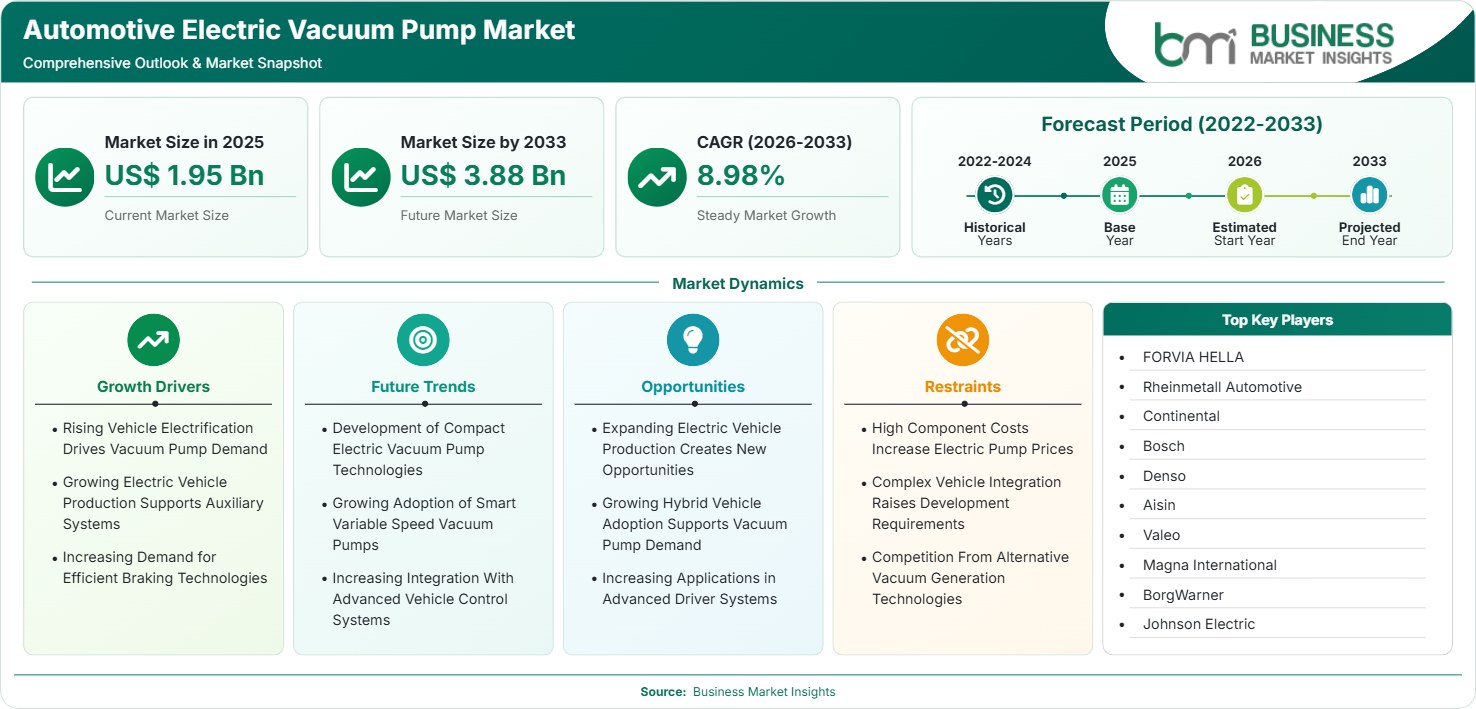
The Automotive Electric Vacuum Pump Market size was valued at US$ 1.95 billion in 2025 and is projected to reach US$ 3.88 billion by 2033, growing at a CAGR of 8.98% during 2026–2033, driven by electrification, efficient braking, hybridization, auxiliary systems, and advanced vehicle architectures.

Report Coverage
  • Electric Vehicle Type: BEV, HEV, PHEV
  • Vehicle Type: Passenger Car, LCV, HCV
US$ 1.95 Bn Market size in 2025
US$ 3.88 Bn Market Size by 2033
8.98% CAGR, 2026 - 2033
2026-2033 Forecast Period

AI Overview

Automotive Electric Vacuum Pump Market Summary

  • North America: North America holds 24%-27% share in 2025 and grows at a CAGR of 8.1%-8.7%, supported by vehicle electrification, hybrid vehicle adoption, advanced braking systems, and increasing demand for electrically driven auxiliary technologies. The U.S. remains the regional center, supported by expanding EV platforms, hybrid powertrains, electronically controlled braking architectures, and integration of electrically powered vacuum generation into modern vehicles.
  • Fastest Growing Region: Asia Pacific holds 43%-46% share in 2025 and expands at a CAGR of 9.6%-10.4%, supported by high vehicle production, accelerating electrification, expanding EV manufacturing, hybrid adoption, and increasing deployment of electronically controlled vehicle systems.
  • Leading Segment: BEV holds 42%-46% share in 2025 and grows at a CAGR of 10.1%-10.8%, supported by increasing electrification, reduced engine vacuum availability, electronically controlled braking, and greater dependence on independent electrically powered auxiliary systems.
  • High Growth Segment: HCV holds 13%-16% Automotive Electric Vacuum Pump Market share in 2025 and grows at a CAGR of 9.2%-10.0%, driven by commercial vehicle electrification, braking reliability requirements, fleet modernization, and increasing use of electronically controlled auxiliary systems.
  • Key Market Opportunity: Electrified powertrains, hybrid vehicles, advanced braking, driver assistance, and commercial vehicle platforms are creating opportunities for compact, efficient, durable vacuum pumps with intelligent control capabilities.
  • Major Market Players: FORVIA HELLA, Rheinmetall Automotive, Continental, Bosch, Denso, Aisin, Valeo, Magna International, BorgWarner, Johnson Electric.
Strategic Insights

Automotive Electric Vacuum Pump Market: Strategic Insights

Automotive Electric Vacuum Pump Market Strategic Framework
FREE PDF
Request your free sample
Request free sample
Stakeholder View

Key Takeaways

  • The value chain is becoming more integrated as vacuum pump suppliers work closely with braking-system manufacturers, vehicle OEMs, powertrain developers, electronics suppliers, and platform engineering teams.
  • Battery-electric and hybrid platforms provide the strongest expansion opportunities because electrified architectures reduce reliance on conventional engine-generated vacuum and increase the need for independent auxiliary systems.
  • Product innovation is moving toward brushless motors, variable-speed operation, compact architectures, integrated pressure sensing, lower acoustic output, and intelligent control strategies.
  • Asia Pacific presents the strongest investment case because vehicle manufacturing, electrification, component localization, and EV supply-chain development are advancing simultaneously.
  • Investment and partnership activity is increasingly focused on electrified vehicle platforms, braking electronics, thermal management, auxiliary motors, and integrated mechatronic systems.
  • Supplier differentiation will increasingly depend on reliability, energy consumption, packaging flexibility, noise performance, software compatibility, and the ability to meet vehicle-specific validation requirements.
Geographic Outlook

Automotive Electric Vacuum Pump Market Regional Highlights

North America Automotive Electric Vacuum Pump Market

North America represents 24%-27% share in 2025 and is projected to grow at a CAGR of 8.1%-8.7% through 2033. Electrified vehicle production, hybrid adoption, advanced braking systems, and electronically controlled auxiliary technologies support regional demand.

  • Electrified passenger vehicles increasingly require independent vacuum generation because braking assistance cannot consistently depend on conventional engine-generated vacuum across operating modes.
  • Hybrid platforms create additional demand as engines periodically shut down, requiring auxiliary vacuum availability during electric-only operation, stop-start conditions, and regenerative braking transitions.
  • Commercial vehicle manufacturers are adopting electrically powered auxiliary systems to improve packaging flexibility and support increasingly electronic vehicle architectures.
  • Vehicle software and electronic control integration is becoming important as pump operation can be coordinated with braking demand, pressure requirements, energy management, and diagnostic systems.

US Automotive Electric Vacuum Pump Market

The U.S. represents 79%-83% of North American demand in 2025 and grows at a CAGR of 8.0%-8.6%. Electrified vehicle adoption, hybrid platforms, and advanced braking architectures support sustained demand.

  • Passenger vehicle electrification is increasing the requirement for electrically generated vacuum, particularly where engine operation is intermittent or absent.
  • Hybrid vehicles provide an important transition application because auxiliary braking support must remain available during engine-off operating conditions.
  • Advanced braking and driver assistance architectures are encouraging closer integration between vacuum generation, electronic controls, sensors, and vehicle control systems.

Europe Automotive Electric Vacuum Pump Market

Europe represents 26%-29% share in 2025 and grows at a CAGR of 8.5%-9.2%. Germany leads regional demand, while France, Italy, Spain, and the United Kingdom provide additional opportunities through electrification and vehicle-system modernization.

  • Germany benefits from an advanced automotive manufacturing ecosystem and strong development activity across electric, hybrid, braking, chassis, and electronically controlled vehicle platforms.
  • France and Italy provide opportunities as manufacturers expand electrified passenger vehicles and increasingly integrate electronically controlled auxiliary systems into new architectures.
  • Spain supports demand through automotive manufacturing and increasing production of electrified vehicle platforms requiring compact and efficient auxiliary components.
  • The United Kingdom provides opportunities through EV development, advanced vehicle engineering, and increasing deployment of electronically controlled braking and driver assistance technologies.

Asia Pacific Automotive Electric Vacuum Pump Market

Asia Pacific represents 43%-46% share in 2025 and expands at a CAGR of 9.6%-10.4%, making it the fastest-growing region. China, Japan, South Korea, and India provide major opportunities.

  • China provides substantial demand through high vehicle production, rapid EV adoption, expanding domestic component manufacturing, and increasing deployment of electronically controlled vehicle systems.
  • Japan supports mature demand through established hybrid technology, advanced vehicle electronics, high manufacturing capabilities, and continued development of efficient auxiliary systems.
  • South Korea provides opportunities through EV manufacturing, battery-electric platforms, advanced braking technologies, and strong automotive electronics capabilities.
  • India is developing rapidly as EV and hybrid adoption increases, creating opportunities for localized components supporting electrified passenger and commercial vehicle architectures.

Rest of World Automotive Electric Vacuum Pump Market

Rest of World represents 8%-11% share in 2025 and grows at a CAGR of 7.4%-8.2%. Latin America provides leading opportunities, while Middle Eastern and African markets develop from smaller electrified vehicle bases. Latin America is supported by vehicle production, hybrid adoption, and gradual electrification.

Brazil and Mexico provide leading opportunities, while Argentina and Chile offer additional demand as electrified mobility and advanced vehicle technologies expand. Middle Eastern and African markets remain earlier-stage opportunities, with adoption concentrated in premium vehicles, fleet applications, and new electrified mobility initiatives. Infrastructure development and vehicle affordability will influence the pace of market expansion.

  • Brazil provides opportunities through automotive manufacturing, hybrid vehicles, and increasing interest in electrified powertrain technologies.
  • Mexico benefits from substantial vehicle manufacturing activity and integration into global automotive supply chains, supporting demand for advanced vehicle components.
  • Gulf markets provide opportunities for premium electrified vehicles and advanced braking technologies as manufacturers expand technology-rich vehicle portfolios.
  • South Africa offers longer-term potential as hybrid and electric vehicle availability expands and advanced vehicle components become more widely adopted.
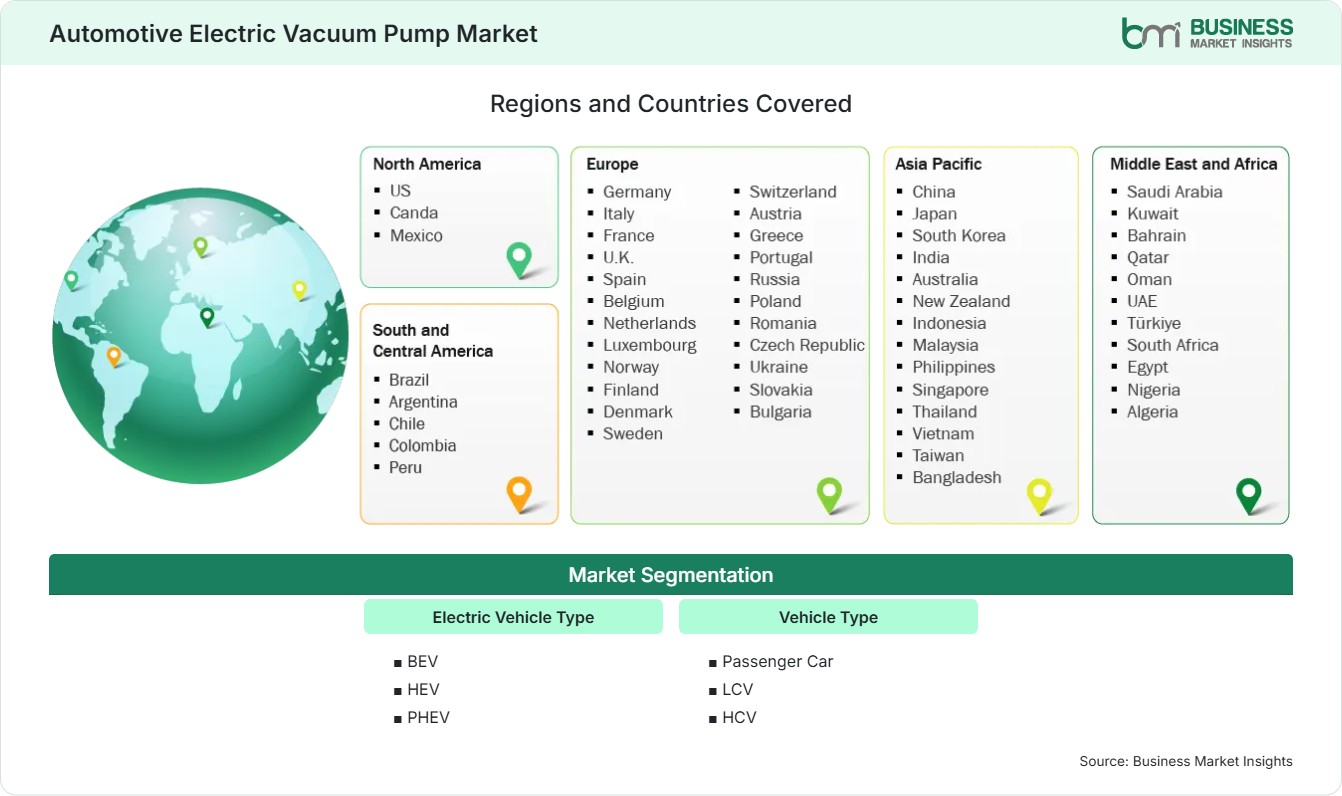
Global Market Geography
FREE PDF
Request your free sample
Request free sample
Segment Analysis

Automotive Electric Vacuum Pump Market Segmentation

Electric Vehicle Type

BEV represents 42%-46% share in 2025 and grows at 10.1%-10.8% CAGR through 2033, supported by the absence of conventional engine vacuum and increasing dependence on electric auxiliary systems. HEV and PHEV platforms also require independent vacuum support during engine-off conditions. The Automotive Electric Vacuum Pump Market scope is therefore expanding across multiple electrified powertrain configurations.

  • BEV: BEVs require independent electric vacuum generation because they lack conventional engine vacuum, supporting consistent braking assistance and electronically managed auxiliary operation.
  • HEV: HEVs require vacuum support during engine-off and electric-drive conditions, increasing demand for compact pumps capable of responsive pressure generation.
  • PHEV: PHEVs combine electric and combustion operation, requiring auxiliary vacuum systems that maintain braking support across changing powertrain operating modes.

Vehicle Type

Passenger Car represents 72%-76% Automotive Electric Vacuum Pump Market share in 2025 and grows at 8.7%-9.3% CAGR through 2033, supported by large electrified vehicle volumes and advanced braking adoption. LCV and HCV applications provide additional opportunities as commercial fleets adopt electric and hybrid powertrains. Vehicle architecture, braking requirements, packaging, duty cycles, and operating environments influence pump specifications.

  • Passenger Car: Passenger vehicles represent the largest application base as electrification, hybridization, advanced braking, and electronically controlled chassis systems expand across new vehicle platforms.
  • LCV: LCV applications benefit from fleet electrification and urban delivery requirements, creating demand for durable auxiliary vacuum systems with compact packaging and efficient energy consumption.
  • HCV: HCV applications require robust vacuum generation for demanding braking environments, supporting opportunities as commercial vehicle electrification and electronic braking technologies develop.
Market Forces

Automotive Electric Vacuum Pump Market Dynamics

Key Market Drivers

Rising Vehicle Electrification Drives Vacuum Pump Demand

The Automotive Electric Vacuum Pump Market growth is associated with the electrification of vehicles, since electric powertrains do not produce engine-generated vacuum and, in most hybrid designs, the engine does not run continuously. This necessitates the presence of an auxiliary vacuum-generation system for the braking system and other vacuum-assisted functions. Electrified vehicles also consider energy efficiency, compactness, thermal management, and electronic system control. The pump design will need to be flexible enough to generate a vacuum as needed, rather than relying on continuous electrical power for operation. With the shift in vehicle architecture towards software-defined design, electric vacuum pumps will transition from mechanical pumps to electronic mechatronic systems.

Growing Electric Vehicle Production Supports Auxiliary Systems

There are two major driving factors influencing the growth of the Automotive Electric Vacuum Pump Market trend . Firstly, there has been a rise in electric vehicle production. Secondly, there is a rise in auxiliary functions that work independently of the combustion engine. The electric car requires proper operation of various systems, including brakes, cooling, steering, and other electrical components such as compressors and pumps. There is thus a need to integrate various technologies, including compact motors, electronics, sensors, and controls, to meet these needs. The vacuum pump needs to function reliably regardless of battery status, temperature, brake cycles, and vehicle operating modes. Therefore, manufacturers have focused on low power consumption, low acoustic noise, compactness, and durability.

Increasing Demand for Efficient Braking Technologies

Advancements in braking systems are leading to greater demand for vacuum generation due to their increasing dependence on electronic systems and integration with regenerative braking systems. Vehicles have both regenerative and friction braking systems, and the effective coordination of these systems under variable conditions requires proper management of braking force. Vacuum systems will still find applications in systems that require hydraulic or electro-hydraulic braking with controlled vacuuming. The pump's performance affects the system's responsiveness, reliability, noise level, and energy usage. Manufacturers are developing compact systems that deliver pressure without unnecessary pumping.

Key Market Opportunities

Expanding Electric Vehicle Production Creates New Opportunities

The Automotive Electric Vacuum Pump Market Forecast is driven by continued growth in electric vehicle production and the adoption of dedicated electric platforms. Every new platform presents an opportunity for vacuum pump suppliers to establish their presence on a long-term program via collaboration and validation in the early stages of engineering. Suppliers can establish themselves through small size, efficiency, quiet operation, reliability, and integration with vehicle control systems. Opportunities do not only arise from passenger cars but also from electric light and heavy commercial vehicles, which continue to be developed. Modular pump design may enable the transfer of core technology across various vehicle platforms while controlling performance and manufacturing costs.

Growing Hybrid Vehicle Adoption Supports Vacuum Pump Demand

The opportunity offered by hybrid cars lies in the fact that engine stops result in situations where the traditional formation of vacuum becomes impossible or limited. Electric vacuum pumps enable the creation of the vacuum required to achieve the necessary braking force during engine shutdown cycles, electric operation alone, and switching between power sources. Manufacturers can cater to this market using vacuum pumps that are cycle-capable, energy-efficient, space-saving, and fast-acting. The hybrid architecture itself can act as a compromise between traditional and full-electric drivetrains; manufacturers will be able to deploy auxiliary technologies on a number of drivetrain programs. Thus, demand will remain robust regardless of the specific pathway for vehicle electrification pursued.

Increasing Applications in Advanced Driver Systems

There is an increasing need for consistent braking system performance in advanced driver systems due to the reliance of assisted/automated driving functions on a consistent vehicle response. An electric vacuum pump can help enable the adoption of electronically managed braking systems, where pressure availability can be maintained independently of engine operation. The possibilities for integration with sensors, electronic control units, diagnostics, and even redundancy in braking systems are enhanced by vacuum pump technology. There will be increased future demands for functional safety and system availability in future vehicle architectures. This means that vacuum pump suppliers can gain a competitive advantage by monitoring, detecting faults, responding consistently, and communicating with the vehicle control network.

Market Restraints and Challenges

High Component Costs Increase Electric Pump Prices

Factor: electric vacuum pumps require motors, electronics, pressure controls, sensors, specialized materials, and validated components that can cost more than simpler conventional vacuum-generation arrangements. Impact: higher component costs can increase vehicle-system pricing and create pressure on suppliers to achieve cost reductions without compromising reliability or safety. The challenge is particularly relevant in price-sensitive vehicle segments where electrification already increases powertrain and electronics costs. Manufacturers are addressing this through component standardization, modular architectures, manufacturing automation, and improved motor efficiency. However, cost optimization must remain compatible with demanding automotive validation requirements. Suppliers able to scale common platforms across multiple vehicle programs can improve economics while preserving the performance characteristics required for electrified braking applications.

Complex Vehicle Integration Raises Development Requirements

Factor: electric vacuum pumps must integrate with braking systems, electronic controls, vehicle networks, electrical architectures, packaging constraints, thermal environments, and functional-safety requirements. Impact: integration complexity increases engineering time, validation requirements, software coordination, testing costs, and program-development risk. Requirements also vary by vehicle platform, powertrain, braking architecture, operating environment, and redundancy strategy. Suppliers therefore need multidisciplinary capabilities spanning mechanical engineering, electronics, software, controls, acoustics, and automotive validation. Close cooperation with vehicle and braking-system developers becomes essential during early platform design. Standardized interfaces and modular architectures can reduce development complexity, but platform-specific calibration and validation requirements will continue to create barriers for suppliers lacking established automotive engineering infrastructure.

Company Analysis

Competitive Landscape

The Automotive Electric Vacuum Pump Market analysis centers on automotive component suppliers with capabilities spanning braking systems, electric motors, mechatronics, vehicle electronics, and powertrain technologies. Competition increasingly depends on reliability, energy efficiency, acoustic performance, packaging, electronic integration, and OEM qualification. Suppliers with broad vehicle-system expertise can address increasingly complex electrified architectures.

Company Name

Overview

Products and Services relevant to this market

FORVIA HELLA

Automotive technology supplier providing electronic, lighting, and vehicle-system solutions for global vehicle manufacturers.

Electric vacuum pumps, braking-related components, electronics, sensors, actuators, and vehicle control technologies.

Rheinmetall Automotive

Automotive supplier providing mobility technologies and components across powertrain and vehicle-system applications.

Pumps, thermal-management components, electric auxiliary systems, mechatronic technologies, and vehicle components.

Continental

Global automotive technology company developing braking, electronics, software, and vehicle architecture solutions.

Brake systems, electronic controls, sensors, actuators, vacuum-related technologies, and electrified vehicle components.

Bosch

Major automotive technology supplier with broad expertise in braking, electronics, powertrain, and electrification.

Vacuum pumps, braking systems, electric motors, sensors, control units, and electrified vehicle technologies.

Denso

Global automotive component manufacturer specializing in thermal, powertrain, electronics, and vehicle-system technologies.

Electric pumps, braking components, motors, sensors, electronic controls, and electrification solutions.

Aisin

Automotive supplier providing drivetrain, braking, chassis, and vehicle-system technologies to global manufacturers.

Electric pumps, braking technologies, actuators, chassis components, and electrified vehicle systems.

Valeo

Automotive technology company developing electrification, braking, thermal, and driver assistance solutions.

Electric pumps, braking components, electrification systems, motors, sensors, and vehicle electronics.

Magna International

Diversified automotive supplier providing complete vehicle systems, components, electronics, and electrification technologies.

Electrified vehicle components, braking technologies, mechatronics, electronic systems, and integrated vehicle solutions.

BorgWarner

Automotive technology supplier focused on electrification, powertrain, thermal management, and advanced vehicle systems.

Electric pumps, motors, thermal-management systems, power electronics, and electrification technologies.

Johnson Electric

Motion and motor technology supplier serving automotive and industrial applications worldwide.

Electric motors, pumps, actuators, switches, motion systems, and compact mechatronic components for vehicles.

Trust & Transparency

Research Methodology

The market analysis combines proprietary research with secondary data from government agencies, company disclosures, regulatory filings, industry databases and expert interviews. Market estimates are validated through data triangulation, cross-market benchmarking and analyst review.

View Full Research Methodology

Questions Answered

Frequently Asked Questions

What does the Automotive Electric Vacuum Pump Market report indicate about future competition?

The report indicates that competition will focus on reliability, energy efficiency, low acoustic output, compact packaging, functional safety, electronic integration, and OEM qualification. Suppliers capable of adapting pump platforms across BEV, HEV, PHEV, passenger, and commercial vehicle architectures can strengthen their competitive positioning.

Why are electric vehicles creating new opportunities for vacuum pump suppliers?

Battery-electric vehicles do not generate conventional engine vacuum, creating a direct requirement for independent vacuum generation in suitable braking architectures. This gives suppliers opportunities to develop compact, efficient, quiet, electronically controlled pumps designed specifically for electric vehicle platforms.

How are electric vacuum pumps influencing braking-system development?

Electric vacuum pumps allow braking systems to maintain vacuum independently of engine operation. This supports electrified powertrains, regenerative braking coordination, electronically controlled braking architectures, and vehicle operating modes where conventional engine-generated vacuum is unavailable.

Which applications present the strongest opportunity in the market?

Battery-electric passenger vehicles, hybrid vehicles, electric commercial vehicles, and advanced braking systems provide strong opportunities. Commercial applications are particularly relevant as electrified fleets require reliable braking assistance across demanding duty cycles and increasingly electronic vehicle architectures.

What factors are improving Automotive Electric Vacuum Pump Market return on investment?

Vehicle electrification, hybridization, electronically controlled braking, advanced driver assistance, and growing demand for independent auxiliary systems are improving investment opportunities. Electric vacuum pumps provide braking support across engine-off and electric operating conditions while enabling compact vehicle architectures and electronically managed pressure generation.

Access the Full Automotive Electric Vacuum Pump Market Report

Get segment-level forecasts, regional estimates, competitive benchmarking, company profiles and downloadable Excel datasets.

Access the full Automotive Electric Vacuum Pump Market Report
350 pages PDF & Excel | 2026-08-19