Market Summary
Executive Summary and Global Market Analysis
Electric coolant pumps are electronically controlled fluid circulation systems used to regulate thermal management in vehicles, batteries, power electronics, fuel cells, and internal combustion engines. Unlike conventional mechanically driven pumps, electric coolant pumps operate independently of engine speed, enabling precise temperature control, improved energy efficiency, and optimized system performance. Their role has become increasingly important with the growing adoption of electric and hybrid vehicles that require advanced thermal management solutions.
The market is experiencing steady growth as automotive manufacturers prioritize energy efficiency, vehicle electrification, and advanced thermal management architectures. Electric coolant pumps are increasingly integrated into battery-electric vehicles (BEVs), hybrid electric vehicles (HEVs), fuel-cell electric vehicles (FCEVs), and modern internal combustion engine platforms to improve thermal regulation and operational reliability.
The transition toward electrified mobility is creating significant demand for intelligent thermal management systems capable of controlling battery temperatures, cabin climate systems, electric motors, and power electronics. As vehicle architectures become more complex, coolant circulation systems are evolving from single-loop configurations to multi-loop thermal management systems requiring multiple electric coolant pumps.
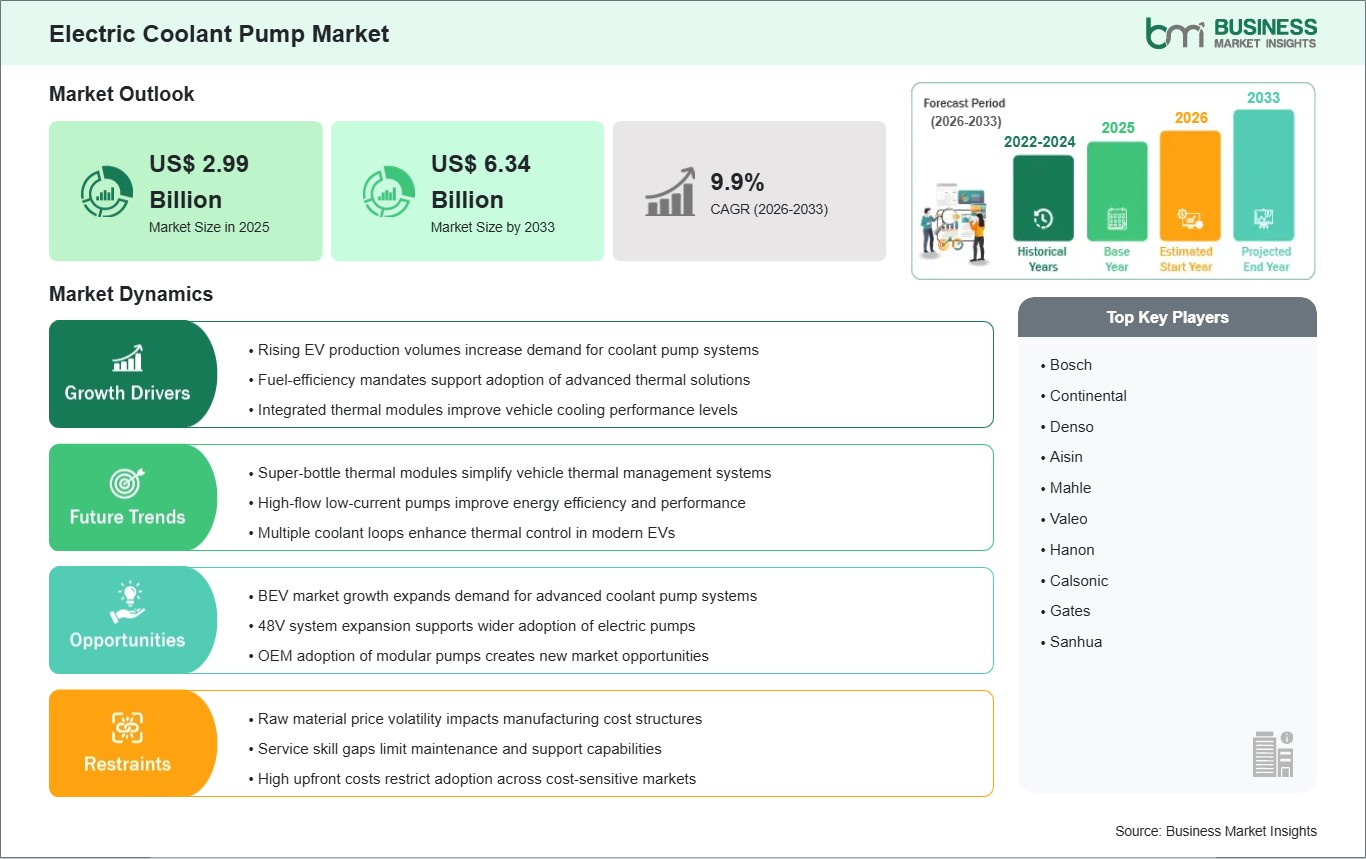
Technological advancements in pump design, electronic control systems, and lightweight materials are improving efficiency while reducing power consumption. Manufacturers are focusing on compact, high-flow, and low-noise solutions that support vehicle range optimization and enhanced thermal performance. Integration with centralized thermal management modules is further improving system efficiency and reducing vehicle complexity.
Segment Analysis
Electric Coolant Pump Market Segmentation
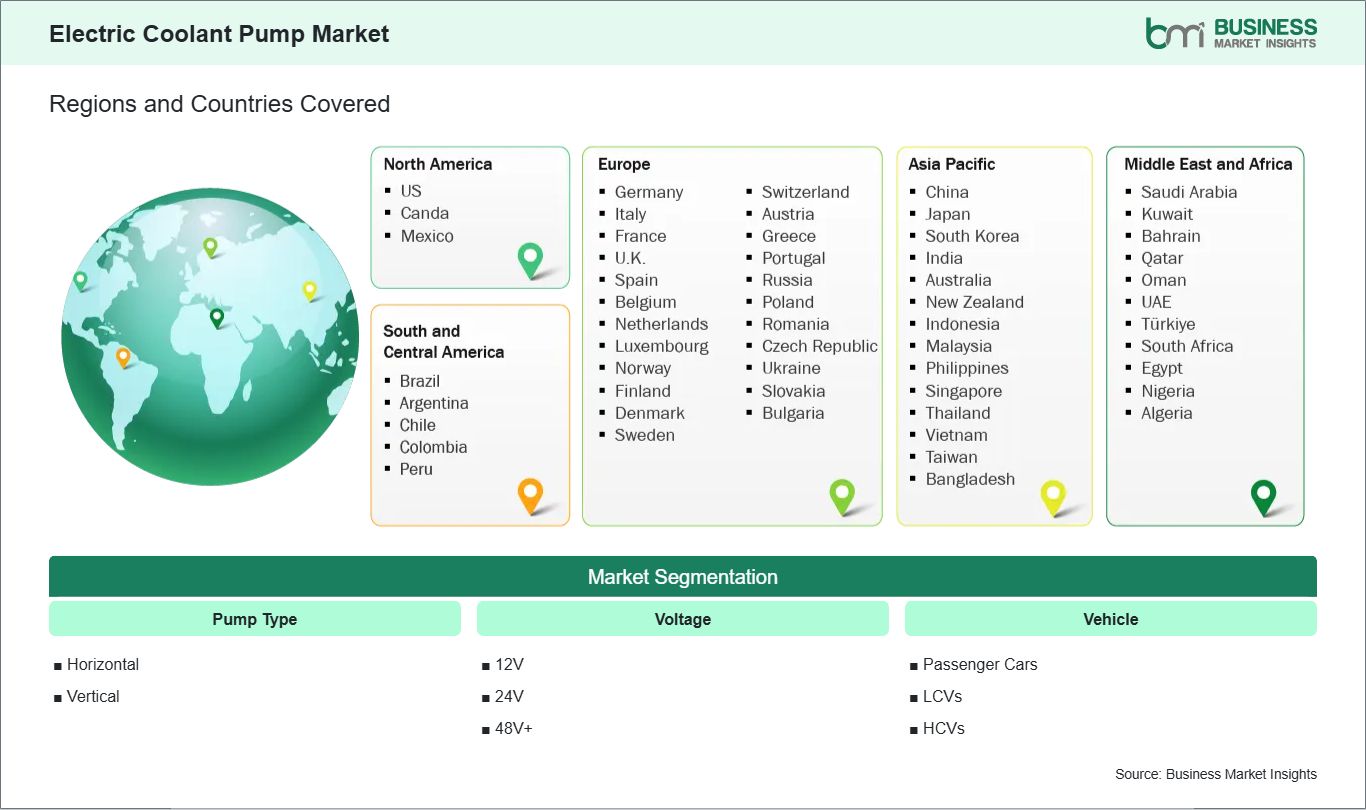
The electric coolant pump market is segmented based on pump type, voltage, and vehicle, reflecting the increasing demand for advanced thermal management systems across automotive applications.
By Pump Type
- Horizontal: Widely utilized across passenger and commercial vehicle applications due to flexible installation capabilities, compact packaging, and efficient coolant flow management.
- Vertical: Increasingly adopted in applications requiring optimized space utilization and specialized thermal management configurations.
By Voltage
- 12V: Maintains significant deployment in conventional passenger vehicles, hybrid vehicles, and auxiliary cooling applications.
- 24V: Commonly used in commercial vehicle platforms and heavy-duty applications requiring enhanced cooling performance.
- 48V+: Witnessing strong growth due to increasing adoption of advanced electrified powertrains, mild hybrid architectures, and battery-electric vehicle platforms.
By Vehicle
- Passenger Cars: Account for a major share owing to rising vehicle electrification, fuel-efficiency requirements, and increasing deployment of advanced thermal management systems.
- LCVs: Experiencing growing demand as fleet operators adopt electric and hybrid delivery vehicles for urban logistics applications.
- HCVs: Increasingly integrating electric coolant pumps to support electrified drivetrains, battery cooling, and emission reduction objectives.
Market Forces
Electric Coolant Pump Market Drivers and Opportunities
Rising EV Production Volumes
As electric vehicles (EVs) continue to gain traction in terms of production rates, there is an increasing need for electric coolant pumps due to the requirement that they have advanced thermal management systems to ensure that batteries, electric motors, power electronics, and charging systems remain within their specified operating temperature ranges. The thermal management requirement for electric coolant pumps will increase as EV production expands, both for passengers and commercial vehicles. The requirements for coolants will also expand due to the thermal management's relationship to battery performance, charging efficiency, safety and range.
The advantages provided by electric coolant pumps include the ability to provide precise thermal management to maintain consistent performance from a battery that may be in a different environment or driving condition. Because of these benefits, vehicle manufacturers are implementing multiple electric pumps into many of their new advanced thermal management designs.
Governments worldwide are continuing to promote the adoption of electric vehicles through emissions regulations, purchase incentives and investments in infrastructure. All of these actions have helped to accelerate the production of EVs, thereby helping to build a long-term market for electric coolant pump technologies in the global automotive industry.
Growth in BEVs
The electric coolant pump market has a significant growth opportunity due to the rising popularity of battery electric vehicles (BEVs). Unlike traditional vehicles, BEVs utilize active thermal management systems extensively to control the temperature of battery packs, inverters, electric motors, onboard charger and cabin climate control systems.
Due to the increasing amount of energy stored in batteries and the anticipated increase in the use of ultra-fast charging technologies, advanced thermal management systems will be needed to maintain the efficiency and reliability of these systems. This trend creates a considerable demand for high-performance electric coolant pumps that can produce multiple cooling circuits per vehicle platform.
Automakers are now increasingly investing in modular thermal management architectures that consolidate electric pumps, valves, heat exchangers and centralized control systems. The growth of global production of BEVs is expected to provide long term growth opportunities to suppliers who provide efficient, compact and intelligent coolant pump solution.
Size and Share Analysis
Electric Coolant Pump Market Size and Share Analysis
The electric coolant pump market is projected to grow from US$ 2.99 billion in 2025 to US$ 6.34 billion by 2033, registering a CAGR of 9.9% from 2026 to 2033.
By pump type, horizontal electric coolant pumps account for a significant market share due to widespread deployment across passenger and commercial vehicle platforms. Vertical pumps are also gaining adoption in specialized vehicle architectures requiring optimized packaging solutions.
By voltage, 12V systems continue to maintain a substantial market presence, while 48V+ systems are expected to witness the fastest growth due to increasing vehicle electrification and advanced thermal management requirements.
By vehicle, passenger cars dominate market demand owing to rising EV production and increasing integration of sophisticated thermal management technologies. LCV adoption is expanding through electrified logistics fleets, while HCV deployment is supported by growing electrification across commercial transportation sectors.
Report Coverage
Electric Coolant Pump Market Report Coverage and Deliverables
The "Electric Coolant Pump Market Size and Forecast (2022 - 2033)" report provides a detailed analysis of the market covering below areas:
- Market size and forecast at global, regional, and country levels for all key market segments covered under the scope
- Market trends, along with market dynamics such as drivers, restraints, and key opportunities
- Market analysis covering key trends, global and regional frameworks, major players, regulations, and recent developments
- Industry landscape and competitive analysis covering market concentration, heat map analysis, prominent players, and recent developments
- Detailed company profiles, including SWOT analysis
Geographic Insights
Electric Coolant Pump Market Geographic Insights
Regional growth within the electric coolant pump market continues to be varied depending not only on Automotive Manufacturing Volumes, but also Electrification Strategy, Regulation and Rate of Adoption of Thermal-Management Technology. The continual advancement of electric-vehicles as well as development of Advanced Powertrains, have a strong correlation to the continued growth in this market.
The North American region will continue to see strong growth in the electric coolant pump market, due in part, to the increase in production of EV's, increased manufacturing investments (such as Battery Manufacturing), combined with the push for advanced thermal-management systems. Automotive OEM's in the North American region are investing in cooling systems that improve both vehicle efficiency and reduce battery usage/extend battery life.
Asia-Pacific is currently the largest and fastest-growing region in terms of electric coolant pumps, as it is the global leader in terms of automotive production and rapidly growing producers of EV's, including countries such as China, Japan, South Korea, etc.. Countries in the Asia-Pacific region are investing heavily into vehicle Electrification, Battery Technology and Innovative Thermal Management Solutions.
Europe continues to be a large market, primarily driven by stringent emission regulations, aggressive decarbonization goals, and an increase in adoption of EV's. Automotive manufacturers operating in this region are increasingly implementing advanced thermal management systems to achieve energy efficiency and regulatory compliance.
Finally, the electric coolant pump market continues to grow in emerging markets such as the Middle East and Africa, as well as South and Central America, as these regions are beginning to expand Their adoption rate of engine Accessory Electrification Technology due primarily to ongoing vehicle modernization programs and the development of electrification initiatives (such as EV's).
Industry Activity
Recent Developments
The electric coolant pump market is evaluated by gathering qualitative and quantitative data post primary and secondary research, which includes important corporate publications, association data, and databases. Recent developments and news in the market include:
- In May 2025, MAHLE started selling its latest service unit, E-CARE Fluid, in Europe. The innovative solution enables easy maintenance of the cooling circuit in vehicles of all drive types.
- In May 2025, Mahindra & Mahindra Limited (M&M) has awarded MAHLE a special appreciation award for its Intelligent Thermal Management System (ITMS). The system uses intelligent software and strategy to actively control temperatures. It adjusts airflow and cooling module usage, reducing the car's power consumption by up to 15-20% compared to reference vehicles.
Trust & Transparency
Research Methodology
The market analysis combines proprietary research with secondary data from government agencies, company disclosures, regulatory filings, industry databases and expert interviews. Market estimates are validated through data triangulation, cross-market benchmarking and analyst
review.
View Full Research Methodology
Key Sources Referred:
International Energy Agency (IEA)International Organization of Motor Vehicle Manufacturers (OICA)World Bank - Transport and Infrastructure DataInternational Monetary Fund (IMF)International Trade Administration (ITA)World Trade Organization (WTO)European Automobile Manufacturers Association (ACEA)