
Automotive Electric Drivetrain Components Market Outlook: Size, Share, Trends, Growth Analysis, Competitive Landscape & Forecast, 2026-2033

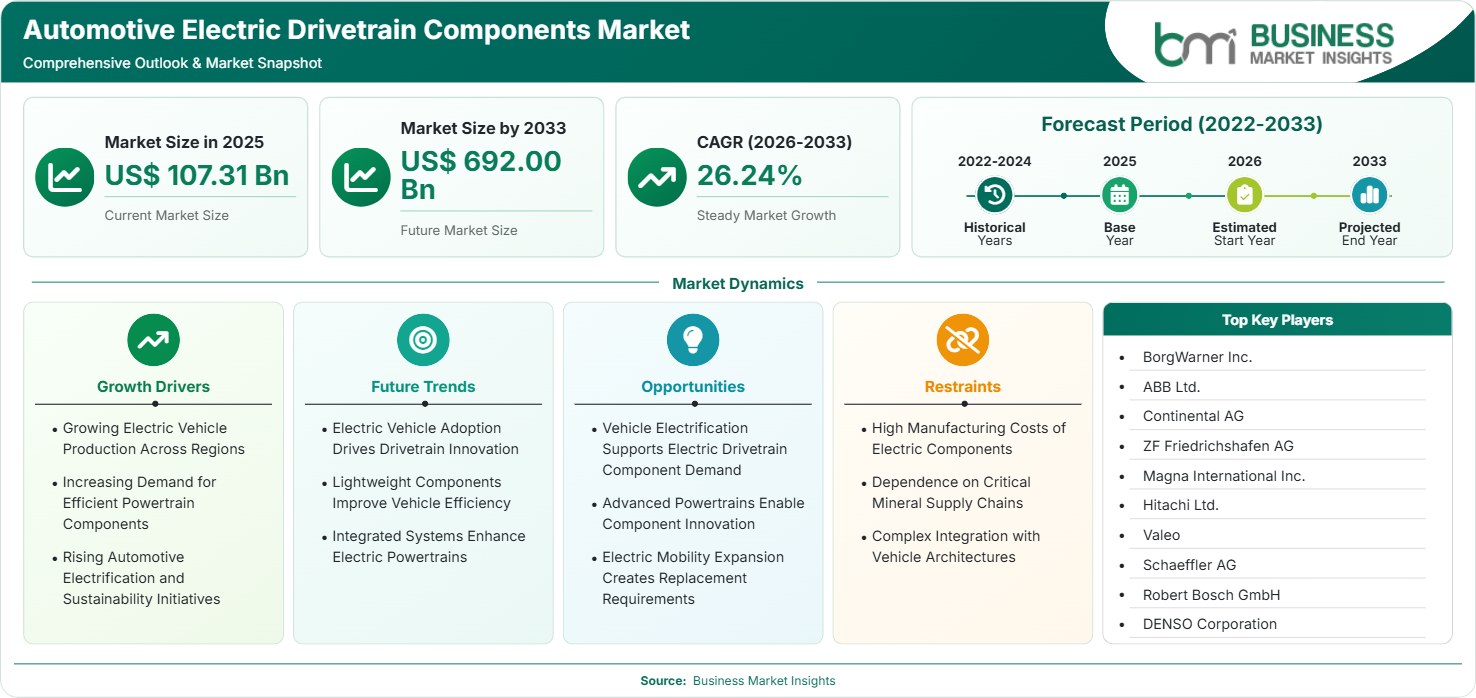
The Automotive Electric Drivetrain Components Market size was valued at US$ 107.31 Billion in 2025 and is projected to reach US$ 692 Billion by 2033, growing at a CAGR of 26.24% during 2026–2033, driven by EV adoption, higher drivetrain integration, 800V architectures, efficiency mandates, and localized component manufacturing.

Report Coverage
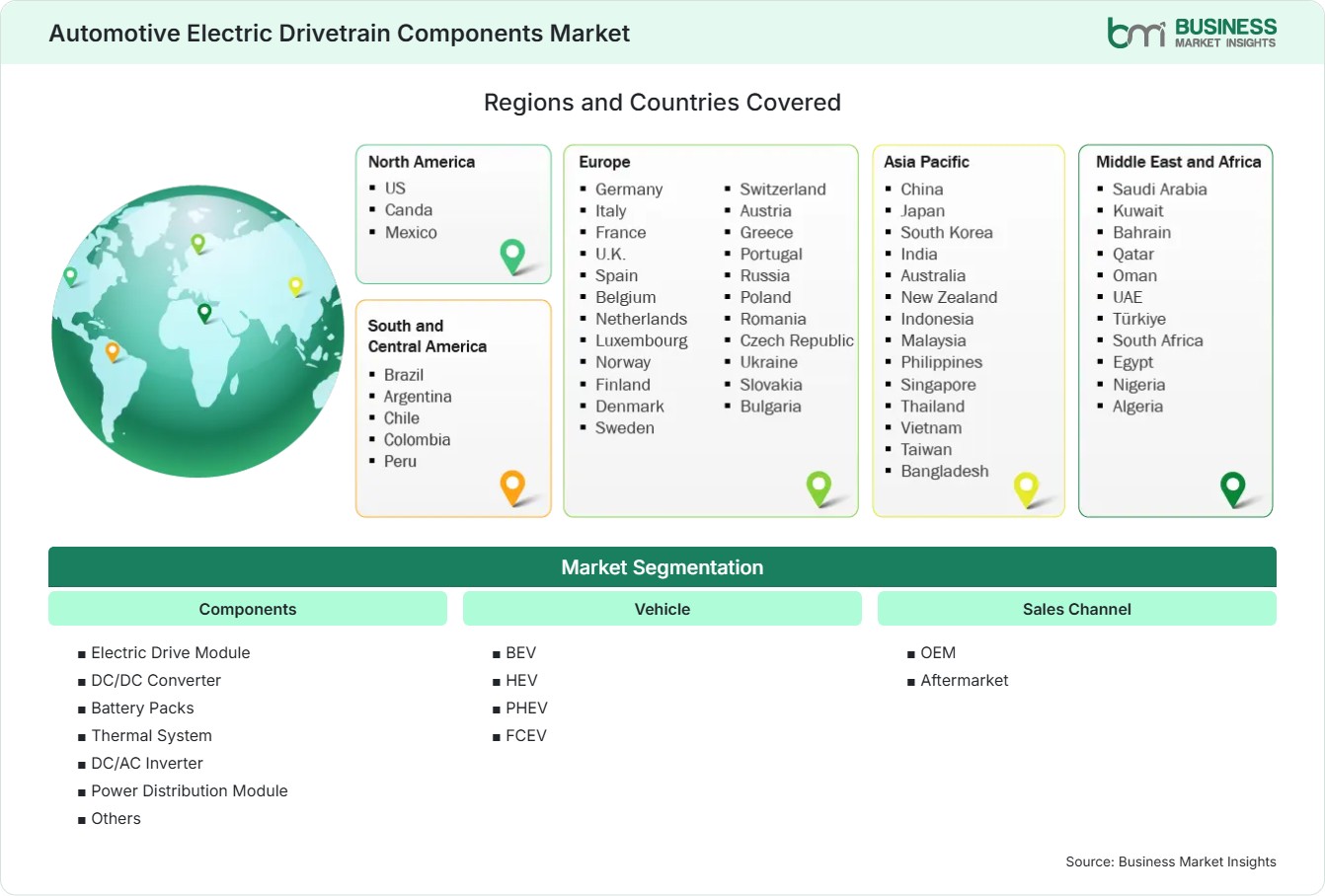
  • Components: Electric Drive Module, DC/DC Converter, Battery Packs, Thermal System, DC/AC Inverter, Power Distribution Module, Others
  • Vehicle: BEV, HEV, PHEV, FCEV
  • Sales Channel: OEM, Aftermarket
US$ 107.31 Bn Market size in 2025
US$ 692.00 Bn Market Size by 2033
26.24% CAGR, 2026 - 2033
2026-2033 Forecast Period

AI Overview

Automotive Electric Drivetrain Components Market Summary

  • North America Region: North America holds a modeled 20%–23% share in 2025, growing with a 24.0%–25.5% CAGR through 2033, driven by EV manufacturing, battery investment, advanced power electronics, fleet electrification, and localized drivetrain production. The U.S. accounts for 16%–19% of global demand, advancing at 23.8%–25.2% CAGR as automakers expand BEV, hybrid, and range-extended platforms.
  • Fastest Growing Region: Asia Pacific holds a modeled 49%–53% share in 2025, growing with a 28.0%–29.3% CAGR, supported by China’s EV production scale, Japanese electrification programs, Indian vehicle localization, high-volume component manufacturing, battery integration, and rapidly expanding electric commercial mobility.
  • Leading Segment: Electric Drive Module holds a modeled 31%–35% share in 2025, expanding at a 27.0%–28.2% CAGR, supported by demand for integrated motor, inverter, and reduction-gear packages that improve packaging, efficiency, weight, thermal performance, and manufacturing economics.
  • High Growth Segment: BEV applications hold a modeled 59%–63% share in 2025, advancing at a 28.2%–29.5% CAGR, supported by rising electric sales, declining drivetrain complexity, higher platform commonality, fast-charging architectures, and continuous optimization of motor, inverter, thermal, and battery systems.
  • Key Market Opportunity: Integrated 800V e-axles combining motors, inverters, reducers, thermal interfaces, and controls can create premium content while reducing packaging complexity and accelerating OEM platform development.
  • Major Market Players: BorgWarner Inc., ABB Ltd, Continental AG, ZF Friedrichshafen AG, Magna International Inc., Hitachi Ltd, Valeo, Schaeffler AG, Robert Bosch GmbH, and DENSO Corporation.
Strategic Insights

Automotive Electric Drivetrain Components Market: Strategic Insights

Automotive Electric Drivetrain Components Market Strategic Framework
FREE PDF
Request your free sample
Request free sample
Stakeholder View

Key Takeaways

  • The drivetrain value chain is consolidating around integrated propulsion modules rather than isolated motors, inverters, reducers, converters, and controls. Suppliers able to engineer complete systems can influence efficiency, packaging, thermal performance, software integration, and warranty outcomes.
  • BEV programs offer the largest structural volume opportunity, while PHEV, HEV, and range-extended architectures provide an important bridge for automakers operating across regions with different charging infrastructure and regulatory conditions.
  • Silicon-carbide power switches, 800V inverters, high-speed motors, hairpin windings, integrated cooling, and software-controlled torque management are becoming central differentiation points as OEMs pursue longer range and faster charging without proportionally increasing battery size.
  • Asia Pacific remains the strongest investment region because China combines vehicle volume, battery manufacturing, supplier density, and domestic electrification demand. India offers a complementary opportunity through localized e-axle and power-electronics production.
  • Investment is increasingly tied to platform awards and localization. Magna secured a 250kW 800V two-speed eDrive program with Chery in July 2026, while Valeo inaugurated localized 3-in-1 e-axle production in Pune earlier in 2026.
  • Suppliers with flexible architectures covering BEV, HEV, and PHEV platforms are positioned to manage uneven electrification trajectories. Schaeffler’s portfolio demonstrates this strategy through electric axles, inverters, transmissions, hybrid systems, and 48V technologies.
Geographic Outlook

Automotive Electric Drivetrain Components Market Regional Highlights

North America Automotive Electric Drivetrain Components Market

The North American share of the market stood at about 20%-23% in 2025, and it is anticipated to expand at a CAGR of 24.0%-25.5% between 2023 and 2033. This region has a mix of established engineering skills, developing battery production, increasing adoption of commercial EVs, and high demand for high-voltage power electronics. The USA leads in technology manufacturing and development within the region, whereas Canada reaps the benefits of investments in vehicle and battery manufacturing. Localization, software integration, and modularity are critical supplier strategies for serving BEV and hybrid platforms.

  • U.S. OEM programs are increasingly evaluating 800V drivetrains, integrated motors and inverters, and range-extended architectures to balance performance, charging speed, cost, and infrastructure constraints.
  • Canada provides opportunities through battery and vehicle-production ecosystems, creating demand for high-voltage connectors, thermal systems, power distribution modules, and integrated e-drive assemblies.
  • North American commercial vehicles are adopting electric axles rapidly as fleet operators prioritize lower energy costs, predictable maintenance, and compliance with urban emissions requirements.
  • Regional suppliers benefit from platform localization because integrated drivetrain manufacturing can reduce freight complexity, simplify validation, and improve responsiveness to changing OEM production schedules.

US Automotive Electric Drivetrain Components Market

The Automotive Electric Drivetrain Components Market in the United States accounted for around 16% to 19% of total global demand in 2025 and is forecast to grow by 23.8% to 25.2% by 2033. Demand drivers include EV production, hybrid proliferation, electric commercial vehicles, charging infrastructure, and homegrown technology development. U.S. manufacturers are focusing on integrating powertrains and high-voltage technologies, whereas automotive manufacturers are interested in scalable architectures that support multiple propulsion technologies on the same platform.

  • Domestic automakers are increasing use of integrated drive modules that combine motors, gearboxes, and inverters to reduce packaging volume and improve vehicle-level efficiency.
  • Fleet electrification creates demand for rugged electric axles, high-power converters, thermal systems, and serviceable architectures capable of operating under high-duty cycles.
  • Silicon-carbide inverter adoption is expanding as higher voltage systems require lower switching losses, better thermal performance, and improved high-speed operating efficiency.

Europe Automotive Electric Drivetrain Components Market

The Automotive Electric Drivetrain Components Market in Europe was assessed at 21%-24% of the market in 2025 and is expected to grow at a 22.8%-24.3% CAGR till 2033. Germany still maintains its position as the leader in engineering, whereas France, Italy, Spain, and Central Europe have increasing manufacturing potential. The potential for Germany lies between 22.5% and 24.0%, and France is forecast to be between 23.5% and 25.0%.  EU emissions rules, efficiency standards, and industrial localization continue to encourage higher drivetrain integration and localized component production.

  • Germany remains central to electric motor, inverter, transmission, and e-axle engineering because established automotive suppliers can transfer mechanical expertise into electrified platforms.
  • France is strengthening high-voltage component production, with Valeo expanding inverter manufacturing and integrated propulsion capabilities at its Étaples and Indian operations.
  • Central European plants provide cost-efficient manufacturing platforms for motors, power electronics, thermal systems, and battery-related components serving multiple OEM programs.
  • European suppliers increasingly compete on lifetime efficiency, functional safety, cybersecurity-ready controls, and modularity rather than component price alone.

Asia Pacific Automotive Electric Drivetrain Components Market

The Asia Pacific Automotive Electric Drivetrain Components Market accounts for about 49%-53% of total demand in 2025 and is projected to grow 28.0%-29.3% through 2033. China is the leading region, while other contributing regions are Japan, South Korea, India, and Southeast Asia. In 2025, China accounted for over half of the total number of electric cars sold in the automobile market. India is modeled at 29.0%–30.5% growth as localization accelerates across e-axles and power electronics.

  • China combines vehicle production, battery supply, inverter manufacturing, motor expertise, and dense supplier networks, creating the largest integrated market for electric drivetrain components.
  • India is becoming a manufacturing base for localized e-axles and power electronics, supported by domestic EV programs and growing collaboration between global suppliers and Indian OEMs.
  • Japan and South Korea retain strengths in motor materials, semiconductors, control systems, compact drivetrains, and advanced manufacturing, supporting higher-value component opportunities.
  • Southeast Asia offers emerging demand as electric two-wheelers, passenger vehicles, buses, and localized automotive assembly expand across Thailand, Indonesia, Malaysia, and Vietnam.

Rest of World Automotive Electric Drivetrain Components Market

The Automotive Electric Drivetrain Components Market in South and Central America accounted for about 7%–9% of 2025 demand and is forecast to grow at 23.0%–24.8% CAGR through 2033. Brazil dominates regional demand due to local vehicle manufacturing and increasing electrification of its automotive fleet. Mexico remains important in vehicle manufacturing, serving North American supply chains. The forecast for Brazil ranges from 24.0% to 25.5%.

The Middle East and Africa account for about 5%–7% of demand and are forecasted to grow at 20.5%–22.5% CAGR. The UAE, Saudi Arabia, South Africa, and some North African countries are emerging markets with bus and commercial fleets, electric-vehicle assembly lines, and investments in charging infrastructure.

  • Mexico provides a strategic opportunity because its established automotive manufacturing network can support production of motors, power electronics, thermal components, and assembled electric drive systems.
  • Brazil offers expanding demand for electric buses, hybrid vehicles, and urban mobility platforms where drivetrain efficiency has direct operating-cost implications.
  • Gulf markets are developing premium EV and electric commercial mobility programs, creating demand for sophisticated cooling, high-voltage distribution, and high-output traction systems.
  • South Africa presents a smaller but specialized opportunity in mining, commercial transport, and industrial mobility, where rugged electric drivetrains can replace diesel propulsion in selected duty cycles.
Global Market Geography
FREE PDF
Request your free sample
Request free sample
Segment Analysis

Automotive Electric Drivetrain Components Market Segmentation

Components

The Components category is led by the Electric Drive Module, which is forecast to achieve 31%–35% market share in 2025 and is projected to grow at 27.0%–28.2% through 2033. Integration leads to better packaging, fewer interfaces, thermal harmonization, and increased system efficiency. The scope of the Automotive Electric Drivetrain Components Market is shifting towards integrated propulsion modules in favor of discrete components, as OEMs demand faster development, lower assembly complexity, and scalable architectures.

  • Electric Drive Module: Integrated motor, reducer, and inverter packages improve packaging and efficiency while supporting platform standardization, scalable power ratings, and localized production.
  • DC/DC Converter: DC/DC systems connect high-voltage battery networks with low-voltage electrical architectures, requiring efficiency, thermal control, compact packaging, and reliable power conversion.
  • Battery Packs: Battery packs increasingly integrate structural, thermal, sensing, and protection functions, creating closer coordination between energy storage and drivetrain controls.
  • Thermal System: Cooling systems manage motors, inverters, batteries, and power electronics, making thermal integration critical for sustained performance, charging capability, and component durability.
  • DC/AC Inverter: Inverters convert battery DC power into controlled AC motor power, with silicon-carbide switches improving efficiency and enabling higher-voltage, high-frequency architectures.
  • Power Distribution Module (PDM): PDMs manage high-voltage electrical routing and protection, supporting safer energy distribution while reducing wiring complexity and improving serviceability.
  • Others: Sensors, connectors, control units, actuators, and auxiliary power components increasingly contribute to drivetrain intelligence, reliability, diagnostics, and functional safety.

Vehicle

Vehicle Segment Dominated by BEVs: With an expected market share of 59%–63% in 2025 and forecasted growth of 28.2%–29.5% through 2033, BEVs will be the key application for the Vehicle segment. These vehicles require complete high-voltage propulsion systems; therefore, demand for components such as motors, inverters, converters, thermal management systems, and battery packs will be significant. Automotive Electric Drivetrain Components Market trends increasingly favor platform designs that support common hardware, software reuse, and multiple performance variants.

  • BEV: Battery-electric vehicles require dedicated high-voltage propulsion systems, creating the broadest content opportunity across motors, inverters, batteries, thermal management, and power distribution.
  • HEV: Hybrid vehicles combine combustion and electric propulsion, sustaining demand for compact motors, inverters, DC/DC converters, and thermal systems optimized around limited battery capacity.
  • PHEV: Plug-in hybrids require higher electric capability than conventional hybrids, supporting larger batteries, more powerful motors, high-voltage inverters, and sophisticated energy-management controls.
  • FCEV: Fuel-cell vehicles rely on electric traction architectures with battery buffering, high-voltage converters, thermal systems, and motors, creating specialized drivetrain requirements.

Sales Channel

The Sales Channel subsector is still being propelled by OEM sales because of driveline integration, functional safety testing, platform calibrations, and long production periods. In this regard, OEMs are responsible for most value-added components, while the aftermarket focuses on services, replacements, thermal components, power electronics, and fleet maintenance. Supplier collaboration occurs at the vehicle's architecture level, not after production.

  • OEM: OEM programs account for the largest procurement opportunity because drivetrain components must be engineered, validated, calibrated, and integrated before vehicle production begins.
  • Aftermarket: Aftermarket demand develops through replacement motors, inverters, converters, cooling systems, battery components, diagnostics, and service parts as electrified vehicle fleets mature.
Market Forces

Automotive Electric Drivetrain Components Market Dynamics

Key Market Drivers

Rapid EV Adoption Is Expanding Drivetrain Content

There is a rising demand for components for electric vehicles across the spectrum, from motors, inverters, and converters to batteries, thermal systems, and power distribution. The IEA estimates that more than 20 million electric cars were sold in 2025, representing 25% of new car sales worldwide. There was a single nation, i.e., China, where sales accounted for more than 50% annually. This creates a large installed base of the drivetrain components. The Automotive Electric Drivetrain Components Market growth is expected, as every electric platform will need a high-voltage system. The result is structural demand for integrated modules, higher-output inverters, compact motors, and more efficient thermal systems.

800V Architectures Are Raising Component Performance Requirements

High-voltage architectures are being implemented in EV projects beyond premium vehicles due to the reduced current at higher voltages, which enables lower conductive losses and faster charging. Magna’s July 2026 award for an 800V system with Chery is based on an integrated design of a 250kW two-speed eDrive. Similarly, BorgWarner’s August 2026 inverter awards are based on 800V battery-electric and plug-in-hybrid projects featuring silicon carbide-based power switches. These are just some examples of how the Automotive Electric Drivetrain Components Market trends are increasingly focused on high-voltage-efficiency thermal management, compact packaging, and power semiconductor capability rather than simply increasing motor output.

Integration Is Reducing Vehicle Packaging and System Complexity

Automotive manufacturers are now opting for 3-in-1 or higher levels of integration for traction motors, gearboxes, and inverters. Valeo's Pune facility manufactures 3-in-1 e-axles that combine a motor, inverter, and reducer, while Schaeffler provides 2-in-1 and 3-in-1 electric axle designs. Integration may provide fewer interfaces, easier assembly, shorter high-voltage interconnections, and better thermal management. Also, there are more barriers to entry, since suppliers will need skills in mechanical, electrical, software, and manufacturing all at once. The Automotive Electric Drivetrain Components Market is hence being tipped towards system engineering and platform integration abilities.

Key Market Opportunities

Localized E-Axle Production Can Win Regional OEM Platforms

Local manufacturing provides suppliers with an avenue to mitigate logistics risks, quicken service responses, and address local sourcing mandates. Magna's local manufacturing capabilities in Wuhu enable the production of electric drivetrains for Chery, while Valeo's Pune-based factory supports Mahindra's Born Electric range. Such local manufacturing investments indicate that drivetrain localization has become part of the OEM platform strategy rather than just a manufacturing decision. Consequently, Automotive Electric Drivetrain Components Market Forecasts must account for geographic production capacities, the nomination pipeline, and local engineering expertise, as well as vehicle volumes.

Commercial Vehicles Offer Significant E-Axle Expansion Potential

Electric commercial vehicles create a distinct growth opportunity because drivetrain efficiency directly influences fleet economics and battery sizing. ZF secured a multi-year Indian order for several thousand AxTrax 2 electric axles for zero-emission intercity buses, with the company stating that the latest system delivers up to 20% greater efficiency than its predecessor. ABB similarly markets integrated motors, inverters, batteries, and converters for heavy electric vehicles. These applications can accelerate supplier scale because buses, trucks, and industrial vehicles often use standardized platforms and centralized fleet procurement. The commercial segment also rewards thermal durability, serviceability, high continuous power, and total-cost-of-ownership improvements.

Circular E-Drive Systems Can Create a New Aftermarket Value Pool

As electric axles enter large vehicle fleets, remanufacturing and recovery of motors, gearsets, power electronics, and structural components can become commercially important. Schaeffler launched the ReDriveS research project in January 2026 with around 80 consortium participants to investigate sustainable and circular use of electric axle drives. This creates an opportunity around component diagnostics, remanufacturing, material recovery, software-supported lifecycle management, and performance certification. The aftermarket channel can gradually expand beyond replacement parts toward verified reconditioned systems and component-level refurbishment. Suppliers that design products for disassembly, traceability, and service access can capture additional lifecycle revenue while helping fleet operators control the cost of electrified vehicle ownership.

Market Restraints and Challenges

High Engineering Complexity Raises Development and Validation Costs

Factor: integrated electric drivetrains combine high-voltage electrical systems, rotating machinery, semiconductors, software, thermal interfaces, sensors, and functional-safety requirements in a single architecture.

Impact: The suppliers require extensive testing, simulations, calibrations, validations, and manufacturing effort to obtain production approvals. It is especially tough to achieve validation for 800V systems since the insulation, switching, cooling, electromagnetic compatibility, and high currents must be validated together. The development cycle by the original equipment manufacturer is lengthy, hence delaying revenue generation. An integrated system helps with vehicle packaging; however, the system's increased complexity leads to greater risks in the event of a failure. Smaller technology companies may therefore struggle to fund qualification programs without customer-backed production commitments or strategic partnerships.

Uneven Electrification Creates Volume and Capacity Planning Risk

Factor: BEV adoption is accelerating globally but differs sharply by region, vehicle class, charging infrastructure, and consumer economics.

Impact: Supplier flexibility is likely to be affected due to mismatched production capabilities as the OEM program switches from BEV and HEV to PHEV platforms. Magna has stressed the importance of flexible powertrain solutions as electrification progresses at varying rates across geographies, whereas Schaeffler continues to maintain a diverse portfolio of BEV, PHEV, hybrid, and 48V platforms. It becomes difficult for a supplier to make investments when there is a risk of underutilizing assets such as tooling and dedicated production lines due to a change in customer mix.

Company Analysis

Competitive Landscape

The Automotive Electric Drivetrain Components Market analysis shows competition increasingly centered on integrated e-axles, traction motors, high-voltage inverters, DC/DC conversion, thermal coordination, functional safety, and localized manufacturing. Leading suppliers are broadening their portfolios across BEV, PHEV, HEV, and commercial-vehicle architectures to manage differing electrification trajectories.

Company Name

Overview

Products and Services relevant to this market

BorgWarner Inc.

Global propulsion technology supplier with strong programs across electric motors, inverters, eDrive modules, hybrids, and power electronics.

Integrated drive modules, electric motors, traction inverters, silicon-carbide power electronics, eTurbo systems, and hybrid drivetrain technologies.

ABB Ltd

Electrification and motion technology company offering drivetrain solutions for heavy vehicles, buses, off-highway equipment, and specialized mobility.

Traction motors, mobile inverters, DC/DC converters, traction batteries, converters, and integrated electric drivetrain solutions.

Continental AG

German automotive technology supplier supporting electrified mobility through electronic, thermal, software, and vehicle-efficiency technologies.

Electric drivetrain electronics, thermal technologies, sensors, control systems, vehicle electronics, and electrification-related architectures.

ZF Friedrichshafen AG

Global mobility supplier with extensive electric axle and driveline expertise across passenger and commercial vehicles.

AxTrax electric axles, e-motors, inverters, transmissions, power electronics, hybrid drivetrains, and commercial-vehicle propulsion systems.

Magna International Inc.

Major automotive supplier combining propulsion engineering, vehicle systems, localized manufacturing, and electrification expertise.

800V eDrive systems, integrated electric axles, motors, hybrid drives, range extenders, and powertrain manufacturing services.

Hitachi Ltd

Japanese technology group contributing power-electronics and mobility technologies through its automotive business ecosystem.

Electric motors, inverters, power electronics, battery-management technologies, control systems, and integrated electrified powertrain components.

Valeo

French technology supplier with a strong focus on electric powertrains, inverters, motors, thermal systems, and regional localization.

3-in-1 e-axles, electric motors, inverters, high-voltage powertrain systems, thermal components, and localized manufacturing.

Schaeffler AG

German motion-technology company offering broad electrification coverage from hybrid components to complete electric axle systems.

Electric axles, motors, transmissions, inverters, DC/DC converters, thermal management, hybrid systems, and lifecycle services.

Robert Bosch GmbH

Global automotive technology supplier with extensive experience in electric motors, power electronics, battery systems, and software-defined mobility.

Electric motors, inverters, eAxles, DC/DC converters, battery systems, control units, thermal management, and vehicle software.

DENSO Corporation

Japanese automotive supplier with deep capabilities in electrified powertrains, power electronics, motor technologies, and thermal management.

Electric motors, inverters, battery-management systems, thermal components, power electronics, and electrified propulsion control technologies.

Trust & Transparency

Research Methodology

The market analysis combines proprietary research with secondary data from government agencies, company disclosures, regulatory filings, industry databases and expert interviews. Market estimates are validated through data triangulation, cross-market benchmarking and analyst review.

View Full Research Methodology

Questions Answered

Frequently Asked Questions

What should buyers examine in an Automotive Electric Drivetrain Components Market Report?

A comprehensive Market Report should assess component demand, vehicle propulsion mix, regional production, OEM nominations, e-axle integration, inverter technology, thermal architectures, supply-chain localization, competitive capabilities, manufacturing investments, and future platform requirements.

How is the aftermarket opportunity changing as EV fleets mature?

The aftermarket is developing around motor and inverter replacement, battery service, thermal-system maintenance, diagnostics, electronic control units, and remanufacturing. Circular-economy initiatives could expand future opportunities toward certified refurbished e-axles and recovered drivetrain components.

Which vehicle category currently creates the strongest component opportunity?

BEVs create the broadest component opportunity because they require dedicated high-voltage propulsion systems across batteries, motors, inverters, converters, thermal systems, and power distribution. Commercial vehicles are another attractive area because efficiency directly affects fleet operating economics.

Why are integrated e-axles becoming more important for OEMs?

Integrated e-axles combine multiple drivetrain functions into a compact architecture, reducing packaging complexity, minimizing interfaces, improving system coordination, and potentially lowering assembly requirements. They also allow suppliers to offer standardized modules that can be adapted across several vehicle platforms.

What technologies are driving the next generation of electric drivetrains?

Key technologies include 800V electrical architectures, silicon-carbide inverters, high-speed electric motors, hairpin winding, integrated 3-in-1 and 4-in-1 e-axles, advanced thermal management, and software-controlled torque and energy management.

Access the Full Automotive Electric Drivetrain Components Market Report

Get segment-level forecasts, regional estimates, competitive benchmarking, company profiles and downloadable Excel datasets.

Access the full Automotive Electric Drivetrain Components Market Report
350 pages PDF & Excel | 2026-09-21
Similar Research

Related Market Reports