
LNG Carriers Market Outlook: Size, Share, Trends, Growth Analysis, Competitive Landscape & Forecast, 2026–2033

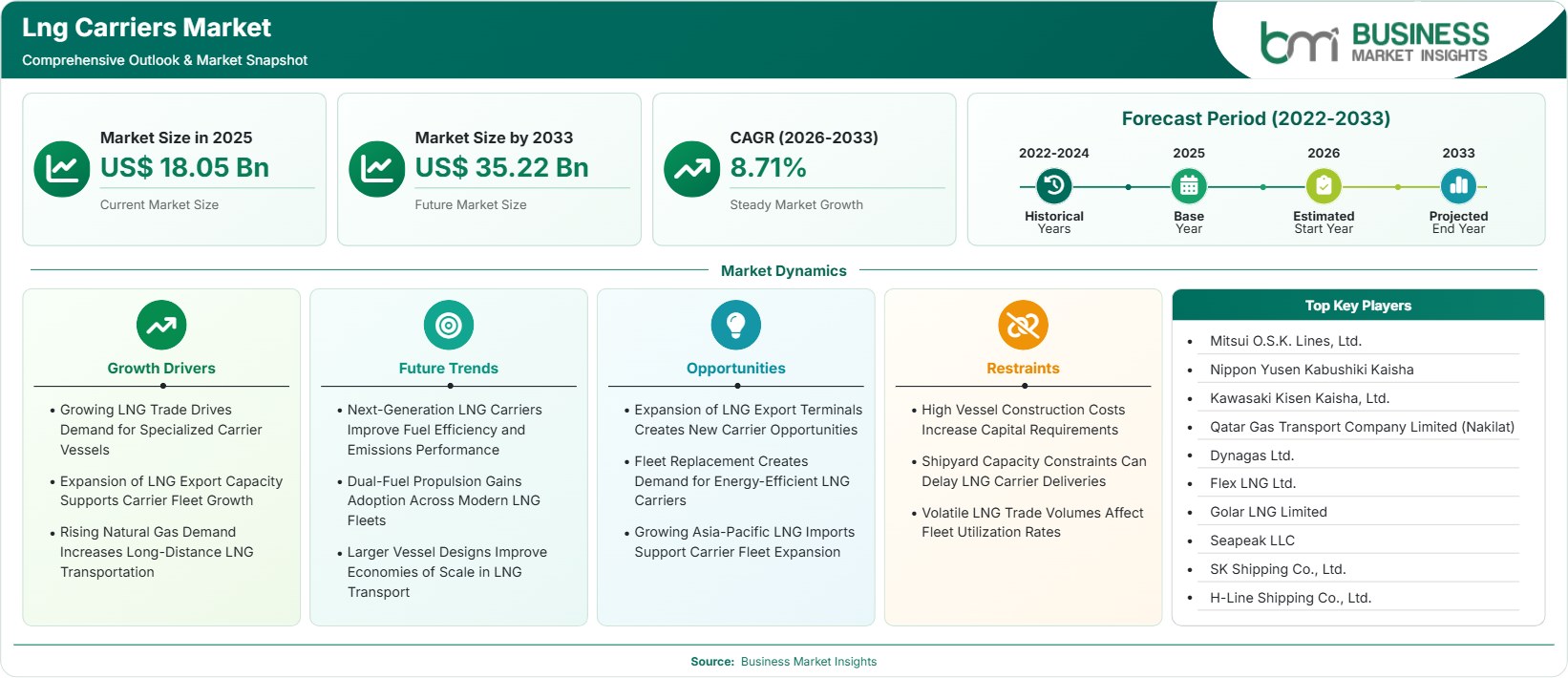
The LNG Carriers Market size was valued at US$ 18.05 Billion in 2025 and is projected to reach US$ 35.22 Billion by 2033, growing at a CAGR of 8.71% during 2026–2033, supported by expanding LNG trade, export capacity, fleet renewal, larger vessels, and rising Asian import requirements.

Report Coverage
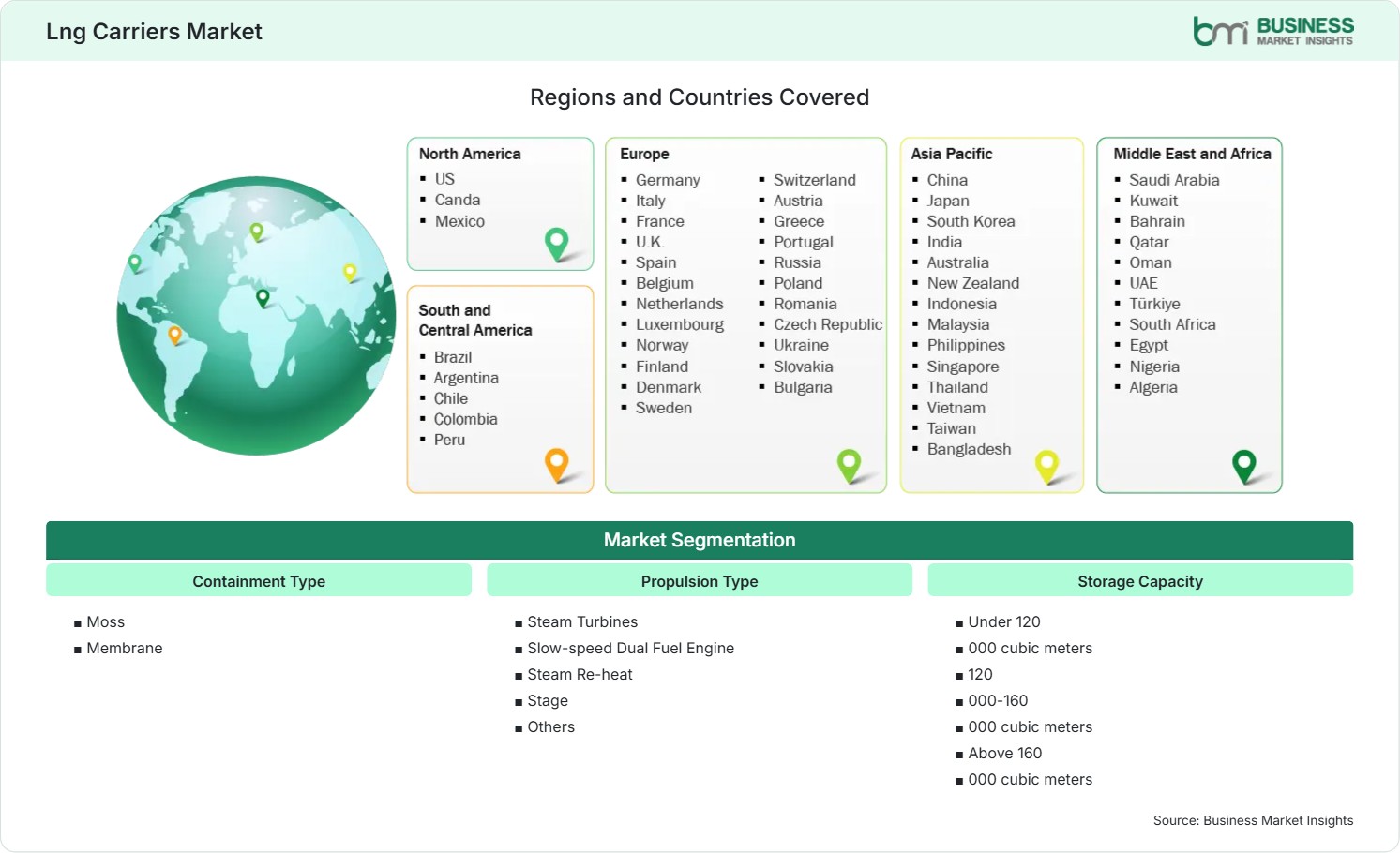
  • Containment Type: Moss, Membrane
  • Propulsion Type: Steam Turbines, Slow-speed Dual Fuel Engine, Steam Re-heat, Stage, Others
  • Storage Capacity: Under 120,000 cubic meters, 120,000-160,000 cubic meters, Above 160,000 cubic meters
US$ 18.05 Bn Market size in 2025
US$ 35.22 Bn Market Size by 2033
8.71% CAGR, 2026 - 2033
2026-2033 Forecast Period

01 AI Overview

LNG Carriers Market Summary

  • North America: holds 25%–29% share in 2025, growing at a CAGR of 8.0%–8.7% during 2026–2033, supported by LNG exports, and rising vessel utilization. US demand accounts for 82%–87% of regional activity and is projected to expand at 8.1%–8.8% CAGR through 2033, supported by export infrastructure and vessel requirements.
  • Fastest Growing Region: Asia Pacific holds 38%–42% share in 2025, expanding at a CAGR of 9.5%–10.2% during 2026–2033, supported by LNG imports, energy diversification, industrial gas consumption, and replacement of aging transportation capacity.
  • Leading Segment: Membrane containment holds 88%–92% share in 2025, growing at a CAGR of 8.9%–9.5% during 2026–2033, supported by cargo-space efficiency, insulation performance, and modern LNG carrier design requirements.
  • High Growth Segment: Above 160,000 cubic meters holds 35%–39% share in 2025, growing at a CAGR of 9.4%–10.1% during 2026–2033, supported by cargo economies, long-haul routes, export expansion, terminal compatibility, and efficient transportation of higher LNG volumes.
  • Key Market Opportunity: Export capacity expansion, fleet replacement, larger vessels, and Asian import growth create opportunities for energy-efficient carriers, and advanced vessel systems.
  • Major Market Players: Mitsui O.S.K. Lines, Ltd., Nippon Yusen Kabushiki Kaisha, Kawasaki Kisen Kaisha, Ltd., Qatar Gas Transport Company Limited, Dynagas Ltd., Flex LNG Ltd., Golar LNG Limited, Seapeak LLC, SK Shipping Co., Ltd., H-Line Shipping Co., Ltd.
02 Strategic Insights

LNG Carriers Market: Strategic Insights

LNG Carriers Market Strategic Framework
FREE PDF
Request your free sample
Request free sample
03 Stakeholder View

Key Takeaways

  • The value chain links LNG producers, liquefaction facilities, shipowners, charterers, shipyards, containment technology suppliers, propulsion providers, financiers, ports, terminals, and classification organizations.
  • Large-capacity vessels provide stronger transportation economics on suitable long-distance routes because greater cargo volumes can improve efficiency per unit of LNG transported.
  • Propulsion development is increasingly focused on dual-fuel operation, improved boil-off-gas utilization, energy efficiency, emissions performance, and lower lifecycle operating costs.
  • Asia Pacific provides the strongest regional expansion opportunity because LNG remains important for power generation, industrial consumption, energy diversification, and supply balancing.
  • Long-term transportation contracts can provide revenue visibility for vessel owners while helping LNG suppliers and importers secure transportation capacity for future cargo requirements.
  • Specialized shipyard availability remains strategically important because LNG carrier construction requires cryogenic containment expertise, complex propulsion integration, specialized materials, and controlled manufacturing processes.
04 Geographic Outlook

LNG Carriers Market Regional Highlights

North America LNG Carriers Market

North America holds 25%–29% share in 2025 and is projected to grow at 8.0%–8.7% CAGR through 2033. The region benefits from expanding liquefaction capacity and rising LNG exports, particularly from the US. The US represents 82%–87% of regional demand and is projected to grow at 8.1%–8.8% CAGR. Export terminal development, long-haul shipping requirements, and fleet replacement are supporting vessel demand. The regional LNG Carriers Market share is therefore strongly influenced by export capacity additions and vessel charter requirements.

  • Expanding US LNG production increases transportation requirements between Gulf Coast export terminals and distant importing markets, strengthening demand for modern large-capacity carriers.
  • Long-haul voyages increase the importance of propulsion efficiency, cargo retention, reliquefaction capability, and vessel utilization because fuel consumption materially affects voyage economics.
  • Export-project schedules influence carrier contracting cycles, with shipowners increasingly aligning newbuilding commitments with anticipated liquefaction capacity and long-term transportation requirements.
  • Fleet renewal is creating demand for modern carriers that offer improved energy performance, larger cargo capacity, and stronger compliance with evolving maritime requirements.

US LNG Carriers Market

The US represents 82%–87% of North American demand in 2025 and is projected to grow at 8.1%–8.8% CAGR through 2033. Growing LNG export capacity is strengthening demand for dedicated transportation, while Gulf Coast terminals support large-scale international trade. Longer sailing distances to Asia and Europe increase the value of high-capacity vessels and efficient propulsion.

  • Gulf Coast liquefaction capacity creates sustained vessel requirements because export terminals depend on reliable transportation capacity to move LNG into international markets.
  • Long-distance routes increase the commercial value of larger vessels, particularly where terminal infrastructure and navigation conditions permit higher cargo volumes.
  • New export capacity encourages long-term chartering arrangements that provide producers with transportation security and owners with greater revenue visibility.

Europe LNG Carriers Market

Europe LNG Carriers Market holds 20%–24% share in 2025 and is projected to grow at 7.9%–8.6% CAGR through 2033. Germany, the UK, France, Spain, and Italy represent leading demand centers, while Germany is projected to expand at 8.3%–9.0% CAGR. European LNG demand is influenced by energy diversification, storage requirements, declining domestic gas production, and infrastructure supporting seaborne imports.

  • Germany remains a major demand center because expanded LNG receiving infrastructure has increased access to seaborne natural gas and diversified supply options.
  • Spain maintains an important role through substantial regasification capacity and established LNG import infrastructure supporting flexible procurement.
  • France and Italy provide stable demand through established import terminals, industrial consumption, power generation requirements, and diversified gas sourcing.
  • Germany's 8.3%–9.0% CAGR reflects continued infrastructure utilization, energy diversification, and demand for flexible seaborne gas supply.

Asia Pacific LNG Carriers Market

Asia Pacific LNG Carriers Market holds 38%–42% share in 2025 and is projected to grow at 9.5%–10.2% CAGR through 2033, making it the fastest-growing region. China, Japan, South Korea, India, and Taiwan are leading demand centers, while India is projected to grow at 10.0%–10.7% CAGR. Rising gas consumption, power generation, industrial use, energy diversification, and seasonal procurement support imports.

  • China remains a major LNG importing market, with demand influenced by industrial consumption, power generation, urban gas requirements, and efforts to diversify energy supply.
  • India offers the strongest growth at 10.0%–10.7% CAGR as natural gas infrastructure expands and LNG supports power, fertilizer, industrial, and city-gas applications.
  • Japan and South Korea maintain substantial import requirements supported by mature LNG infrastructure, power generation, industrial demand, and established long-term procurement practices.
  • Taiwan and Southeast Asian economies provide additional demand as natural gas infrastructure expands and LNG becomes increasingly important for power-sector diversification.

Rest of World LNG Carriers Market

South and Central America hold an expanding role in seaborne LNG demand, with Brazil, Argentina, Chile, and Colombia representing important markets. Brazil remains the largest regional demand center, while Argentina's gas development can alter future import requirements. Improved terminal infrastructure also increases the flexibility of LNG procurement.

Middle East and Africa provide both import and export opportunities. Qatar remains a major global LNG supplier, while Egypt, the UAE, and other markets influence regional vessel utilization. Rest of World holds 10%–14% share in 2025 and is projected to grow at 8.3%–9.1% CAGR through 2033.

  • Brazil supports regional demand through LNG receiving infrastructure, power-sector balancing requirements, and the need to manage seasonal variations in domestic gas availability.
  • Argentina and Chile provide additional import opportunities as gas demand, power requirements, and infrastructure development shape regional LNG procurement patterns.
  • Qatar remains strategically important for global LNG shipping because its export volumes serve major Asian and European destinations.
  • Egypt and selected Middle Eastern markets influence vessel utilization through LNG exports, imports, transshipment, and changing regional gas balances.
Global Market Geography
FREE PDF
Request your free sample
Request free sample
05 Segment Analysis

LNG Carriers Market Segmentation

Containment Type

Membrane containment holds 88%–92% share in 2025 and is projected to grow at a CAGR of 8.9%–9.5% through 2033. Its strong position reflects efficient space utilization, established shipyard expertise, insulation performance, and compatibility with large LNG carrier designs. Moss containment remains relevant for specific fleet requirements, but membrane systems dominate newbuilding activity across major commercial routes.

  • Moss: Spherical tanks provide robust structural characteristics and established operational performance, maintaining demand where owners prioritize proven containment configurations and vessel-specific design requirements.
  • Membrane: Efficient cargo-space utilization, lower vessel dimensions for equivalent capacity, established construction expertise, and suitability for large carriers support continued dominance in newbuilding programs.

Propulsion Type

Slow-speed dual-fuel engines hold 54%–58% share in 2025 and are projected to grow at a CAGR of 9.0%–9.6% through 2033. Demand reflects fuel efficiency, dual-fuel capability, lower-speed operation, and compatibility with boil-off gas. Steam turbines retain an installed-base role, while steam re-heat, stage, and other configurations serve specialized fleet requirements. Propulsion selection increasingly reflects lifecycle efficiency.

  • Steam Turbines: Established LNG carrier propulsion technology continues supporting existing vessels, although efficiency considerations and fleet modernization increasingly favor newer propulsion architectures.
  • Slow-speed Dual Fuel Engine: High efficiency, dual-fuel operation, and effective use of boil-off gas support adoption in modern large-capacity LNG carriers.
  • Steam Re-heat: Reheat configurations improve thermal efficiency over conventional steam arrangements and remain relevant where lifecycle operating economics justify the additional system complexity.
  • Stage: Advanced staged propulsion arrangements can support improved efficiency in selected vessel configurations, particularly where owners prioritize fuel consumption and operational flexibility.

Storage Capacity

Above 160,000 cubic meters holds 35%–39% share in 2025 and is projected to grow at a CAGR of 9.4%–10.1% through 2033. Large-capacity carriers benefit from economies of scale on long-distance routes and align with expanding export projects. Mid-sized vessels remain important across established trade routes, while smaller capacity ships serve specific terminal, regional, and infrastructure constraints.

  • Under 120,000 cubic meters: Smaller vessels serve routes and terminals with tighter infrastructure constraints, supporting regional distribution, shorter voyages, and specialized LNG transportation requirements.
  • 120,000-160,000 cubic meters: Mid-sized carriers provide operational flexibility across established LNG routes, balancing cargo capacity, port compatibility, fuel consumption, and charter economics.
  • Above 160,000 cubic meters: Large vessels maximize cargo volume on long-haul routes, supporting economies of scale and efficient transportation from major export projects to distant importing markets.
06 Market Forces

LNG Carriers Market Dynamics

Key Market Drivers

Growing LNG Trade Drives Demand for Specialized Carrier Vessels

Demand is also affected by vessel turnaround times, sailing distances, port congestion, and fleet utilization. The LNG Carriers Market growth therefore depends not only on LNG production but also on the geographic separation between export and import centers. Increasing interregional trade strengthens demand for larger cargo capacity and efficient propulsion. This orderbook reflects both new LNG supply requirements and fleet replacement needs. Continued trade growth should support carrier utilization, chartering activity, and long-term vessel investment through the forecast period.

Expansion of LNG Export Capacity Supports Carrier Fleet Growth

The increase in liquefaction capacity leads to the creation of transportation needs that have to be matched by the available capacity for carriers. This is because the development of new export plants may result in transportation needs which would stretch over a considerable period of time since the producers will need reliable access to vessels when the plant starts its commercial operation. These developments reinforce the Lng Carriers Market trends toward long-term chartering, and coordinated vessel procurement linked to project schedules.

Rising Natural Gas Demand Increases Long-Distance LNG Transportation

Demand for natural gas in the importer regions has been fostering long-distance shipments of LNG as customers look to diversify their sources of gas and maintain flexibility between piped and shipped gas. This geographic dependence places a premium on carrier availability and voyage efficiency. Thus, factors that will influence LNG Carriers Market growth include regional shortages of gas, demand from the power sector, industrial gas demand, and availability of local production. Long voyages place an increased emphasis on fuel efficiency, insulation technology, and effective vapor boil-off management.

Key Market Opportunities

Expansion of LNG Export Terminals Creates New Carrier Opportunities

Additional LNG export terminals create direct opportunities for vessel owners, charterers, shipyards, and financing institutions because every new liquefaction project requires dependable transportation capacity. Export projects in North America and other producing regions can support new long-term transportation requirements, particularly where destination markets are geographically distant. The LNG Carriers Market Forecasts are therefore increasingly linked to the commissioning schedules of liquefaction facilities and associated storage infrastructure. Owners can improve revenue visibility by securing charter commitments before delivery, while producers can reduce exposure to vessel shortages through dedicated capacity arrangements.

Fleet Replacement Creates Demand for Energy-Efficient LNG Carriers

Fleet renewal is becoming an important source of demand alongside transportation growth. Replacement programs therefore create opportunities for modern carriers using efficient dual-fuel engines, advanced insulation, reliquefaction, and energy-saving technologies. Owners can also improve competitiveness by reducing voyage fuel consumption and maintaining higher cargo retention. The opportunity extends to retrofit technologies where replacing entire vessels is not commercially optimal. Fleet modernization can create a steady order pipeline independent of short-term changes in LNG trade because older tonnage eventually requires retirement, conversion, or replacement.

Growing Asia-Pacific LNG Imports Support Carrier Fleet Expansion

Asia Pacific offers the strongest expansion opportunity because the region combines substantial LNG import volumes with continued energy demand growth and diversification requirements. Japan, China, South Korea, India, and other Asian markets rely on seaborne LNG to supplement domestic production and pipeline availability. This concentration supports demand for long-distance carriers operating between Middle Eastern, North American, and Asian terminals. The LNG Carriers Market scope therefore extends beyond vessel replacement to include fleet additions aligned with Asian import growth.

Market Restraints and Challenges

High Vessel Construction Costs Increase Capital Requirements

Factor: LNG carriers require specialized cryogenic containment systems, high-grade materials, sophisticated propulsion equipment, insulation, safety systems, and tightly controlled shipbuilding processes, making construction substantially more capital intensive than many conventional commercial vessels. Impact: High upfront investment increases financing requirements and can delay fleet expansion when charter commitments, freight rates, or project schedules remain uncertain. Owners must evaluate expected utilization, charter duration, financing costs, residual values, and future regulatory requirements before committing to newbuildings.

Shipyard Capacity Constraints Can Delay LNG Carrier Deliveries

Factor: LNG carrier construction depends on a limited group of shipyards with the technical capability, skilled workforce, containment-system integration expertise, and production infrastructure required for large cryogenic vessels. Impact: Limited shipyard availability can extend delivery schedules, raise ordering costs, and create mismatches between LNG project commissioning dates and vessel availability. Delays may also affect charter commencement, financing schedules, and terminal utilization. Shipyard concentration increases exposure to labor availability, material procurement, production bottlenecks, and geopolitical disruptions.

07 Company Analysis

Competitive Landscape

The LNG Carriers Market analysis shows competition centered on fleet scale, vessel efficiency, charter coverage, geographic reach, access to shipyard capacity, financing strength, and technical capabilities. Operators with modern vessels and diversified charter portfolios are positioned to manage fluctuations in spot rates while maintaining longer-term transportation commitments.

Company Name

Overview

Products and Services relevant to this market

Mitsui O.S.K. Lines, Ltd.

Japanese shipping company with a large energy transportation portfolio and established LNG carrier operations.

LNG carrier ownership, operation, ship management, long-term chartering, LNG transportation, and energy logistics.

Nippon Yusen Kabushiki Kaisha

Diversified Japanese shipping group with extensive LNG transportation and global maritime operations.

LNG carrier operation, ship management, chartering, fleet development, and international LNG transportation.

Kawasaki Kisen Kaisha, Ltd.

Japanese shipping company with established gas transportation activities and specialized vessel capabilities.

LNG carrier operation, vessel management, chartering, energy transportation, and fleet development.

Qatar Gas Transport Company Limited (Nakilat)

Qatar-based LNG shipping company closely connected with the country's large-scale LNG export infrastructure.

LNG carrier ownership, ship management, maritime transportation, vessel operations, and LNG logistics.

Dynagas Ltd.

Specialized LNG shipping company focused on owning and operating modern LNG carriers.

LNG transportation, vessel ownership, long-term chartering, fleet management, and specialized maritime services.

Flex LNG Ltd.

LNG-focused shipping company operating a modern fleet of large-capacity carriers.

LNG carrier ownership, chartering, vessel management, transportation services, and fleet optimization.

Golar LNG Limited

LNG infrastructure and shipping company with extensive experience in floating LNG and gas transportation.

LNG carrier assets, floating LNG solutions, vessel management, chartering, and gas transportation infrastructure.

Seapeak LLC

Global LNG shipping company with a large portfolio of LNG carriers and long-term transportation arrangements.

LNG carrier ownership, ship management, chartering, transportation, and maritime energy services.

SK Shipping Co., Ltd.

South Korean shipping company with substantial LNG transportation and energy shipping operations.

LNG carrier operation, energy transportation, vessel management, chartering, and fleet services.

H-Line Shipping Co., Ltd.

South Korean maritime company active in LNG transportation and energy-related shipping services.

LNG carrier operation, ship management, chartering, vessel development, and energy transportation.

10 Trust & Transparency

Research Methodology

The market analysis combines proprietary research with secondary data from government agencies, company disclosures, regulatory filings, industry databases and expert interviews. Market estimates are validated through data triangulation, cross-market benchmarking and analyst review.

View Full Research Methodology

11 Questions Answered

Frequently Asked Questions

How does shipyard concentration affect LNG carrier supply?

Limited specialized shipbuilding capacity can lengthen delivery schedules and increase competition for construction slots. Owners may therefore place orders well ahead of expected transportation requirements to secure suitable delivery positions.

Why are large LNG carriers gaining importance on long-distance routes?

Larger vessels can transport more LNG per voyage, potentially lowering transportation cost per unit when terminal infrastructure and route conditions support their deployment.

How do long-term LNG carrier charters benefit shipowners?

Long-term charters provide greater revenue visibility and can support financing for expensive newbuildings. They also reduce exposure to short-term freight-rate fluctuations and help align vessel investment with predictable LNG transportation requirements.

Why are membrane containment systems widely used in large LNG carriers?

Membrane systems provide efficient cargo-space utilization and can support large vessel capacities while maintaining strong insulation performance. Their established construction ecosystem also supports standardized large-scale carrier development.

What factors determine the economic efficiency in LNG Carriers Market report?

Cargo capacity, vessel utilization, propulsion efficiency, fuel consumption, boil-off-gas management, and financing costs collectively determine transportation economics.

Access the Full LNG Carriers Market Report

Get segment-level forecasts, regional estimates, competitive benchmarking, company profiles and downloadable Excel datasets.

Access the full LNG Carriers Market Report
350 pages PDF & Excel | 2026-08-24