
Automotive Biometrics Market Outlook: Size, Share, Trends, Growth Analysis, Competitive Landscape & Forecast, 2026–2033

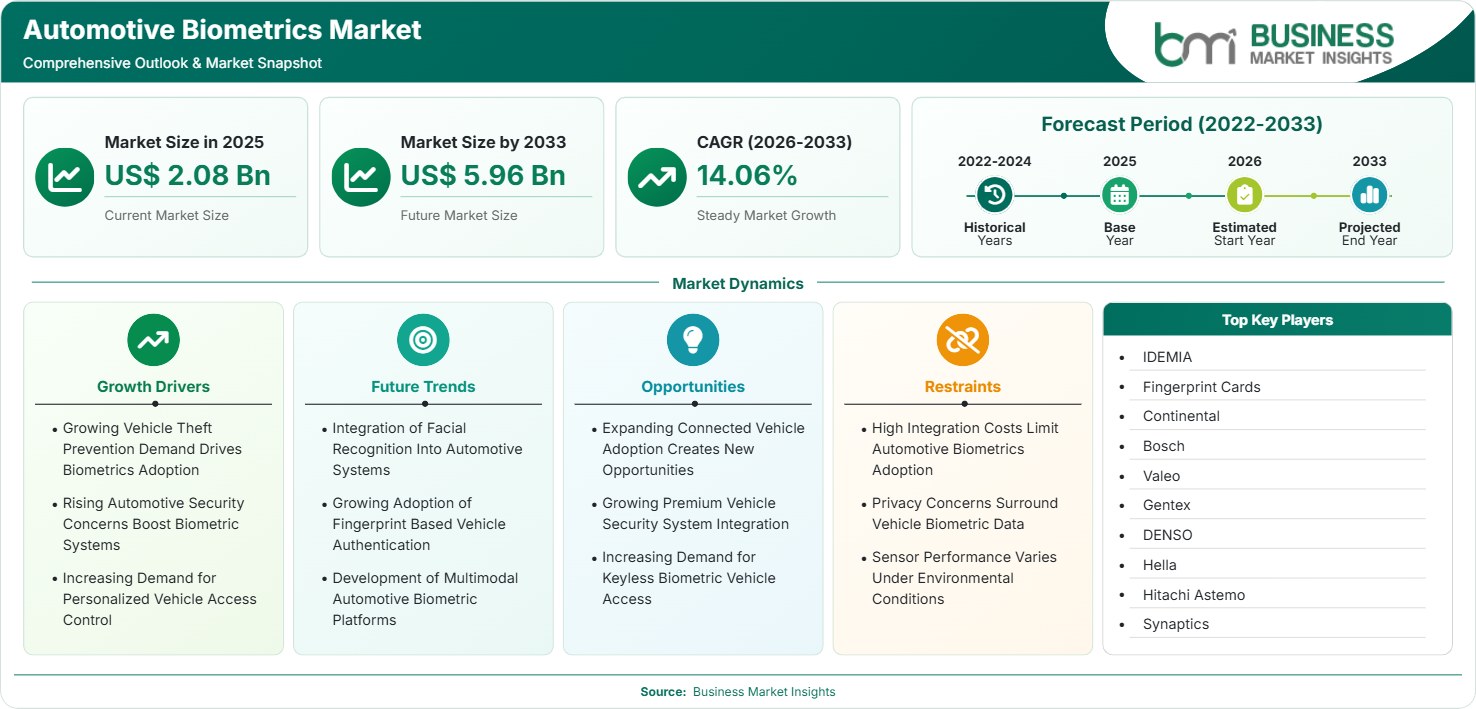
The Automotive Biometrics Market size was valued at US$ 2.08 billion in 2025 and is projected to reach US$ 5.96 billion by 2033, growing at a CAGR of 14.06% during 2026–2033, supported by vehicle security requirements, connected mobility, driver monitoring, personalized access, keyless authentication, and software-defined vehicle architectures.

Report Coverage
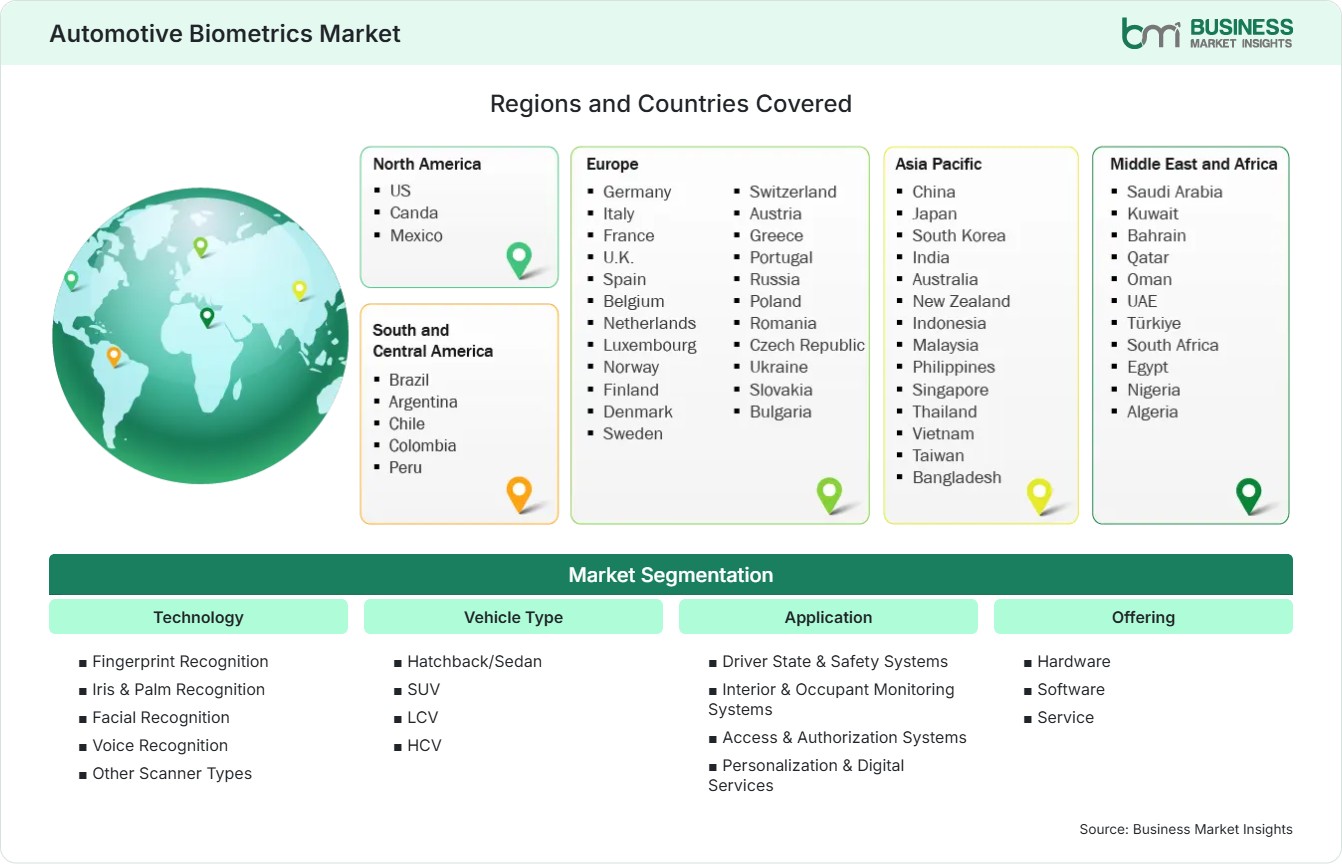
  • Technology: Fingerprint Recognition, Iris & Palm Recognition, Facial Recognition, Voice Recognition, Other Scanner Types
  • Vehicle Type: Hatchback/Sedan, SUV, LCV, HCV
  • Application: Driver State & Safety Systems, Interior & Occupant Monitoring Systems , Access & Authorization Systems, Personalization & Digital Services
  • Offering: Hardware, Software, Service
US$ 2.08 Bn Market size in 2025
US$ 5.96 Bn Market Size by 2033
14.06% CAGR, 2026 - 2033
2026-2033 Forecast Period

AI Overview

Automotive Biometrics Market Summary

  • North America Region: North America holds a 32%–36% share in 2025 and is projected to grow at a 15.8%–17.2% CAGR through 2033, supported by connected vehicles, premium security features, advanced driver monitoring, consumer familiarity with biometrics, and established automotive electronics capabilities.
  • Fastest Growing Region: Asia Pacific holds a 37%–40% share in 2025 and is projected to grow at a 18.5%–20.5% CAGR through 2033, supported by connected vehicle expansion, advanced vehicle production, digital mobility initiatives, rising security requirements, and increasing integration of biometric authentication.
  • Leading Segment: Fingerprint Recognition holds a 39%–42% Automotive Biometrics Market share in 2025 and is projected to grow at a 13.8%–15.0% CAGR through 2033, supported by compact sensors, familiar authentication workflows, secure access, low-power operation, and integration into handles, start controls, and interior interfaces.
  • High Growth Segment: Software holds a 15%–19% share in 2025 and is projected to grow at a 18.0%–20.0% CAGR through 2033, driven by continuous authentication, personalization algorithms, driver-state analytics, secure identity management, over-the-air functionality, and software-defined vehicle platforms.
  • Key Market Opportunity: Integration of biometric identity with connected vehicles, digital payments, personalization, driver monitoring, and keyless access creates opportunities for suppliers that combine secure hardware with scalable software and lifecycle services.
  • Major Market Players: IDEMIA; Fingerprint Cards AB; Continental AG; Robert Bosch GmbH; Valeo SE; Gentex Corporation; DENSO Corporation; FORVIA HELLA GmbH; Astemo, Ltd.; Synaptics Incorporated.
Strategic Insights

Automotive Biometrics Market: Strategic Insights

Automotive Biometrics Market Strategic Framework
FREE PDF
Request your free sample
Request free sample
Stakeholder View

Key Takeaways

  • Suppliers that combine biometric hardware, algorithms, secure processing, and automotive integration can capture more value across the vehicle identity stack.
  • Driver monitoring and secure access provide complementary adoption pathways, allowing one sensor architecture to support multiple vehicle functions.
  • Multimodal authentication can improve resilience where individual biometric signals face environmental, usability, or spoofing limitations.
  • Asia Pacific offers strong expansion potential because vehicle production, connected mobility, and digital automotive ecosystems are developing rapidly.
  • Software is becoming strategically important as biometric functions move toward continuous authentication, personalization, and vehicle-service integration.
  • Privacy-by-design, local processing, encryption, and transparent consent mechanisms can become important differentiators during OEM procurement.
Geographic Outlook

Automotive Biometrics Market Regional Highlights

North America Automotive Biometrics Market

North America holds a 32%–36% share in 2025 and is projected to grow at a 15.8%–17.2% CAGR through 2033. The Automotive Biometrics Market share is supported by connected vehicle penetration, premium security systems, driver monitoring adoption, and established automotive electronics supply chains.

  • The U.S. remains the leading regional market, supported by vehicle security concerns, connected-car integration, premium personalization, biometric access technologies, and established automotive technology development.
  • Canada provides additional opportunities through connected vehicle adoption, advanced driver assistance integration, premium vehicle features, and increasing interest in digital vehicle identity systems.
  • North American OEMs increasingly evaluate biometric systems according to cybersecurity, liveness detection, processing architecture, software integration, user convenience, and long-term serviceability.
  • Premium and technology-focused vehicle programs provide an important early-adoption channel before broader deployment reaches higher-volume vehicle categories.

US Automotive Biometrics Market

The U.S. accounts for approximately 78%–82% of North American demand in 2025 and is projected to grow at a 16.0%–17.2% CAGR through 2033. The Automotive Biometrics Market growth outlook is reinforced by vehicle security, driver monitoring, personalization, and keyless authentication requirements.

  • U.S. vehicle manufacturers and technology suppliers are developing biometric functions around secure access, driver identification, personalization, payment authentication, and in-cabin monitoring.
  • Driver monitoring is gaining strategic relevance as automated driving and advanced assistance systems require reliable assessment of driver engagement and availability.
  • Premium vehicles provide an important commercialization pathway because customers are more receptive to technology-enabled security, convenience, and individualized cabin experiences.

Europe Automotive Biometrics Market

Europe holds a 21%–24% share in 2025 and is projected to grow at a 14.5%–16.0% CAGR through 2033. Germany, the United Kingdom, France, Italy, and the Nordic markets represent important demand centers. Regulatory attention toward driver monitoring, automated driving, cybersecurity, and data governance strengthens demand for validated biometric technologies.

  • Germany benefits from a strong automotive manufacturing ecosystem, sophisticated vehicle electronics capabilities, and established supplier networks supporting biometric authentication and driver monitoring.
  • The United Kingdom and France offer opportunities through premium vehicles, connected mobility, software development, and growing demand for personalized digital vehicle services.
  • European manufacturers must address privacy and data governance carefully because biometric information can fall within specially protected personal-data categories under GDPR.
  • Regulatory developments around driver engagement and automated driving create additional demand for reliable sensing, recognition, and monitoring technologies integrated into vehicle safety architectures.

Asia Pacific Automotive Biometrics Market

Asia Pacific holds a 37%–40% share in 2025 and is projected to grow at a 18.5%–20.5% CAGR through 2033. China, Japan, South Korea, India, and Southeast Asia represent important markets. The region combines large vehicle production volumes, connected mobility development, electronics manufacturing capabilities, and expanding consumer interest in digital vehicle features, making it the strongest regional expansion opportunity.

  • China is a major demand center because of extensive vehicle production, connected vehicle development, advanced electronics manufacturing, and increasing integration of intelligent cabin technologies.
  • Japan and South Korea provide strong opportunities through sophisticated automotive industries, electronics expertise, premium vehicle technology, and established development of intelligent mobility platforms.
  • India offers long-term potential as connected vehicles, digital services, premium vehicle features, and advanced security systems expand across passenger vehicle categories.
  • Southeast Asian markets provide emerging opportunities as automotive manufacturing, digital mobility services, and technology-oriented vehicle offerings continue to develop.

Rest of World Automotive Biometrics Market

Rest of World represents an estimated 7%–11% share in 2025 and is projected to grow at a 12.5%–15.0% CAGR through 2033. Latin America, the Middle East, and Africa provide differentiated opportunities based on premium vehicle adoption, connected mobility, fleet security, and automotive electronics modernization. Brazil, Mexico, the UAE, Saudi Arabia, and South Africa represent important commercial entry points for international suppliers.

  • Brazil and Mexico offer opportunities through large automotive markets, connected vehicle adoption, premium vehicle penetration, and modernization of security and driver-monitoring technologies.
  • Gulf markets provide attractive opportunities through premium vehicle demand, smart mobility programs, high technology adoption, and investment in connected transportation ecosystems.
  • South Africa offers regional potential through premium vehicles, fleet applications, and growing interest in advanced automotive electronics and security technologies.
  • Suppliers entering developing markets need localized support, cost-efficient architectures, distributor relationships, training, and solutions compatible with varying vehicle electronics platforms.
Global Market Geography
FREE PDF
Request your free sample
Request free sample
Segment Analysis

Automotive Biometrics Market Segmentation

Technology

Fingerprint Recognition holds a 39%–42% share in 2025 and is projected to grow at a 13.8%–15.0% CAGR through 2033. Facial Recognition is gaining momentum because cameras can support identity, driver monitoring, and occupant functions simultaneously, increasing the value of shared sensing hardware.

  • Fingerprint Recognition: Fingerprint sensors enable secure driver identification and vehicle access while fitting into handles, start controls, steering interfaces, and other compact vehicle locations.
  • Iris & Palm Recognition: Iris and palm technologies offer alternative identity signals, supporting high-security authentication where manufacturers require additional biometric diversity or multimodal verification.
  • Facial Recognition: Facial systems can authenticate occupants while supporting driver monitoring, personalization, and attention analysis, increasing sensor utilization across multiple vehicle functions.
  • Voice Recognition: Voice recognition enables hands-free identity verification and personalized interaction, although performance depends on cabin acoustics, speech variation, background noise, and language handling.
  • Other Scanner Types: Emerging scanner approaches provide additional authentication options for specialized applications, multimodal systems, and future vehicle architectures requiring alternative biometric inputs.

Vehicle Type

SUVs hold a 34%–38% share in 2025 and are projected to grow at a 14.2%–15.4% CAGR through 2033. Hatchback and sedan models provide broader volume opportunities, while LCV and HCV adoption increasingly centers on driver identification, fleet security, and authorization.

  • Hatchback/Sedan: These vehicles provide broad deployment potential because biometric access can support security, driver personalization, digital services, and connected cabin functions across mainstream passenger models.
  • SUV: SUVs provide strong opportunities because premium variants frequently incorporate advanced electronics, personalized cabin functions, keyless access, and driver-monitoring technologies.
  • LCV: Light commercial vehicles can use biometrics for driver authorization, fleet access, vehicle security, and user-specific configuration across business-operated transportation fleets.
  • HCV: Heavy commercial vehicles can benefit from secure driver identification, fleet authorization, driver monitoring, and operational controls where multiple authorized drivers share vehicles.

Application

Driver State & Safety Systems hold a 40%–44% share in 2025 and are projected to grow at a 17.0%–19.0% CAGR through 2033. UNECE regulations increasingly address driver availability, attention, and drowsiness, supporting the integration of sensing and recognition technologies into safety architectures.

  • Driver State & Safety Systems: These systems use facial, physiological, behavioral, and visual signals to assess driver attention, fatigue, availability, and identity for safety-related functions.
  • Interior & Occupant Monitoring Systems (OMS): OMS technologies identify occupants, monitor cabin conditions, and enable personalized safety and comfort responses based on recognized users and passenger characteristics.
  • Access & Authorization Systems: Biometric authentication can replace or supplement keys, passwords, and mobile credentials by authorizing vehicle entry, ignition, and selected digital functions.
  • Personalization & Digital Services: Recognition enables individualized seat, climate, infotainment, payment, and connected-service settings, creating a more continuous digital relationship between users and vehicles.

Offering

Hardware holds a 63%–66% share in 2025 and is projected to grow at a 12.8%–14.0% CAGR through 2033. Sensors, cameras, secure processors, and embedded modules remain foundational to deployment. Industry estimates similarly identify hardware as the largest current component while software expands faster.

  • Hardware: Hardware includes fingerprint sensors, cameras, microphones, secure processors, biometric modules, and supporting electronic components required to capture and process identity signals.
  • Software: Software provides matching algorithms, liveness detection, authentication logic, identity management, driver-state analysis, personalization, and integration with vehicle operating environments.
  • Service: Services include system integration, calibration, cybersecurity support, maintenance, compliance assistance, software updates, technical support, and lifecycle management.
Market Forces

Automotive Biometrics Market Dynamics

Key Market Drivers

Growing Vehicle Theft Prevention Demand Drives Biometrics Adoption

Theft protection in vehicles is making identity-based authentication more prominent in modern vehicle security architecture. The problem with traditional keys and credentials is that they can get lost, cloned, stolen, and hacked, whereas biometric authentication ties authentication to physical attributes of people. Systems based on fingerprints, face recognition, iris scanning, and multimodal approaches can add an extra layer of protection without reducing ease of access. Continental has been able to show facial authentication technology for the unlocking and starting of vehicles using an authorized person's face. The Automotive Biometrics Market trend is moving toward combining anti-theft technology with personalized access to vehicles.

Rising Automotive Security Concerns Boost Biometric Systems

Car security is transitioning from physical security towards multi-layered digital identification management. Vehicles with connectivity create more interfaces where there is need for authentication in terms of access, ignition, digital services, payments, and remote functions. Biometrics may be used to generate an identity directly at this layer while allowing safe interactions between the car and its driver. Modern systems have incorporated technologies such as liveness detection, processing security, and multi-modal sensors to minimize the risk of spoofing. In Continental's facial authentication system, there are liveness features that enable it to differentiate real skin from images.

Increasing Demand for Personalized Vehicle Access Control

Personalization is expanding the commercial role of biometric authentication beyond basic vehicle entry. Once a user is recognized, the vehicle can associate identity with preferred seating, climate, infotainment, navigation, digital services, and other configurable functions. This creates an opportunity to transform authentication into a persistent user-profile layer. IDEMIA specifically positions biometric identity technologies for connected products and identifies driver authentication in connected vehicles as an application. The Automotive Biometrics Market growth opportunity therefore extends from security into broader digital vehicle experiences.

Key Market Opportunities

Expanding Connected Vehicle Adoption Creates New Opportunities

Connected vehicles provide a natural platform for biometric identity because vehicle functions increasingly depend on software, cloud services, mobile applications, and digital credentials. Authentication can link physical access with digital services, enabling secure personalization and user-specific authorization. The opportunity is particularly relevant to software-defined vehicle architectures, where functions can be updated throughout the vehicle lifecycle. As identity becomes an interface between the vehicle and external services, suppliers can create recurring software value through authentication management, personalization, secure transactions, and service authorization.

Growing Premium Vehicle Security System Integration

Premium vehicles provide a strong commercialization pathway because manufacturers can justify higher-value technology through security, convenience, personalization, and differentiated user experiences. Biometric systems can be integrated into door handles, displays, mirrors, steering interfaces, and cabin cameras without creating separate visible devices. Continental's face authentication display demonstrates this design direction by integrating biometric sensing behind a vehicle display while supporting secure access and driver attention functions. The Automotive Biometrics Market forecast remains attractive for suppliers targeting premium platforms before technology expands into higher-volume vehicle categories.

Increasing Demand for Keyless Biometric Vehicle Access

Keyless entry systems are transitioning from proximity-based credentialing to identity-based entry methods. Biometric authentication can reduce the need for physical keys and enable automobiles to distinguish among individuals who have been granted permission. Fingerprint and facial recognition systems could also integrate authentication for keyless entry and ignition. The use of multimodal authentication, secure local processing, liveness detection, and credential backup will enable suppliers to differentiate their product lines. This is not limited to cars but also to fleets, where driver authentication can prevent misuse.

Market Restraints and Challenges

High Integration Costs Limit Automotive Biometrics Adoption

Factor: The implementation of biometrics in automotive applications is dependent on sensors, cameras, processors, secure memory, algorithms, software, validation, cybersecurity measures, and vehicle testing. Impacts: Increased system complexity may lead to higher development costs, longer validation periods, and implementation difficulties for cost-sensitive automotive programs. The OEMs need to incorporate biometric features into electronic control units, automotive operating systems, access control systems, and safety systems, and ensure they are reliable across temperature, vibration, lighting, and connectivity scenarios. Suppliers can overcome this barrier using modularity and scalability in hardware, shared sensor architecture, edge processing, software reuse, and scalability across multiple automotive programs.

Privacy Concerns Surround Vehicle Biometric Data

Factor: Biometrics can uniquely identify an individual and, therefore, will be afforded greater protection within data protection frameworks such as the GDPR. Impact: The need for privacy can result in increased compliance costs, limitations on data storage and transfer, and decreased consumer acceptance when there is insufficient information available to consumers about data collection, processing, retention, and disposal. According to the European Commission, biometric data used to uniquely identify an individual is considered a special category of personal data. Automotive suppliers need to ensure that systems are designed with consent, data minimization, processing security, encryption, access controls, and governance in mind. Local processing may lower risk by avoiding any unnecessary transfer of biometric data.

Company Analysis

Competitive Landscape

The competitive environment includes biometric technology specialists, automotive Tier 1 suppliers, semiconductor companies, sensing providers, and diversified mobility technology businesses. Automotive Biometrics Market analysis indicates that competitive differentiation increasingly depends on sensor accuracy, liveness detection, automotive qualification, software integration, cybersecurity, personalization, and system-level reliability.

Company Name

Overview

Products and Services relevant to this market

IDEMIA

Global identity technology provider offering biometric authentication and secure identity solutions for connected products.

Fingerprint and facial recognition technologies, biometric SDKs, identity verification, secure authentication, and OEM integration.

Fingerprint Cards AB

Swedish biometrics company providing fingerprint and identity technologies for embedded authentication applications.

Fingerprint sensors, biometric algorithms, identity platforms, secure authentication, and embedded biometric technologies.

Continental AG

Automotive technology supplier developing biometric authentication, driver identification, and intelligent cockpit technologies.

Facial authentication, driver identification, access control, interior sensing, display-integrated cameras, and personalization technologies.

Robert Bosch GmbH

Diversified automotive technology supplier with capabilities across vehicle electronics, sensing, software, and safety systems.

Driver monitoring technologies, vehicle electronics, cameras, sensors, software, security systems, and integrated mobility platforms.

Valeo SE

Global automotive supplier focused on electrification, driving assistance, vehicle access, and intelligent cabin technologies.

Vehicle access systems, cameras, sensing technologies, driver monitoring, cockpit electronics, and software solutions.

Gentex Corporation

Automotive technology company specializing in vehicle vision, sensing, and smart interior technologies.

Interior sensing, cameras, driver monitoring, electro-optical technologies, digital vision systems, and automotive electronics.

DENSO Corporation

Major automotive supplier developing electronics, sensing, safety, and mobility technologies.

Vehicle sensors, electronic control systems, driver monitoring, security technologies, cockpit electronics, and mobility solutions.

FORVIA HELLA GmbH

Automotive supplier focused on lighting, electronics, sensing, and intelligent vehicle systems.

Automotive electronics, sensing systems, driver assistance components, cockpit technologies, and vehicle access-related electronics.

Astemo, Ltd.

Japanese mobility technology supplier supporting electrification, intelligent vehicles, chassis, and software capabilities.

Vehicle electronics, sensing, intelligent mobility systems, driver assistance technologies, software, and integrated automotive components.

Synaptics Incorporated

Semiconductor and human-machine-interface technology company with expertise in biometric sensing and edge processing.

Fingerprint sensors, biometric processors, secure authentication, edge AI, human-machine interfaces, and automotive sensing technologies.

Trust & Transparency

Research Methodology

The market analysis combines proprietary research with secondary data from government agencies, company disclosures, regulatory filings, industry databases and expert interviews. Market estimates are validated through data triangulation, cross-market benchmarking and analyst review.

View Full Research Methodology

Questions Answered

Frequently Asked Questions

What does the Automotive Biometrics Market report indicate about future competition?

The market is likely to become more competitive around secure sensor design, liveness detection, edge processing, software integration, privacy controls, driver monitoring, and OEM relationships. Companies capable of combining automotive-grade hardware with biometric algorithms and secure lifecycle software should be better positioned to participate in expanding vehicle identity architectures.

Why are connected vehicles creating new opportunities for automotive biometrics?

Connected vehicles increasingly rely on software-based identities, digital services, remote access, personalization, and electronic authorization. Biometrics can provide a secure identity layer connecting physical vehicle access with digital functions, enabling individualized experiences while reducing dependence on conventional keys and static credentials.

How are advanced biometric technologies influencing vehicle security?

Advanced systems improve vehicle security by using unique physical characteristics to verify authorized users. Liveness detection and secure processing can further reduce spoofing risks. Multimodal approaches can combine facial, fingerprint, voice, or other signals when manufacturers require stronger authentication or greater operational flexibility.

Which applications present the strongest opportunity in the market?

Driver state and safety systems, access and authorization, and personalization provide strong opportunities because they address distinct vehicle requirements while using related sensing technologies. Premium passenger vehicles and connected platforms are especially suitable for early deployment because security and digital experience are major differentiation factors.

What factors are improving Automotive Biometrics Market return on investment?

Biometric systems can create value by combining security, personalization, driver identification, and digital-service authentication within shared vehicle electronics. Reusing cameras or sensors across multiple functions can improve system economics, while software-based features can create additional lifecycle value through updates and service integration.

Access the Full Automotive Biometrics Market Report

Get segment-level forecasts, regional estimates, competitive benchmarking, company profiles and downloadable Excel datasets.

Access the full Automotive Biometrics Market Report
350 pages PDF & Excel | 2026-08-20
Similar Research

Related Market Reports