
High Performance Trucks Market Outlook: Size, Share, Trends, Growth Analysis, Competitive Landscape & Forecast, 2026–2033

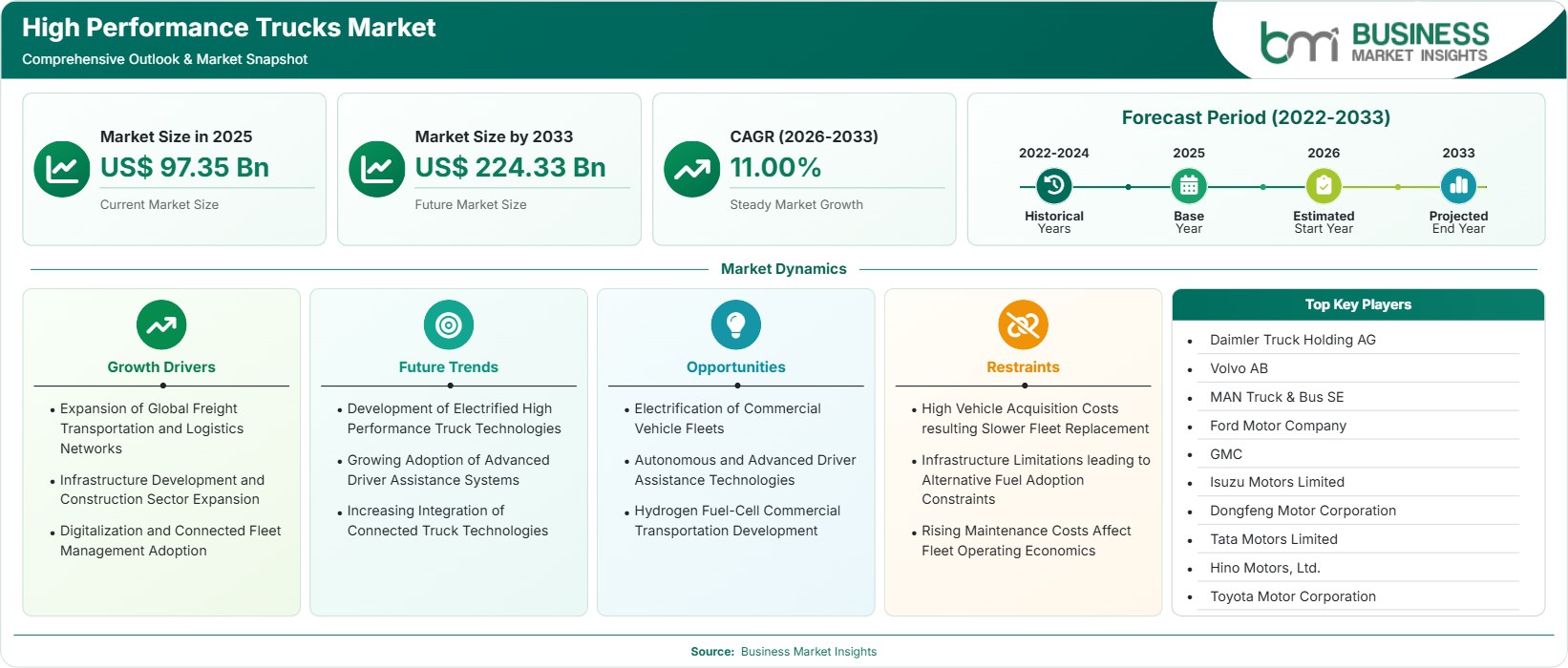
The High Performance Trucks Market size was valued at US$ 97.35 Billion in 2025 and is projected to reach US$ 224.33 Billion by 2033, growing at a CAGR of 11.00% during 2026–2033, driven by fleet modernization, infrastructure development, logistics expansion, connected vehicle adoption, autonomous driving advancements, and opportunities in electrification, telematics integration, and emerging freight transportation networks.

Report Coverage
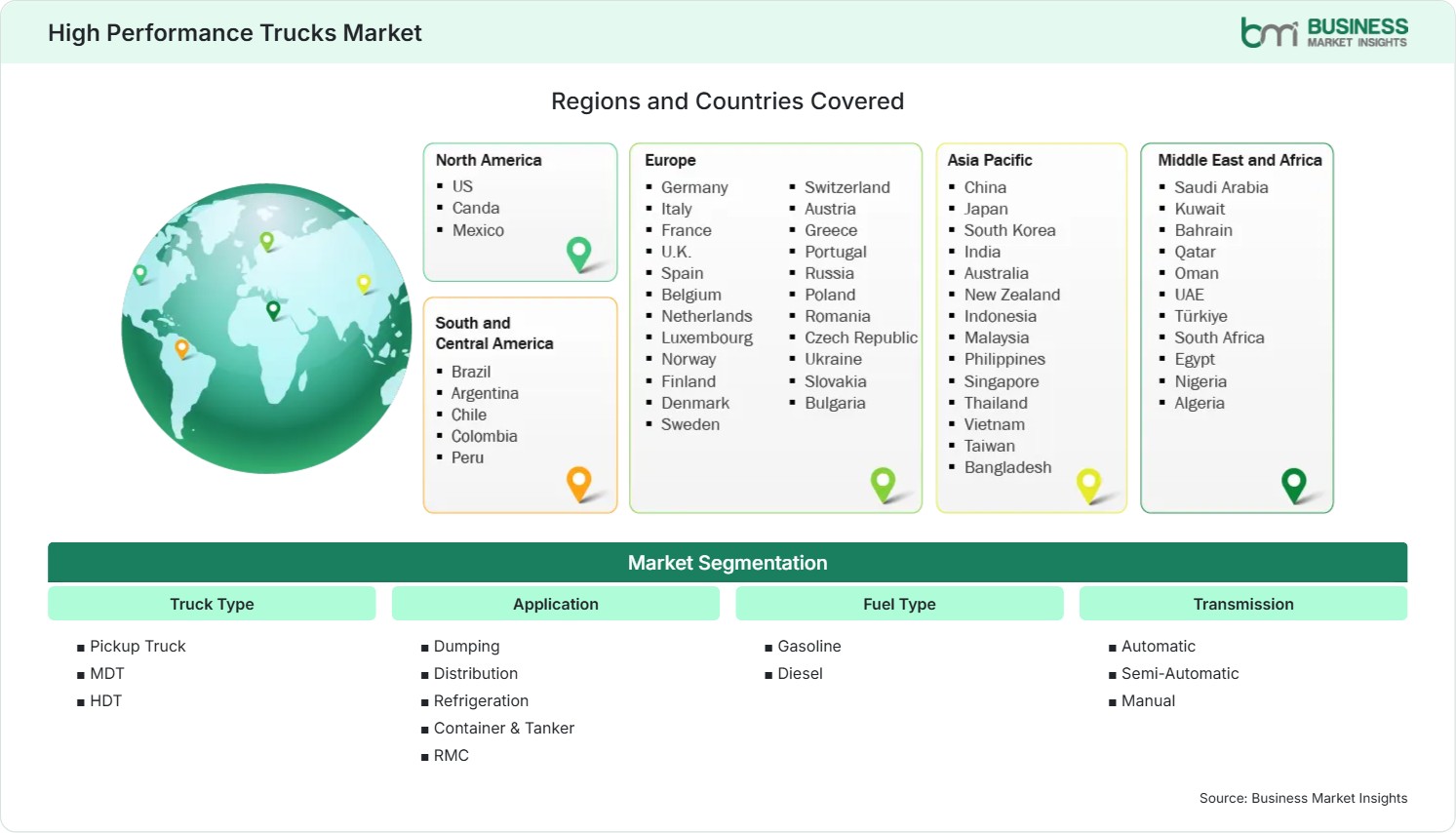
  • Truck Type: Pickup Truck, MDT, HDT
  • Application: Dumping, Distribution, Refrigeration, Container & Tanker, RMC
  • Fuel Type: Gasoline, Diesel
  • Transmission: Automatic, Semi-Automatic, Manual
US$ 97.35 Bn Market size in 2025
US$ 224.33 Bn Market Size by 2033
11.00% CAGR, 2026 - 2033
2026-2033 Forecast Period

01 AI Overview

High Performance Trucks Market Summary

  • North America Region: North America holds a 34%–37% share in 2025 and is expected to grow at a 10.2%–10.8% CAGR during 2026–2033. Demand is supported by fleet replacement cycles, freight movement growth, advanced telematics adoption, infrastructure spending, e-commerce logistics expansion, autonomous technologies, fuel-efficiency improvements, and increasing investment in smart transportation ecosystems. The US remains the regional leader due to strong freight demand and fleet digitization, advancing at 10.4%–11.0% CAGR through 2033.
  • Fastest Growing Region: Asia Pacific accounts for 29%–32% share in 2025 and is projected to register a 12.1%–12.8% CAGR during 2026–2033. Industrial expansion, infrastructure investment, manufacturing growth, urbanization, logistics modernization, rising construction activity, expanding mining operations, and government support for commercial vehicle adoption continue driving strong momentum.
  • Leading Segment: HDT represents 43%–47% share in 2025 and is anticipated to grow at a 10.4%–11.0% CAGR during 2026–2033. Growth is supported by long-haul freight demand, mining applications, construction activities, fleet productivity requirements, advanced powertrain technologies, and increasing investment in high-capacity transportation infrastructure globally.
  • High Growth Segment: Automatic transmission holds 27%–31% share in 2025 and is forecast to expand at a 12.5%–13.2% CAGR during 2026–2033. Driver comfort improvements, fuel optimization technologies, autonomous driving compatibility, fleet efficiency goals, reduced maintenance requirements, and rising acceptance across commercial transportation operations accelerate adoption.
  • Key Market Opportunity: Growing deployment of connected, electric, and autonomous commercial vehicles creates opportunities for manufacturers to develop advanced truck platforms, predictive maintenance solutions, fleet management technologies, and sustainable transportation offerings.
  • Major Market Players: Daimler Truck Holding AG; Volvo AB; MAN Truck & Bus SE; Ford Motor Company; GMC; Isuzu Motors Limited; Dongfeng Motor Corporation; Tata Motors Limited; Hino Motors, Ltd.; Toyota Motor Corporation.
02 Strategic Insights

High Performance Trucks Market: Strategic Insights

High Performance Trucks Market Strategic Framework
FREE PDF
Request your free sample
Request free sample
03 Stakeholder View

Key Takeaways

  • The value chain is becoming increasingly integrated, connecting component suppliers, technology providers, OEMs, fleet operators, and logistics companies to improve vehicle performance, operational efficiency, and lifecycle management.
  • Heavy-duty transportation applications present the strongest revenue opportunities due to rising freight volumes, infrastructure expansion, and increasing demand for long-haul logistics capabilities across industrial economies.
  • Innovation is increasingly focused on electrified powertrains, advanced telematics, predictive maintenance platforms, autonomous driving technologies, and software-defined vehicle architectures that enhance operational productivity.
  • Asia Pacific offers one of the most compelling investment opportunities due to rapid industrialization, growing construction activity, manufacturing expansion, and increasing transportation infrastructure spending.
  • Strategic collaborations, acquisitions, and joint ventures are accelerating technology development in connected mobility, alternative fuels, fleet analytics, and intelligent transportation solutions.
  • Sustainability initiatives are driving investment in low-emission engines, battery-electric trucks, hydrogen fuel-cell technologies, and energy-efficient logistics ecosystems that support long-term environmental objectives.
04 Geographic Outlook

High Performance Trucks Market Regional Highlights

North America High Performance Trucks Market

North America accounted for approximately 34%–37% of global revenue share in 2025 and is projected to expand at a CAGR of 10.2%–10.8% during 2026–2033. Strong freight transportation demand, fleet modernization programs, and extensive highway infrastructure continue supporting regional leadership. The High Performance Trucks Market share remains substantial due to advanced logistics networks and high commercial vehicle utilization rates.

  • E-commerce expansion continues increasing freight volumes, encouraging fleet operators to invest in technologically advanced commercial vehicles capable of supporting high-utilization logistics operations.
  • Infrastructure modernization initiatives across the United States and Canada are generating sustained demand for heavy-duty and medium-duty transportation equipment.
  • Fleet operators increasingly deploy telematics and predictive maintenance platforms to reduce downtime, improve fuel efficiency, and optimize operational performance.
  • Electrification projects supported by public and private investments are accelerating adoption of battery-electric and alternative-fuel truck platforms.
  • Autonomous driving trials and connected vehicle ecosystems continue strengthening long-term commercial vehicle innovation across regional transportation networks.

US High Performance Trucks Market

The United States contributes approximately 75%–79% of North American revenue in 2025 and is forecast to register a CAGR of 10.4%–11.0% through 2033. The High Performance Trucks Market growth outlook benefits from increasing logistics investments, expanding warehousing activity, and growing adoption of intelligent fleet management technologies.

  • Rising demand for same-day and next-day delivery services continues supporting investments in advanced transportation fleets and route optimization technologies.
  • Federal infrastructure spending programs contribute to increased deployment of construction and heavy-haul commercial vehicles across major project developments.
  • Fleet electrification initiatives are expanding as operators seek lower operating costs and improved compliance with emissions regulations.
  • Connected vehicle technologies improve operational visibility, maintenance scheduling, and driver safety across commercial transportation networks.

Europe High Performance Trucks Market

Europe held approximately 24%–27% share in 2025 and is expected to grow at a CAGR of 9.6%–10.2% between 2026 and 2033. The region benefits from advanced commercial vehicle manufacturing capabilities, stringent emissions regulations, and strong logistics infrastructure.

  • Germany maintains regional leadership through strong truck manufacturing capabilities, extensive logistics activity, and advanced engineering expertise.
  • Poland is emerging as a high-growth market supported by logistics expansion, industrial investments, and increasing freight transportation requirements.
  • European fleet operators increasingly prioritize low-emission transportation solutions to comply with evolving environmental regulations.
  • Investments in hydrogen fuel-cell and battery-electric truck technologies continue accelerating across key transportation corridors.
  • Cross-border trade activity supports demand for technologically advanced long-haul transportation vehicles throughout the region.

Asia Pacific High Performance Trucks Market

Asia Pacific accounted for approximately 29%–32% of global revenue in 2025 and is projected to expand at a CAGR of 12.1%–12.8% during 2026–2033. Rapid industrialization, urbanization, infrastructure development, and manufacturing growth continue supporting strong demand.

  • China benefits from large-scale infrastructure development, industrial production, and extensive freight transportation requirements across domestic and international trade routes.
  • India demonstrates strong growth potential supported by logistics modernization, highway expansion projects, and increasing industrial output.
  • Mining, construction, and manufacturing activities continue generating substantial demand for heavy-duty transportation equipment.
  • Digital fleet management platforms are increasingly adopted to improve utilization, maintenance efficiency, and operational productivity.
  • Commercial vehicle electrification programs are expanding as governments encourage sustainable transportation development.

Rest of World High Performance Trucks Market

The Rest of World region accounted for approximately 10%–13% share in 2025 and is projected to register a CAGR of 10.8%–11.5% through 2033. South & Central America benefit from mining activity, agricultural transportation demand, and logistics development. Meanwhile, Middle East & Africa markets are supported by infrastructure projects, energy-sector investments, and trade corridor expansion.

The combination of industrial diversification, transportation modernization, and infrastructure investments continues creating favorable conditions for commercial vehicle deployment throughout emerging markets.

  • Brazil benefits from agricultural exports, mining transportation demand, and expanding logistics networks supporting commercial vehicle adoption.
  • Saudi Arabia is witnessing increased investment in transportation infrastructure and logistics hubs aligned with long-term economic diversification initiatives.
  • Resource extraction industries continue generating demand for heavy-duty hauling and specialized transportation solutions across emerging economies.
  • Fleet modernization programs encourage replacement of aging commercial vehicles with technologically advanced truck platforms.
  • Expansion of trade routes and regional logistics networks supports long-term growth in freight transportation demand.
Global Market Geography
FREE PDF
Request your free sample
Request free sample
05 Segment Analysis

High Performance Trucks Market Segmentation

Truck Type

Truck Type represents the largest revenue-generating segment, with HDT accounting for approximately 43%–47% share in 2025 and the overall segment advancing at a CAGR of 10.7%–11.3% during 2026–2033. The High Performance Trucks Market scope continues expanding as fleet operators prioritize payload efficiency, durability, fuel economy, and advanced connectivity features across commercial transportation operations.

  • Pickup Truck: Widely adopted across construction, utility, agriculture, and light commercial applications due to versatility, towing capability, operational flexibility, and increasing integration of advanced safety and connectivity technologies.
  • MDT: Medium-duty trucks play a critical role in urban distribution, municipal services, and regional logistics operations where maneuverability, fuel efficiency, and payload optimization remain important purchasing considerations.
  • HDT: Heavy-duty trucks remain indispensable for long-haul transportation, mining operations, construction projects, and industrial logistics requiring superior hauling capacity, durability, and operational performance.

Application

Application-based demand remains diversified across multiple industrial sectors. This segment is projected to register a CAGR of 11.2%–11.8% through 2033, while Distribution applications account for approximately 30%–34% share in 2025.

  • Dumping: Strong demand originates from mining, construction, quarrying, and infrastructure projects where high-capacity hauling and operational reliability are critical to project efficiency.
  • Distribution: Expanding e-commerce, retail logistics, warehousing activity, and regional transportation networks continue supporting widespread deployment of distribution-focused commercial vehicles.
  • Refrigeration: Growth is supported by increasing transportation of pharmaceuticals, food products, beverages, and temperature-sensitive goods requiring controlled logistics environments.
  • Container & Tanker: Industrial manufacturing, chemicals, petroleum products, and international trade activities continue driving demand for specialized transportation solutions within this category.
  • RMC: Ready-mix concrete transportation applications benefit from infrastructure development, commercial construction projects, and urban expansion initiatives across emerging and developed economies.

Fuel Type

Fuel Type remains a critical determinant of fleet economics and regulatory compliance. Diesel-powered vehicles account for approximately 62%–66% share in 2025, while the segment is expected to advance at a CAGR of 10.5%–11.1% during 2026–2033. Current High Performance Trucks Market trends indicate increasing investment in alternative fuels and low-emission technologies.

  • Gasoline: Primarily utilized in light commercial and pickup truck applications where lower upfront costs, accessibility, and operational flexibility support continued adoption.
  • Diesel: Maintains leadership because of superior energy density, long-range capabilities, extensive fueling infrastructure, and suitability for demanding freight transportation requirements.

Transmission

Transmission technologies continue evolving to enhance fuel efficiency, driver comfort, and vehicle productivity. Automatic systems account for approximately 27%–31% share in 2025 and are expected to expand at a CAGR of 12.5%–13.2% through 2033. Automation trends are further accelerating adoption across commercial transportation fleets.

  • Automatic: Growing adoption is supported by improved fuel optimization, enhanced driver comfort, reduced training requirements, and compatibility with connected and autonomous vehicle technologies.
  • Semi-Automatic: These systems provide a balance between efficiency and driver control, making them attractive for operators seeking performance improvements without full automation.
  • Manual: Manual transmissions remain relevant in certain regions and specialized applications where operational familiarity, lower acquisition costs, and maintenance simplicity influence purchasing decisions.
06 Market Forces

High Performance Trucks Market Dynamics

Key Market Drivers

Expansion of Global Freight Transportation and Logistics Networks

The growth in global trade, development of e-commerce, and increased industrial production continue to contribute significantly to the need for sophisticated transport systems for commercial operations. From international trade analyses and logistics sector statistics, the flow of cargo in major economies continues to increase, and this calls for enhanced transport capability on the part of operators. The High Performance Trucks Market growth is tied directly to the increase in movement of goods in the manufacturing, retail, construction, and resource sectors. The use of trucks that have been integrated with telematics and predictive maintenance, as well as efficient engine systems, allows operators to transport more while minimizing expenses.

Infrastructure Development and Construction Sector Expansion

Infrastructure projects in various segments, including transport, energy, industries, and urban developments, are creating a greater need for commercial trucks. Countries all over the world continue spending huge amounts of money on road construction, logistics corridors, ports, and industrial parks. There is a need for specialized transport equipment that can help move materials and undertake construction activities. Mining and resources exploration activities are also contributing to the need for such equipment. The manufacturing of commercial vehicles is enjoying increased demand for commercial vehicles with specialized designs. Infrastructure upgrades all over the world are playing an important role in industry growth.

Digitalization and Connected Fleet Management Adoption

Fleet organizations are increasingly using sophisticated telematics systems, intelligent analytics through artificial intelligence, and connected car technology in an effort to increase operational efficiencies. Telematics offers real-time capabilities for predictive maintenance, routing, fuel use analysis, and improved safety management. The application of digital technology decreases downtime and increases the utilization rate of assets. Digitalized fleet ecosystem allows for informed decision-making and enhances overall productivity in transportation. Vehicle manufacturers keep integrating software-defined architecture and intelligent diagnostics into their trucks. As transportation firms strive to optimize operations and costs, the demand for digitized commercial vehicles is expected to stay high in many sectors.

Key Market Opportunities

Electrification of Commercial Vehicle Fleets

Shifting to emission-free mobility solutions is full of potential for companies manufacturing trucks and providing technologies for their operation and maintenance. Incentives and strict emissions regulations, as well as new investments into the development of the infrastructure for the utilization of electric trucks, have been implemented by different governments around the world. Further developments in battery technology and cost reduction of energy storage, along with the availability of more charging stations, increase the viability of electric trucks. According to High Performance Trucks Market Forecasts, the penetration rate of electric truck platforms increases in urban logistics, regional transport, and selected heavy-duty applications.

Autonomous and Advanced Driver Assistance Technologies

Autonomous transport solutions are generating new revenues for the entire commercial vehicle industry. The use of advanced driver assistance systems increases safety, reduces risks, and increases the efficiency of transportation. Long-haul logistics, logistics corridors, and industrial areas are seen as potential application areas. The technology companies, software firms, and vehicle manufacturers are continuing their substantial investments in autonomous mobility solutions. As the regulation is evolving and more pilot projects are being launched, more application possibilities will be opened up for commercial applications. Early movers that can offer reliable autonomous mobility solutions could have competitive advantages.

Hydrogen Fuel-Cell Commercial Transportation Development

The hydrogen fuel cell is an appealing technology for those applications that would require long-range driving, fast fueling, and high payloads. Several countries and other organizations are still working to implement hydrogen technologies and vehicles. The fuel-cell platform can be more advantageous compared to battery-powered electric cars in certain heavy-duty transportation areas that have some restrictions. Collaboration between truck manufacturers, energy companies, and fueling companies is moving forward with the implementation process. With the reduction of hydrogen manufacturing costs and expansion of its fueling stations, hydrogen will find its application in long-distance transportation and industries.

Market Restraints and Challenges

High Vehicle Acquisition Costs resulting in Slower Fleet Replacement

Modern commercial trucks tend to be equipped with advanced telematic devices, automatic transmissions, alternative engines, and other advanced technologies. Factor: such innovations greatly raise initial costs when compared to standard truck designs. Impact: fleet managers, especially small and mid-size companies, will experience difficulties in making purchase decisions or delaying the time between replacement of old equipment due to financing needs. Tight financial conditions in developing countries will add to the problem. While the savings in operations do make such purchases feasible in the long run, high costs pose a major challenge for many buyers.

Infrastructure Limitations leading to Alternative Fuel Adoption Constraints

The adoption of electric and hydrogen fuel technologies for transport relies heavily on the availability of relevant infrastructures. Factor: Lack of sufficient charging stations, hydrogen fuel stations, and infrastructure development at the regional level hampers the adoption possibilities. Impact: Fleet managers can hold back on investing in alternative fuel technologies because of doubts about operational reliability and route flexibility. The lack of infrastructure is highly observable in long-distance transportation routes and new markets. This makes the adoption of these technologies a challenge, thus making the adoption timelines long and making investments less certain.

07 Company Analysis

Competitive Landscape

The competitive environment is characterized by continuous investments in powertrain efficiency, fleet connectivity, safety technologies, electrification, and autonomous driving capabilities. Current High Performance Trucks Market analysis indicates that manufacturers are prioritizing intelligent transportation solutions, alternative-fuel platforms, and digital fleet management technologies to strengthen competitive positioning and address evolving customer requirements.

Company Name

Overview

Products and Services relevant to this market

Daimler Truck Holding AG

One of the world's largest commercial vehicle manufacturers with strong global presence across heavy-duty, medium-duty, and specialty truck segments.

Freight transportation vehicles, heavy-duty trucks, connected fleet solutions, electric trucks, safety systems, and commercial mobility technologies.

Volvo AB

Global leader in commercial transportation known for innovation in safety, sustainability, and advanced vehicle technologies.

Heavy-duty trucks, autonomous transport solutions, telematics systems, electric trucks, logistics services, and fleet management platforms.

MAN Truck & Bus SE

Major European truck manufacturer focused on efficient transportation solutions and digital mobility innovations.

Long-haul trucks, distribution vehicles, fleet connectivity services, electric transportation solutions, and commercial vehicle support services.

Ford Motor Company

Leading automotive company with strong presence in pickup truck and commercial vehicle markets worldwide.

Performance pickup trucks, fleet vehicles, connected mobility solutions, commercial transportation technologies, and advanced driver assistance systems.

GMC

Premium truck and utility vehicle brand recognized for durable commercial and performance-oriented vehicle offerings.

Pickup trucks, commercial transportation vehicles, towing solutions, fleet services, and advanced safety technologies.

Isuzu Motors Limited

Prominent commercial vehicle manufacturer specializing in medium-duty and heavy-duty transportation solutions.

Commercial trucks, logistics vehicles, diesel powertrains, fleet support services, and transportation management solutions.

Dongfeng Motor Corporation

Large Chinese vehicle manufacturer serving industrial, logistics, construction, and freight transportation markets.

Heavy-duty trucks, logistics transportation vehicles, construction trucks, commercial fleet products, and mobility solutions.

Tata Motors Limited

Leading commercial vehicle producer with extensive portfolio serving transportation, mining, and infrastructure sectors.

Heavy-duty trucks, construction vehicles, logistics transportation solutions, electric commercial vehicles, and fleet services.

Hino Motors, Ltd.

Established commercial vehicle manufacturer known for reliability, fuel efficiency, and fleet-focused transportation solutions.

Medium-duty trucks, heavy-duty transportation vehicles, maintenance services, telematics systems, and fleet management offerings.

Toyota Motor Corporation

Global automotive leader expanding commercial mobility and alternative-fuel transportation initiatives.

Hydrogen fuel-cell technologies, commercial mobility solutions, connected vehicle platforms, and advanced transportation systems.

10 Trust & Transparency

Research Methodology

The market analysis combines proprietary research with secondary data from government agencies, company disclosures, regulatory filings, industry databases and expert interviews. Market estimates are validated through data triangulation, cross-market benchmarking and analyst review.

View Full Research Methodology

11 Questions Answered

Frequently Asked Questions

What does the High Performance Trucks Market Report indicate regarding future competition?

The report suggests competition will increasingly center on electrification, autonomous technologies, software-defined vehicles, fleet analytics, and integrated transportation ecosystems that improve efficiency and sustainability.

Why are connected fleet technologies becoming important?

Connected solutions improve operational efficiency through predictive maintenance, route optimization, real-time vehicle monitoring, fuel consumption analysis, and enhanced fleet productivity across transportation networks.

How is electrification influencing commercial vehicle development?

Electrification is encouraging manufacturers to invest in battery technologies, charging infrastructure partnerships, energy management systems, and low-emission transportation platforms designed to meet evolving sustainability objectives.

Which truck category generates the highest revenue contribution?

Heavy-duty trucks generate the largest revenue contribution because of their extensive utilization in long-haul freight transportation, mining operations, infrastructure projects, and industrial logistics applications requiring superior hauling capacity.

What factors are driving demand for high-performance commercial trucks?

Growing freight transportation requirements, infrastructure development projects, logistics modernization, fleet digitization, and increasing adoption of advanced safety and telematics technologies are supporting demand across global transportation sectors.

Access the Full High Performance Trucks Market Report

Get segment-level forecasts, regional estimates, competitive benchmarking, company profiles and downloadable Excel datasets.

Access the full High Performance Trucks Market Report
350 pages PDF & Excel | 2026-08-24