Automotive Logging Devices Market Outlook: Size, Share, Trends, Growth Analysis, Competitive Landscape & Forecast, 2026-2033

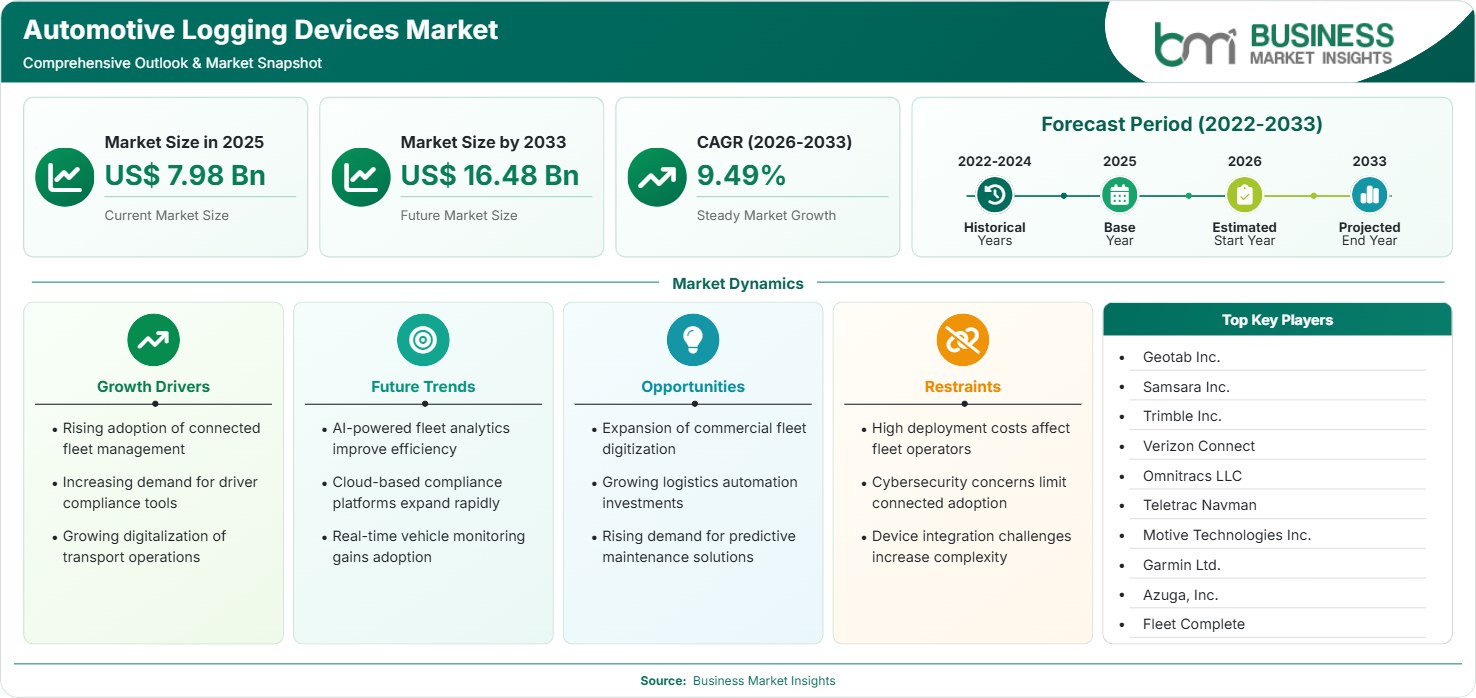
The Automotive Logging Devices Market size was valued at US$ 7.98 billion in 2025 and is projected to reach US$ 16.48 billion by 2033, growing at a CAGR of 9.49% during 2026–2033. Increasing fleet digitalization, stricter compliance regulations, connected vehicle adoption, and demand for real-time fleet visibility continue supporting market expansion.

Report Coverage
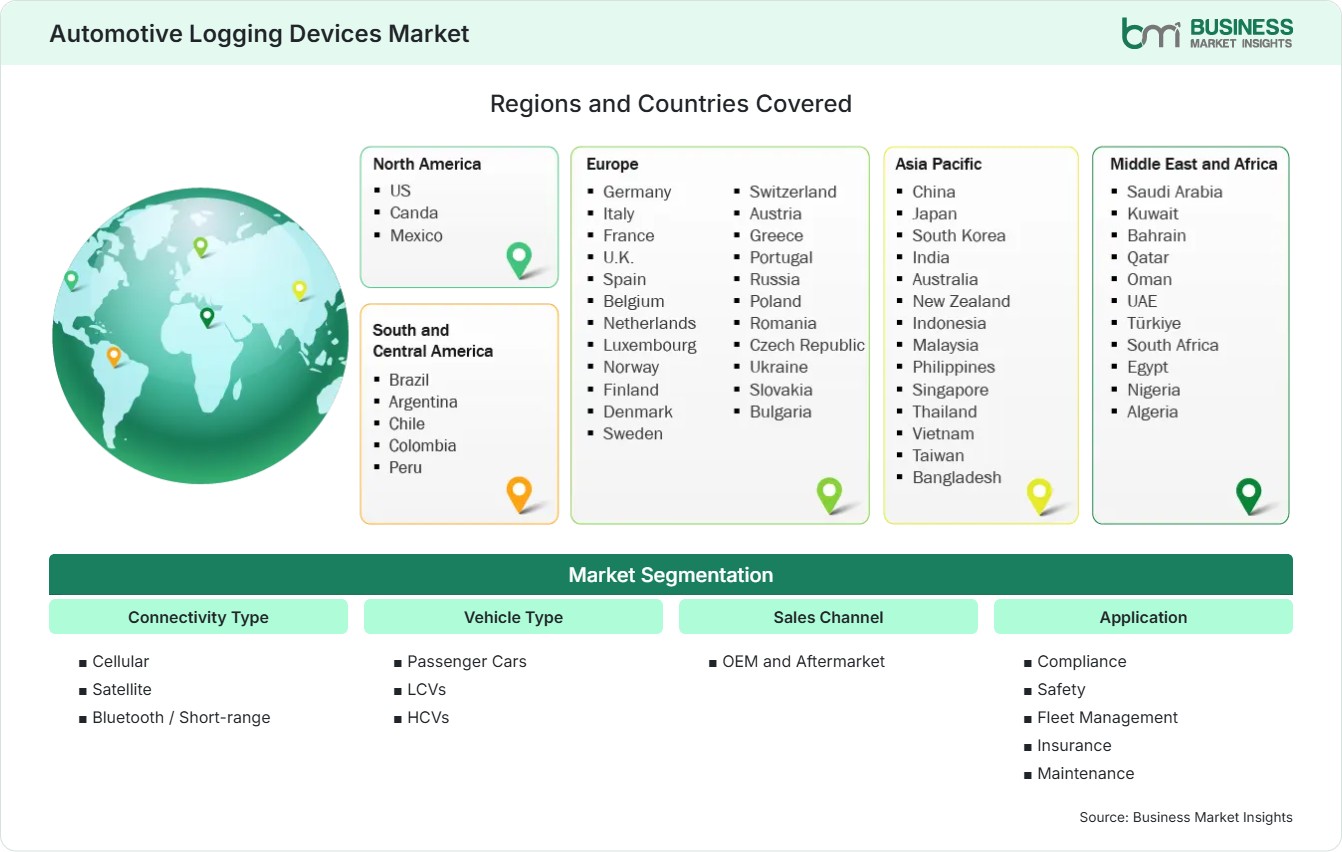
  • Connectivity Type: Cellular, Satellite, Bluetooth / Short-range
  • Vehicle Type: Passenger Cars, LCVs, HCVs
  • Sales Channel: OEM and Aftermarket
  • Application: Compliance, Safety, Fleet Management, Insurance, Maintenance
US$ 7.98 Bn Market size in 2025
US$ 16.48 Bn Market Size by 2033
9.49% CAGR, 2026 - 2033
2026-2033 Forecast Period

01 AI Overview

Automotive Logging Devices Market Summary

  • North America Region: Holds 38%–41% share in 2025 and is expected to grow at a CAGR of 8.7%–9.2% during 2026–2033, driven by regulatory compliance, telematics investments, connected fleets, and digital logistics. The U.S. leads regional adoption through large commercial fleets and advanced telematics, growing at approximately 8.8%–9.3% CAGR.
  • Fastest Growing Region: Asia Pacific accounts for 24%–27% share in 2025 with a CAGR of 11.0%–11.8%, supported by logistics expansion, vehicle production, government digital initiatives, and e-commerce growth.
  • Leading Segment: Fleet Management represents 34%–37% share in 2025, expanding at a CAGR of 9.8%–10.4% owing to demand for route optimization, operational visibility, and predictive maintenance.
  • High Growth Segment: Cellular (4G/5G LTE) captures 56%–60% share in 2025, growing at a CAGR of 10.4%–11.1%, driven by expanding connectivity, cloud platforms, and real-time vehicle communication.
  • Key Market Opportunity: AI-enabled telematics, predictive maintenance, insurance analytics, and cloud-based fleet platforms create opportunities for operational efficiency, compliance automation, and connected mobility.
  • Major Market Players: Geotab Inc., Samsara Inc., Trimble Inc., Verizon Connect, Omnitracs LLC, Teletrac Navman, Motive Technologies Inc., Garmin Ltd., Azuga, Inc., Fleet Complete.
02 Strategic Insights

Automotive Logging Devices Market: Strategic Insights

Automotive Logging Devices Market Strategic Framework
FREE PDF
Request your free sample
Request free sample
03 Stakeholder View

Key Takeaways

  • The development of integrated ecosystems involving OEMs, telematics solutions, software vendors, and logistics providers is improving fleet management solutions.
  • The fleet management solution provides the best income prospects thanks to compliance, efficiency, and fuel consumption optimization.
  • Artificial intelligence, predictive analysis, edge computing, and software updates via the cloud are driving innovations.
  • Asia Pacific region presents promising prospects due to the development of logistics infrastructure and rapid digitalization of fleets.
  • Collaboration and acquisitions, as well as software-as-a-service platforms, keep on changing the competitive landscape.
  • Data-driven insurance and predictive maintenance present other income prospects for tech vendors.
04 Geographic Outlook

Automotive Logging Devices Market Regional Highlights

North America Automotive Logging Devices Market

North America accounts for 38%–41% Automotive Logging Devices Market share in 2025 and is projected to grow at a CAGR of 8.7%–9.2%. Mature logistics infrastructure, regulatory compliance, high telematics penetration, and enterprise fleet modernization support regional leadership.

  • Electronic logging regulations continue accelerating digital fleet management adoption.
  • AI-enabled telematics improve route optimization, maintenance scheduling, and driver monitoring.
  • Commercial vehicle electrification increases demand for integrated fleet analytics.
  • Cloud computing and cybersecurity investments strengthen connected fleet ecosystems.

US Automotive Logging Devices Market

The United States contributes 82%–85% of North American revenue and is expected to grow at a CAGR of 8.8%–9.3%. Large trucking fleets, advanced transportation infrastructure, and digital freight management support continued adoption.

  • Transportation companies integrate electronic logging with enterprise fleet platforms.
  • Legacy systems are increasingly replaced by cloud-connected solutions.
  • E-commerce expansion supports demand for intelligent fleet technologies.
  • Subscription-based telematics platforms improve scalability and recurring revenues.

Europe Automotive Logging Devices Market

Europe represents 27%–30% market share in 2025 with a CAGR of 8.9%–9.6%. Connected mobility investments, freight digitalization, and regulatory modernization support market expansion. Germany leads regional demand, while Poland records the fastest growth.

  • Intelligent tachographs enhance compliance and operational visibility.
  • OEMs expand factory-installed connectivity and cybersecurity capabilities.
  • Fleet electrification increases demand for connected software platforms.
  • Smart transportation initiatives continue supporting technology deployment.

Asia Pacific Automotive Logging Devices Market

Asia Pacific holds 24%–27% market share and records the fastest 11.0%–11.8% CAGR during 2026–2033. Commercial vehicle production, logistics expansion, and government-supported digital transportation projects accelerate adoption.

  • Fleet operators increasingly deploy AI-enabled telematics.
  • Smart transportation investments encourage connected fleet management.
  • OEM connectivity integration supports advanced analytics.
  • Expanding 5G infrastructure improves real-time fleet communication.

Rest of World Automotive Logging Devices Market

The Rest of World region accounts for 8%–11% market share in 2025 and grows at a CAGR of 9.5%–10.2%. Logistics modernization, infrastructure development, and fleet digitalization continue supporting adoption.

  • Brazil leads South and Central America, while Mexico records faster growth.
  • GCC countries invest heavily in intelligent logistics infrastructure.
  • South Africa remains a major adopter across mining and logistics.
  • Expanding telecommunications networks strengthen connected fleet deployments.
Global Market Geography
FREE PDF
Request your free sample
Request free sample
05 Segment Analysis

Automotive Logging Devices Market Segmentation

Connectivity Type

The connectivity type segment remains a critical differentiator in fleet communication capabilities. It accounted for approximately 56%–60% market share in 2025 and is projected to grow at a CAGR of 10.4%–11.1% during 2026–2033. Increasing demand for uninterrupted vehicle communication, cloud-based fleet monitoring, and intelligent transportation systems continues supporting adoption. The Automotive Logging Devices Market scope continues expanding as advanced connectivity technologies improve operational efficiency and regulatory compliance.

  • Cellular (4G/5G LTE): Widely adopted for real-time fleet tracking, electronic logging compliance, over-the-air software updates, and cloud connectivity, enabling continuous communication, remote diagnostics, and operational visibility across commercial transportation fleets.
  • Satellite: Preferred for long-distance freight transportation and remote operating environments where terrestrial network coverage remains limited, ensuring uninterrupted communication, location tracking, regulatory reporting, and fleet visibility across geographically dispersed routes.
  • Bluetooth / Short-range: Increasingly utilized for local data synchronization, driver authentication, mobile application connectivity, and wireless communication between onboard devices, improving operational convenience while reducing hardware complexity and installation requirements.

Vehicle Type

Vehicle type segmentation reflects varying compliance requirements and operational priorities across transportation categories. This segment represented approximately 31%–34% market share in 2025 and is anticipated to register a CAGR of 9.2%–9.8% through 2026–2033. Rising commercial transportation activity, connected vehicle adoption, and fleet modernization continue driving technology deployment across passenger and commercial vehicles.

  • Passenger Cars: Growing adoption among corporate mobility providers, government agencies, rental operators, and shared mobility services supports fleet monitoring, vehicle utilization analysis, maintenance scheduling, and operational transparency.
  • LCVs: Expanding e-commerce deliveries, urban logistics operations, and regional distribution networks continue encouraging deployment of electronic logging solutions supporting route optimization, compliance management, and driver productivity improvements.
  • HCVs: Represents the largest commercial deployment owing to stringent compliance regulations, long-haul transportation requirements, fleet safety initiatives, and increasing adoption of intelligent telematics across heavy-duty logistics operations.

Sales Channel

The sales channel segment continues evolving as vehicle manufacturers increasingly integrate connected technologies while aftermarket suppliers serve existing commercial fleets. The segment accounted for approximately 52%–55% market share in 2025 and is forecast to expand at a CAGR of 9.5%–10.0% during 2026–2033. Demand for scalable digital fleet solutions and connected vehicle platforms supports steady market expansion.

  • OEM: Vehicle manufacturers increasingly integrate factory-installed electronic logging devices with embedded telematics, enabling seamless connectivity, software updates, enhanced cybersecurity, and simplified deployment for fleet operators.
  • Aftermarket: Continues serving large installed vehicle populations through flexible retrofit solutions that improve compliance, fleet monitoring, maintenance planning, and operational visibility without requiring complete vehicle replacement.

Application

Application-based demand is expanding as fleet operators prioritize digital operations, safety improvement, compliance automation, and predictive maintenance. This segment held approximately 34%–37% market share in 2025 and is expected to record a CAGR of 9.8%–10.4% through 2026–2033. Organizations continue investing in integrated software platforms delivering operational intelligence and data-driven fleet optimization.

  • Compliance: Supports automated driver hour recording, regulatory reporting, audit readiness, and electronic documentation, reducing administrative workload while improving adherence to transportation regulations.
  • Safety: Enables driver behavior monitoring, incident reporting, fatigue management, and risk reduction through continuous vehicle performance monitoring and real-time safety alerts.
  • Fleet Management: Combines vehicle tracking, route optimization, fuel monitoring, asset utilization, and predictive analytics, helping organizations improve productivity while lowering operating costs.
  • Insurance: Enables usage-based insurance programs, driver risk assessment, claims validation, and data-driven underwriting through continuous vehicle performance and operational monitoring.
  • Maintenance: Supports predictive servicing, remote diagnostics, equipment health monitoring, and preventive maintenance scheduling, minimizing unexpected downtime while extending vehicle life and improving fleet availability.
06 Market Forces

Automotive Logging Devices Market Dynamics

Key Market Drivers

Rising adoption of connected fleet management

Fleet management systems that are connected are emerging as a key strategy for transportation organizations trying to gain efficiencies. Fleet management systems are using telematics, cloud computing, artificial intelligence, and Internet of Things (IoT) to manage the health of vehicles, enhance routing efficiency, and improve the performance of drivers. As per the International Energy Agency (IEA), digital technologies are making the transport efficiency push a faster process. These developments enable real-time data exchange, predictive maintenance, and lower operating costs. Consequently, Automotive Logging Devices Market growth is supported by increasing enterprise investments in intelligent fleet ecosystems capable of improving productivity, minimizing downtime, and enhancing asset utilization across commercial transportation operations.

Increasing demand for driver compliance tools

Regulatory agencies across several countries continue strengthening electronic recordkeeping requirements for commercial transportation, encouraging fleet operators to replace manual documentation with automated compliance platforms. An electronic logging device minimizes documentation, increases the accuracy of reporting, makes inspections easier, and assists in the compliance with the working hour regulations of drivers. The logistics companies benefit from the automatic audit trail and compliance management. An increase in cross-border transportation of cargo adds to the demand for such solutions that provide digital compliance. With the increasing regulation becoming more and more data-based, there is continued investment in logging technologies.

Growing digitalization of transport operations

The increasing digitization in the transport, warehouse, and logistics operations is pushing the adoption of intelligent fleet solutions. The transportation firms are now incorporating the electronic logging device along with transportation management systems, ERP software, and predictive analytics tools. Cloud-based software enables centralized fleet monitoring, automated reporting, and data-driven decision-making. Expanding e-commerce distribution networks and rising commercial vehicle utilization further strengthen demand for integrated digital fleet solutions. Automotive Logging Devices Market trends increasingly reflect the industry's transition toward connected transportation ecosystems supported by artificial intelligence, real-time analytics, and interoperable fleet management platforms.

Key Market Opportunities

Expansion of commercial fleet digitization

Investments in digital transformation by commercial fleet owners are increasing significantly in order to boost efficiency, sustainability, and compliance. Connected cars, cloud computing technology, artificial intelligence, and analytical capabilities offer a chance for the integration of fleet ecosystem solutions that enable predictive maintenance and route optimization. Fleet modernization programs across developing economies further strengthen long-term demand for electronic logging solutions. The Automotive Logging Devices Market Forecasts indicate that expanding digital infrastructure, growing commercial transportation activity, and increasing enterprise software adoption will continue creating investment opportunities for technology providers offering scalable fleet management platforms.

Growing logistics automation investments

Warehouse automation, intelligent freight management, autonomous dispatch systems, and smart logistics infrastructure continue transforming commercial transportation operations. Fleet operators increasingly require electronic logging devices capable of integrating with automated scheduling, warehouse management, and transportation planning platforms. Increased investments in digital logistics will ensure better coordination while ensuring that assets remain visible in real time. Technology companies providing software ecosystems that are interoperable and cloud-native along with enhanced analytics are poised to gain from the growing demand for logistics automation systems by enterprises.

Rising demand for predictive maintenance solutions

Predictive maintenance is becoming an essential investment area as fleet operators seek to reduce unexpected vehicle failures and maintenance expenses. Electronic logging devices integrated with vehicle diagnostics generate operational insights supporting proactive servicing and component replacement. AI-driven algorithms optimize the scheduling of maintenance activities through the detection of equipment malfunctions even before breakdowns happen. Businesses in the commercial transportation sector are gradually acknowledging that predictive maintenance is an efficient approach to ensuring that vehicles last longer, increase availability, minimize repair expenses, and deliver maximum ROI from fleet investments.

Market Restraints and Challenges

High deployment costs affect fleet operators

Factor: Initial deployment requires investments in hardware, cloud subscriptions, software integration, installation, employee training, and cybersecurity infrastructure. Impact: Fleet owners operating small to medium fleets tend to delay the process due to high costs of implementation that might exceed the amount budgeted for technology investment. Even though subscription plans make things affordable, it still requires substantial effort to integrate with other enterprise systems. Additionally, organizations need to account for expenses relating to software upgrade, maintenance, and connectivity services, among others.

Cybersecurity concerns limit connected adoption

Factor: Connected fleet platforms continuously exchange operational, driver, and vehicle information across cloud environments, increasing exposure to cyber threats and unauthorized access. Impact: Fleet companies consider security protocols for communication, encryption of data exchange, identification and regulation compliance prior to scaling up connectivity projects. Issues such as ransomware, data privacy, and network security drive organizations to look for cybersecurity technology along with the use of electronic logs. Even though there are continuous improvements in security standards, cyber threats are still significant when it comes to the purchase decision for connected fleets.

07 Company Analysis

Competitive Landscape

Competitive landscape is defined by constant investment in areas such as cloud telematics, AI, fleet analytics, cybersecurity, and connected mobility solutions. According to Automotive Logging Devices Market analysis, top players have started to develop their software solutions further, foster relationships with their Equipment Manufacturer partners, and upgrade their subscription services.

Company Name

Overview

Products and Services relevant to this market

Geotab Inc.

Global telematics provider offering cloud-based fleet intelligence, analytics, and regulatory compliance solutions for commercial transportation and enterprise fleet operators.

Electronic logging devices, fleet telematics, vehicle diagnostics, AI-powered analytics, compliance software, driver safety monitoring, and asset tracking solutions.

Samsara Inc.

Provides connected operations technology integrating IoT hardware, cloud software, and AI-driven analytics for transportation, logistics, and industrial fleet management.

Electronic logging devices, fleet management software, AI dash cameras, vehicle tracking, maintenance management, compliance reporting, and safety solutions.

Trimble Inc.

Develops advanced transportation technologies supporting fleet productivity, routing optimization, logistics planning, and connected commercial vehicle operations worldwide.

Fleet mobility software, electronic logging systems, route optimization, driver workflow management, telematics, and transportation management solutions.

Verizon Connect

Offers cloud-connected fleet management platforms supported by advanced wireless communication infrastructure and enterprise mobility technologies.

GPS fleet tracking, electronic logging, driver monitoring, fuel management, maintenance scheduling, and real-time fleet analytics solutions.

Omnitracs LLC

Specializes in transportation technology solutions helping commercial carriers improve compliance, operational performance, and fleet safety across freight operations.

Electronic logging devices, dispatch software, compliance management, fleet analytics, routing optimization, and driver performance monitoring solutions.

Teletrac Navman

Provides telematics and fleet intelligence platforms serving transportation, construction, utilities, and government fleet operators across international markets.

Fleet tracking, electronic logging, asset management, AI video telematics, compliance software, and predictive maintenance solutions.

Motive Technologies Inc.

Develops AI-enabled fleet management technologies focused on commercial transportation safety, operational efficiency, and regulatory compliance.

AI fleet platform, electronic logging devices, vehicle gateways, driver safety cameras, maintenance management, and fleet analytics software.

Garmin Ltd.

Global technology company delivering GPS navigation, fleet connectivity, and transportation technologies supporting commercial mobility applications.

GPS navigation, fleet telematics hardware, electronic logging solutions, driver communication systems, and connected vehicle technologies.

Azuga, Inc.

Offers cloud-based fleet management solutions emphasizing driver safety, operational visibility, and usage-based analytics for commercial fleets.

Fleet tracking, electronic logging devices, driver coaching, maintenance alerts, compliance reporting, and vehicle utilization analytics.

Fleet Complete

Provides connected fleet, mobile workforce, and asset management technologies serving transportation, field services, and enterprise fleet customers globally.

Fleet management software, electronic logging devices, GPS tracking, compliance tools, maintenance management, and mobile workforce solutions.

10 Trust & Transparency

Research Methodology

The market analysis combines proprietary research with secondary data from government agencies, company disclosures, regulatory filings, industry databases and expert interviews. Market estimates are validated through data triangulation, cross-market benchmarking and analyst review.

View Full Research Methodology

11 Questions Answered

Frequently Asked Questions

What does the Automotive Logging Devices Market Report help stakeholders understand?

The report provides insights into market dynamics, competitive positioning, regional opportunities, technology trends, segmentation, strategic developments, and future investment prospects, supporting informed business planning and long-term decision-making.

How are AI and analytics transforming fleet operations?

Artificial intelligence improves route optimization, predictive maintenance, driver behavior monitoring, fuel efficiency, and operational planning. These capabilities enable transportation companies to reduce costs while improving compliance and fleet productivity.

Which region offers the highest future growth potential?

Asia Pacific is projected to record the fastest growth owing to expanding logistics infrastructure, commercial vehicle production, government-backed digital transportation initiatives, and increasing investment in intelligent fleet management technologies.

Which connectivity technology dominates the market?

Cellular (4G/5G LTE) connectivity leads the market due to its ability to provide continuous communication, real-time vehicle diagnostics, cloud integration, and over-the-air software updates for commercial transportation fleets.

What is driving demand for automotive logging devices?

There is a growing need for automated compliance, real-time vehicle tracking, predictive maintenance, and efficiency in operations. There are connected transport solutions and cloud fleet management platforms that make fleet usage easier.

Access the Full Automotive Logging Devices Market Report

Get segment-level forecasts, regional estimates, competitive benchmarking, company profiles and downloadable Excel datasets.

Access the full Automotive Logging Devices Market Report
350 pages PDF & Excel | 2026-08-06