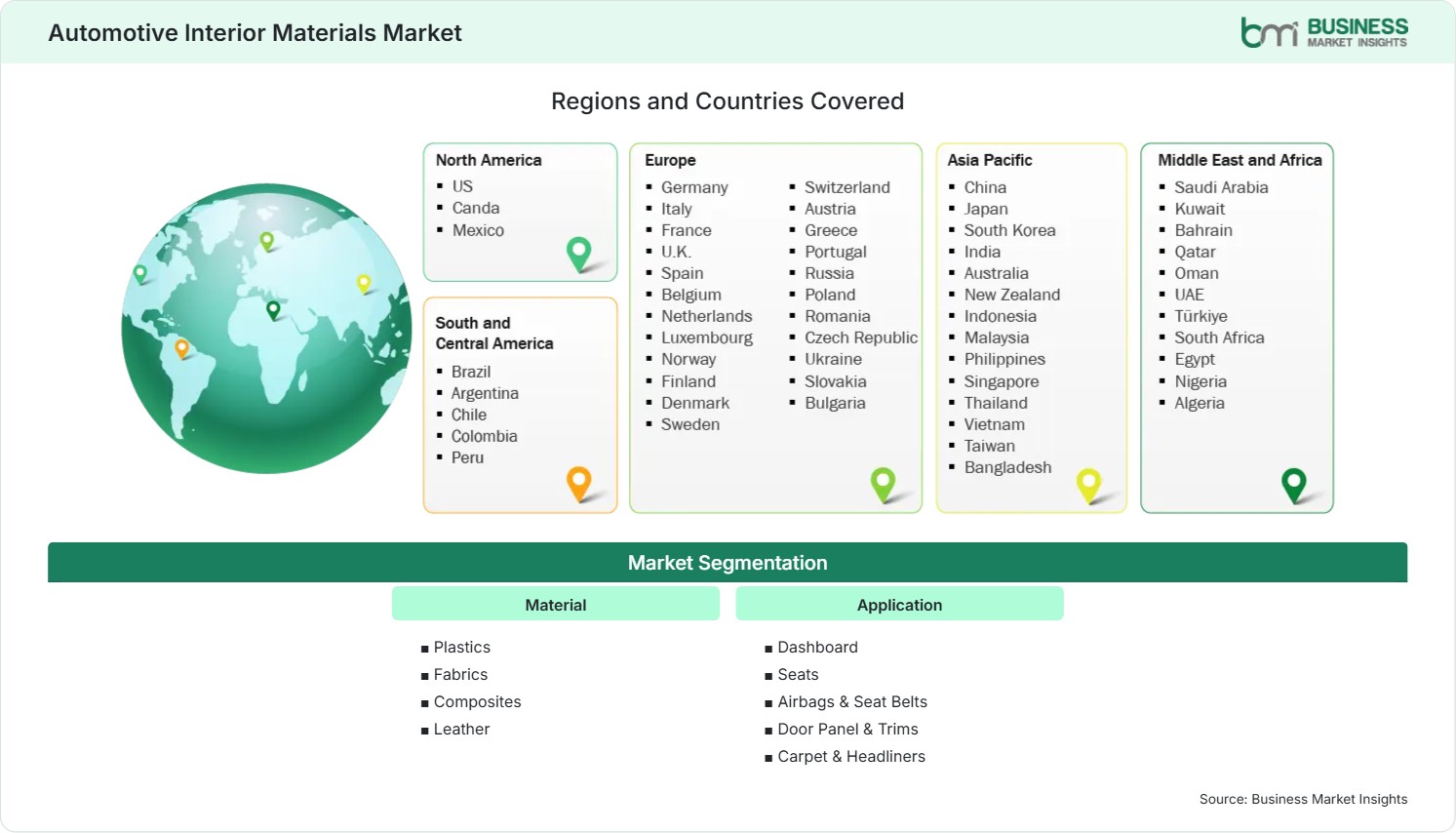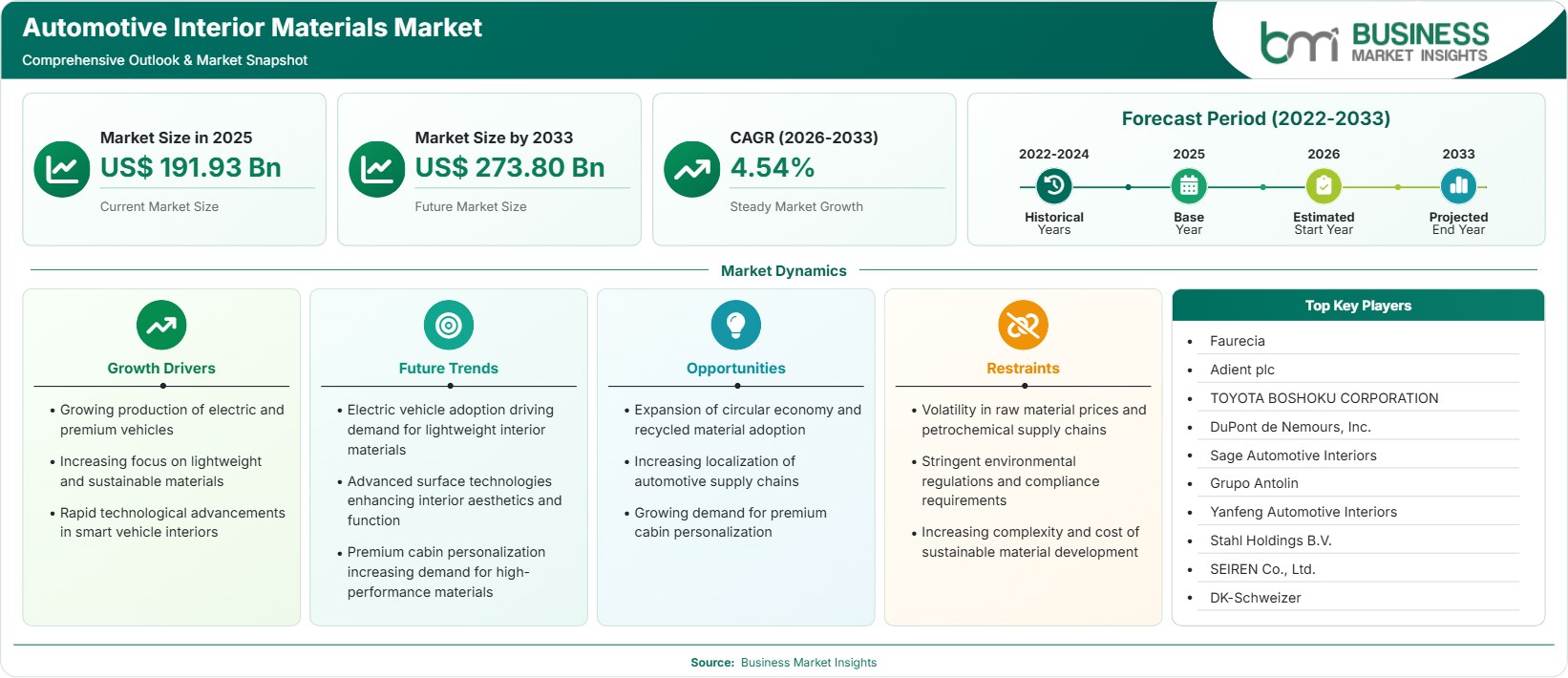
Automotive Interior Materials Market Regional Highlights
North America Automotive Interior Materials Market
North America accounts for 24%–27% of the Automotive Interior Materials Market share in 2025 and is projected to expand at a CAGR of 3.9%–4.3% during 2026–2033. The region benefits from strong production of pickup trucks, SUVs, and premium passenger vehicles, where demand for durable plastics, engineered fabrics, synthetic leather, and lightweight composites remains high. Automakers are also accelerating investments in electric vehicle interiors, recycled materials, and low-VOC cabin solutions to comply with sustainability regulations while enhancing passenger comfort and safety.
- The growing number of electric SUVs and luxury passenger cars has led to an increased need for light weight dashboards, innovative seat materials, and recyclable interior polymers while prompting manufacturers to build their manufacturing facilities within the region.
- OEMs are working more closely with suppliers of material in order to increase their localized sourcing of high-performance materials such as fabrics and plastics.
- The greater concern regarding emissions and sustainability issues prompts the adoption of sustainable interior materials such as recycled plastics and coatings with low emission.
US Automotive Interior Materials Market
The United States represents 72%–75% of the North American market in 2025 and is anticipated to record a CAGR of 4.0%–4.4% through 2033. Strong consumer preference for premium vehicles, rising EV production, and investments in domestic manufacturing continue driving demand for innovative interior materials. Government support for advanced manufacturing and sustainable supply chains further encourages adoption of recycled polymers and lightweight composites across passenger and commercial vehicles.
- Expansion of domestic electric vehicle production is accelerating investments in sustainable cabin materials, smart seating systems, and lightweight dashboard components while strengthening supplier partnerships with major automotive OEMs.
- Premium vehicle demand encourages manufacturers to incorporate high-quality synthetic leather, acoustic insulation materials, and advanced decorative trims that improve passenger comfort and overall cabin experience in automotive interior materials market.
- Increasing reshoring initiatives enhance supply chain resilience by supporting domestic production of engineered textiles, specialty plastics, and performance composites used in next-generation vehicle interiors.
- Rising research investments focus on recyclable interior materials, bio-based polymers, and advanced coatings designed to reduce lifecycle emissions while maintaining safety and long-term durability.
Europe Automotive Interior Materials Market
Europe captures 22%–25% market share in 2025 and is forecast to grow at a CAGR of 4.1%–4.6% during 2026–2033. The region is characterized by stringent environmental regulations, strong premium automotive production, and growing adoption of circular economy practices. Germany leads regional demand, while Eastern European manufacturing hubs continue expanding through competitive production costs and increasing automotive investments supporting advanced interior material development.
- Germany remains the leading regional market, supported by premium vehicle manufacturing, advanced engineering capabilities, and continuous investment in sustainable interior materials with a CAGR of 4.0%–4.4%.
- Poland and Hungary represent the fastest-growing manufacturing locations, supported by expanding automotive assembly operations and projected CAGRs ranging between 4.8%–5.2% through 2033 in automotive interior materials market.
- European sustainability regulations continue accelerating adoption of recycled textiles, bio-based leather alternatives, and lightweight composites across vehicle interior applications.
- Luxury vehicle manufacturers increasingly collaborate with innovative material developers to improve cabin aesthetics, durability, and environmental performance while meeting evolving consumer expectations.
Asia Pacific Automotive Interior Materials Market
Asia Pacific holds 39%–42% market share in 2025 and is expected to expand at a CAGR of 5.2%–5.7% during 2026–2033, making it the fastest-growing regional market. China leads global vehicle production, while India, Japan, and South Korea continue investing in electric mobility, premium passenger vehicles, and localized material manufacturing. Rapid urbanization, rising disposable incomes, and expanding automotive exports further strengthen regional demand for advanced interior materials.
- China remains the dominant regional market with extensive automotive production, large EV manufacturing capacity, and significant investments in recycled plastics, engineered fabrics, and advanced composite technologies.
- India records the strongest expansion potential with a projected CAGR between 5.8%–6.3% in automotive interior materials market, supported by increasing vehicle ownership, manufacturing incentives, and growing localization of automotive component production.
- Japan continues investing in premium interior technologies, lightweight engineering, and sustainable material innovations to strengthen competitiveness across domestic and export vehicle markets.
- South Korea benefits from advanced electronics integration, intelligent cabin technologies, and increasing exports of premium electric vehicles requiring high-performance interior materials.
Rest of World Automotive Interior Materials Market
The Rest of World region accounts for 10%–13% market share in 2025 and is projected to grow at a CAGR of 4.4%–4.9% during 2026–2033. South & Central America benefit from expanding automotive assembly operations, while the Middle East and Africa increasingly attract investments supporting localized vehicle production and component manufacturing. Improving industrial capabilities and rising demand for affordable passenger vehicles continue supporting gradual market expansion across both regions.
- Brazil leads South & Central America through established automotive manufacturing infrastructure and is projected to grow at a CAGR between 4.5%–4.9% during the forecast period.
- Mexico continues strengthening its position as a major automotive export hub, encouraging investments in engineered plastics, advanced fabrics, and premium interior component manufacturing.
- Saudi Arabia and the United Arab Emirates are increasing investments in automotive manufacturing ecosystems while supporting localized production of vehicle components through industrial diversification initiatives.
- South Africa remains an important automotive manufacturing center within Africa, benefiting from export-oriented production and increasing demand for durable, cost-effective interior materials.