
Automotive Forging Market Outlook: Size, Share, Trends, Growth Analysis, Competitive Landscape & Forecast, 2026-2033

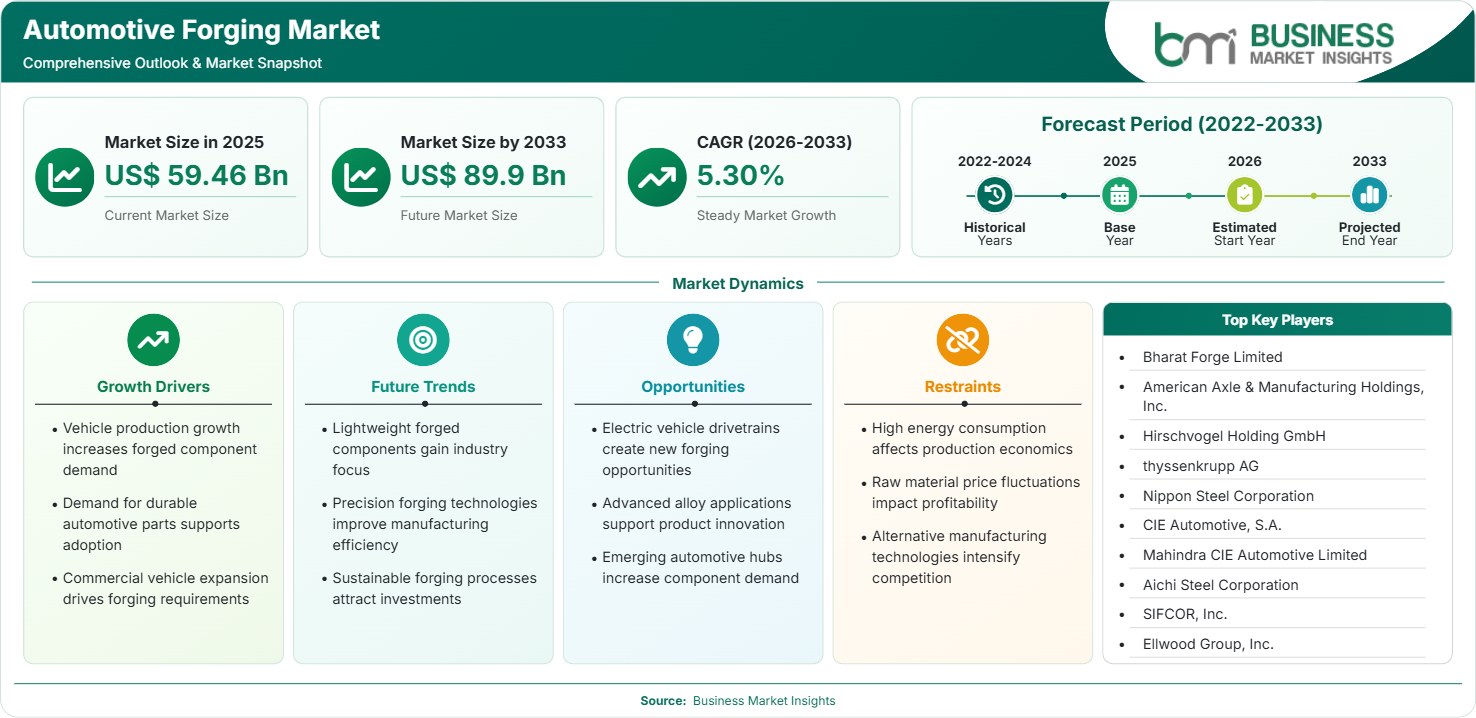
The Automotive Forging Market size was valued at US$ 59.46 Billion in 2025 and is projected to reach US$ 89.9 Billion by 2033, growing at a CAGR of 5.3% during 2026–2033, supported by vehicle production recovery, lightweight component adoption, electrification-driven part redesign, commercial vehicle demand, and expanding manufacturing investments across emerging automotive hubs.

Report Coverage
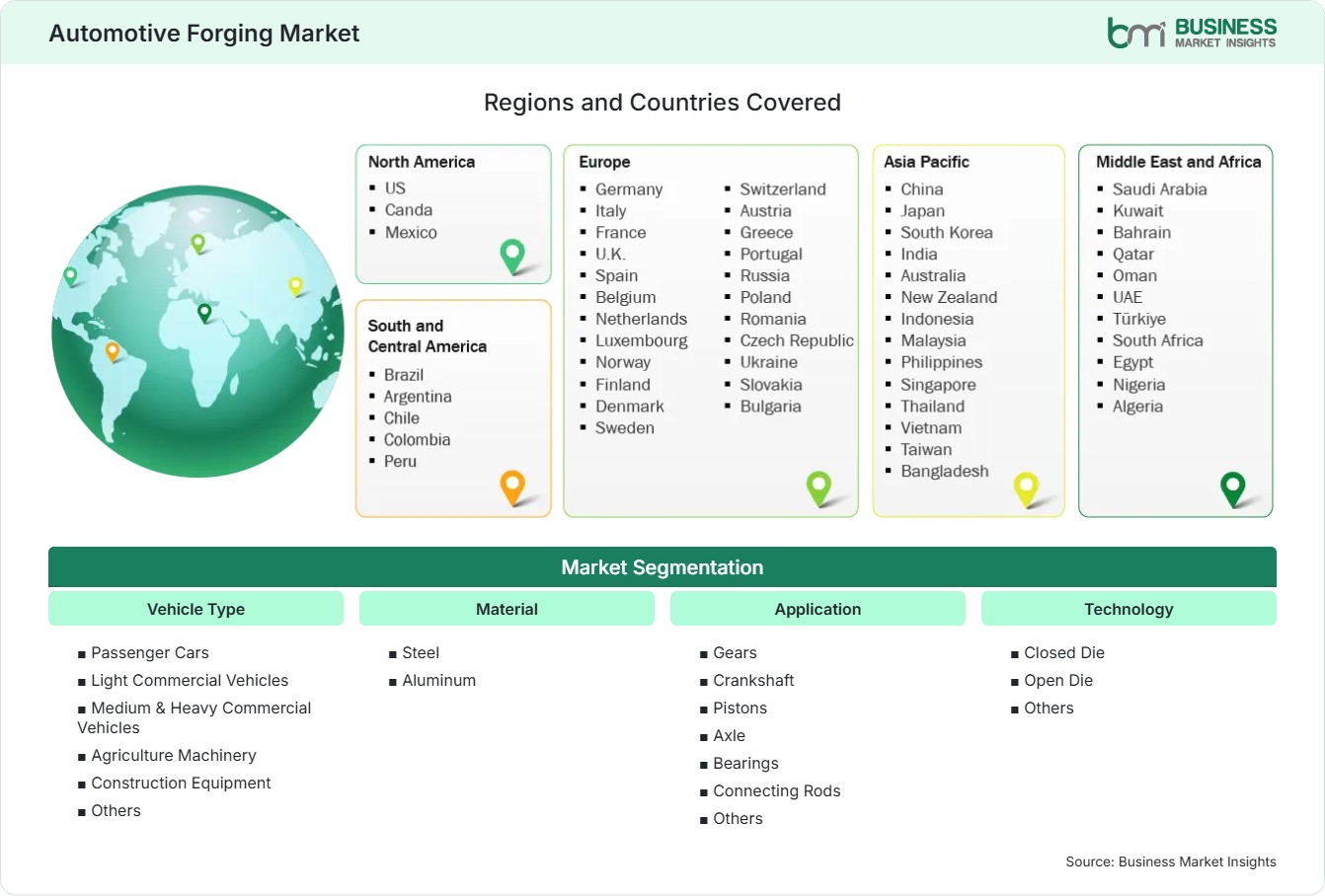
  • Vehicle Type: Passenger Cars, Light Commercial Vehicles, Medium & Heavy Commercial Vehicles, Agriculture Machinery, Construction Equipment, Others
  • Material: Steel, Aluminum
  • Application: Gears, Crankshaft, Pistons, Axle, Bearings, Connecting Rods, Others
  • Technology: Closed Die, Open Die, Others
  • Supplier Type: Local, International
US$ 59.46 Bn Market size in 2025
US$ 89.9 Bn Market Size by 2033
5.30% CAGR, 2026 - 2033
2026-2033 Forecast Period

AI Overview

Automotive Forging Market Summary

  • North America Region: North America holds a market share range of 24%–27% in 2025, growing at a CAGR range of 4.6%–5.0% during 2026–2033. Demand for high-strength drivetrain components, commercial vehicle upgrades, reshoring initiatives, and advanced forging automation create sustained opportunities across OEM and aftermarket supply chains. US market benefits from pickup, SUV, and electric vehicle production expansion, advancing at an estimated CAGR of 4.8%–5.2%.
  • Fastest Growing Region: Asia Pacific accounts for 41%–44% share in 2025 and is expected to grow at 6.1%–6.6% CAGR. Strong vehicle manufacturing capacity, industrialization, export-oriented component production, and investments in forging facilities support rapid expansion across regional automotive ecosystems.
  • Leading Segment: Steel represents 66%–70% share in 2025 and advances at 4.8%–5.2% CAGR. Extensive usage in crankshafts, gears, axles, and structural components, combined with durability requirements and established supply networks, sustains segment leadership.
  • High Growth Segment: Aluminum is expected to expand at 6.5%–7.0% CAGR while holding 30%–34% share in 2025. Lightweighting requirements, electric vehicle efficiency goals, and emissions reduction strategies are accelerating adoption in critical automotive applications worldwide.
  • Key Market Opportunity: Electrified powertrain architectures require newly engineered forged components, creating opportunities for advanced alloys, precision forging technologies, localized manufacturing, and long-term contracts with global vehicle manufacturers.
  • Major Market Players: Bharat Forge Limited, American Axle & Manufacturing Holdings, Inc., Hirschvogel Holding GmbH, thyssenkrupp AG, Nippon Steel Corporation, CIE Automotive, S.A., Mahindra CIE Automotive Limited, Aichi Steel Corporation, SIFCOR, Inc., and Ellwood Group, Inc.
Strategic Insights

Automotive Forging Market: Strategic Insights

Automotive Forging Market Strategic Framework
FREE PDF
Request your free sample
Request free sample
Stakeholder View

Key Takeaways

  • The industry is still very closely linked to the production cycles of motor vehicle original equipment manufacturers, raw material suppliers, forgers, machining specialists, and the vehicle manufacturers, all working via highly coordinated supply networks.
  • The use of aluminum in the manufacture of components for electric vehicles, hybrid powertrains, and lightweight chassis systems offers the most promising long-term prospects for increasing revenue.
  • The industry is now focusing its innovation on simulation-driven die development, robotic forging lines, digital quality inspection, and advanced metallurgical engineering to improve component consistency.
  • The cases for investing in India, Mexico, Vietnam, and Thailand are strong since these countries have expanding vehicle production, are cost-competitive, and are becoming more integrated into global supply chains.
  • Manufacturers are able to broaden their product lines, acquire manufacturing facilities in various regions, and enhance their relationships with automotive customers who need production to be localized through strategic acquisitions.
  • The fact that sustainability issues is leading manufacturing companies to put money into renewable energy, the recycling of scrap materials, and more energy-efficient production technologies in order to boost their competitiveness.
Geographic Outlook

Automotive Forging Market Regional Highlights

North America Automotive Forging Market

North America accounted for approximately 24%–27% Automotive Forging Market share in 2025 and is projected to grow at a 4.6%–5.0% CAGR through 2033. A high demand for parts by commercial vehicles, pickup trucks, sports utility vehicles, and industrial machines ensures the usage of components. The regional suppliers have been constantly increasing their automation in manufacturing forging machinery, and the trend towards vehicle electrification encourages innovation of new forging designs.

  • The investment in advanced manufacturing is helping to improve operational efficiency and is at the same time, reinforcing the domestic supply of components for the big vehicle producers in North America.
  • The need for forged crankshafts, gears, axles, and drivetrain assemblies remains due to the continued use of commercial vehicle replacement cycles.
  • The number of aluminum components being used is increasing as car manufacturers aim to improve fuel economy and vehicle range performance.
  • Mexico is becoming an ever more important center for production to serve both the regional and export automotive markets.

US Automotive Forging Market

The United States represents roughly 70%–74% of North American Automotive Forging Market share and is forecast to expand at 4.8%–5.2% CAGR. The demand will continue to be buoyed by robust light truck production, aftermarket replacement, and investment in electric vehicle assembly lines. The domestic suppliers are increasingly concentrating on automation equipment, advanced materials research, and forging methods to keep pace with OEM requirements.

  • The main users of forged drivetrain and suspension parts are still pickups and utility vehicles.
  • Electrification schemes provide opportunities for the use of lightweight forged aluminium.
  • Strategies aimed at reshoring promote sourcing within the country and enhance local supplier networks.
  • The incentives offered by the advanced manufacturing sector aid in the modernisation of forging facilities across the country.

Europe Automotive Forging Market

Europe holds an estimated 22%–25% Automotive Forging Market share in 2025 and is expected to advance at a 4.7%–5.1% CAGR. Stringent emission targets and advanced engineering capacities lead to the use of lightweight forged parts. Germany continues to be the dominant country, whereas manufacturing plants in Eastern Europe register greater growth rates. Developments in electric mobility and sustainable manufacturing technologies have continued to influence competitiveness in the region.

  • Germany takes the lead in terms of regional consumption due to the extent of its automotive manufacturing ecosystem.
  • Poland and the Czech Republic are achieving growth that is above average because of their cost-competitive conditions for production.
  • The development of lightweight components is still a priority for car manufacturers.
  • Sustainability rules push companies to use energy-efficient ways to make products.
  • Premium vehicle segments still need complex precision-forged parts.

Asia Pacific Automotive Forging Market

Asia Pacific commands 41%–44% share of global revenue in 2025 and records the strongest growth at 6.1%–6.6% CAGR. China, India, Japan, and South Korea collectively dominate production volumes. Rapid industrialization, expanding vehicle ownership, export-oriented manufacturing, and investments in forging capacity reinforce regional leadership. Automotive Forging Market growth across the Asia Pacific benefits from cost advantages, skilled labor availability, and extensive OEM presence.

  • China is still the world's largest producer and user of forged automotive parts.
  • India is experiencing one of the fastest growth trajectories, this being due to the expansion of its manufacturing sector and its exports.
  • Japan continues to lead in the field of precision forging and in terms of quality standards.
  • Foreign investment is drawn to Southeast Asia because it has diversified supply chains.
  • The growing growth in the manufacture of electric vehicles supports the demand for advanced aluminium forging.

Rest of World Automotive Forging Market

The Rest of World region accounts for approximately 9%–12% share in 2025 and is projected to expand at 5.0%–5.5% CAGR. South and Central America will definitely reap the gains of restoring automobile production and the after-market industry, while the Middle East and Africa are becoming more attractive to industrial investments. Brazil is the region’s major market, but Saudi Arabia and the UAE showcase their industrial potential.

  • Brazil remains the most important center for motor vehicle manufacturing in South and Central America.
  • Programs aimed at promoting infrastructure and industrial diversification support investments in the manufacturing of components.
  • The Gulf countries are carrying out strategies for automotive localization and industrial development projects.
  • The demand for forged components remains steady because of mining and commercial vehicle operations.
  • The greater demand for after-market products leads to higher consumption of replacement parts in developing economies.
Global Market Geography
FREE PDF
Request your free sample
Request free sample
Segment Analysis

Automotive Forging Market Segmentation

Vehicle Type

Vehicle Type contributes nearly 38%–42% share of industry demand and is expected to expand at 5.2%–5.7% CAGR. The Automotive Forging Market scope within this segment is shaped by vehicle production volumes, platform redesign cycles, and durability requirements. Passenger and commercial vehicles remain primary consumers of forged powertrain and chassis components.

  • Passenger Cars: Largest demand base driven by high production volumes, safety requirements, and long-term component durability across global automotive platforms.
  • Light Commercial Vehicles: E-commerce logistics expansion supports demand for reliable forged drivetrain and suspension systems.
  • Medium & Heavy Commercial Vehicles: Heavy-load operations require high-strength forged components capable of extended service life.
  • Agriculture Machinery: Mechanization trends increase the utilization of forged transmission and axle components in farming applications.
  • Construction Equipment: Infrastructure spending supports demand for durable forged parts used in heavy equipment systems.

Material

Material selection strongly influences performance and cost efficiency. This segment represents a substantial revenue base with expected growth of 5.1%–5.8% CAGR. Automotive Forging Market trends increasingly favor balancing strength, weight, manufacturability, and sustainability objectives.

  • Steel: Preferred for strength-critical components, including gears, crankshafts, axles, and connecting rods requiring durability.
  • Aluminum: Lightweight characteristics support fuel efficiency and electric vehicle performance improvements while enabling component optimization.

Application

Applications account for a broad range of critical vehicle systems and maintain 5.3%–5.9% CAGR prospects. Continuous engineering advancements support enhanced reliability, precision, and operational efficiency.

  • Gears: Widely used in transmission systems where strength and wear resistance are essential.
  • Crankshaft: Requires exceptional fatigue resistance and metallurgical consistency for engine performance.
  • Pistons: Lightweight engineering trends support high-performance forged piston adoption.
  • Axle: Heavy-duty vehicle applications drive sustained demand for forged axle components.
  • Bearings: Precision manufacturing requirements support advanced forging usage in bearing production.
  • Connecting Rods: Engine downsizing and efficiency targets encourage the adoption of forged connecting rods.

Technology

Technology advancements are transforming production efficiency and quality. This category grows at 5.2%–6.0% CAGR while manufacturers pursue precision and cost optimization.

  • Closed Die: Dominant process due to dimensional accuracy, repeatability, and suitability for complex automotive components.
  • Open Die: Utilized for larger components where flexibility and customized production requirements are important.

Supplier Type

Supplier networks influence procurement strategies, quality standards, and supply security. Growth remains supported by global sourcing diversification and localized manufacturing.

  • Local: Supports faster delivery, reduced logistics risk, and stronger responsiveness to OEM requirements.
  • International: Offers access to advanced technologies, broader product portfolios, and global manufacturing capabilities.
Market Forces

Automotive Forging Market Dynamics

Key Market Drivers

Rising Global Vehicle Production and Fleet Expansion

Global automotive manufacturing continues driving demand for forged components because critical systems depend on superior strength and fatigue resistance. According to international automotive production trends reported by industry associations, vehicle output recovery across Asia and North America is increasing the consumption of gears, crankshafts, connecting rods, and axles. Automotive Forging Market trends are highly connected to the volume of production, as forgings are still vital in the passenger car and truck industry. Growth in logistics networks, construction operations, and agricultural machinery makes more demand for heavy trucks. All these aspects altogether contribute to the demands for component sourcing.

Growing Lightweighting Requirements Across Vehicle Platforms

There is growing pressure on car manufacturers to reduce the weight of vehicles without compromising safety or performance. Parts made from forged aluminum and high-strength steel offer a good strength-to-weight ratio and thus help to achieve the required fuel economy figures. In the case of electric vehicles, companies are looking for lightweight design solutions that will enable them to maximize the range when the battery is in operation and ensure efficient performance as well. The automotive industry uses forged engineered components to reduce weight while maintaining durability. The increasing use of these components in suspensions, drive trains, and structures is driven by advances in metallurgy and precise forging techniques.

Expansion of Electric and Hybrid Vehicle Manufacturing

The demand for specially designed forgings continues to grow due to evolving drivetrain configurations. Even though the internal combustion engine remains an important component, hybrid and electric vehicles will require a totally new design for their transmission systems, axles, and chassis. Forgings are required for these applications because of their superior mechanical properties. In all the major automobile-producing regions, governments are adopting the use of electric vehicles by providing incentives and employing other measures. To produce such powertrains, car manufacturers are setting up dedicated manufacturing plants. Thereby, opportunities arise in the field of forging technology and engineered materials.

Key Market Opportunities

Advanced Aluminum Forgings for Next-Generation Mobility

Lightweight systems will be increasingly needed in future mobility systems to achieve the aims of efficiency, performance, and sustainability. There are possibilities with aluminum forging processes to help suppliers meet these challenges. Automotive Forging Market Forecasts indicate there is an expected high level of demand from electric cars, hybrid, and luxury segments of the automobile market. For companies that are willing to put effort into developing advanced alloys, simulating software, and forming processes, there will be an opportunity to conclude profitable long-term agreements with leading international original equipment manufacturers.

Localization Strategies and Regional Supply Chain Development

Because of the recent disruptions to the supply chain, car manufacturers are aiming to establish robust sourcing arrangements. This is leading to opportunities for forging companies to set up their plants near assembly sites. Manufacturing sites such as India, Mexico, Thailand, and Vietnam continue to attract investments from producers of parts. Having the manufacturing located near the assembly process helps to shorten delivery times, reduces transportation costs, and enables compliance with regulatory requirements. Firms that achieve a balance between competitive costs and production quality are likely to succeed in the market.

Digital Manufacturing and Smart Factory Integration

The introduction of Industry 4.0 presents great opportunities for boosting productivity and improving product quality. By using advanced sensors, predictive analytics, automated inspection systems, and digital twin models, it is possible to optimize manufacturing processes. Greater transparency results in higher quality products, better use of machines, and reduced loss of materials. Nowadays, more automotive customers pay attention to the traceability and consistency of the components supplied. As a result of digital transformation, companies can gain a competitive edge while improving profitability. Companies that adopt the new technologies early can establish stronger relationships with their clients and succeed in technically complex applications.

Market Restraints and Challenges

Raw Material Price Volatility and Margin Pressure

Factor: Steel and aluminum prices remain exposed to geopolitical uncertainty, energy market fluctuations, and supply-demand imbalances.

Impact: Component makers struggle to ensure that production expenses and contract profits remain predictable. Fluctuations may result in lower margins where there is no opportunity to pass price increases to customers immediately. This problem affects smaller firms more due to their inability to make purchases and maintain inventory flexibly. Volatility in prices complicates investment planning. However, today companies use approaches such as diversifying supply sources and improving productivity to minimize the impact.

High Capital Requirements for Advanced Forging Operations

Factor: Modern forging facilities require substantial investments in presses, automation systems, tooling, quality-control infrastructure, and environmental compliance measures.

Impact: High entry barriers make expansion difficult for small players and prolong return-on-investment periods. Continuous upgrading of machines is required to meet changing consumer needs and compete effectively. Lack of skilled labor for manufacturing jobs increases the cost of production. As technology becomes more sophisticated, the need for financial investment remains a critical issue.

Company Analysis

Competitive Landscape

Automotive Forging Market analysis indicates competition is driven by manufacturing scale, technology capabilities, material expertise, and long-term OEM relationships.

Company Name

Overview

Products and Services relevant to this market

Bharat Forge Limited

Global forging leader with extensive automotive manufacturing and engineering capabilities across multiple regions.

Forged crankshafts, connecting rods, chassis parts, axle components, machining and engineering services.

American Axle & Manufacturing Holdings, Inc.

Major driveline and metal-forming supplier serving global automotive OEMs.

Axles, drivetrain systems, forged components, powertrain solutions, engineering services.

Hirschvogel Holding GmbH

Leading specialist in steel and aluminum forged automotive components.

Precision forged transmission, engine, chassis, and electric mobility components.

thyssenkrupp AG

Diversified industrial group with advanced automotive component manufacturing expertise.

Forged steering, drivetrain, axle, and structural automotive components.

Nippon Steel Corporation

Major materials producer supporting automotive forging and specialty steel applications.

Automotive-grade steel products and forging materials.

CIE Automotive, S.A.

International automotive supplier with metal transformation capabilities.

Forged and machined automotive parts, engineered component solutions.

Mahindra CIE Automotive Limited

Key automotive component manufacturer serving domestic and global markets.

Forgings, castings, gears, and precision automotive components.

Aichi Steel Corporation

Japanese materials and component specialist supporting automotive manufacturing.

Specialty steels, forged components, and engineered materials.

SIFCOR, Inc.

North American precision forging company focused on high-performance applications.

Closed-die forgings, engineered automotive components, machining services.

Ellwood Group, Inc.

Industrial forging specialist with advanced metallurgical capabilities.

Forged steel products and customized component manufacturing services.

Trust & Transparency

Research Methodology

The market analysis combines proprietary research with secondary data from government agencies, company disclosures, regulatory filings, industry databases and expert interviews. Market estimates are validated through data triangulation, cross-market benchmarking and analyst review.

View Full Research Methodology

Questions Answered

Frequently Asked Questions

What information does an Automotive Forging Market Report typically provide?

An Automotive Forging Market Report generally covers market sizing, competitive developments, technology trends, regional performance, supply-chain dynamics, segmentation, and future growth opportunities.

Which region offers the strongest long-term growth potential?

Asia Pacific presents the strongest outlook due to vehicle manufacturing expansion, export activity, industrialization, and substantial component production investments.

What makes closed-die forging important in automotive manufacturing?

Closed-die processes deliver excellent dimensional accuracy, repeatability, and material efficiency, making them suitable for large-scale automotive production.

How does electrification affect forged component demand?

Electric vehicles require redesigned structural, transmission, and lightweight components, creating demand for advanced aluminum and precision-forged products.

Which vehicle category generates the highest demand for forged components?

Passenger cars remain the largest consumer because of their high production volume and extensive use of forged powertrain, drivetrain, and safety-critical components.

Access the Full Automotive Forging Market Report

Get segment-level forecasts, regional estimates, competitive benchmarking, company profiles and downloadable Excel datasets.

Access the full Automotive Forging Market Report
350 pages PDF & Excel | 2026-09-23
Similar Research

Related Market Reports