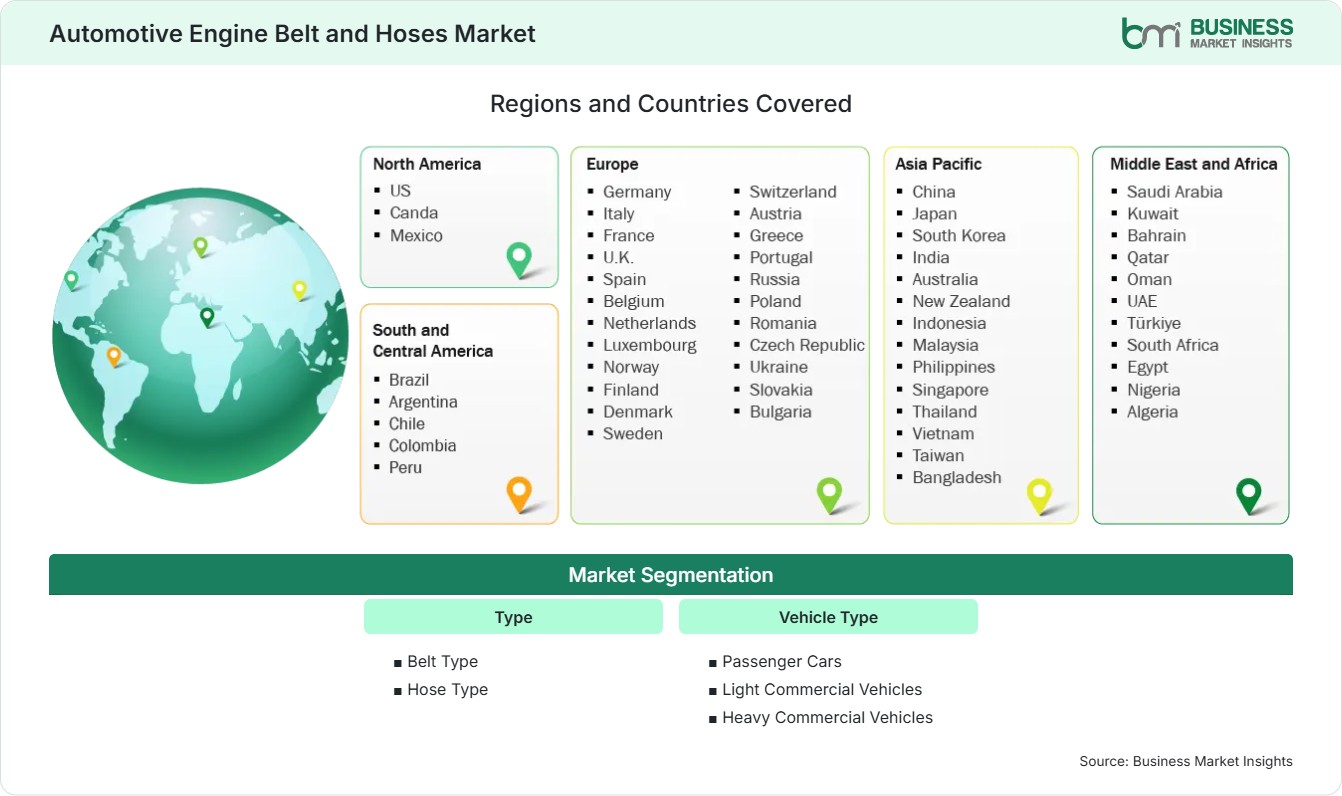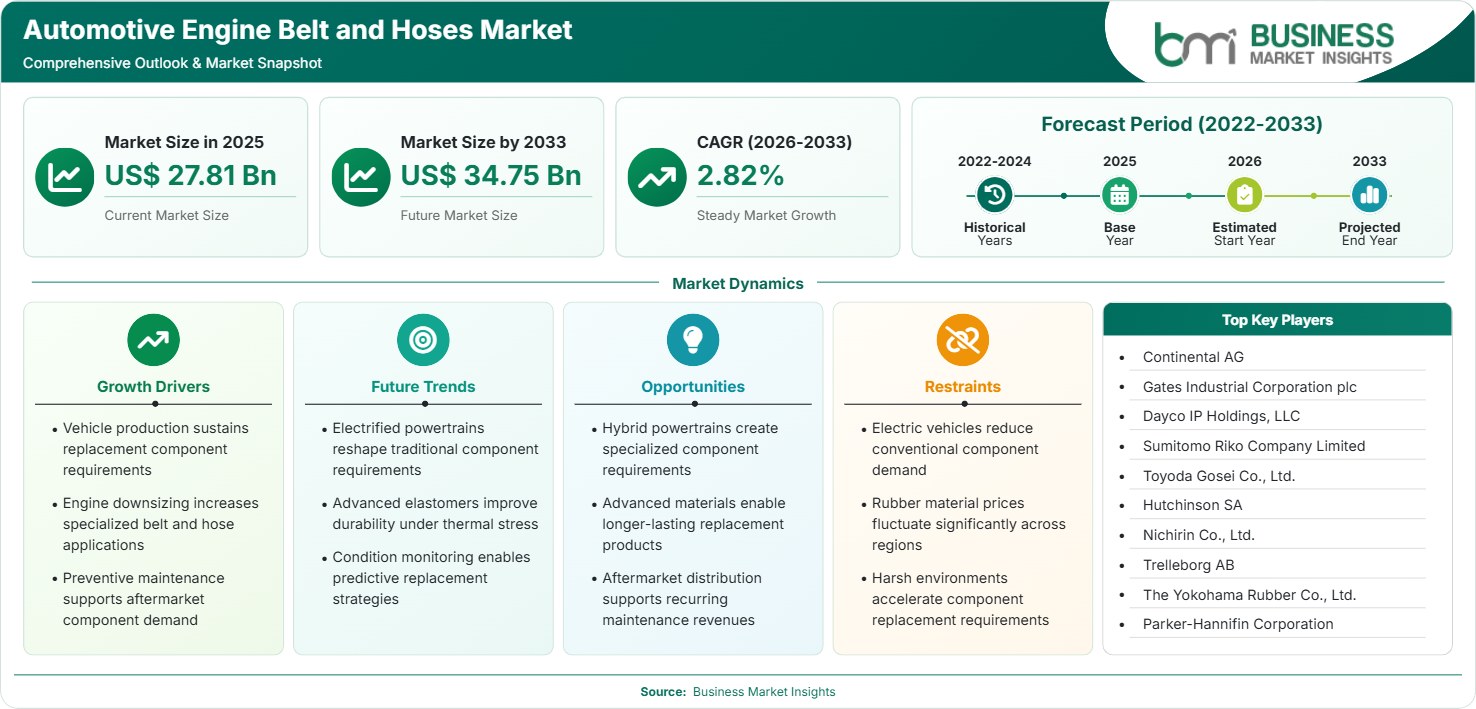
Automotive Engine Belt and Hoses Market Regional Highlights
North America Automotive Engine Belt and Hoses Market
North America accounted for 28%–31% of the Automotive Engine Belt and Hoses Market share in 2025 and is projected to grow at 2.2%–2.6% CAGR through 2033. Demand is driven primarily by replacement cycles and aging vehicles. Fleet operators prioritize durability and lifecycle performance, supporting premium product adoption. Strong distribution networks, advanced maintenance practices, and high vehicle ownership rates sustain stable demand across passenger and commercial vehicle categories.
- Vehicle age exceeding 12 years in many fleet categories supports consistent aftermarket replacement demand.
- Major suppliers continue investing in advanced elastomer materials and regional manufacturing resilience.
- Commercial vehicle utilization supports consumption of fuel, cooling, and brake hose products.
- Distribution channel modernization improves product availability and inventory efficiency.
- Regulatory compliance encourages high-performance component specifications.
US Automotive Engine Belt and Hoses Market
The United States represents 74%–78% of North American revenue share and is forecast to grow at 2.1%–2.5% CAGR. Strong replacement demand remains the primary consumption driver. Fleet activity, logistics growth, and prolonged vehicle ownership patterns contribute to stable market conditions. OEM production activity and a well-developed aftermarket ecosystem support consistent sales across both belt and hose categories.
- Strong independent aftermarket networks contribute to replacement product demand.
- Logistics fleet expansion supports braking, fuel delivery, and cooling hose consumption.
- Higher maintenance awareness supports premium replacement product adoption.
- Advanced diagnostics improve preventative component replacement practices.
Europe Automotive Engine Belt and Hoses Market
Europe held a 24%–27% share in 2025 and is anticipated to record 2.4%–2.8% CAGR through 2033. Germany remains the leading country, while Poland and Turkey demonstrate faster expansion through manufacturing investments. Emission standards encourage advanced material adoption. Demand is supported by vehicle longevity, specialist aftermarket channels, and strong engineering requirements across premium vehicle platforms.
- Germany leads regional demand through extensive automotive manufacturing capabilities.
- Poland records stronger growth supported by supplier investments and export activities.
- Fuel-efficiency regulations encourage thermal management innovation.
- Premium vehicle production sustains demand for specialized performance components.
- Commercial transport activities support replacement cycles throughout the region.
Asia Pacific Automotive Engine Belt and Hoses Market
Asia Pacific accounted for a 39%–42% share in 2025 and is expected to expand at 3.4%–3.8% CAGR, making it the fastest-growing regional market. China leads industry demand, while India emerges as the highest-growth major market. Rising vehicle ownership, localization strategies, and expanding manufacturing capacity continue supporting long-term demand across all major application categories.
- China remains the largest vehicle production hub and component consumption market.
- India benefits from accelerating vehicle parc expansion and aftermarket development.
- Regional suppliers are increasing manufacturing localization and export capabilities.
- Infrastructure investment supports commercial vehicle usage and maintenance demand.
- Strong OEM production maintains consistent procurement volumes.
Rest of World Automotive Engine Belt and Hoses Market
The Rest of World region held an 8%–11% share in 2025 and is projected to achieve 2.8%–3.2% CAGR through 2033. Brazil leads South and Central American demand, while Saudi Arabia and the UAE support Middle East growth. Expanding vehicle fleets and improving parts distribution networks contribute to market development across these economies.
- Brazil remains the largest regional automotive manufacturing center.
- GCC countries support premium replacement component demand.
- Fleet modernization increases consumption of cooling and fuel delivery hoses.
- Parts availability improvements stimulate aftermarket growth.
- Local distribution investments enhance market accessibility.