
Engine Bearings Market Outlook: Size, Share, Trends, Growth Analysis, Competitive Landscape & Forecast, 2026-2033

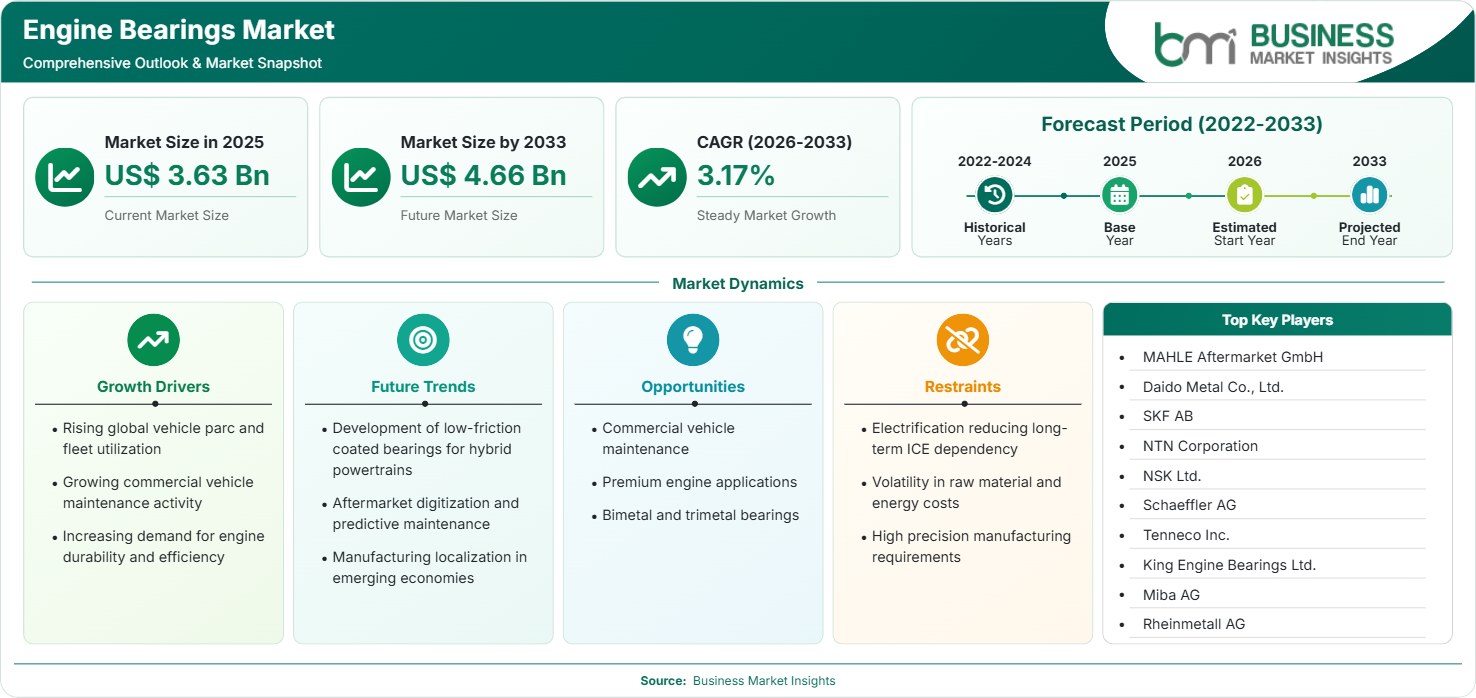
The Engine Bearings Market size was valued at US$ 3.63 Billion in 2025 and is projected to reach US$ 4.66 Billion by 2033, growing at a CAGR of 3.17% during 2026–2033. Growth is supported by rising vehicle parc, commercial fleet utilization, engine efficiency upgrades, advanced material adoption, aftermarket replacement demand, and opportunities linked to premium engines, hybrid powertrains, and durability-focused bearing technologies.

Report Coverage
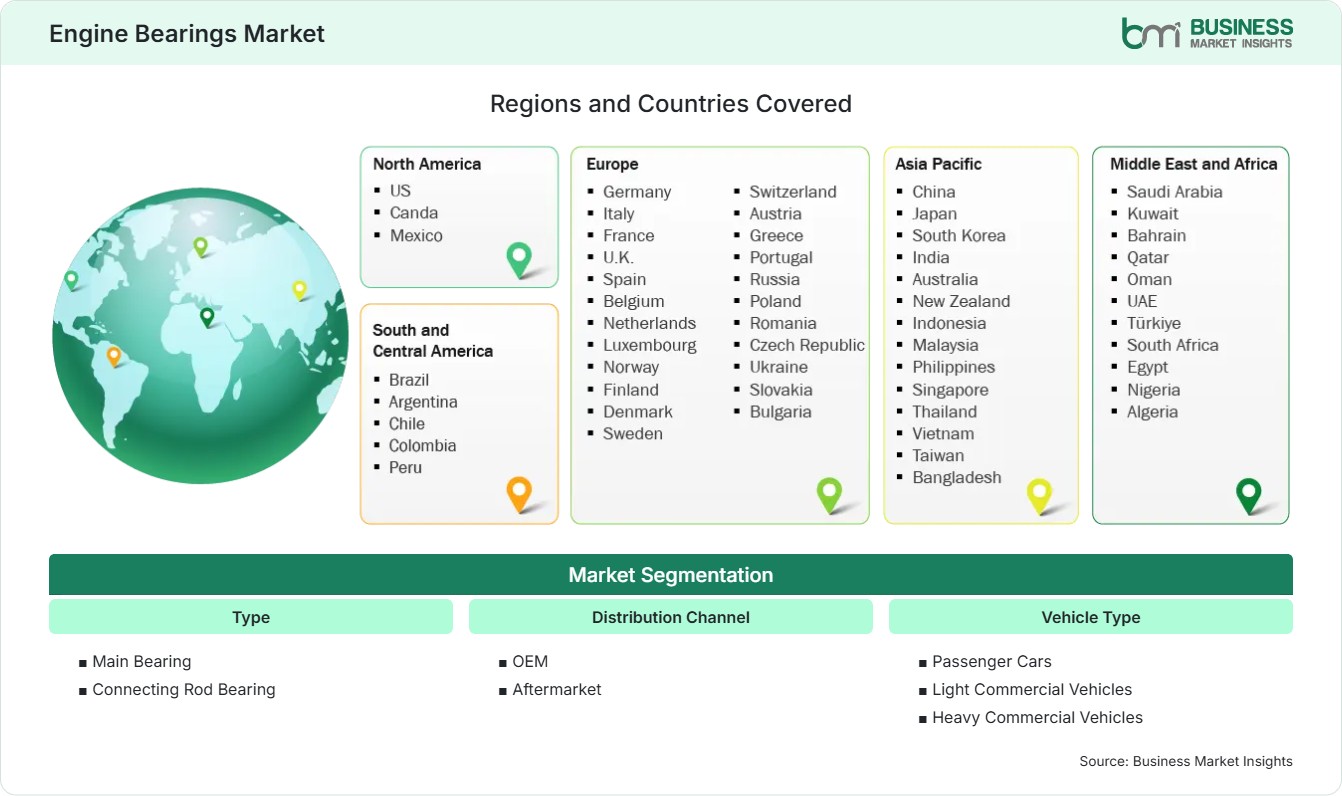
  • Type: Main Bearing, Connecting Rod Bearing
  • Distribution Channel: OEM, Aftermarket
  • Vehicle Type: Passenger Cars, Light Commercial Vehicles, Heavy Commercial Vehicles
US$ 3.63 Bn Market size in 2025
US$ 4.66 Bn Market Size by 2033
3.17% CAGR, 2026 - 2033
2026-2033 Forecast Period

AI Overview

Engine Bearings Market Summary

  • North America Region: North America holds a market share of 28%–31% in 2025, growing at a CAGR of 2.8%–3.2% during 2026–2033. Demand is supported by fleet longevity programs, pickup truck production, premium lubrication technologies, and service-part replacement cycles. Opportunity emerges from high-performance engines and heavy-duty transportation applications. Brief U.S. analysis: Strong aftermarket demand and large vehicle parc support stable expansion with an estimated CAGR of 2.9%–3.3%.
  • Fastest Growing Region: Asia Pacific holds 37%–40% share in 2025 and is expected to expand at 3.8%–4.4% CAGR. Vehicle production growth, industrialization, expanding commercial fleets, localization of auto components, and manufacturing investments create sustained opportunities across developing automotive ecosystems.
  • Leading Segment: OEM accounts for 58%–61% share in 2025 and advances at 2.9%–3.3% CAGR. Long-term supply contracts, integrated manufacturing networks, stricter engine performance specifications, growing passenger vehicle production, and durability requirements support consistent revenue generation.
  • High Growth Segment: Aftermarket represents 39%–42% share in 2025 and grows at 3.8%–4.3% CAGR. Aging vehicles, rising replacement frequency, expanding independent repair channels, commercial fleet maintenance programs, and demand for performance upgrades strengthen market momentum globally.
  • Key Market Opportunity: Development of low-friction coated bearings for hybrid and fuel-efficient engines enables manufacturers to improve wear resistance, reduce energy losses, extend service life, and strengthen premium product differentiation strategies.
  • Major Market Players: MAHLE Aftermarket GmbH, Daido Metal Co., Ltd., SKF AB, NTN Corporation, NSK Ltd., Schaeffler AG, Tenneco Inc., King Engine Bearings Ltd., Miba AG, Rheinmetall AG.
Strategic Insights

Engine Bearings Market: Strategic Insights

Engine Bearings Market Strategic Framework
FREE PDF
Request your free sample
Request free sample
Stakeholder View

Key Takeaways

  • The industry operates through a tightly integrated ecosystem involving raw material suppliers, coating specialists, OEM manufacturers, distributors, and aftermarket service providers, creating substantial entry barriers for new participants.
  • Replacement demand within commercial vehicle fleets presents one of the strongest value opportunities due to higher engine utilization rates and recurring maintenance requirements.
  • Product innovation is increasingly focused on low-friction coatings, lightweight alloys, improved lubrication performance, and durability enhancement under higher combustion pressures.
  • India, Southeast Asia, and Mexico offer compelling investment prospects due to expanding automotive production bases and favorable manufacturing economics.
  • Strategic partnerships between bearing manufacturers and vehicle producers continue strengthening long-term supply contracts and accelerating product development programs.
  • Digital quality-control systems, predictive maintenance solutions, and precision manufacturing technologies are becoming important competitive differentiators.
Geographic Outlook

Engine Bearings Market Regional Highlights

North America Engine Bearings Market

North America accounts for 28%–31% Engine Bearings Market share in 2025 and is projected to grow at 2.8%–3.2% CAGR through 2033. Demand is supported by large commercial fleets, pickup truck production, and a strong aftermarket ecosystem. High vehicle ownership rates create consistent replacement demand. Manufacturers are investing in advanced coatings and wear-resistant materials. Engine remanufacturing and fleet maintenance programs remain important revenue contributors, while premium engine applications continue supporting higher-value product sales across the region.

  • Growing light-truck parc increases bearing replacement cycles and strengthens aftermarket revenue streams across regional distributors.
  • Fleet operators prioritize durability, creating demand for high-performance bearing materials and precision-engineered components.
  • Manufacturing localization strategies improve supply security and reduce procurement risks for automotive producers.
  • Adoption of advanced lubrication technologies improves engine efficiency and bearing lifespan.

US Engine Bearings Market

The United States represents 78%–82% of North American share and records an estimated 2.9%–3.3% CAGR. Strong passenger vehicle ownership, heavy-duty trucking activity, and established repair networks support recurring demand. OEM programs continue emphasizing durability and fuel efficiency. Investment in advanced materials and precision manufacturing enhances product performance while supporting domestic production strategies. Premium vehicle segments create incremental demand for technologically advanced bearings with enhanced thermal and wear resistance characteristics.

  • Replacement demand remains strong because of vehicle aging trends and extended ownership cycles.
  • Commercial transportation activity drives recurring engine overhaul requirements and component replacement.
  • Premium powertrain applications support greater adoption of coated and low-friction bearing solutions.
  • Strong distributor networks improve market access for domestic and international suppliers.

Europe Engine Bearings Market

Europe holds 24%–27% share in 2025 and is forecast to expand at 2.7%–3.1% CAGR. Germany remains the leading market due to its automotive manufacturing base, while Poland and Eastern European countries display faster expansion supported by supplier investments. Strict efficiency requirements encourage adoption of advanced bearing technologies. Commercial vehicle production and engine remanufacturing activities further support demand. Regional manufacturers focus on sustainability, material optimization, and production efficiency improvements to remain globally competitive.

  • Germany leads regional demand through extensive automotive manufacturing activity and engineering capabilities.
  • Poland exhibits faster growth with expanding auto-component production infrastructure.
  • Fuel-efficiency requirements support investment in low-friction bearing technologies.
  • Commercial vehicle manufacturing remains an important demand generator.
  • Material innovation programs improve performance while supporting sustainability targets.

Asia Pacific Engine Bearings Market

Asia Pacific holds 37%–40% share in 2025 and records the highest growth at 3.8%–4.4% CAGR. China leads regional demand through large-scale vehicle production, while India demonstrates the strongest growth trajectory owing to industrialization and expanding automotive output. Rising disposable incomes, fleet growth, and supplier localization support market expansion. Manufacturers continue adding capacity and investing in advanced production technologies. Export-oriented manufacturing activity strengthens regional competitiveness and supports long-term demand fundamentals.

  • China remains the largest contributor through extensive automotive and commercial vehicle production.
  • India shows the highest regional growth supported by manufacturing expansion and vehicle ownership increases.
  • Localization strategies encourage domestic sourcing and production investment.
  • Commercial fleet expansion drives replacement-bearing consumption.
  • Rising industrial machinery demand creates additional opportunities beyond automotive applications.

Rest of World Engine Bearings Market

Rest of World accounts for 8%–10% share in 2025 and advances at 3.1%–3.6% CAGR. South and Central America benefit from vehicle fleet aging, supporting aftermarket demand. Brazil remains the leading regional market. In the Middle East and Africa, expanding transportation infrastructure and commercial vehicle utilization support consumption. Saudi Arabia and South Africa represent important markets, while emerging industrial activity creates incremental opportunities for suppliers seeking geographic diversification and distribution expansion.

  • Brazil leads demand in South and Central America through automotive manufacturing and replacement markets.
  • Mexico-linked regional supply chains strengthen component distribution efficiency.
  • Saudi Arabia benefits from transportation and logistics sector growth.
  • South Africa supports demand through fleet maintenance activities.
  • Expanding infrastructure projects contribute to heavy-vehicle component consumption.
Global Market Geography
FREE PDF
Request your free sample
Request free sample
Segment Analysis

Engine Bearings Market Segmentation

Type

Type segment dynamics reflect evolving engine performance requirements. Main bearings account for the largest share at 44%–47% in 2025 and are expected to grow at 3.0%–3.4% CAGR. The Engine Bearings Market scope within this category is strengthened by durability requirements, precision engineering demand, improved bearing materials, and increasing engine efficiency standards across vehicle platforms.

  • Main Bearing: Supports crankshaft stability, reduces friction, and remains essential for engine reliability. Continuous material improvements and precision manufacturing support broad adoption across passenger and commercial vehicle applications.
  • Connecting Rod Bearing: Critical for transmitting combustion forces efficiently. Growth reflects rising engine-performance expectations, durability requirements, and demand for better thermal management capabilities across modern vehicle platforms.

Distribution Channel

OEM dominates with 58%–61% share in 2025 and expands at 2.9%–3.3% CAGR. Vehicle production activity, stringent quality standards, and long-term supply agreements support performance. The aftermarket segment benefits from aging fleets, maintenance activity, and replacement demand, enabling stronger growth prospects over the forecast period.

  • OEM: Long-term manufacturer relationships, strict quality compliance requirements, and integrated supply chains support stable procurement volumes and consistent demand across global vehicle production facilities.
  • Aftermarket: Rising vehicle age, increasing maintenance spending, independent repair activities, and expanding distribution channels strengthen replacement-bearing demand across developed and emerging economies.

Vehicle Type

Passenger Cars lead with 51%–54% share in 2025 and are estimated to grow at 3.0%–3.4% CAGR. Large vehicle populations and replacement requirements support demand. Commercial vehicle categories remain important due to intensive engine utilization and maintenance frequency.

  • Passenger Cars: Large global fleet size, recurring maintenance requirements, and continuous production activity sustain demand for durable and fuel-efficient bearing solutions.
  • Light Commercial Vehicles: E-commerce expansion and logistics fleet growth create steady replacement demand and opportunities for enhanced durability products.
  • Heavy Commercial Vehicles: High engine loads, intensive operating cycles, and frequent overhaul schedules support demand for premium wear-resistant bearing technologies.
Market Forces

Engine Bearings Market Dynamics

Key Market Drivers

Expansion of Global Vehicle Parc and Fleet Utilization

Vehicle populations in developing countries keep on growing, hence creating the need for engine servicing and parts replacement. Transport vehicle fleets are operating with longer lifespans to ensure proper use of resources, thus creating a more frequent need for bearing replacement. Statistics from the International Organization of Motor Vehicle Manufacturers indicate that there is still much production of vehicles taking place in the world. Engine Bearings Market growth continues to be associated with vehicle usage intensity since the components become worn out through continued use. An increasing network of services, along with increased parts availability, is contributing to the ability of manufacturers to exploit market potential.

Advances in Bearing Materials and Surface Technologies

Manufacturers continue investing in advanced alloys, polymer overlays, and low-friction coatings to improve wear resistance and thermal performance. These developments allow engines to operate efficiently under higher loads and tighter emission requirements. Research and development spending across automotive suppliers is supporting product differentiation. Engine Bearings Market trends focus more on performance optimization, efficiency improvements, and long maintenance periods. Improvements help minimize losses in operations and assist the OEMs in meeting the efficiency requirements. The technology helps enable high prices and enhance the competitive advantages of suppliers.

Growth of Commercial Vehicle Maintenance Activity

Heavy-duty fleets require regular engine servicing because operational reliability directly affects profitability. Freight movements, construction work, mining activities, and public transport systems result in repeat business for bearing replacements. Preventive maintenance is becoming a key focus area for fleet managers in order to reduce the time machines stand idle. Replacement of bearings occurs as part of an engine overhaul, thus ensuring steady aftermarket income. Growing logistics networks in developing nations add to the demand. Suppliers gain from close working relations with service centers.

Key Market Opportunities

Low-Friction Solutions for Hybrid Powertrains

Hybrid vehicles keep on needing sophisticated internal combustion engine parts even with the ongoing trend of electrification. Bearings that work well under conditions of frequent starts and stops, high-quality lubricants, and low friction present promising opportunities. Manufacturers who can develop suitable materials can capitalize on these opportunities. Engine Bearings Market Forecasts indicate ongoing demand for hybrid-compatible components as automakers pursue transitional powertrain strategies. Product innovation targeting efficiency and durability creates opportunities for premium-margin offerings while supporting long-term partnerships with vehicle manufacturers developing next-generation platforms.

Aftermarket Digitization and Predictive Maintenance

Connected vehicle technologies and fleet monitoring systems enable earlier identification of component wear. With predictive maintenance, it will be possible for the operators to schedule their maintenance in advance and thus enhance visibility of the demand for replacement components. There is room for strengthening the channel relationship in case the suppliers incorporate diagnostic services, inventory management, and technical services. There is significant growth potential in commercial transport, where there is a need for greater efficiency.

Manufacturing Localization in Emerging Economies

Governments increasingly encourage domestic component production through industrial initiatives and automotive investment programs. Localization decreases supply risks and improves delivery time schedules. Regional suppliers setting up local manufacturing plants have access to the market and benefit from cost savings. Developing countries will remain attractive for automobile manufacturing investments owing to cheap labor and a growing market. The strategy to develop localization capabilities can be used by bearing manufacturers in their businesses.

Market Restraints and Challenges

Electrification Reducing Long-Term ICE Dependency

Factor: The battery electric vehicle (BEV) is able to do away with many ICE parts, which traditionally used bearings, and hence has less use in such applications.

Impact: With the continued global adoption of electric vehicles, suppliers whose primary focus is engine bearings may face an ever-shrinking addressable market. While hybrids help to sustain demand, it is uncertain what product needs will be required in the future with the ongoing trend towards electric powertrains. Manufacturers need to strike a balance between their present business interests in engines and future growth through diversification into other sectors.

Volatility in Raw Material and Energy Costs

Factor: The manufacturing of bearings involves the use of metals, specialized alloys, coating materials, engineered parts, and energy-intensive production processes, all of which are subject to volatile prices. The price changes of steel, alloy availability, energy prices, and transport costs may affect bearing production economics directly.

Impact: Fluctuating input prices may strain profit margins and make it hard for companies to keep up with long-term pricing contracts with their OEM customers. In very competitive industries, it may become difficult for businesses to pass on rising prices to consumers, thereby reducing their flexibility and profitability. Companies have started to improve procurement practices, efficiency, and diversification.

Company Analysis

Competitive Landscape

Engine Bearings Market analysis indicates competition is centered on technological capability, OEM relationships, manufacturing precision, and aftermarket reach.

Company Name

Overview

Products and Services relevant to this market

MAHLE Aftermarket GmbH

Global automotive component supplier with strong aftermarket presence and extensive engine expertise.

Engine bearings, engine systems, filtration products, replacement components, technical support services.

Daido Metal Co., Ltd.

Specialized plain-bearing manufacturer serving automotive and industrial customers worldwide.

Main bearings, connecting rod bearings, bushings, tribology solutions.

SKF AB

Global bearing technology provider with advanced engineering and manufacturing capabilities.

Automotive bearings, lubrication solutions, condition monitoring technologies.

NTN Corporation

Japanese manufacturer supplying precision bearing technologies to multiple industries.

Engine bearings, drivetrain components, industrial bearing products.

NSK Ltd.

Leading motion and bearing solutions company serving transportation markets globally.

Automotive bearing systems, precision components, engineering services.

Schaeffler AG

Major automotive supplier focused on mobility technologies and precision engineering.

Bearing technologies, engine components, motion solutions.

Tenneco Inc.

Global automotive supplier operating across OEM and aftermarket channels.

Engine components, bearing-related products, replacement parts.

King Engine Bearings Ltd.

Specialist manufacturer recognized for high-performance engine bearing expertise.

Performance bearings, racing bearings, OEM-compatible solutions.

Miba AG

Technology group supplying advanced components for transportation and industry sectors.

Engine bearings, coated bearing systems, high-performance solutions.

Rheinmetall AG

Industrial and automotive technology company with engine-component capabilities.

Bearings, engine systems, mobility technologies, engineering solutions.

Trust & Transparency

Research Methodology

The market analysis combines proprietary research with secondary data from government agencies, company disclosures, regulatory filings, industry databases and expert interviews. Market estimates are validated through data triangulation, cross-market benchmarking and analyst review.

View Full Research Methodology

Questions Answered

Frequently Asked Questions

What insights does the Engine Bearings Market Report provide?

The Engine Bearings Market Report evaluates competitive positioning, regional demand patterns, technology developments, growth opportunities, segment performance, and strategic industry trends.

What makes OEM contracts strategically important?

OEM agreements provide predictable volumes, quality-validation benefits, and long-term customer relationships that support stable revenue generation.

How does electrification affect industry dynamics?

Battery electric vehicles reduce dependence on conventional engine components, encouraging suppliers to diversify technologies and pursue hybrid or industrial opportunities.

What factor most influences replacement-bearing sales?

Vehicle age and engine overhaul frequency strongly influence replacement sales, particularly within commercial fleets and high-mileage transportation applications.

Which vehicle category generates the highest bearing demand?

Passenger cars generate the highest demand because of their large global fleet, continuing production volumes, and recurring maintenance requirements throughout vehicle lifecycles.

Access the Full Engine Bearings Market Report

Get segment-level forecasts, regional estimates, competitive benchmarking, company profiles and downloadable Excel datasets.

Access the full Engine Bearings Market Report
350 pages PDF & Excel | 2026-09-02
Similar Research

Related Market Reports