
Internal Combustion Engine Market Outlook: Size, Share, Trends, Growth Analysis, Competitive Landscape & Forecast, 2026-2033

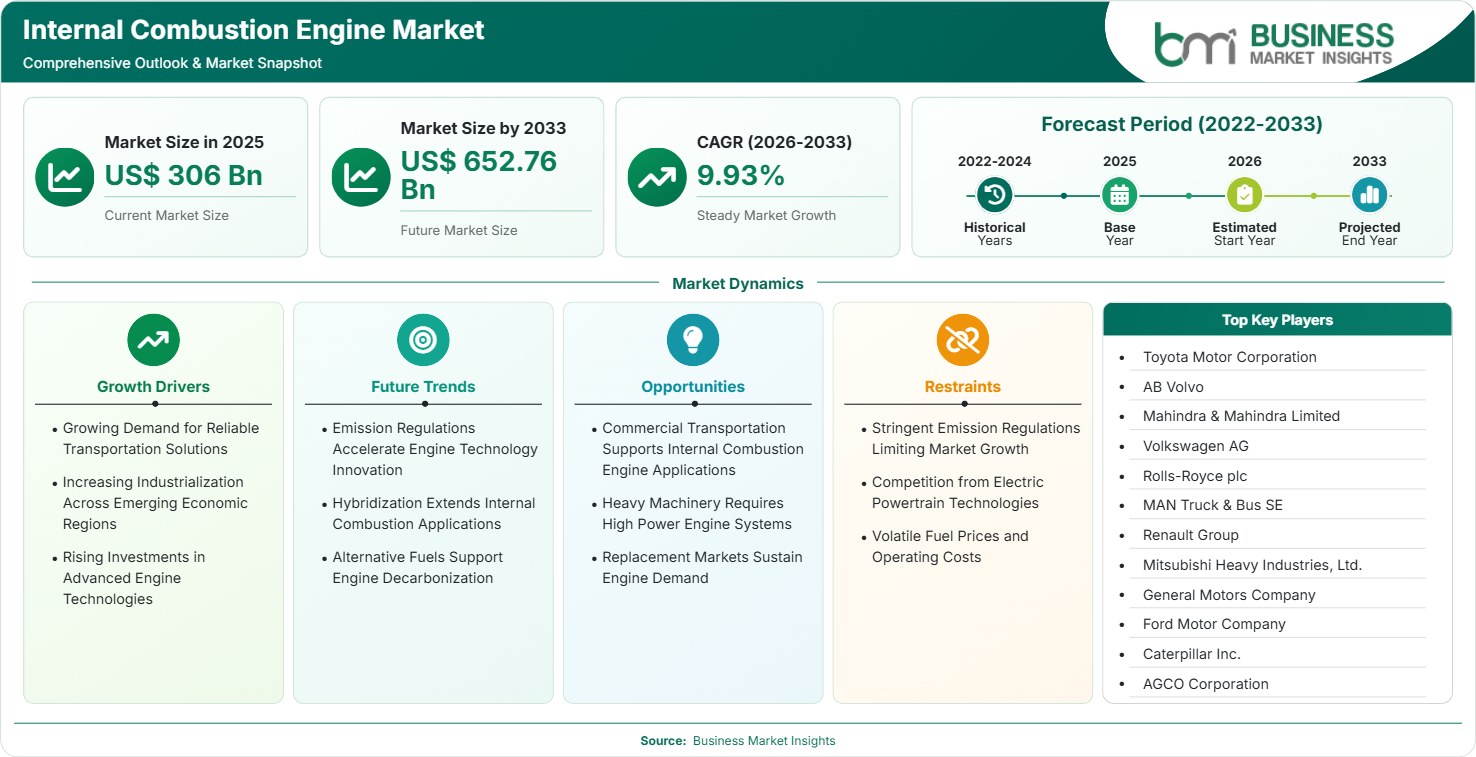
The Internal Combustion Engine Market size was valued at US$ 306 Billion in 2025 and is projected to reach US$ 652.76 Billion by 2033, growing at a CAGR of 9.93% during 2026–2033. Rising demand for commercial transportation, agricultural mechanization, marine propulsion systems, hybrid powertrains, and industrial backup power solutions continues creating opportunities for advanced fuel-efficient engine technologies globally.

Report Coverage
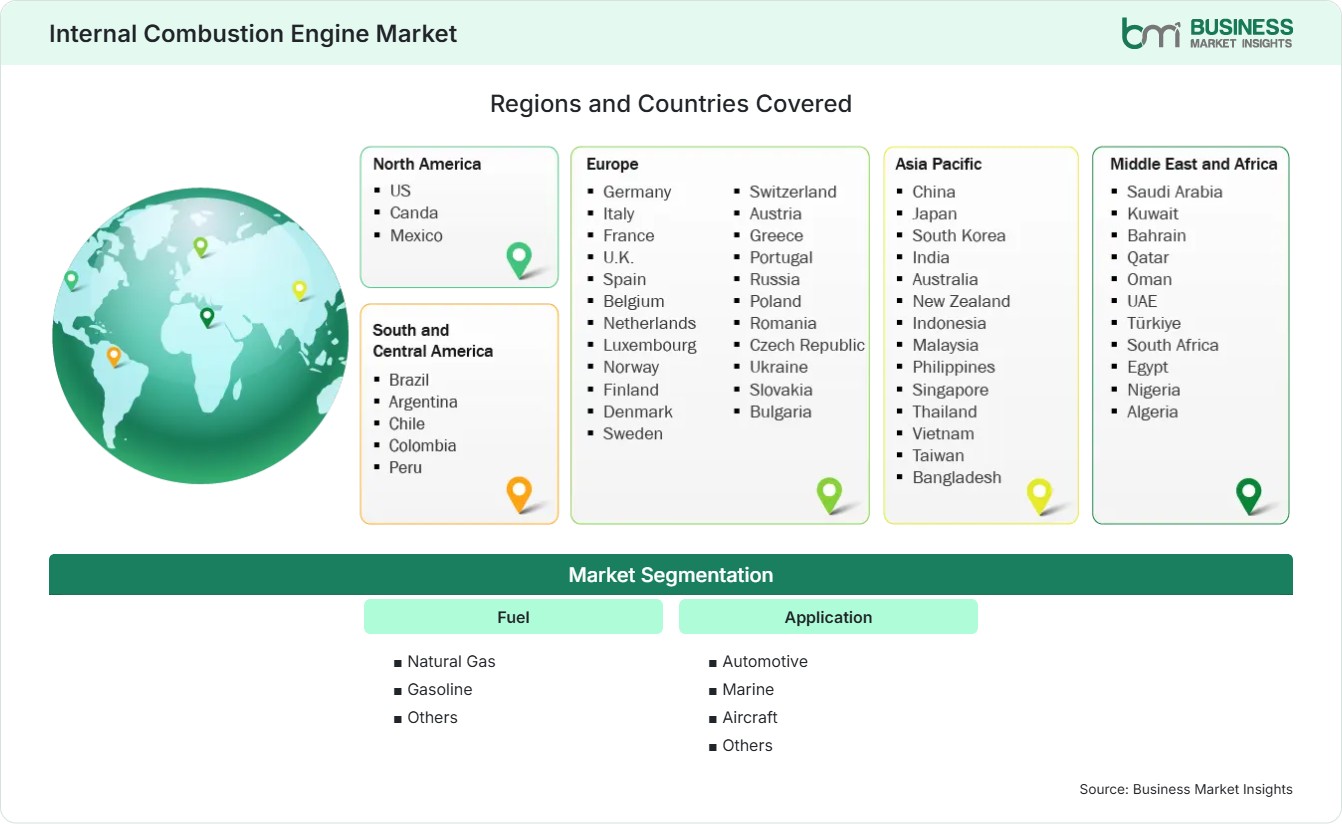
  • Fuel: Natural Gas, Gasoline, Others
  • Application: Automotive, Marine, Aircraft, Others
US$ 306 Bn Market size in 2025
US$ 652.76 Bn Market Size by 2033
9.93% CAGR, 2026 - 2033
2026-2033 Forecast Period

AI Overview

Internal Combustion Engine Market Summary

  • North America Region: North America holds a market share of 30%–33% in 2025, growing at a CAGR of 8.4%–9.0% during 2026–2033. Fleet modernization, off-highway equipment demand, industrial power generation investments, and fuel-efficiency improvements continue supporting adoption across transportation and heavy-duty applications. The U.S. market benefits from commercial vehicle demand, industrial equipment replacement cycles, and hybrid engine integration, advancing at a CAGR of 8.6%–9.2% through 2033.
  • Fastest Growing Region: Asia Pacific holds a market share of 34%–37% in 2025, growing at a CAGR of 10.8%–11.6% during 2026–2033. Expanding vehicle ownership, infrastructure development, agricultural mechanization, manufacturing growth, and freight transportation requirements continue strengthening engine demand across emerging economies and industrial sectors.
  • Leading Segment: Automotive accounts for 49%–52% share in 2025 and is expected to grow at a CAGR of 9.4%–10.1% through 2033. Passenger vehicles, commercial fleets, hybrid platforms, logistics expansion, and replacement demand support sustained deployment of advanced engine technologies worldwide.
  • High Growth Segment: Natural Gas represents 20%–23% share in 2025 and is projected to grow at a CAGR of 11.2%–12.0% during 2026–2033. Lower emissions, fuel-cost advantages, government incentives, and expanding gas distribution infrastructure encourage adoption across transportation, marine, and industrial applications.
  • Key Market Opportunity: Increasing integration of internal combustion engines within hybrid propulsion systems enables manufacturers to improve fuel economy, comply with emissions regulations, and extend operational flexibility across transportation, industrial, and marine sectors.
  • Major Market Players: Toyota Motor Corporation, AB Volvo, Mahindra & Mahindra Limited, Volkswagen AG, Rolls-Royce plc, MAN Truck & Bus SE, Renault Group, Mitsubishi Heavy Industries, Ltd., General Motors Company, Ford Motor Company, Caterpillar Inc., and AGCO Corporation.
Strategic Insights

Internal Combustion Engine Market: Strategic Insights

Internal Combustion Engine Market Strategic Framework
FREE PDF
Request your free sample
Request free sample
Stakeholder View

Key Takeaways

  • The value chain remains deeply integrated across component suppliers, fuel system manufacturers, OEMs, distributors, and aftermarket service providers, creating opportunities for operational efficiency and supply-chain optimization.
  • Commercial transportation, agricultural machinery, and industrial equipment applications offer attractive expansion potential due to increasing mechanization rates and infrastructure investment across developing economies.
  • Research efforts increasingly focus on low-emission combustion systems, intelligent engine management software, lightweight materials, and hybrid-compatible architectures to improve operational performance.
  • Asia Pacific presents a compelling investment destination owing to industrial expansion, vehicle production growth, logistics development, and rising demand for construction and agricultural equipment.
  • Strategic acquisitions and collaborative ventures continue strengthening technological capabilities, manufacturing capacity, and regional market access among major engine manufacturers and component suppliers.
  • Lifecycle service contracts, predictive maintenance platforms, and connected diagnostics are becoming important differentiators, enabling manufacturers to generate recurring revenue beyond initial equipment sales.
Geographic Outlook

Internal Combustion Engine Market Regional Highlights

North America Internal Combustion Engine Market

North America accounts for approximately 30%–33% of global demand in 2025 and is expected to expand at a CAGR of 8.4%–9.0% through 2033. Strong commercial transportation activity, advanced agricultural equipment deployment, and continued investment in industrial machinery support regional expansion. The Internal Combustion Engine Market growth across North America is also supported by hybrid vehicle integration and modernization of off-highway equipment fleets. Demand remains particularly resilient in construction, mining, logistics, and backup power applications where operational reliability is essential.

  • Commercial freight transportation continues generating substantial engine demand as logistics operators invest in fleet replacement programs emphasizing fuel efficiency, durability, and lower lifecycle costs across regional and long-haul transportation networks.
  • Agricultural equipment manufacturers are integrating advanced combustion technologies to improve productivity and operational efficiency, supporting equipment upgrades among large-scale farming operations throughout the United States and Canada.
  • Natural gas engine adoption is increasing across municipal transportation and industrial facilities due to emissions reduction objectives, favorable operating economics, and expanding fueling infrastructure development.
  • Construction and mining industries continue investing in heavy-duty machinery powered by advanced engines capable of meeting stringent performance requirements in demanding operational environments.
  • Growing hybrid powertrain deployment creates opportunities for advanced combustion systems designed to complement electrification strategies while preserving operational flexibility and range.

US Internal Combustion Engine Market

The United States represents approximately 72%–76% of regional revenue in 2025 and is projected to advance at a CAGR of 8.6%–9.2% through 2033. The demand for industrial equipment, the movement of goods in the commercial transport sector, modernization of the agriculture sector, and investments in the construction sector continue to contribute to growth. The presence of robust manufacturing facilities within the nation is helpful in bringing innovation to the field of engines, and fleet replacement initiatives help in promoting efficient combustion technology.

  • Infrastructure modernization initiatives continue stimulating demand for construction equipment, creating sustained requirements for high-performance engines capable of operating under challenging conditions.
  • Agricultural mechanization investments support replacement demand for tractors, harvesters, and specialized equipment incorporating advanced fuel-management and combustion technologies.
  • Manufacturing facilities increasingly deploy backup power systems to enhance operational resilience, supporting demand for industrial-grade engines and related service offerings.
  • Commercial fleet operators continue prioritizing efficiency improvements, leading to investments in engines offering reduced fuel consumption and enhanced emissions performance.

Europe Internal Combustion Engine Market

Europe holds approximately 24%–27% Internal Combustion Engine Market share in 2025 and is forecast to expand at a CAGR of 8.1%–8.8% during 2026–2033. The region is endowed with well-engineered solutions, robust commercial vehicle production and consistent industrial equipment demand. Germany continues to be the front-runner with its CAGR of 8.0%-8.6%, whereas the manufacturing zones of Eastern Europe experience greater growth at 8.9%-9.6%. The stringent emissions standards keep pushing for cleaner combustion engines and hybrid-capable engines in the regional environment.

  • Commercial vehicle manufacturers continue investing in next-generation engine technologies that balance emissions compliance, performance requirements, and operational cost considerations.
  • Marine transportation and specialized industrial applications maintain stable demand for advanced engines across European manufacturing and logistics sectors.
  • Germany leads regional production due to strong automotive, industrial machinery, and engineering capabilities supported by extensive supplier networks.
  • Central and Eastern European countries are attracting manufacturing investments because of competitive operating costs and expanding industrial infrastructure.
  • Increased research into alternative fuels and hybrid propulsion technologies supports long-term innovation across transportation and industrial applications.

Asia Pacific Internal Combustion Engine Market

Asia Pacific commands approximately 34%–37% share in 2025 and is expected to register the fastest CAGR of 10.8%–11.6% through 2033. Rapid industrialization, infrastructure development, urbanization, and agricultural modernization continue driving demand. China remains the leading regional market with a CAGR of 10.6%–11.3%, while India records the strongest growth at 11.4%–12.2%. The Internal Combustion Engine Market share in the region benefits from extensive manufacturing activity, expanding transportation networks, and increasing deployment of industrial equipment.

  • Rising vehicle ownership and expanding freight transportation requirements continue supporting engine demand across passenger, commercial, and specialized vehicle categories.
  • Infrastructure investments stimulate purchases of construction equipment, generators, and industrial machinery powered by advanced combustion technologies.
  • China maintains leadership through large-scale manufacturing capabilities, extensive supplier ecosystems, and significant domestic equipment demand.
  • India demonstrates rapid expansion supported by industrial growth, agricultural mechanization programs, and infrastructure development initiatives.
  • Southeast Asian economies increasingly invest in logistics, marine transportation, and manufacturing sectors, creating additional opportunities for engine suppliers.

Rest of World Internal Combustion Engine Market

Rest of World represents approximately 9%–12% share in 2025 and is anticipated to grow at a CAGR of 9.3%–10.0% through 2033. Agricultural growth, mining operations, and infrastructure investments have contributed to the advantage of South and Central America, mainly in Brazil and Mexico. The Middle East and Africa are aided through infrastructure developments, energy sector investment, and industrialization programs. Brazil is still the foremost market for South and Central America at CAGR of 9.4%–10.1%, whereas Saudi Arabia has superior growth at 9.8%–10.5%.

  • Agricultural exports and large-scale farming operations continue driving demand for tractors, harvesters, and related machinery powered by advanced engines.
  • Mining projects across Latin America require reliable heavy-duty equipment capable of operating in remote and demanding environments.
  • Infrastructure and industrial diversification programs across Gulf countries support demand for construction equipment and power-generation systems.
  • Expanding logistics and transportation networks create opportunities for commercial vehicle deployment across developing economies.
  • Energy sector investments and industrial facility expansion continue supporting long-term demand for stationary and mobile engine applications.
Global Market Geography
FREE PDF
Request your free sample
Request free sample
Segment Analysis

Internal Combustion Engine Market Segmentation

Fuel

The fuel segment remains central to demand patterns across transportation, industrial, marine, and power generation applications. Gasoline continues holding the largest share at approximately 52%–55% in 2025, supported by widespread vehicle deployment and established fueling infrastructure, while the segment advances at a CAGR of 8.8%–9.5% through 2033. Natural gas demonstrates the strongest expansion trajectory, supported by emissions-reduction initiatives and cost advantages. The Internal Combustion Engine Market scope continues broadening as alternative fuel adoption expands across commercial and industrial operations.

  • Natural Gas: Natural gas engines are gaining traction across heavy-duty transportation, industrial facilities, and marine operations due to lower emissions profiles, favorable operating economics, and increasing investments in fueling infrastructure.
  • Gasoline: Gasoline-powered engines remain dominant in passenger vehicles, light commercial transportation, and small industrial equipment because of mature supply chains, widespread availability, and strong consumer familiarity.

Application

Application diversity remains a defining characteristic of the market, supporting demand across transportation, marine, aerospace, industrial, and specialized sectors. Automotive accounts for the largest share of 49%–52% in 2025 and is projected to grow at a CAGR of 9.4%–10.1% through 2033. Continuous fleet expansion, replacement demand, and hybrid powertrain adoption reinforce segment leadership. Current Internal Combustion Engine Market trends indicate increasing technology integration, higher efficiency requirements, and greater emphasis on lifecycle performance across end-use applications.

  • Automotive: Automotive applications continue generating the highest demand through passenger vehicles, commercial fleets, logistics operations, and hybrid vehicle platforms requiring advanced efficiency, durability, and emissions-management capabilities.
  • Marine: Marine applications rely on high-performance engines for cargo transportation, offshore activities, fishing operations, and passenger vessels where reliability and operational endurance remain essential performance criteria.
  • Aircraft: Aircraft applications primarily utilize specialized combustion engines in selected aviation segments, training aircraft, and auxiliary power systems where weight optimization and dependable operation are critical.
Market Forces

Internal Combustion Engine Market Dynamics

Key Market Drivers

Expansion of Commercial Transportation and Freight Networks

Global freight transportation continues expanding alongside e-commerce growth, industrial output, and international trade activity. The International Transport Forum projects freight demand to rise substantially over the coming decades, encouraging investments in trucks, logistics fleets, and commercial transportation infrastructure. This trend directly supports Internal Combustion Engine Market growth, especially in heavy-duty categories of vehicles where durability, range, and the ease of refueling are still important factors. The fleet managers continue to focus on efficient combustion technologies in order to save on fuel usage, but at the same time maintain the required level of performance. For this reason, the engine makers are focusing on improving their technologies in terms of combustion optimization, intelligence, and the use of lightweight materials.

Rising Agricultural and Construction Equipment Mechanization

As the need for increased productivity in agriculture and construction infrastructure is becoming greater in the world, the demand for mechanized equipment is growing. In accordance with international development agencies and organizations dealing with agriculture, the degree of mechanization is steadily increasing in Asia, Africa, and Latin America in an effort to improve the productivity of agricultural crops and secure food supplies. The Internal Combustion Engine Market benefits from equipment replacement cycles, growing farm sizes, and construction investments linked to urbanization. Manufacturers are introducing engines with improved torque characteristics, lower emissions, and enhanced durability. These advancements support greater operational efficiency while meeting regulatory requirements across agriculture, mining, construction, and industrial sectors globally.

Hybrid Powertrain Adoption Supporting Engine Innovation

Electrification is reshaping transportation, yet hybrid architectures continue creating substantial opportunities for advanced combustion technologies. Modern hybrid systems combine electric propulsion with efficient engines, enabling manufacturers to improve fuel economy while maintaining driving range and operational flexibility. This evolution is accelerating.. Internal Combustion Engine Market trends include smaller, more efficient, electronically controlled engine designs. Automotive companies are using advanced combustion engines tailored for hybrid engines. Efficiency in terms of thermal efficiency, fuel injection technologies, turbocharging systems, and engine management electronics has improved their competitiveness. The use of hybrid engines across passenger cars, commercial, and industrial fleets will keep combustion technology relevant and help achieve emissions-reduction objectives.

Key Market Opportunities

Natural Gas Engine Deployment Across Transportation Segments

Natural gas presents a compelling opportunity as industries pursue cleaner fuel alternatives without sacrificing operational practicality. Expanding gas distribution infrastructure, supportive government policies, and favorable fuel economics encourage adoption in buses, trucks, marine vessels, and industrial equipment. The Internal Combustion Engine Market Forecasts now emphasize the use of natural gas technology as a viable means of reducing emissions. The manufacturers are developing specialized natural gas systems that deliver high performance while reducing carbon intensity compared to traditional fuels. Municipal transportation authorities, logistics companies, and industries are analyzing these technologies to achieve their sustainability goals. Investments into fueling infrastructure and engine development will bring more opportunities.

Growth of Industrial Backup Power and Distributed Energy

Industrial sites, data centers, healthcare organizations, and critical infrastructures have been increasingly focused on energy resilience. The need to enhance the reliability and continuity of grid operations has created demand for backup power generation using state-of-the-art internal combustion engines. Distributed energy generation has become more common for corporations, manufacturers, and telecommunication providers, who all require uninterrupted operation. The engine manufacturers can take advantage of this trend by providing high-efficiency generating units with low emissions and digital control. The use of technology in maintenance, diagnostics, and fuel management provides further advantages. As the development of industry continues worldwide, there will be growing demands for such power supply solutions.

Emerging Market Manufacturing and Localization Strategies

Manufacturers are increasingly establishing regional production facilities in emerging economies to improve supply chain resilience and reduce logistics costs. Industrial policies that favor localized manufacturing and technology transfers are being adopted by countries throughout Asia, the Middle East, and Latin America. This development creates new opportunities for engine manufacturers to expand capacity near customers and gain better market access. The localization approach offers advantages such as faster product customization, increased customer responsiveness, and greater cost competitiveness. Joint ventures, supplier ecosystems, and human resource development activities add value to the market potential. Companies able to make production investments according to regional demand trends can take advantage of growth potential.

Market Restraints and Challenges

Stringent Emissions Regulations Increasing Compliance Costs

Factor: Governments worldwide continue implementing stricter emissions standards across transportation, industrial equipment, marine operations, and power-generation applications. Impact: Compliance with regulations increases the costs of development, testing, and manufacturing for engines. Large investments must be made in modern after-treatment technology, electronic controls, and fuel-efficiency systems to meet evolving regulations. Although these changes will improve environmental protection, they will result in higher product costs and longer development time. Small businesses may feel the effects even more acutely due to a lack of research resources. Differences in regulations across regions make engineering more difficult because of the need for adaptation.

Acceleration of Battery-Electric Technology Adoption

Factor: Continuous improvements in battery technology, charging infrastructure, and electric vehicle adoption are increasing competition across several transportation categories. Impact: Some vehicle segments may see reduced reliance on traditional combustion systems, especially when the costs associated with electrification prove more economical. This creates strategic uncertainty for firms planning to invest in these technologies. While numerous applications in the heavy-duty industrial and special-vehicle categories, where combustion systems prevail, still remain, the move in passenger cars can shape demand trends. Engine makers have to make tradeoffs between investments in traditional systems and alternative propulsion systems.

Company Analysis

Competitive Landscape

The competitive environment remains characterized by investments in fuel efficiency, emissions optimization, hybrid integration, industrial power solutions, and application-specific engine platforms. Current Internal Combustion Engine Market analysis indicates that manufacturers are prioritizing advanced combustion technologies, digital engine controls, alternative fuels, and regional manufacturing expansion to strengthen market positions.

Company Name

Overview

Products and Services Relevant to this Market

Toyota Motor Corporation

Global automotive manufacturer with extensive engine development capabilities, strong hybrid expertise, and large-scale production operations across major international markets.

Gasoline engines, hybrid-compatible powertrains, passenger vehicle propulsion systems, engine management technologies, and mobility-focused combustion innovations.

AB Volvo

Leading commercial vehicle and industrial equipment producer serving transportation, construction, and infrastructure industries through advanced powertrain technologies.

Heavy-duty diesel engines, truck propulsion systems, construction equipment engines, industrial power solutions, and fuel-efficiency technologies.

Mahindra & Mahindra Limited

Major automotive and agricultural equipment manufacturer with significant presence across emerging economies and off-highway vehicle segments.

Tractor engines, utility vehicle engines, agricultural equipment powertrains, commercial vehicle propulsion systems, and rural mobility solutions.

Volkswagen AG

Diversified automotive group with broad expertise in combustion technologies, hybrid systems, and global vehicle manufacturing operations.

Passenger vehicle engines, gasoline powertrains, hybrid engine systems, emissions technologies, and advanced engine control platforms.

Rolls-Royce plc

Engineering company specializing in aerospace, marine, defense, and industrial propulsion systems for global customers.

Aircraft engines, marine propulsion engines, power-generation engines, defense propulsion technologies, and advanced engine testing services.

MAN Truck & Bus SE

Commercial vehicle and industrial engine manufacturer focused on transportation, logistics, marine, and energy applications.

Truck engines, bus propulsion systems, marine engines, natural gas engines, and industrial power-generation solutions.

Renault Group

Automotive manufacturer with extensive vehicle portfolio and ongoing investments in efficient combustion and hybrid technologies.

Passenger vehicle engines, hybrid propulsion systems, engine electronics, emissions-control technologies, and mobility solutions.

Mitsubishi Heavy Industries, Ltd.

Industrial engineering company serving power generation, marine, aerospace, and industrial machinery sectors worldwide.

Industrial engines, marine propulsion systems, power-generation equipment, aerospace engines, and engineering services.

General Motors Company

Global vehicle manufacturer with significant expertise in combustion technologies, vehicle platforms, and advanced propulsion systems.

Gasoline engines, light-duty vehicle powertrains, hybrid propulsion technologies, engine components, and vehicle integration services.

Ford Motor Company

Automotive company serving passenger and commercial vehicle markets through advanced engine and mobility technologies.

Passenger vehicle engines, commercial vehicle powertrains, turbocharged engine technologies, hybrid systems, and mobility platforms.

Caterpillar Inc.

Major supplier of construction, mining, energy, and transportation equipment operating across global industrial markets.

Heavy-duty diesel engines, mining equipment engines, industrial power systems, marine engines, and energy-generation solutions.

AGCO Corporation

Agricultural equipment manufacturer supporting mechanized farming operations through advanced machinery and power systems.

Tractor engines, agricultural machinery powertrains, farm equipment solutions, precision agriculture technologies, and engine support services.

Trust & Transparency

Research Methodology

The market analysis combines proprietary research with secondary data from government agencies, company disclosures, regulatory filings, industry databases and expert interviews. Market estimates are validated through data triangulation, cross-market benchmarking and analyst review.

View Full Research Methodology

Questions Answered

Frequently Asked Questions

What does the Internal Combustion Engine Market Report indicate about long-term opportunities?

The Internal Combustion Engine Market Report indicates that hybrid powertrains, natural gas engines, industrial backup power systems, marine propulsion technologies, and emerging-market industrialization will remain important opportunity areas through the forecast period.

Which application segment generates the highest revenue contribution?

The automotive segment remains the leading revenue contributor due to large vehicle production volumes, extensive replacement demand, commercial fleet expansion, and continued adoption of hybrid propulsion platforms across global markets.

How are hybrid vehicles influencing engine manufacturers?

Hybrid architectures encourage development of smaller, more efficient, and digitally controlled engines. Manufacturers increasingly optimize combustion systems specifically for integration with electric propulsion technologies to improve overall vehicle efficiency.

Which fuel category is expected to record the fastest expansion through 2033?

Natural gas is projected to demonstrate the strongest growth because it offers lower emissions, competitive operating costs, and increasing infrastructure support across transportation, industrial, and marine applications.

What factors sustain demand for combustion engines despite electrification?

Electrification growth is significant, yet heavy-duty transportation, agriculture, mining, marine operations, aviation support systems, and industrial power generation continue requiring high energy density, operational range, and rapid refueling capabilities that combustion technologies provide effectively.

Access the Full Internal Combustion Engine Market Report

Get segment-level forecasts, regional estimates, competitive benchmarking, company profiles and downloadable Excel datasets.

Access the full Internal Combustion Engine Market Report
350 pages PDF & Excel | 2026-09-21
Similar Research

Related Market Reports