Market Summary
Executive Summary and Global Market Analysis
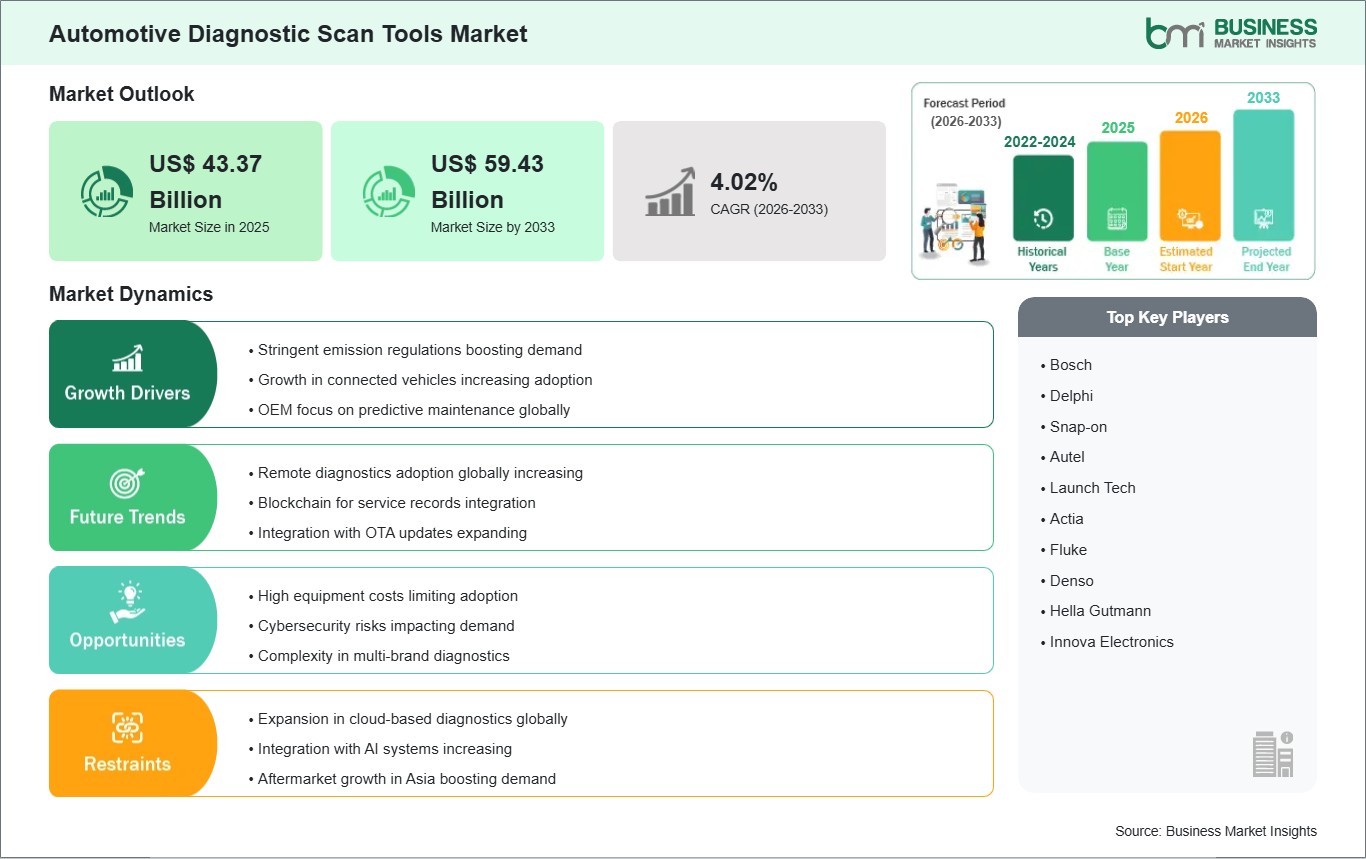
Automotive diagnostic scan tools are electronic devices and software solutions used to identify, monitor, and troubleshoot vehicle systems through onboard diagnostics and communication networks. These tools help technicians, service centers, fleet operators, and vehicle owners detect faults, analyze performance, and perform maintenance activities efficiently. The growing complexity of modern vehicles, including advanced driver assistance systems, connected technologies, and electric powertrains, has increased the importance of accurate diagnostic solutions. The growing number of electric vehicles is also creating demand for specialized diagnostic tools capable of evaluating battery systems, electronic control units, and software-driven vehicle functions.
Several challenges influence market development. The rapid evolution of vehicle electronics requires continuous software updates and technician training, which can increase operating costs for workshops and service providers. Compatibility issues across different vehicle brands and models also create complexity for independent repair facilities. In addition, cybersecurity concerns related to connected diagnostics and remote vehicle access require stronger security frameworks and compliance measures. Smaller workshops may face difficulties investing in advanced diagnostic platforms due to budget constraints. These factors can affect adoption rates, particularly in cost-sensitive markets.
Despite these challenges, the market continues to benefit from ongoing technological advancements. Artificial intelligence-assisted diagnostics, cloud-based service platforms, predictive maintenance solutions, and remote vehicle monitoring are creating new opportunities. Increasing emphasis on vehicle safety, emissions compliance, and software-defined vehicle architectures is expected to strengthen demand for intelligent diagnostic systems. Competition remains focused on expanding diagnostic coverage, improving user experience, integrating real-time data analytics, and supporting next-generation connected and electric vehicles.
Segment Analysis
Automotive Diagnostic Scan Tools Market Segmentation
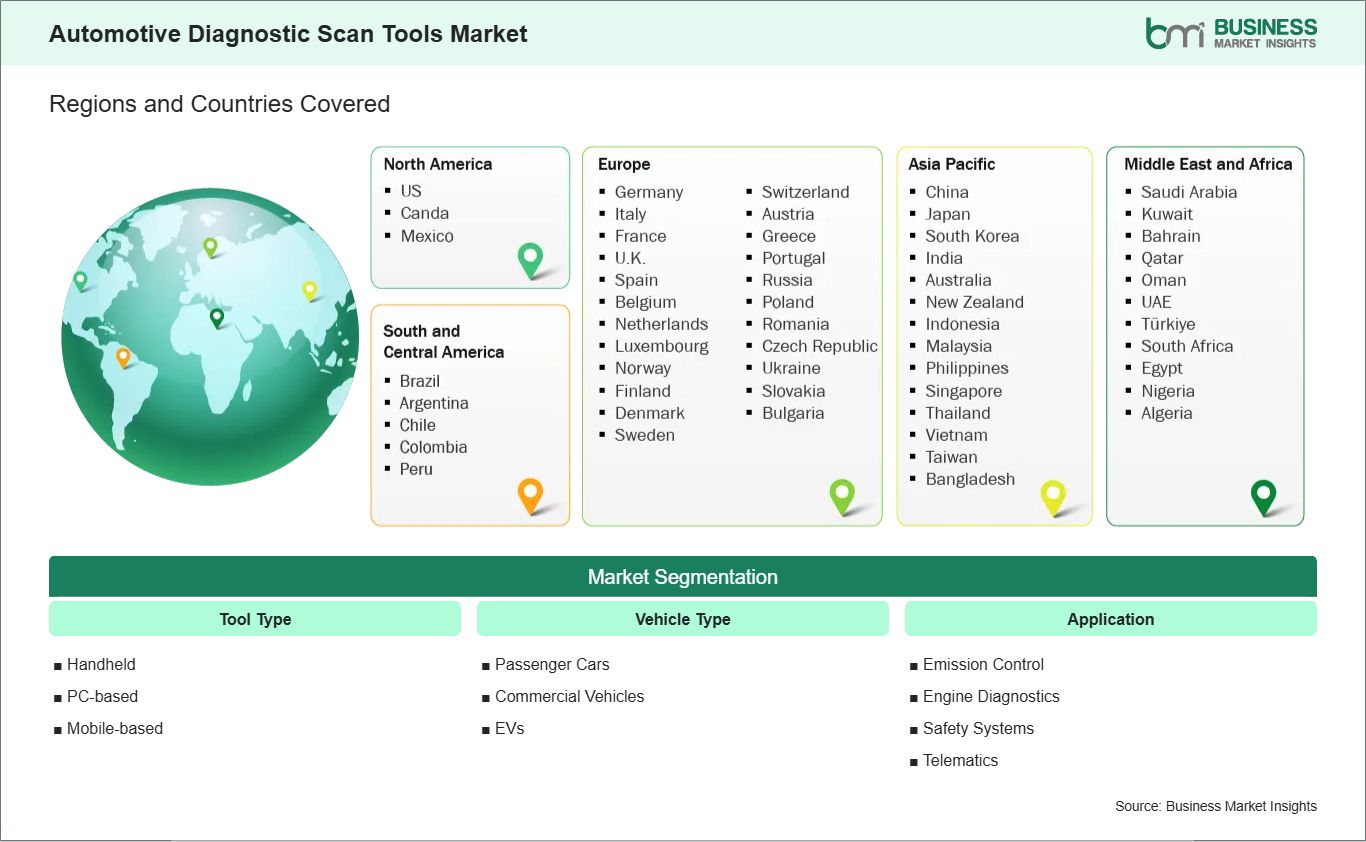
The Automotive Diagnostic Scan Tools market is segmented based on tool type, vehicle type, and application, reflecting diverse diagnostic requirements across the automotive industry.
By Tool Type
- Handheld: Widely used due to portability and ease of vehicle diagnostics
- PC-based: Preferred for advanced analysis, reporting, and workshop applications
- Mobile-based: Increasingly adopted due to wireless connectivity and cloud integration
By Vehicle Type
- Passenger Cars: Largest demand segment driven by vehicle ownership and maintenance needs
- Commercial Vehicles: Supports fleet management, maintenance efficiency, and uptime optimization
- EVs: Requires specialized diagnostic capabilities for batteries, power electronics, and software systems
By Application
- Emission Control: Used for emissions monitoring and regulatory compliance
- Engine Diagnostics: Supports fault detection and engine performance analysis
- Safety Systems: Enables diagnostics of braking, ADAS, and vehicle safety functions
- Telematics: Facilitates connected vehicle monitoring and predictive maintenance
Market Forces
Automotive Diagnostic Scan Tools Market Drivers and Opportunities
Growing Vehicle Electronics Complexity Drives Diagnostic Tool Adoption
Modern vehicles contain a large number of electronic control units, sensors, communication modules, and software-based functions. As automakers continue integrating advanced driver assistance systems, connected vehicle technologies, and electrified powertrains, diagnosing vehicle faults becomes increasingly complex. Traditional inspection methods are no longer sufficient for identifying problems within sophisticated automotive systems. This shift is encouraging workshops, dealerships, and fleet operators to invest in advanced diagnostic scan tools capable of accessing multiple vehicle subsystems and interpreting large volumes of operational data.
Regulatory requirements related to vehicle safety, emissions, and cybersecurity are also contributing to demand. Diagnostic tools help technicians ensure compliance with evolving standards while reducing repair times and improving service quality. Fleet operators benefit from quicker fault identification, which minimizes vehicle downtime and improves operational efficiency. In addition, software updates and over-the-air vehicle functions require more advanced diagnostic capabilities than previous generations of vehicles. As automotive manufacturers continue introducing intelligent and connected vehicle architectures, the need for reliable diagnostic solutions is expected to remain a key factor supporting market growth.
AI-Enabled and Cloud-Based Diagnostics Create Future Growth Potential
The future of the Automotive Diagnostic Scan Tools market is increasingly linked to artificial intelligence, cloud computing, and connected vehicle ecosystems. Advanced diagnostic platforms are evolving beyond fault detection to provide predictive maintenance recommendations, automated troubleshooting guidance, and real-time vehicle health monitoring. These capabilities help service providers identify potential failures before they occur, reducing maintenance costs and improving vehicle reliability.
Cloud-connected diagnostic systems enable remote access to vehicle data, allowing technicians to perform diagnostics without requiring physical inspection in some cases. This trend supports fleet management applications, telematics integration, and remote service models. Artificial intelligence algorithms can analyze historical repair records and operational data to accelerate fault identification and recommend corrective actions. Electric and software-defined vehicles also create opportunities for specialized diagnostic solutions designed for battery systems, electronic architectures, and software management. As automotive digitalization continues, demand for intelligent, scalable, and connected diagnostic platforms is expected to expand across both developed and emerging automotive markets.
Size and Share Analysis
Automotive Diagnostic Scan Tools Market Size and Share Analysis
The Automotive Diagnostic Scan Tools market is expected to reach US$ 59.43 billion by 2033 from US$ 43.37 billion in 2025. The market is estimated to record a CAGR of 4.02% from 2026 to 2033.
By tool type, handheld diagnostic scan tools account for a significant share due to their portability, ease of use, and widespread adoption among independent repair shops and service centers. PC-based tools remain important for advanced diagnostics and detailed reporting functions, while mobile-based solutions are gaining traction with the growing use of wireless connectivity, cloud platforms, and smartphone-based vehicle diagnostics.
By application, engine diagnostics holds a substantial share owing to the continuous need for vehicle performance monitoring and fault detection. Emission control applications remain important due to increasingly stringent environmental regulations, while safety systems diagnostics are expanding with the growing deployment of ADAS and electronic safety features. Telematics applications continue to gain momentum as connected vehicle technologies and remote monitoring solutions become more common across passenger and commercial vehicle segments.
Report Coverage
Automotive Diagnostic Scan Tools Market Report Coverage and Deliverables
The "Automotive Diagnostic Scan Tools Market Size and Forecast (2022-2033)" report provides a detailed analysis of the market covering below areas:
- Market size and forecast at global, regional, and country levels for all the key market segments covered under the scope
- Market trends, as well as market dynamics such as drivers, restraints, and key opportunities
- Market analysis covering key market trends, global and regional framework, major players, regulations, and recent market developments
- Industry landscape and competition analysis covering market concentration, heat map analysis, prominent players, and recent developments for the market
- Detailed company profiles, including SWOT analysis
Geographic Insights
Automotive Diagnostic Scan Tools Market Geographic Insights
The Automotive Diagnostic Scan Tools Market shows diverse regional adoption patterns influenced by vehicle technology advancements, service infrastructure development, and increasing demand for efficient vehicle maintenance solutions.
North America, being a developed region, has a well-established automotive aftermarket and a high adoption rate of advanced vehicle diagnostic technologies. The region comprises the United States and Canada, where service centers, dealerships, and fleet operators increasingly rely on sophisticated diagnostic tools to support connected vehicles, electric vehicles, and advanced safety systems. The region focuses on improving repair efficiency, regulatory compliance, and predictive maintenance capabilities. Its mature automotive ecosystem and strong technological infrastructure support the continued adoption of diagnostic scan tools across multiple vehicle categories.
Asia Pacific is growing significantly, driven by rising vehicle ownership, expanding automotive production, and increasing investments in vehicle servicing infrastructure. The region comprises countries such as China, India, and Japan, where growing vehicle fleets are creating strong demand for diagnostic equipment and maintenance solutions. The region focuses on improving vehicle reliability, reducing maintenance costs, and supporting the transition toward connected and electric mobility. Rapid digitalization and increasing adoption of advanced automotive technologies are further contributing to market expansion across the region.
Both regions are contributing significantly to the growth of the Automotive Diagnostic Scan Tools Market, focusing on automotive modernization, expanding vehicle fleets, increasing adoption of connected technologies, and rising demand for efficient diagnostic and maintenance solutions.
Industry Activity
Recent Developments
The Automotive Diagnostic Scan Tools Market is analyzed using a mix of primary and secondary research sources, including corporate publications, industry associations, and verified databases. This approach ensures accurate tracking of innovation trends and strategic developments influencing the market.
- In May 2025, Snap-on introduced its third-generation TRITON diagnostic platform designed to streamline vehicle repair workflows. The new scan tool includes wireless connectivity, Fast-Track troubleshooting capabilities, and expanded diagnostic coverage for modern vehicle systems. The launch strengthens advanced diagnostic capabilities for professional technicians and repair facilities.
- In September 2025, Hella Gutmann Solutions extended its cooperation with ADAC, enabling deployment of mega macs X multi-brand diagnostic devices across roadside assistance vehicles. The collaboration supports faster vehicle diagnostics and repair services at breakdown locations, highlighting the growing importance of advanced diagnostic technologies in mobility services.
Trust & Transparency
Research Methodology
The market analysis combines proprietary research with secondary data from government agencies, company disclosures, regulatory filings, industry databases and expert interviews. Market estimates are validated through data triangulation, cross-market benchmarking and analyst
review.
View Full Research Methodology
Key Sources Referred:
World Bank - Global Trade IndicatorsWorld Trade Organization (WTO)International Monetary Fund (IMF)International Trade Administration (ITA)Company WebsitesCompany Annual ReportsCompany Investor Presentations