
Automotive Crash Test Dummies Market Outlook: Size, Share, Trends, Growth Analysis, Competitive Landscape & Forecast, 2026-2033

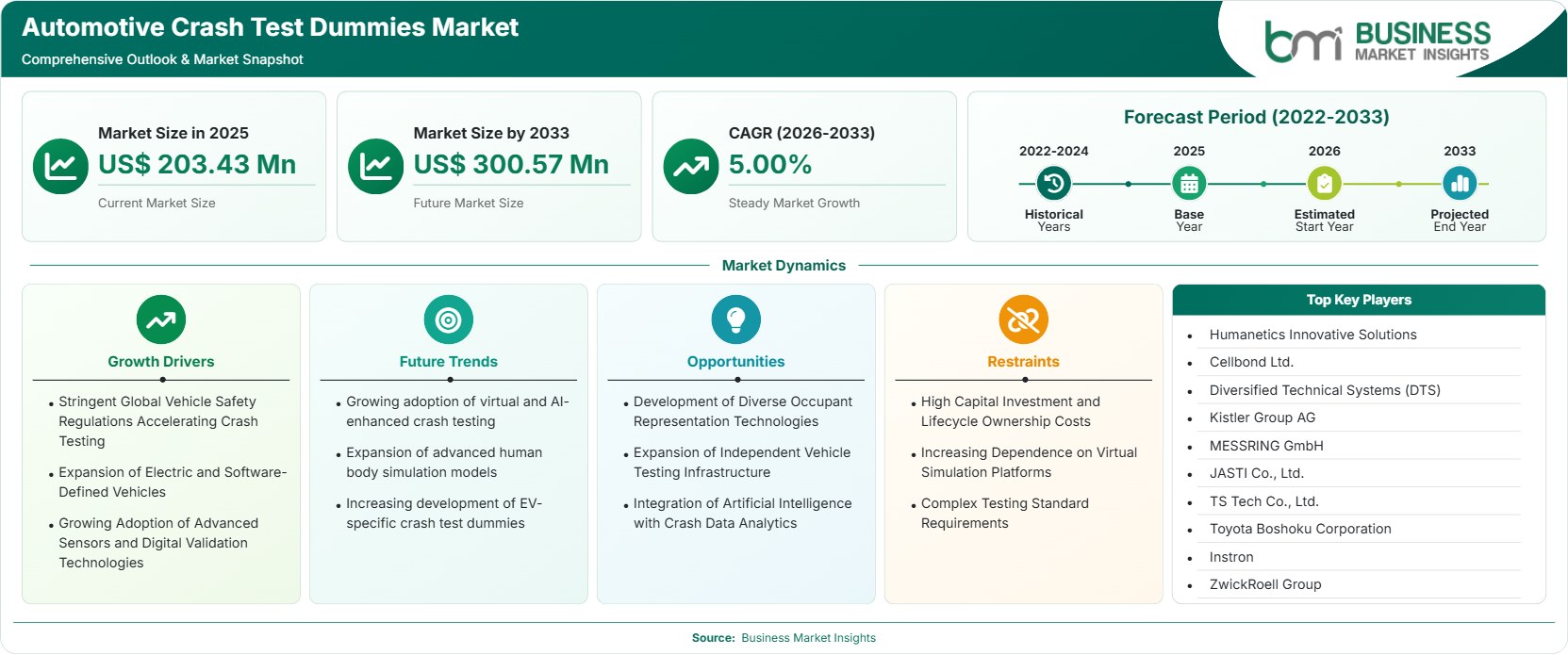
The Automotive Crash Test Dummies Market size was valued at US$ 203.43 Million in 2025 and is projected to reach US$ 300.57 Million by 2033, growing at a CAGR of 5.00% during 2026–2033. Increasing vehicle safety regulations, rapid advancements in intelligent sensing technologies, expanding crash testing requirements for electric vehicles, and rising investments in advanced occupant protection systems are creating sustained opportunities for innovation, calibration services, and next-generation anthropomorphic test devices worldwide.

Report Coverage
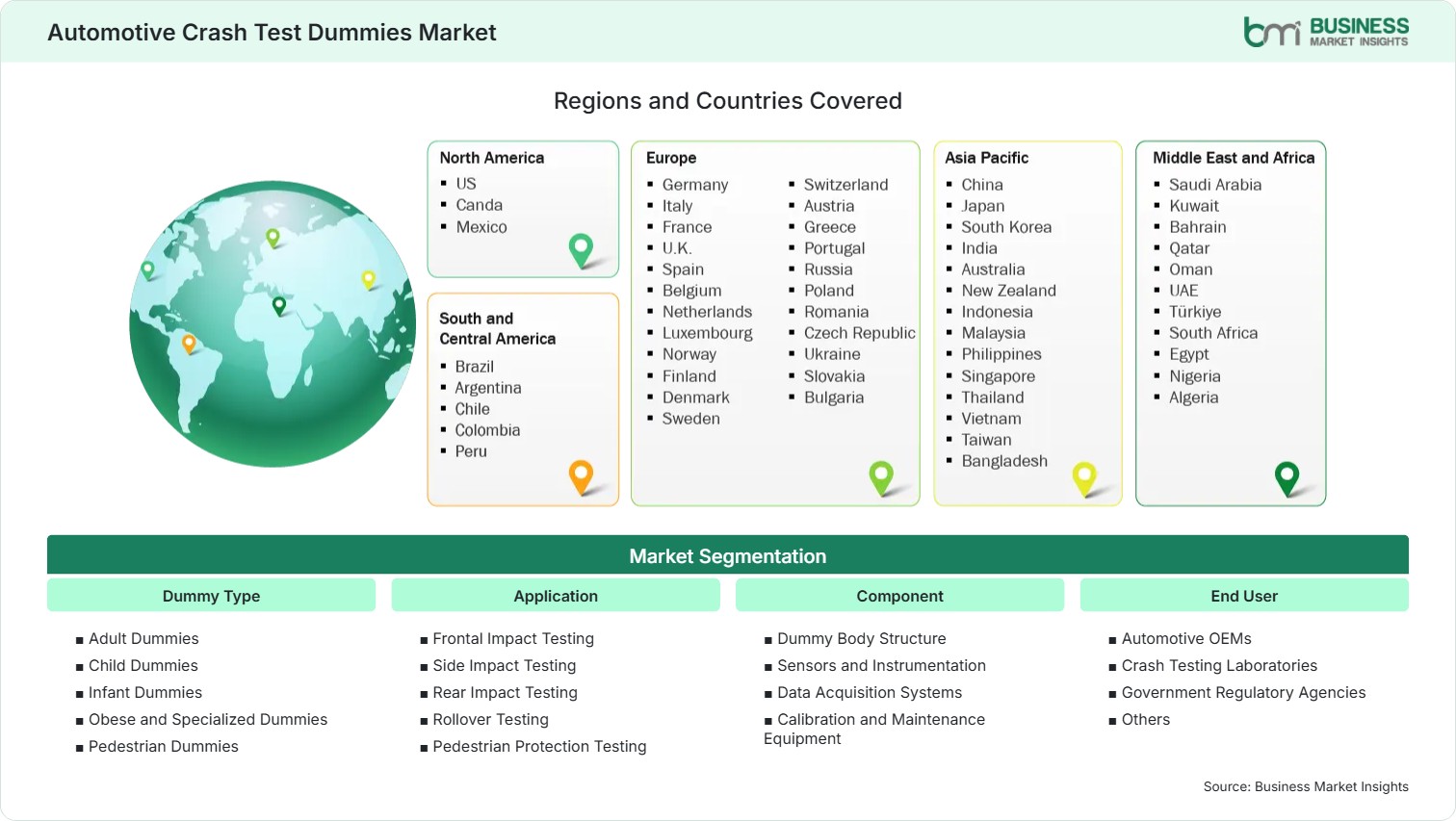
  • Dummy Type: Adult Dummies, Child Dummies, Infant Dummies, Obese and Specialized Dummies, Pedestrian Dummies
  • Application: Frontal Impact Testing, Side Impact Testing, Rear Impact Testing, Rollover Testing, Pedestrian Protection Testing
  • Component: Dummy Body Structure, Sensors and Instrumentation, Data Acquisition Systems, Calibration and Maintenance Equipment
  • End User: Automotive OEMs, Crash Testing Laboratories, Government Regulatory Agencies, Others
US$ 203.43 Mn Market size in 2025
US$ 300.57 Mn Market Size by 2033
5.00% CAGR, 2026 - 2033
2026-2033 Forecast Period

01 AI Overview

Automotive Crash Test Dummies Market Summary

  • North America Region: North America holds a market share of 36%–39% in 2025 and is expected to grow at a CAGR of 4.6%–4.9% during 2026–2033, supported by stringent federal safety standards, continuous R&D investments, sophisticated crash laboratories, autonomous vehicle validation, and expanding electric vehicle safety certification programs driving technology adoption globally. The U.S. dominates regional demand through advanced automotive safety research, regulatory compliance testing, and premium vehicle development, recording a projected CAGR of 4.7%–5.0%.
  • Fastest Growing Region: Asia Pacific accounts for 26%–29% market share in 2025 and is projected to expand at a CAGR of 5.8%–6.2% through 2026–2033, driven by expanding vehicle manufacturing, stricter crash regulations, increasing premium automobile production, growing testing infrastructure investments, international safety collaborations, and evolving consumer safety expectations across developing economies.
  • Leading Segment: Adult Dummies represent 48%–52% of the market in 2025 and are anticipated to register a CAGR of 4.8%–5.2% between 2026–2033, supported by mandatory frontal, side, rollover, and occupant protection evaluations, increasing production of passenger vehicles, regulatory harmonization, and continuous improvements in biofidelic sensor technologies enhancing testing accuracy.
  • High Growth Segment: Sensors and Instrumentation account for 33%–36% share in 2025 and are forecast to grow at a CAGR of 6.2%–6.6% during 2026–2033, fueled by demand for high-speed data capture, precision measurement technologies, intelligent calibration, digital validation, electric vehicle testing requirements, and connected laboratory ecosystems supporting advanced crash analytics.
  • Key Market Opportunity: Growing deployment of electric, connected, and autonomous vehicles requires sophisticated occupant simulation, high-precision sensing, digital twins, and diversified anthropomorphic test devices, creating long-term opportunities for manufacturers delivering intelligent testing ecosystems and specialized validation solutions.
  • Major Market Players: Humanetics Innovative Solutions (U.S.), Cellbond Ltd. (U.K.), DTS – Diversified Technical Systems (U.S.), Kistler Group AG (Switzerland), MESSRING GmbH (Germany), JASTI Co., Ltd. (Japan), TS Tech Co., Ltd. (Japan), Toyota Boshoku Corporation (Japan), Instron (U.S.), and ZwickRoell Group (Germany).
02 Strategic Insights

Automotive Crash Test Dummies Market: Strategic Insights

Automotive Crash Test Dummies Market Strategic Framework
FREE PDF
Request your free sample
Request free sample
03 Stakeholder View

Key Takeaways

  • The value chain is becoming more integrated, with dummy manufacturers, sensor developers, testing labs, automotive companies, and regulators collaborating to improve vehicle safety validation.
  • Demand is expanding beyond passenger vehicles as EVs, autonomous vehicles, commercial vehicles, and ADAS require advanced occupant protection testing.
  • Innovation focuses on advanced crash test dummies with modular designs, wireless data systems, digital twins, AI analytics, and real-time monitoring.
  • Asia Pacific offers strong growth opportunities due to automotive expansion, stricter safety regulations, exports, and new crash testing facilities.
  • Acquisitions, partnerships, licensing, and digital testing investments are strengthening competition and enabling specialized safety solutions.
  • Future success will depend on combining physical crash testing, simulations, software platforms, predictive analytics, and automated calibration systems.
04 Geographic Outlook

Automotive Crash Test Dummies Market Regional Highlights

North America Automotive Crash Test Dummies Market

North America accounts for 36%–39% of the global Automotive Crash Test Dummies Market share in 2025 and is projected to expand at a CAGR of 4.6%–4.9% during 2026–2033. Regional leadership stems from mature automotive safety regulations, advanced crash-testing infrastructure, and extensive investments by OEMs in occupant protection research.

  • FMVSS updates are encouraging OEMs to expand crash testing with advanced dummies, sensors, and data systems.
  • Vehicle manufacturers are combining virtual engineering with physical testing to improve efficiency and compliance.
  • Safety ratings and insurance programs are driving demand for advanced crash testing equipment across impact scenarios.
  • EV and autonomous vehicle development is increasing adoption of next-generation crash test dummies.
  • Collaboration among universities, labs, and suppliers is improving dummy design, sensors, and testing methods.

US Automotive Crash Test Dummies Market

The United States represents 74%–77% of North American demand and is anticipated to record a CAGR of 4.7%–5.0% through 2026–2033. The country's leadership in electric vehicle innovation, autonomous mobility development, and advanced occupant protection research maintains strong demand for precision crash testing equipment, sophisticated instrumentation, and comprehensive validation technologies across passenger and commercial vehicle segments.

  • Automotive manufacturers are investing in digital crash labs combining simulation and physical testing for improved safety compliance.
  • Independent testing organizations are increasing demand for advanced pedestrian, child, and specialized crash dummies.
  • Local suppliers are expanding sensor, calibration, and data acquisition capabilities to strengthen testing supply chains.
  • Federal research on occupant diversity and new mobility solutions supports advanced dummy development and testing improvements.

Europe Automotive Crash Test Dummies Market

Europe holds approximately 28%–31% of global market share in 2025 and is forecast to grow at a CAGR of 4.8%–5.2% through 2026–2033. Stringent Euro NCAP assessment protocols, ambitious vehicle safety legislation, and strong engineering expertise sustain regional demand. Germany leads regional adoption through advanced automotive manufacturing, while France and the United Kingdom maintain significant testing capabilities.

  • Euro NCAP’s stricter safety tests are driving adoption of advanced crash dummies for occupant and pedestrian protection.
  • German automakers are investing in testing facilities, premium instrumentation, and high-fidelity crash simulations.
  • Research collaborations are improving dummy biofidelity, sensor accuracy, and crash testing reliability.
  • Rising EV production in Europe is creating demand for advanced testing labs and calibration services.
  • Sustainable testing initiatives promote energy-efficient equipment, digital workflows, and predictive maintenance solutions.

Asia Pacific Automotive Crash Test Dummies Market

Asia Pacific represents 26%–29% of worldwide demand in 2025 and is projected to register the fastest regional expansion with a CAGR of 5.8%–6.2% during 2026–2033. China remains the leading contributor through its extensive automotive manufacturing base, while Japan continues driving innovation in safety engineering.

  • Expanding New Car Assessment Programs in Asia are increasing demand for advanced adult, child, and pedestrian crash dummies.
  • Japan is strengthening its position through high-precision sensors, biomechanical research, and intelligent testing systems.
  • India’s automotive exports are driving demand for safety testing labs, calibration services, and advanced instruments.
  • China’s EV growth is creating demand for battery safety, structural testing, and occupant protection solutions.
  • Government support for automotive R&D is accelerating adoption of digital and physical crash testing technologies.

Rest of World Automotive Crash Test Dummies Market

The Rest of World region held 8%–10% market share in 2025 and is expected to grow at a 5.1%–5.5% CAGR through 2033. Growth is supported by improving automotive safety regulations, manufacturing expansion, testing infrastructure upgrades, and international partnerships. Brazil, Mexico, UAE, Saudi Arabia, and South Africa are driving demand for advanced crash testing and calibration solutions in Automotive Crash Test Dummies Market.

  • Brazil leads regional automotive production, driving modernization of laboratories and adoption of advanced crash testing equipment.
  • Mexico benefits from automotive exports and partnerships, increasing demand for safety testing technologies.
  • Gulf countries are investing in transportation safety and international crash testing capabilities.
  • South Africa is expanding automotive manufacturing and adopting modern vehicle safety validation systems.
  • Global collaborations are improving knowledge transfer, workforce skills, and harmonized safety testing standards.
Global Market Geography
FREE PDF
Request your free sample
Request free sample
05 Segment Analysis

Automotive Crash Test Dummies Market Segmentation

Dummy Type

The Dummy Type segment accounted for approximately 48%–52% market share in 2025 and is projected to grow at a CAGR of 4.8%–5.2% during 2026–2033. The Automotive Crash Test Dummies Market scope continues expanding as regulatory agencies require occupant protection validation across different age groups and body types.

  • Adult Dummies: Most widely used for frontal, side, rear, and rollover crash tests, with improved sensors and biomechanical accuracy.
  • Child Dummies: Evaluate child restraints and rear-seat safety under various crash conditions, driven by stricter safety regulations.
  • Infant Dummies: Assess infant carriers and restraint systems with advanced measurements of head, neck, and body responses.
  • Obese and Specialized Dummies: Support inclusive safety testing by representing diverse body sizes and occupant conditions.
  • Pedestrian Dummies: Help evaluate vehicle designs and improve protection for vulnerable road users.

Application

The Application segment represented nearly 29%–32% of the market in 2025 and is anticipated to register a CAGR of 5.2%–5.6% through 2026–2033. Growing implementation of comprehensive crash evaluation protocols across passenger cars, commercial vehicles, and electric vehicles is driving demand for advanced testing equipment in Automotive Crash Test Dummies Market trends.

  • Frontal Impact Testing: Primary application driven by safety regulations requiring evaluation of driver and passenger protection during head-on collisions.
  • Side Impact Testing: Assesses occupant safety in lateral crashes through advanced injury measurement and testing systems.
  • Rear Impact Testing: Focuses on reducing neck and spinal injuries through improved seating and restraint designs.
  • Rollover Testing: Evaluates occupant protection, vehicle structure, and restraint performance during rollover scenarios.
  • Pedestrian Protection Testing: Examines vehicle designs to reduce injuries and meet vulnerable road user safety standards.

Component

The Component segment held approximately 33%–36% market share in 2025 and is forecast to expand at a CAGR of 6.2%–6.6% between 2026–2033. Continuous innovation in digital instrumentation, wireless communication, and real-time analytics is improving testing efficiency in Automotive Crash Test Dummies Market.

  • Dummy Body Structure: Uses durable materials to replicate human biomechanics and ensure reliable crash testing results.
  • Sensors and Instrumentation: Capture impact data such as force, acceleration, and pressure with improved accuracy and reliability.
  • Data Acquisition Systems: Collect and process high-speed sensor data for faster analysis and digital testing integration.
  • Calibration and Maintenance Equipment: Maintains testing accuracy, reliability, and compliance while extending equipment lifecycle.

End User

The End User segment accounted for nearly 41%–44% market share in 2025 and is expected to grow at a CAGR of 5.0%–5.4% during 2026–2033. Rising investments in vehicle safety engineering, product certification, and research infrastructure continue supporting adoption across diverse organizations in Automotive Crash Test Dummies Market.

  • Automotive OEMs: Largest end-user segment driven by vehicle development, safety regulations, certification needs, and advanced crash testing investments.
  • Crash Testing Laboratories: Provide independent validation services and invest in advanced instruments, analytics, and specialized crash test devices.
  • Government Regulatory Agencies: Set safety standards, conduct compliance assessments, and drive demand for advanced testing equipment.
06 Market Forces

Automotive Crash Test Dummies Market Dynamics

Key Market Drivers

Stringent Global Vehicle Safety Regulations Accelerating Crash Testing

Government agencies and independent safety assessment organizations continue strengthening vehicle safety requirements, creating sustained demand for advanced anthropomorphic test devices. The National Highway Traffic Safety Administration (NHTSA), Euro NCAP, China NCAP, Japan NCAP, and Global NCAP are expanding crash assessment protocols to include vulnerable road users, advanced driver assistance systems, and diverse occupant categories. Automotive Crash Test Dummies Market growth is supported by these evolving regulatory frameworks, which require increasingly sophisticated testing methodologies and highly instrumented dummies.

Expansion of Electric and Software-Defined Vehicles

The global emergence of electric vehicles has brought about drastic changes in crash validation. Electric cars have distinct designs, battery structures, and weight distributions, thus necessitating elaborate crash tests not only for traditional internal combustion engine cars but also for electric cars. Sales of electric cars worldwide have continued to grow in 2025, according to the International Energy Agency. Crash test programs today include battery safety assessment together with occupant injury assessment, hence the need for precise biomechanical measurements.

Growing Adoption of Advanced Sensors and Digital Validation Technologies

Intelligent instrumentation, artificial intelligence-enabled analysis, and digital engineering tools are being adopted by crash testing laboratories at a rapid pace. The high-speed sensors have produced much more biomechanical data than before, making repeat testing more reliable for engineers. The use of digital twins, simulation software, and physical crash testing is becoming common and helps minimize the time required to develop prototypes while still meeting regulations.

Key Market Opportunities

Development of Diverse Occupant Representation Technologies

Future vehicle safety standards increasingly recognize the need to evaluate occupants representing different ages, genders, body sizes, and physical conditions. Investments in obese, elderly, female, and pediatric anthropomorphic test devices provide manufacturers with opportunities to expand specialized product portfolios supporting inclusive safety validation. Automotive Crash Test Dummies Market Forecasts indicate that laboratories will require broader dummy inventories capable of evaluating emerging regulatory requirements addressing occupant diversity. Manufacturers developing modular body structures, enhanced biomechanical realism, and interchangeable sensor systems can strengthen long-term competitiveness while supporting research institutions, automotive OEMs, and government agencies pursuing more representative vehicle safety testing methodologies.

Expansion of Independent Vehicle Testing Infrastructure

The fast expansion of car manufacturing in developing nations has created an opportunity for governments and independent companies to set up advanced car crash test facilities. Nations that seek to boost their automobile production capacity through localized manufacturing will require modern laboratories having state-of-the-art testing facilities. Independent testing firms can become involved in testing cars exported from these nations in accordance with the various safety standards existing in different regions. Laboratory equipment manufacturers can make use of the situation to provide complete laboratory facilities that comprise of crash test dummies, high speed measuring instruments, software and calibration systems.

Integration of Artificial Intelligence with Crash Data Analytics

Artificial intelligence and machine learning technologies present substantial opportunities to transform the interpretation of crash data. Modern crash tests generate millions of synchronized measurement points requiring sophisticated processing and predictive modelling. AI-based analytics can be used to recognize injury patterns, design optimal structures, and enhance simulations using physically validated test data. Equipment makers who use smart software in their testing environments can deliver more valuable products than by supplying hardware alone. The rising number of digital transformations within the automotive engineering industry also contributes to the need for such integrated platforms.

Market Restraints and Challenges

High Capital Investment and Lifecycle Ownership Costs

Factor: Highly advanced crash test dummies, instruments, calibration equipment, and laboratory facilities entail a significant initial capital investment coupled with constant maintenance, certification, and technical assistance. Impact: Newer automobile producers, suppliers, research institutions, and laboratories are often constrained by limited budgets and thus cannot afford advanced testing equipment. The expense of replacing faulty parts, frequent calibration, and specific engineering knowledge raises the overall cost of ownership. Hence, equipment purchases considerations tend to favor value over technology upgrades due to lifecycle considerations, which slows the adoption of the latest generation of anthropomorphic test devices.

Increasing Dependence on Virtual Simulation Platforms

Factor: The automotive companies continue increasing their investments in computer aided engineering, finite element modeling, and virtual crash simulation to decrease the costs of development and increase the efficiency of vehicle design optimization. Impact: Even though crash tests cannot be replaced by other procedures for certification purposes, greater use of advanced simulation technologies could reduce the number of physical validation programs in the early stages of development. In this way, companies are starting to combine digital engineering with targeted prototyping, which is influencing the frequency of procurement for certain types of test equipment.

07 Company Analysis

Competitive Landscape

The competitive environment is characterized by continuous investments in biomechanical engineering, intelligent sensing technologies, and integrated testing ecosystems. The Automotive Crash Test Dummies Market analysis indicates that leading companies are strengthening their portfolios through advanced anthropomorphic test devices, precision instrumentation, digital data acquisition platforms, and calibration services.

Company Name

Overview

Products and Services Relevant to this Market

Humanetics Innovative Solutions (U.S.)

Global leader specializing in anthropomorphic test devices, digital human modeling, and safety engineering solutions serving automotive manufacturers, laboratories, and regulatory organizations worldwide.

Crash test dummies, pedestrian impact systems, calibration services, digital human simulation software, engineering consulting, occupant safety validation technologies, and lifecycle support services.

Cellbond Ltd. (U.K.)

Specialist manufacturer of crash testing equipment with extensive expertise in impact systems and laboratory safety solutions supporting international vehicle certification programs.

Crash barriers, pedestrian impactors, crash test components, laboratory equipment, calibration accessories, and engineering solutions for automotive safety testing.

DTS – Diversified Technical Systems (U.S.)

Provider of advanced data acquisition systems and sensor technologies designed for demanding automotive crash testing and high-speed measurement applications.

High-speed data acquisition systems, crash sensors, telemetry systems, software platforms, instrumentation integration, and testing support services.

Kistler Group AG (Switzerland)

International measurement technology company delivering precision instrumentation for automotive development, research laboratories, and industrial testing applications worldwide.

Force sensors, accelerometers, pressure sensors, crash measurement systems, data acquisition solutions, calibration technologies, and engineering services.

MESSRING GmbH (Germany)

German company recognized for complete crash testing facilities and integrated vehicle safety testing infrastructure serving global automotive manufacturers.

Crash test systems, propulsion equipment, high-speed cameras, laboratory integration, control software, calibration systems, and engineering support.

JASTI Co., Ltd. (Japan)

Japanese manufacturer focused on anthropomorphic test devices and specialized equipment supporting automotive occupant safety validation and research activities.

Crash test dummies, replacement components, maintenance services, calibration equipment, and testing accessories for vehicle safety laboratories.

TS Tech Co., Ltd. (Japan)

Automotive seating and interior systems supplier actively supporting occupant protection research through advanced seating technologies and safety engineering.

Vehicle seating systems, occupant restraint development, crash evaluation support, interior safety components, and engineering collaboration services.

Toyota Boshoku Corporation (Japan)

Global automotive interior supplier integrating seating innovation with occupant safety engineering and vehicle crash performance optimization.

Automotive seats, interior modules, occupant protection systems, crash performance development, engineering services, and seating validation technologies.

Instron (U.S.)

Materials testing and mechanical evaluation specialist providing laboratory equipment supporting automotive safety component validation and structural testing.

Universal testing systems, material characterization equipment, calibration solutions, mechanical testing instruments, and laboratory engineering services.

ZwickRoell Group (Germany)

International testing technology company delivering advanced mechanical testing equipment for automotive safety research and component validation applications.

Mechanical testing machines, material testing systems, calibration services, software platforms, structural evaluation equipment, and laboratory automation solutions.

10 Trust & Transparency

Research Methodology

The market analysis combines proprietary research with secondary data from government agencies, company disclosures, regulatory filings, industry databases and expert interviews. Market estimates are validated through data triangulation, cross-market benchmarking and analyst review.

View Full Research Methodology

11 Questions Answered

Frequently Asked Questions

What does an Automotive Crash Test Dummies Market Report typically include?

A comprehensive report generally covers market size, segmentation, regional outlook, competitive landscape, technology trends, regulatory developments, company profiles, strategic opportunities, recent industry developments, and forecasts supporting business planning and investment decisions.

How are electric vehicles influencing industry development?

Electric vehicles require additional crash validation covering battery protection, structural integrity, thermal safety, and occupant injury assessment. These evolving testing requirements are encouraging investment in sophisticated anthropomorphic test devices and integrated measurement systems.

Which component category is expected to record the highest growth?

Sensors and Instrumentation is projected to experience the strongest growth owing to increasing adoption of high-speed measurement systems, intelligent analytics, wireless telemetry, and digital laboratory technologies supporting advanced crash validation programs.

Which region currently leads the global market?

North America maintains the leading position because of mature automotive safety regulations, extensive testing infrastructure, strong research investments, and the presence of leading crash testing equipment manufacturers serving global automotive OEMs.

What factors are driving demand for automotive crash test dummies market?

Demand is primarily supported by stricter vehicle safety regulations, increasing electric vehicle production, broader New Car Assessment Program requirements, and continuous investments in advanced crash testing technologies that improve occupant protection and regulatory compliance worldwide.

Access the Full Automotive Crash Test Dummies Market Report

Get segment-level forecasts, regional estimates, competitive benchmarking, company profiles and downloadable Excel datasets.

Access the full Automotive Crash Test Dummies Market Report
350 pages PDF & Excel | 2026-08-12