
Automotive Bushing Market Outlook: Size, Share, Trends, Growth Analysis, Competitive Landscape & Forecast, 2026-2033

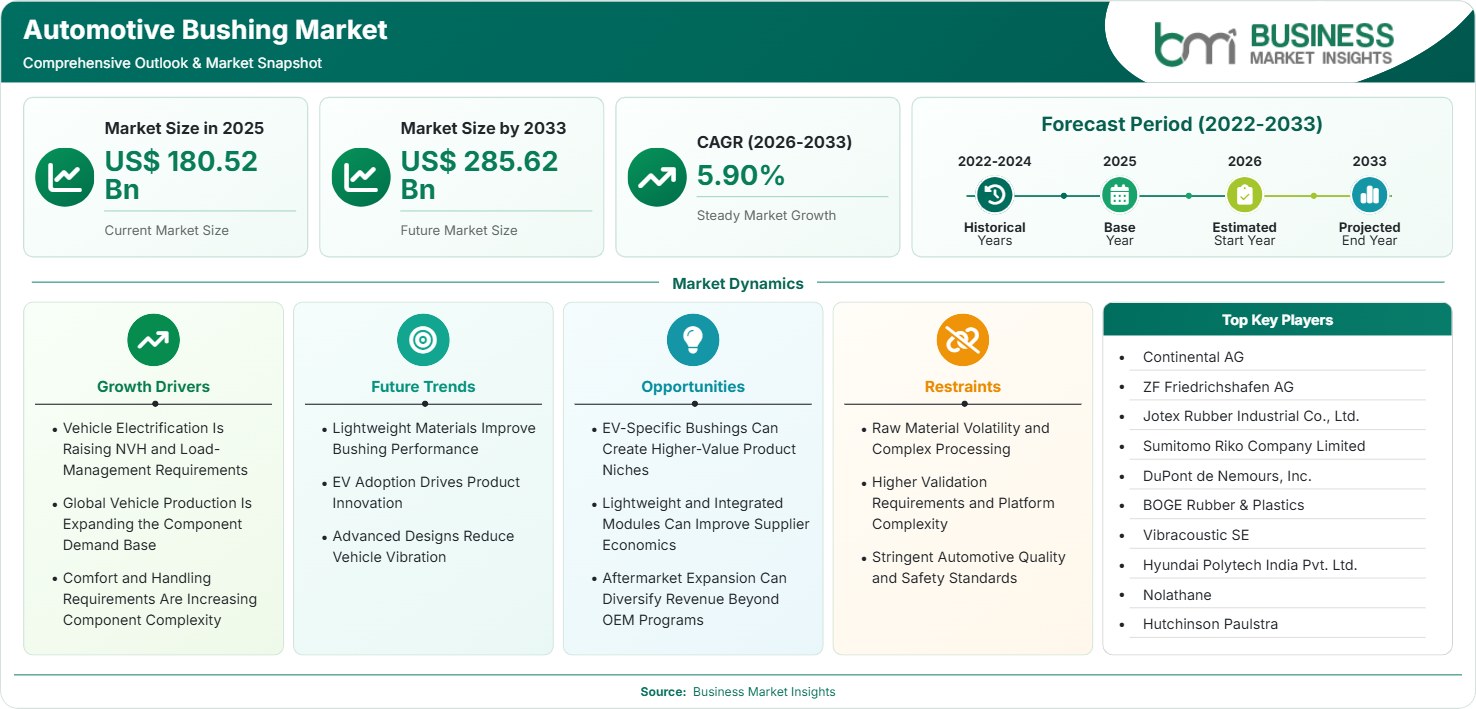
The Automotive Bushing Market size was valued at US$ 180.52 Billion in 2025 and is projected to reach US$ 285.62 Billion by 2033, growing at a CAGR of 5.90% during 2026–2033, driven by vehicle production, suspension refinement, electrification, lightweighting, and advanced noise, vibration, and harshness requirements.

Report Coverage
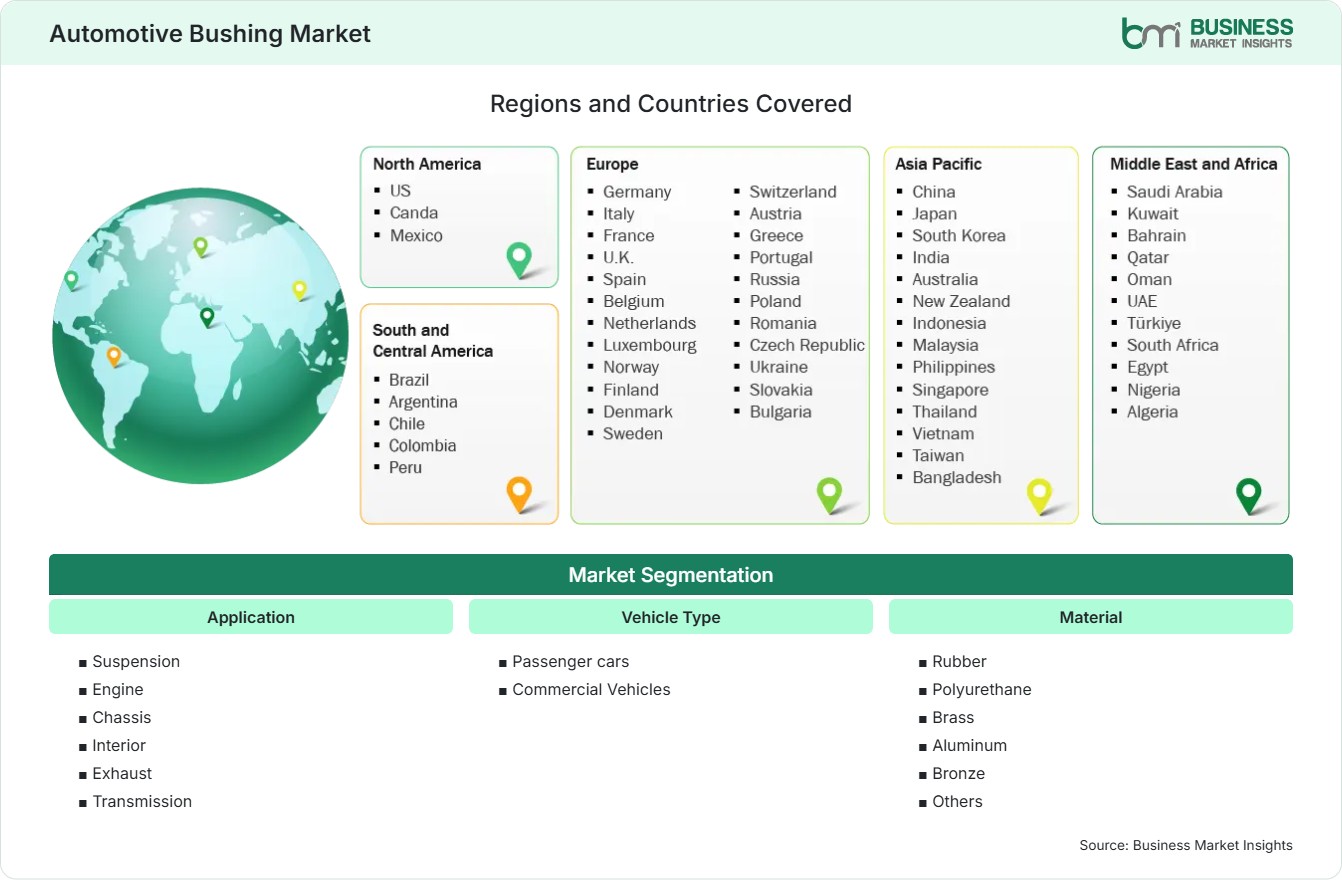
  • Application: Suspension, Engine, Chassis, Interior, Exhaust, Transmission
  • Vehicle Type: Passenger cars , Commercial Vehicles
  • Material: Rubber, Polyurethane, Brass, Aluminum, Bronze, Others
US$ 180.52 Bn Market size in 2025
US$ 285.62 Bn Market Size by 2033
5.90% CAGR, 2026 - 2033
2026-2033 Forecast Period

AI Overview

Automotive Bushing Market Summary

  • North America Region: North America holds an Automotive Bushing Market share of 22%–25% in 2025, growing with a CAGR of 4.8%–5.6%, influenced by large vehicle fleets, pickup demand, replacement cycles, electrification, and advanced chassis engineering. The US market benefits from substantial commercial vehicle production, strong aftermarket demand, and increasing EV adoption, supporting approximately 4.9%–5.7% CAGR during 2026–2033.
  • Fastest Growing Region: Asia Pacific holds a market share of 39%–43% in 2025, growing with a CAGR of 6.8%–7.6%, supported by expanding vehicle production, rising domestic demand, localization, EV manufacturing, cost-efficient component ecosystems, and increasing investment in advanced suspension and NVH technologies.
  • Leading Segment: Suspension applications hold a market share of 38%–42% in 2025, growing with a CAGR of 5.8%–6.4%, supported by rising vehicle weights, ride-comfort requirements, road-load management, chassis durability, steering precision, and growing adoption of tuned rubber, hydraulic, and lightweight bushing architectures.
  • High Growth Segment: Transmission applications represent an Automotive Bushing Market share of 11%–14% in 2025, growing with a CAGR of 6.8%–7.8%, supported by electrified drivetrains, compact transmission architectures, higher torque densities, vibration isolation requirements, thermal exposure, and increasing demand for lightweight elastomeric and polymer-based components.
  • Key Market Opportunity: Advanced elastomers, lightweight housings, hydraulic designs, and EV-specific bushings create opportunities for suppliers to combine durability, low mass, tunable stiffness, and improved NVH performance across global vehicle platforms.
  • Major Market Players: Continental AG, ZF Friedrichshafen AG, Jotex Rubber Industrial Co., Ltd., Sumitomo Riko Company Limited, DuPont de Nemours, Inc., BOGE Rubber & Plastics, Vibracoustic SE, Hyundai Polytech India Pvt. Ltd., Nolathane, and Hutchinson Paulstra.
Strategic Insights

Automotive Bushing Market: Strategic Insights

Automotive Bushing Market Strategic Framework
FREE PDF
Request your free sample
Request free sample
Stakeholder View

Key Takeaways

  • The value chain increasingly spans compound developers, metal-component manufacturers, elastomer molders, Tier 1 chassis suppliers, OEM engineering teams, and aftermarket distributors. Competitive differentiation is shifting from basic molded rubber production toward material formulation, simulation, bonding, testing, and application-specific tuning.
  • Suspension remains the largest application because every vehicle requires multiple vibration-isolation interfaces across control arms, subframes, stabilizers, struts, and related chassis structures. Transmission and EV-oriented applications offer higher upside as torque density, compact packaging, and high-frequency excitation increase.
  • Product development is moving toward low-hardness compounds, hydraulic damping, thermoplastic elastomers, lightweight aluminum housings, integrated modules, and electronically assisted vibration-management architectures. Suppliers increasingly optimize stiffness and damping simultaneously rather than treating bushings as standardized commodity parts.
  • Asia Pacific offers the strongest investment case because it combines the world's largest vehicle production base with accelerating electrification. OICA reported approximately 59.2 million vehicles produced in Asia Pacific in 2025, more than 61% of global output.
  • Suppliers are prioritizing localized production, portfolio expansion, and engineering capabilities instead of relying solely on capacity additions. Continental's 2025 aftermarket expansion illustrates how established suppliers are broadening chassis component coverage while strengthening recurring replacement demand.
  • EV adoption does not eliminate bushing demand. It changes performance specifications. Higher vehicle mass, quieter drivetrains, battery-related packaging constraints, and increased sensitivity to road noise require more precisely engineered isolation components.
Geographic Outlook

Automotive Bushing Market Regional Highlights

North America Automotive Bushing Market

North America constitutes 22%-25% of the Automotive Bushing Market share in 2025, with a 4.8%-5.6% CAGR during 2026-2033. North America will gain due to significant output from passenger cars and pickups, experienced replacement demand, and state-of-the-art chassis designs. The US continues to be the largest contributor to revenue, while Mexico emerges as an important manufacturing hub in integrated North American supply chains. Electrification is creating new demands for suspension isolation, battery installation, and high-frequency NVH management.

  • Pickup trucks and SUVs sustain high bushing content because heavier platforms require durable suspension isolation, greater radial-load capacity, and improved resistance to harsh road conditions.
  • EV adoption is increasing demand for components capable of handling greater vehicle mass and quieter powertrains, making material tuning and frequency-specific damping increasingly important.
  • Mexico provides an attractive manufacturing base because proximity to US vehicle plants supports localized component sourcing, shorter logistics routes, and integrated Tier 1 supplier networks.
  • Replacement demand remains structurally important because large installed vehicle populations generate recurring requirements for suspension, chassis, steering, and drivetrain components.

US Automotive Bushing Market

The USA accounts for 17%-20% of global consumption and is projected to experience a CAGR of 4.9%-5.7% in 2026-2033. This is owing to its substantial number of vehicles in operation, high demand for light trucks, large aftermarket volume, and highly developed OEM engineering. The rising penetration rate of electric cars is expanding the technological scope for bushing applications. According to the International Energy Agency, US electric car sales were expected to account for 11% of total car sales in 2025, while vehicle manufacturers continue to introduce heavier electrified platforms requiring redesigned isolation and damping solutions.

  • The aftermarket provides recurring demand because suspension and chassis bushings experience continuous exposure to road loads, temperature cycling, moisture, and mechanical fatigue.
  • Light trucks and SUVs create opportunities for higher-load bushings, reinforced elastomers, hydro designs, and components engineered for towing, off-road use, and larger wheel loads.
  • EV programs are encouraging suppliers to develop lightweight components with controlled stiffness and improved high-frequency isolation for quieter vehicle interiors.

Europe Automotive Bushing Market

Europe captures a market share of 17% - 20% in 2025 and experiences a 4.0% - 4.8% CAGR from 2026 to 2033 in the Automotive Bushing Market. The market is dominated by Germany, and production in Spain and France offers considerable potential. Poland and Czechia are more growth-oriented manufacturing destinations due to the trend toward supplier localization. There are financial and competitiveness challenges in vehicle production in the EU, but demand for superior engineering in suspension systems and NVH parts continues. In 2025, ACEA reported that 17.4% of EU new car registrations were battery-electric, accelerating the development of components optimized for electrified platforms.

  • Germany remains the regional engineering center, supported by premium vehicle manufacturing, complex chassis systems, and strong demand for high-performance vibration-control components.
  • Spain and France benefit from sizeable vehicle manufacturing bases and expanding electrified model production, supporting localized component sourcing and engineering programs.
  • Czechia and Poland offer higher-growth opportunities because their manufacturing ecosystems are integrated with European OEM and Tier 1 supply chains.
  • European regulations encouraging lower vehicle emissions indirectly reinforce lightweighting, component efficiency, and electrified vehicle development.

Asia Pacific Automotive Bushing Market

The Asia Pacific region captures a 39%-43% share in 2025 and registers a 6.8%-7.6% CAGR for the Automotive Bushing Market in 2026-2033, thereby emerging as the largest and fastest-growing regional market. China dominates regional demand, whereas Japan and India have well-established manufacturing facilities. India and Southeast Asia have high growth potential as the number of vehicles owned, manufactured locally, and exported increases. According to OICA statistics, around 59.2 million vehicles were manufactured in the Asia-Pacific region in 2025, of which China alone accounted for 34.53 million.

  • China combines the world's largest vehicle production base with rapid EV adoption, increasing demand for lightweight chassis isolation, high-load suspension components, and specialized NVH solutions.
  • India provides strong long-term potential through rising passenger vehicle production, expanding commercial vehicle demand, localization programs, and development of domestic automotive component capabilities.
  • Japan remains important for advanced materials, precision manufacturing, and high-reliability anti-vibration products serving domestic and international OEM programs.
  • Southeast Asian manufacturing hubs are benefiting from supply-chain diversification, vehicle assembly investments, and growing regional demand for cost-competitive components.

Rest of World Automotive Bushing Market

South and Central America account for a 6%–9% share in 2025, with a 4.8%–5.7% CAGR during 2026–2033 of the Automotive Bushing Market. Brazil is the leading market, supported by vehicle production and a substantial commercial fleet, while Mexico is treated within North America. Regional suppliers benefit from localization, replacement demand, and increasing adoption of modern suspension architectures.

The Middle East & Africa have a market share of 8%-11%, with a CAGR of 5.0%-6.1%. Saudi Arabia, the UAE, South Africa, and Türkiye offer promising opportunities through vehicle imports, commercial fleets, manufacturing investment, and growth in the aftermarket segment.

  • Brazil's automotive ecosystem creates demand for durable components suited to variable road conditions, commercial vehicles, and high-mileage passenger fleets.
  • South Africa provides a specialized opportunity through commercial vehicles, mining-linked transportation, and replacement demand for high-load suspension applications.
  • Saudi Arabia and the UAE support premium and commercial vehicle demand where heat resistance, durability, and long service intervals are important purchasing criteria.
  • Türkiye provides a manufacturing bridge between Europe and adjacent markets, supporting component exports and regional automotive supply-chain integration.
Global Market Geography
FREE PDF
Request your free sample
Request free sample
Segment Analysis

Automotive Bushing Market Segmentation

Application

The Application section represents 100% market structure, with Suspension being the largest, with a market share of 38%–42% in 2025 and a CAGR of 5.8%–6.4% for the period of 2026-2034 in the Automotive Bushing Market. Market demand can be attributed to comfort in riding, precision in steering, durability, the weight of electric vehicles, and increasingly sophisticated chassis tuning across global vehicle platforms.

  • Suspension: Suspension bushings isolate road excitation while controlling compliance and handling. Increasing vehicle mass and tighter ride targets encourage hydraulic, tuned-rubber, lightweight, and higher-durability designs.
  • Engine: Engine bushings and related mounts manage vibration transmission and structural loads. Hybrid architectures preserve demand while requiring broader frequency-control capability and improved thermal durability.
  • Chassis: Chassis bushings connect structural components while controlling vibration, noise, and movement. Modular platforms increase demand for precisely tuned components supporting handling, comfort, and durability.
  • Interior: Interior isolation components reduce transmitted vibration and improve perceived refinement. Premium vehicles and quieter electric drivetrains increase sensitivity to small disturbances, supporting advanced elastomer solutions.
  • Exhaust: Exhaust applications require heat-resistant vibration isolation and controlled movement. Hybrid and combustion platforms continue generating demand, while thermal durability remains a principal engineering requirement.
  • Transmission: Transmission bushings control drivetrain movement and vibration while accommodating torque and thermal loads. Electrification is encouraging compact, high-torque architectures requiring advanced isolation and lightweight designs.

Vehicle Type

Types of Vehicles include passenger cars and commercial vehicles, with passenger cars dominating the market, accounting for around 72%-76% in 2025, with a CAGR of 5.6%-6.2% during 2026-2034 in the Automotive Bushing Market. The number of passenger cars, SUVs, and electric vehicles drives the components.

  • Passenger cars: Passenger cars generate high bushing volumes because each platform incorporates multiple suspension, chassis, engine, transmission, and interior isolation points across different body configurations.
    • Hatchback/Sedan: Hatchbacks and sedans prioritize ride comfort, compact packaging, and steering response. Tuned rubber and lightweight components help meet refinement targets without increasing assembly complexity.
    • SUVs: SUVs require higher-load suspension and chassis bushings because larger dimensions, heavier bodies, and higher ground clearance increase dynamic loads and durability requirements.
  • Commercial Vehicles: Commercial vehicles prioritize load-bearing capability, durability, and long service intervals. Fleet operators increasingly require components capable of maintaining performance under intensive operating conditions.
      • LCV (Light Commercial Vehicles): LCVs balance passenger-car refinement with commercial-duty requirements. Delivery fleets and urban logistics applications create demand for durable suspension and chassis isolation components.
      • Heavy Trucks: Heavy trucks impose high radial, torsional, and impact loads on bushings. Reinforced elastomers, high-load designs, and serviceable components are important for fleet reliability.
      • Buses & Coaches: Buses and coaches require durable isolation systems for high passenger loads, frequent road excitation, and extended operating cycles, supporting robust chassis and suspension bushing designs.

Material

Material selection influences stiffness, durability, damping, thermal resistance, weight, and manufacturability. Rubber is predominant, but polyurethane and metal composites are attracting interest for better load-bearing ability and lightweighting.

  • Rubber: Rubber provides strong damping, flexibility, cost efficiency, and proven durability. It remains the preferred material for high-volume suspension and chassis applications requiring balanced stiffness and vibration isolation.
  • Polyurethane: Polyurethane offers high wear resistance, stiffness, and tunable performance. Its adoption is strongest where enhanced durability, sharper handling characteristics, and aftermarket performance are prioritized.
  • Brass: Brass supports specialized bushing applications requiring dimensional stability, corrosion resistance, and controlled friction. Its use remains concentrated in selected mechanical interfaces rather than high-volume suspension systems.
  • Aluminum: Aluminum enables lightweight housings and structural integration. Its low density and corrosion-resistant variants support EV-oriented designs where mass reduction and packaging flexibility are important.
  • Bronze: Bronze provides strong wear resistance and load-bearing capability in demanding mechanical interfaces. It remains relevant where durability and controlled friction outweigh the benefits of lower-cost elastomeric designs.
Market Forces

Automotive Bushing Market Dynamics

Key Market Drivers

Vehicle Electrification Is Raising NVH and Load-Management Requirements

Electrification is leading to changes in bushing specifications, since electric vehicles usually have a higher weight but lower drivetrain masking noise. Vibracoustic has found that high loads, higher preload needs, and increased NVH sensitivity are among the challenges in an EV chassis. According to the International Energy Agency, worldwide sales of electric cars exceeded 20 million in 2025. This development helps create market demand by providing tuned compounds and high-load designs. There is an increasing Automotive Bushing Market trends toward components that combine stiffness control and low mass, becoming more popular. Suppliers that can validate performance at the vehicle level are better positioned than manufacturers competing solely on molded-part cost.

Global Vehicle Production Is Expanding the Component Demand Base

Global vehicle production in 2025 totaled 96.4 million units, up 3.9% year over year, according to data from OICA. Such high production volumes mean that there is an ongoing demand for suspension, chassis, engine, exhaust, and transmission isolation elements. The Asia Pacific region accounts for more than 61% of global production, making it imperative to consider localized production facilities and capacities in China, India, Japan, and Southeast Asia. Hence, the Automotive Bushing Market growth depends on vehicle replacements and the number of new vehicle assemblies. Market analysis suggests that suppliers with regional facilities, adaptable tooling, and platform-level engineering will be better positioned to capture demand as OEMs seek to minimize logistics risk and development time.

Comfort and Handling Requirements Are Increasing Component Complexity

Modern cars need bushings to fulfill contradictory demands of isolation, precise handling, durability, and controlled structure. Vibracoustic offers a chassis range comprising traditional, hydro, Dual Rubber, steering column, subframe, and EV-specific bushings, reflecting a shift away from the one-compound solution. In premium cars, demand for the same grows even higher, since consumers can detect vibrations and noises in their vehicles when their engines go silent. That is why the Automotive Bushing Market report covers hydraulic dampers, multi-staged stiffness, lightweight housing, thermoplastic elastomers, and specific shapes for each application. These developments raise engineering content per component and create opportunities for suppliers that combine simulation, material science, molding expertise, and vehicle testing.

Key Market Opportunities

EV-Specific Bushings Can Create Higher-Value Product Niches

Specific chassis applications in EVs, batteries, motors, and thermal management offer a path to higher-value parts. According to the International Energy Agency, electric car sales reached 21 million units in 2025, and electric heavy-duty freight trucks saw a sharp rise in sales. As more and more types of vehicles are electrified, including SUVs, trucks, vans, and commercial vehicles, suppliers may develop bushings suitable for greater mass, high-frequency excitation, and battery isolation. Investment efforts should focus on materials and architecture that are lightweight yet retain preload capabilities. The greatest potential of the Automotive Bushing Market lies in engineering products alongside OEMs during platform development.

Lightweight and Integrated Modules Can Improve Supplier Economics

Integrated bushing modules can reduce part count, assembly operations, packaging requirements, and vehicle mass. Vibracoustic's lightweight plastic top-mount approach demonstrates how several functions can be consolidated within a compact module while maintaining structural and isolation performance. Similar concepts can be applied to suspension, chassis, motor, and transmission interfaces. Where OEMs are focused on reducing platform complexity and improving assembly efficiency, the investment opportunity would be greatest. Those suppliers that go beyond simple bushings to engineered modules may find an opportunity to add content and further integrate with their customers. The combination of aluminum, TPE’s, reinforced plastics, and rubber provides opportunities for weight reduction without sacrificing necessary stiffness and damping.

Aftermarket Expansion Can Diversify Revenue Beyond OEM Programs

Diversification into the aftermarket represents a compelling alternative due to the ongoing nature of bushing wear, regardless of the drivetrain technology in use. In 2025, Continental expanded its chassis and steering aftermarket portfolio with more than 1,000 additional parts and intends to further extend its range in 2026, including hydraulic bushings. This is evidence of the profitability of a wide range of vehicles, strong brand awareness, and workshop-based distribution. Thus, the Automotive Bushing Market forecasts that one needs to take into account not only OE production but also replacement cycles. The ability of manufacturers to provide a broad range of parts, cross-referencing, installation assistance, warranty programs, and localized distribution will help improve the economics of the aftermarket business.

Market Restraints and Challenges

Raw Material Volatility and Complex Processing

Factor: Rubber compounds, polyurethane systems, specialty polymers, metals, bonding materials, and additives may be subject to price and availability fluctuations, while advanced bushings require controlled mixing, molding, bonding, curing, and inspection.

Impact: High material costs could erode supplier margins, particularly when OEM purchasing teams focus on reducing unit prices for standardized items. This problem becomes even more difficult if the customer requires several compounds and engineering variations, in which case the tooling and validation costs are spread over fewer units. Supplier solutions to the problem include material qualification from multiple sources, process automation, formulation improvements, and regional sourcing. It is critical, however, that compound characteristics do not vary across manufacturing sites, as changes could impact vehicle performance and warranty exposure.

Higher Validation Requirements and Platform Complexity

Factor: Contemporary chassis development programs require significant durability, environmental, acoustic, fatigue, and whole vehicle validation, especially for EV platforms with modified mass properties and vibration excitations.

Impact: Development programs will be costly and technologically challenging, making it difficult for smaller companies without simulation, testing, and OEM engineering capabilities. Bushings are responsible for ride, handling, NVH, and durability, and thus, manufacturers cannot test them independently. As such, suppliers are increasingly being asked to conduct finite element analysis, dynamic testing, accelerated aging, road load simulation, and benchmarking. Furthermore, platform proliferation can complicate tooling development, as OEMs use unique stiffness and geometry specifications.

Company Analysis

Competitive Landscape

The Automotive Bushing Market analysis indicates a competitive structure combining global Tier 1 suppliers, specialized NVH manufacturers, material technology providers, and regional specialists. Competition is increasingly shaped by compound development, application engineering, OEM qualification capability, manufacturing localization, and aftermarket coverage rather than component price alone. Sumitomo Riko, for example, maintains a broad anti-vibration portfolio including suspension bushings, while ZF is expanding its chassis technology strategy around electrification and software-defined vehicle architectures.

Company Name

Overview

Products and Services relevant to this market

Continental AG

Germany-based automotive technology supplier with broad rubber, chassis, aftermarket, and vibration-management capabilities.

Suspension and chassis bushings, rubber-metal components, vibration-control systems, aftermarket chassis components, and related NVH solutions.

ZF Friedrichshafen AG

Global automotive supplier with strong chassis, steering, braking, and drivetrain engineering capabilities serving major OEM platforms.

Chassis components, suspension technologies, mounts, vibration-control systems, steering-related components, and integrated chassis solutions.

Jotex Rubber Industrial Co., Ltd.

Taiwan-based rubber component specialist focused on engineered rubber products and automotive applications.

Automotive rubber bushings, molded rubber components, vibration-isolation parts, and customized rubber-to-metal products.

Sumitomo Riko Company Limited

Japanese anti-vibration specialist with extensive global automotive manufacturing and material-development capabilities.

Suspension bushes, engine mounts, exhaust supports, anti-vibration rubber, hoses, and advanced mobility NVH components.

DuPont de Nemours, Inc.

US-based materials technology company providing polymers, elastomers, specialty adhesives, and engineered solutions.

Rubber-to-metal bonding technologies, bushings, anti-vibration systems, engineered polymer components, and specialty materials.

BOGE Rubber & Plastics

Belgium-based supplier specializing in rubber and plastic components for automotive and industrial applications.

Rubber-metal components, chassis isolation products, mounts, bushings, vibration-control components, and engineered plastic solutions.

Vibracoustic SE

Germany-based global NVH specialist focused on vibration isolation and chassis performance.

Chassis bushings, EV bushings, hydro bushings, subframe mounts, steering-column bushings, TPE bushings, and integrated NVH systems.

Hyundai Polytech India Pvt. Ltd.

India-based automotive rubber component manufacturer serving vehicle and industrial applications.

Molded rubber components, automotive bushings, mounts, seals, vibration-control products, and customized elastomer solutions.

Nolathane

Australia-based specialist brand focused on polyurethane replacement and performance suspension components.

Polyurethane suspension bushings, sway-bar components, control-arm bushings, and performance-oriented replacement components.

Hutchinson Paulstra

France-based vibration-control specialist serving automotive and industrial markets with engineered elastomer technologies.

Flexible bushes, vibration isolators, rubber-metal assemblies, mounts, damping products, and customized anti-vibration solutions.

Trust & Transparency

Research Methodology

The market analysis combines proprietary research with secondary data from government agencies, company disclosures, regulatory filings, industry databases and expert interviews. Market estimates are validated through data triangulation, cross-market benchmarking and analyst review.

View Full Research Methodology

Questions Answered

Frequently Asked Questions

What role does material engineering play in future bushing development?

Material engineering determines damping, stiffness, wear resistance, temperature capability, fatigue behavior, weight, and bonding performance. Future products are likely to combine tuned rubber, polyurethane, thermoplastic elastomers, aluminum, and engineered polymers to meet increasingly specific chassis requirements. Material optimization also enables suppliers to reduce component mass while preserving durability and ride-control characteristics.

Why does the aftermarket remain important for bushing manufacturers?

Bushings operate under continuous mechanical, thermal, and environmental stress, creating replacement demand as vehicles age. The large global vehicle parc supports recurring aftermarket requirements even when new-vehicle production fluctuates. Suppliers can strengthen this channel through broad catalog coverage, recognized quality standards, workshop distribution, installation support, and warranty programs.

Which manufacturing capabilities provide the strongest competitive advantage?

Advanced compound formulation, automated molding, rubber-to-metal bonding, dynamic testing, finite-element simulation, and vehicle-level validation provide the strongest advantage. Global OEM programs also favor suppliers capable of maintaining consistent material and dimensional performance across multiple plants while supporting localized production and rapid engineering changes.

How are electric vehicles changing bushing design?

Electric vehicles increase emphasis on lightweighting, higher-load capability, high-frequency isolation, and precise damping because heavier batteries alter chassis loads while quieter drivetrains expose road and suspension noise. Suppliers are responding with EV-specific compounds, hydro designs, thermoplastic elastomers, lightweight housings, and integrated isolation modules.

What factors are most important when selecting an automotive bushing supplier?

Supplier selection typically depends on compound consistency, dynamic stiffness control, fatigue life, bonding reliability, dimensional capability, testing infrastructure, OEM qualification history, and global manufacturing coverage. For EV programs, customers increasingly assess high-frequency NVH performance, weight reduction, thermal durability, and the ability to validate components under higher loads and altered excitation patterns.

Access the Full Automotive Bushing Market Report

Get segment-level forecasts, regional estimates, competitive benchmarking, company profiles and downloadable Excel datasets.

Access the full Automotive Bushing Market Report
350 pages PDF & Excel | 2026-10-22
Similar Research

Related Market Reports