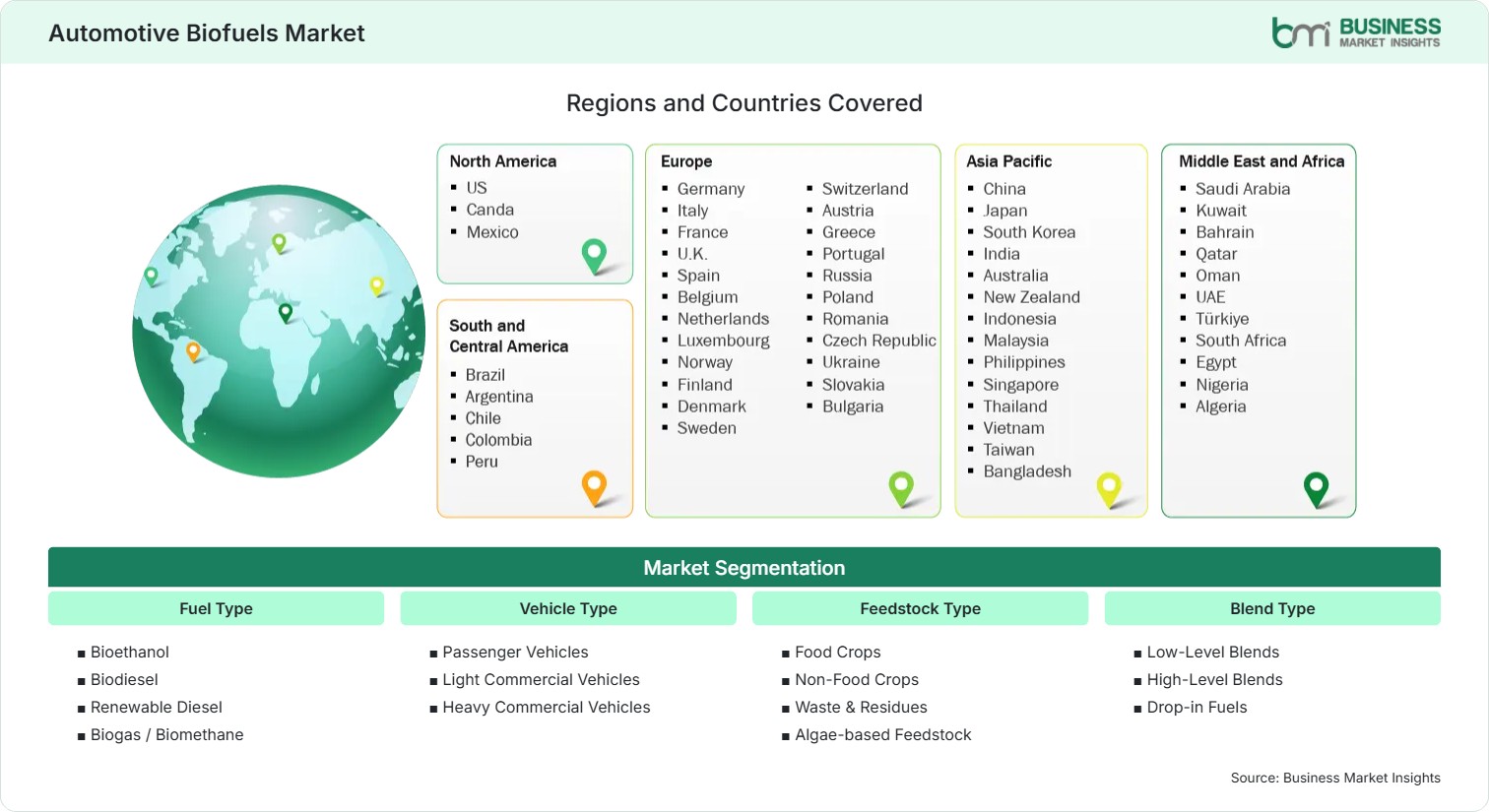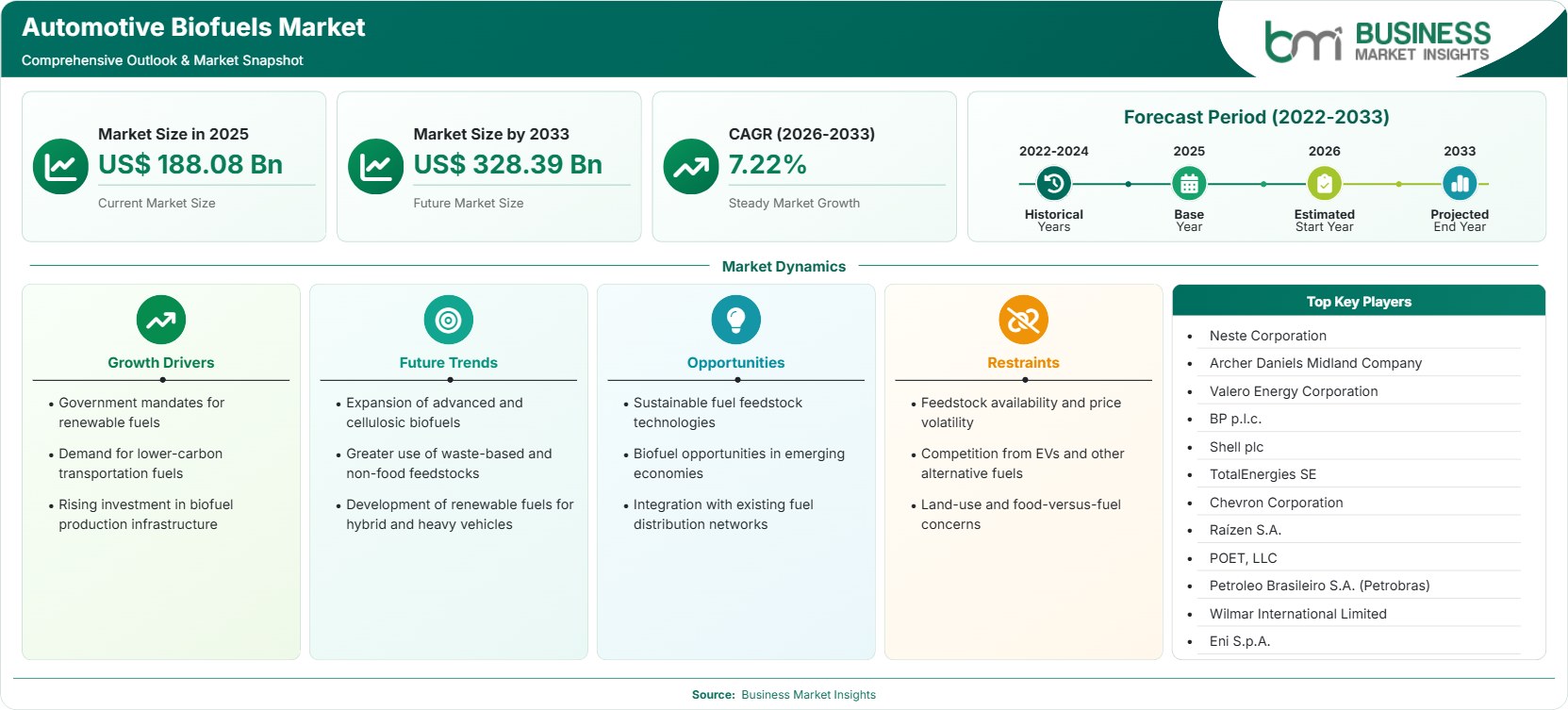
Automotive Biofuels Market Regional Highlights
North America Automotive Biofuels Market
North America accounts for 35%–38% of global revenue in 2025 and is projected to expand at a 6.8%–7.2% CAGR during 2026–2033. Strong renewable fuel policies, refinery conversion investments, and abundant agricultural feedstocks continue strengthening regional competitiveness. The U.S. and Canada remain major producers of bioethanol and renewable diesel, supported by low-carbon fuel programs and commercial fleet decarbonization initiatives. The Automotive Biofuels Market share remains the highest in this region because of mature infrastructure, integrated supply chains, and continuous investments in advanced biofuel technologies.
- Renewable diesel capacity is expanding through refinery conversions, enabling lower-carbon fuel production using existing infrastructure.
- Renewable fuel standards and low-carbon fuel programs are driving investment in advanced biofuels, waste-based feedstocks, and carbon reduction technologies.
- Corn, soybean oil, and waste cooking oils provide reliable feedstock availability, supporting production stability and industry partnerships.
- Heavy-duty transportation decarbonization programs are increasing demand for renewable diesel and biodiesel as drop-in alternatives to conventional diesel.
US Automotive Biofuels Market
The U.S. contributes approximately 72%–76% of North American revenue in 2025 and is expected to record a 6.9%–7.3% CAGR during 2026–2033. Federal government incentives, growing production of renewable diesel fuel, use of agricultural resources, and state-of-the-art refining processes are among those factors that still contribute to national leadership. Significant capital expenditure by energy companies and benefits of renewable fuel credits facilitate commercialization of new biofuel technology.
- California’s Low Carbon Fuel Standard is driving investment in renewable diesel, sustainable feedstocks, and carbon reduction technologies.
- Integrated agricultural production supports reliable ethanol manufacturing, domestic energy security, and rural economic development.
- Fleet operators are adopting renewable diesel for immediate emissions reductions without engine modifications or major transition costs.
- Public-private investments in algae-based, cellulosic, and waste-derived fuels are expanding advanced biofuel commercialization opportunities.
Europe Automotive Biofuels Market
Europe represents 25%–28% of worldwide revenue in 2025 and is forecast to grow at a 7.1%–7.6% CAGR during 2026–2033. Ambitious climate objectives, Renewable Energy Directive implementation, and expanding circular economy initiatives accelerate adoption of sustainable transportation fuels. Germany remains the leading national Automotive Biofuels Market, while Spain records the fastest regional expansion with a CAGR ranging between 7.8%–8.3%, supported by refinery modernization and renewable fuel investments.
- European Union renewable energy policies are increasing demand for waste-based and advanced biofuels while reducing reliance on conventional crop-based feedstocks.
- Germany maintains regional leadership through advanced refining capacity, industrial innovation, and integrated renewable fuel infrastructure.
- Spain is attracting investment in renewable diesel and advanced ethanol facilities, supported by decarbonization policies and rising demand for sustainable fuels.
- Growing use of used cooking oil, animal fats, and agricultural residues improves feedstock sustainability and supports compliance with stricter carbon reduction regulations.
Asia Pacific Automotive Biofuels Market
Asia Pacific holds 26%–29% of global revenue in 2025 and is anticipated to achieve the fastest regional CAGR of 8.1%–8.7% during 2026–2033. Expanding vehicle ownership, government ethanol blending mandates, biodiesel programs, and domestic feedstock production stimulate sustained market expansion. China leads regional revenue generation, while India demonstrates the strongest growth momentum with a CAGR between 8.6%–9.1% due to aggressive renewable fuel policies.
- India is expanding ethanol blending targets, increasing domestic production, reducing crude oil import dependence, and supporting rural agricultural incomes.
- China is investing in advanced biorefineries, renewable diesel facilities, and waste-to-fuel technologies to reduce industrial and transport emissions.
- Southeast Asian economies are leveraging palm oil, agricultural residues, and biomass to expand renewable fuel production and strengthen energy security.
- Partnerships among technology providers, refiners, and agricultural producers are accelerating the commercialization of second-generation biofuel technologies.
Rest of World Automotive Biofuels Market
Rest of World contributes 10%–13% of global revenue in 2025 and is projected to expand at a 7.3%–7.8% CAGR during 2026–2033. South and Central America have well-established ethanol industries and are developing their sugarcane production, while the Middle East and Africa have been focusing on diversifying their energy sources and on waste-based biofuels. Brazil is the leading country in terms of earnings, while the UAE boasts the highest growth rate.
- Brazil is strengthening its global position through large-scale sugarcane ethanol production, integrated processing facilities, and expanding renewable fuel exports.
- Argentina is increasing biodiesel production using soybean resources while expanding exports through supportive renewable energy and agricultural policies.
- Gulf countries are investing in renewable fuel research, waste-to-energy projects, and sustainable transportation initiatives to diversify beyond conventional petroleum.
- South Africa is promoting renewable fuel development through agricultural modernization, biomass utilization, and climate strategies targeting transport emissions.