
Automotive Ball Joint Market Outlook: Size, Share, Trends, Growth Analysis, Competitive Landscape & Forecast, 2026-2033

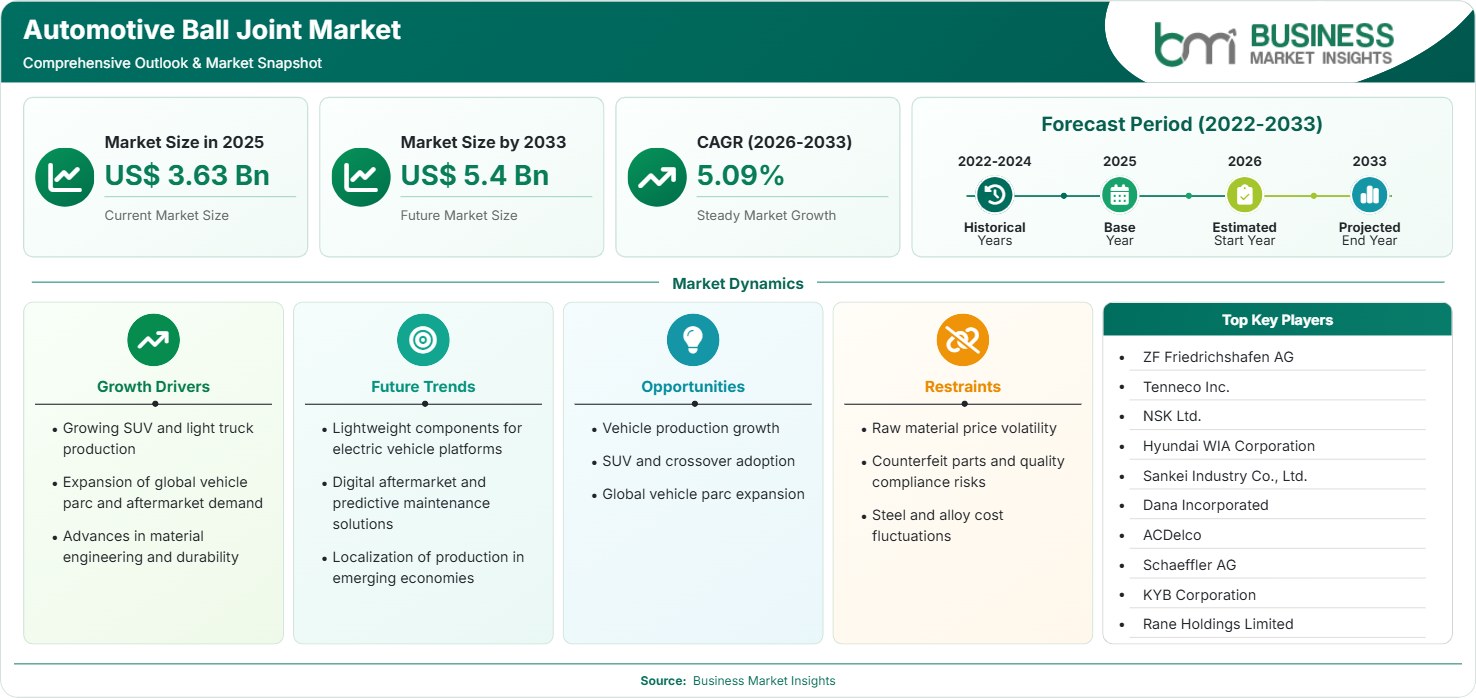
The Automotive Ball Joint Market size was valued at US$ 3.63 Billion in 2025 and is projected to reach US$ 5.4 Billion by 2033, growing at a CAGR of 5.09% during 2026–2033, supported by rising vehicle production, SUV adoption, suspension durability requirements, aftermarket replacement demand, lightweight materials adoption, and expanding commercial vehicle fleets worldwide.

Report Coverage
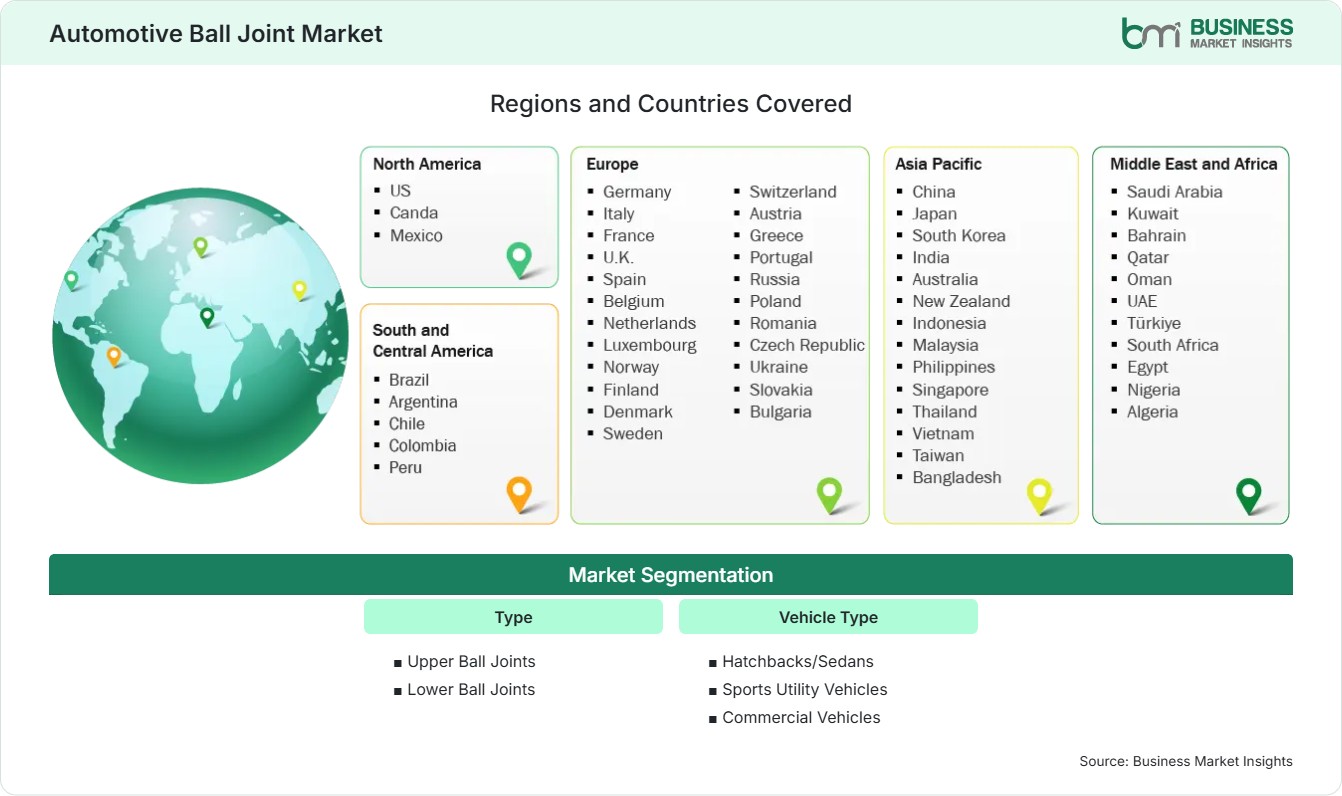
  • Type: Upper Ball Joints, Lower Ball Joints
  • Vehicle Type: Hatchbacks/Sedans, Sports Utility Vehicles, Commercial Vehicles
US$ 3.63 Bn Market size in 2025
US$ 5.4 Bn Market Size by 2033
5.09% CAGR, 2026 - 2033
2026-2033 Forecast Period

AI Overview

Automotive Ball Joint Market Summary

  • North America Region: Holds a market share of 34%–37% in 2025, growing at a CAGR of 4.5%–4.9% during 2026–2033. Demand is supported by large vehicle parc, premium pickup sales, expanding suspension replacement cycles, fleet modernization, advanced chassis technologies, aftermarket penetration, supplier localization, and durability enhancement investments. The US market benefits from high replacement rates and fleet demand, advancing at 4.6%–5.0% CAGR through 2033.
  • Fastest Growing Region: Asia Pacific holds a market share of 29%–32% in 2025 and expands at a CAGR of 6.1%–6.5% during 2026–2033. Growth stems from rising vehicle production, growing middle-class ownership, localization strategies, component manufacturing investments, expanding dealer networks, electrification programs, infrastructure development, commercial transport expansion, and export-oriented automotive manufacturing.
  • Leading Segment: OEM accounts for 58%–61% share in 2025 and records a CAGR of 4.8%–5.2% through 2033. Strong vehicle assembly volumes, platform standardization, quality compliance requirements, integrated supply agreements, engineering collaboration, durability validation, production scalability, and long-term manufacturer procurement strategies support demand.
  • High Growth Segment: Sports Utility Vehicles (SUVs) represent 34%–37% share in 2025 and register 6.0%–6.4% CAGR through 2033. Higher suspension loads, consumer preference shifts, premium vehicle penetration, off-road capability requirements, replacement frequency, global crossover sales strength, larger wheel configurations, and chassis upgrades accelerate adoption.
  • Key Market Opportunity: Lightweight aluminum suspension architectures, EV-compatible chassis systems, predictive maintenance solutions, digital aftermarket distribution, localized manufacturing, and premium replacement parts create attractive avenues for suppliers seeking margin expansion.
  • Major Market Players: ZF Friedrichshafen AG, Tenneco Inc., NSK Ltd., Hyundai WIA Corporation, Sankei Industry Co., Ltd., Dana Incorporated, ACDelco, Schaeffler AG, KYB Corporation, and Rane Holdings Limited.
Strategic Insights

Automotive Ball Joint Market: Strategic Insights

Automotive Ball Joint Market Strategic Framework
FREE PDF
Request your free sample
Request free sample
Stakeholder View

Key Takeaways

  • The market value chain remains highly interconnected, with forging specialists, machining providers, coating suppliers, OEMs, and aftermarket distributors collectively influencing pricing, quality, and delivery performance.
  • SUV platforms and commercial fleet applications offer the strongest upside because heavier loads require more durable suspension components and generate recurring replacement demand.
  • Product innovation increasingly focuses on lightweight aluminum designs, advanced sealing technologies, corrosion-resistant coatings, and extended service-life engineering.
  • Asia Pacific presents the most compelling greenfield investment opportunity due to expanding vehicle production and supplier localization policies.
  • Strategic acquisitions continue targeting chassis, steering, and suspension portfolios to broaden aftermarket distribution and strengthen regional manufacturing footprints.
  • Digital parts identification platforms are improving aftermarket efficiency, reducing inventory complexity, and increasing conversion rates across distributor networks.
Geographic Outlook

Automotive Ball Joint Market Regional Highlights

North America Automotive Ball Joint Market

North America accounts for 34%–37% Automotive Ball Joint Market share in 2025 and is projected to grow at 4.5%–4.9% CAGR through 2033. The region benefits from a large installed vehicle base and robust aftermarket replacement activity. Demand remains concentrated in the United States, where pickup trucks and SUVs dominate sales. Fleet operators increasingly prioritize durability and predictive maintenance programs. Advanced suspension technologies and strong relationships between OEMs and tier-one suppliers continue supporting long-term procurement volumes and product innovation.

  • Large pickup and SUV ownership increases suspension wear cycles and replacement requirements across independent repair channels.
  • Fleet modernization programs encourage adoption of premium-grade components with enhanced durability and lifecycle performance characteristics.
  • Digitized aftermarket distribution improves product availability and inventory management throughout regional supply networks.
  • Vehicle safety regulations reinforce demand for certified steering and suspension components with consistent quality standards.

US Automotive Ball Joint Market

The United States represents approximately 74%–77% Automotive Ball Joint Market share within North America and advances at 4.6%–5.0% CAGR during 2026–2033. Strong light truck sales, high vehicle age, and extensive road transport activity support replacement demand. Commercial fleet maintenance spending remains resilient, while consumers increasingly seek premium replacement components. Domestic manufacturing investments and supplier localization efforts strengthen supply-chain resilience, enabling greater responsiveness to OEM and aftermarket customer requirements across multiple vehicle categories.

  • Aging vehicle fleets support recurring replacement purchases through repair workshops and national retailer networks.
  • Heavy commercial transport usage creates demand for high-load suspension systems capable of extended operating cycles.
  • Growth in online parts procurement is enhancing customer accessibility and product comparison capabilities.
  • Strong tier-one supplier presence supports engineering partnerships and product development initiatives.

Europe Automotive Ball Joint Market

Europe holds 25%–28% share in 2025 and is expected to expand at 4.7%–5.1% CAGR through 2033. Germany remains the leading national market due to its automotive manufacturing base, while Poland and other Eastern European countries demonstrate faster expansion supported by supplier investments. Demand is influenced by premium vehicle production, stringent quality standards, and increasing adoption of lightweight chassis technologies. Replacement demand remains stable as regional vehicle fleets age and maintenance requirements increase.

  • Germany leads regional demand, supported by established automotive production ecosystems and engineering capabilities.
  • Eastern Europe records stronger expansion due to lower-cost manufacturing and localization strategies.
  • Lightweight suspension architectures increase interest in advanced steel and aluminum component solutions.
  • Independent workshop networks contribute substantially to recurring replacement demand.
  • Sustainability initiatives encourage development of durable products with extended service intervals.

Asia Pacific Automotive Ball Joint Market

Asia Pacific captures 29%–32% share in 2025 and delivers the strongest performance with 6.1%–6.5% CAGR through 2033. China is the leader in consumption and production within the region, whereas India experiences the highest rate of growth due to increased car ownership and manufacturing. The suppliers in the region have scale advantages and are active exporters. Automotive Ball Joint Market growth is reinforced by expanding passenger vehicle demand, infrastructure development, and increasing localization of component manufacturing across major automotive hubs.

  • China remains the largest producer and consumer due to extensive automotive manufacturing capacity.
  • India records the highest regional expansion supported by vehicle ownership growth and infrastructure investment.
  • Strong supplier ecosystems enable cost-efficient production and export competitiveness.
  • Electrification programs support redesign of suspension systems for emerging vehicle platforms.
  • Regional governments continue incentivizing automotive manufacturing and industrial development.

Rest of World Automotive Ball Joint Market

Rest of World represents 10%–13% share in 2025 and progresses at 5.3%–5.7% CAGR through 2033. South and Central America are led by Brazil, benefiting from vehicle assembly activity and aftermarket expansion. For the Middle East and Africa region, countries such as Saudi Arabia and South Africa bring about some significant demand from commercial transportation and maintenance of fleets. The increase in car ownership and the upgrading of infrastructure in the regions will create a favorable environment for the components' suppliers.

  • Brazil remains the primary regional automotive manufacturing and replacement market.
  • Saudi Arabia benefits from logistics activity and vehicle fleet modernization programs.
  • South Africa serves as an important automotive assembly and export hub.
  • Rising road infrastructure investments encourage vehicle utilization and maintenance activity.
  • Expanding distributor networks improve product availability across developing economies.
Global Market Geography
FREE PDF
Request your free sample
Request free sample
Segment Analysis

Automotive Ball Joint Market Segmentation

Type

Type-based demand reflects application-specific load requirements and steering performance needs. This segment accounts for 100% market coverage, with lower ball joints contributing a larger installed base. Overall segment demand expands in line with 5.09% CAGR expectations. The Automotive Ball Joint Market scope continues widening as modern suspension architectures require improved durability, stability, and lifecycle performance across passenger and commercial vehicles.

  • Upper Ball Joints: Widely used in suspension assemblies requiring controlled articulation and alignment support. Demand benefits from vehicle production growth and increasing emphasis on ride quality and steering responsiveness.
  • Lower Ball Joints: Experience greater operational loads and replacement frequency, making them essential across passenger cars, SUVs, and commercial vehicles requiring robust suspension performance.

Vehicle Type

Vehicle type remains a primary purchasing determinant. Hatchbacks and sedans retain substantial volume, while SUVs represent the strongest demand momentum. The segment reflects changing consumer preferences and accounts for significant replacement opportunities. SUVs hold 34%–37% share in 2025 and register 6.0%–6.4% CAGR, making them the leading high-growth category.

  • Hatchbacks/Sedans: Continue generating stable demand due to large global ownership bases and routine maintenance requirements across developed and emerging markets.
  • Sports Utility Vehicles (SUVs): Benefit from larger suspension systems, heavier loads, and rising global consumer preference for crossover and utility platforms.
  • Commercial Vehicles: Require heavy-duty designs engineered for increased durability, extended operating cycles, and higher weight-bearing performance.

Material

Material selection influences strength, weight, corrosion resistance, and manufacturing economics. Steel remains dominant owing to durability advantages, while aluminum adoption increases in premium and efficiency-focused vehicle platforms. Material-focused Automotive Ball Joint Market trends increasingly emphasize lightweighting without compromising safety or operational reliability under diverse driving conditions.

  • Steel: Preferred for high strength, fatigue resistance, manufacturing scalability, and suitability across mass-market vehicle categories.
  • Aluminum: Gains traction through lightweight properties supporting fuel efficiency, electrification objectives, and premium suspension architectures.

Sales Channel

The sales channel landscape is shaped by vehicle production volumes and replacement cycles. OEM remains the largest category with 58%–61% share in 2025 and 4.8%–5.2% CAGR, while aftermarket channels benefit from aging fleets and expanding digital distribution capabilities.

  • OEM: Driven by long-term supply agreements, quality certification requirements, platform integration, and ongoing vehicle production activity.
  • Aftermarket: Supported by replacement demand, expanding e-commerce penetration, distributor networks, and increasing consumer focus on preventive maintenance.
Market Forces

Automotive Ball Joint Market Dynamics

Key Market Drivers

Growing SUV and Light Truck Production

The global preference for SUVs and pickups continues to drive changes in the demand for suspension parts. It is evident that from the perspective of global vehicle manufacturing and sales trends, the share of utility vehicles grows in terms of newly registered cars. This means that the load on the steering and suspension systems is higher. Automotive Ball Joint Market growth is thus intrinsically linked to the production of SUVs. Manufacturers have been designing tougher casings, superior sealing, and enhanced load capacity in order to meet the requirements of durability. This trend is especially evident in the markets of North America, China, and India.

Expansion of Global Vehicle Parc and Aftermarket Demand

An increase in the number of vehicles on a global scale calls for routine maintenance needs through their life cycle. The ball joints are highly prone to wear because of their constant flexing, vibration, and transferring loads. The older the vehicle, the higher the need for replacement. Automotive Ball Joint Market trends indicate that replacement sales are becoming strategically important due to attractive margins and recurring customer demand. Suppliers increasingly invest in branded aftermarket portfolios, product traceability systems, and expanded distribution partnerships to improve market penetration and service responsiveness.

Advances in Material Engineering and Durability

Manufacturers continue improving metallurgy, sealing technologies, and surface treatments to extend component life. Corrosion-resistant coating and precise machining will help to prevent early wear and enhance reliability in severe climatic conditions. Lightweighting measures will also favor the application of more advanced materials that can ensure structural strength without increasing weight. These developments offer definite benefits to the manufacturers and fleets by reducing maintenance expenses. Durable standards are increasingly important selection criteria for luxury cars, electric cars, and commercial fleets for cost optimization over their life cycles.

Key Market Opportunities

Lightweight Components for Electric Vehicle Platforms

Electric cars will have to have optimized weight distribution and chassis architectures. Suppliers of ball joints who can supply solutions that are light but still durable will find an advantage in the changing platform needs. Suspension systems that use much aluminum offer possibilities for value-added items. Automotive Ball Joint Market Forecasts indicate increased collaboration between component manufacturers and OEMs developing next-generation electric platforms. Investments focused on precision forging, lightweight alloys, and integrated suspension technologies may generate long-term returns as electrification expands across passenger and commercial mobility ecosystems worldwide.

Digital Aftermarket and Predictive Maintenance Solutions

The aftermarket is experiencing a transition toward connected maintenance ecosystems. For fleet companies, the importance of diagnostics and predictive maintenance services in reducing downtime is growing. Component providers can add value by offering digital product identification solutions, monitoring warranties, and integrating condition monitoring. With the shift to a data-driven distribution channel, manufacturers can gain visibility into replacement patterns and customer needs. Such a paradigm shift will help in effective inventory management, targeted marketing, and regular revenue generation from the aftermarket.

Localization of Production in Emerging Economies

Automotive manufacturers increasingly seek resilient supply chains supported by regional sourcing strategies. Countries like India, Mexico, Vietnam, and Poland continue to attract investment in automotive component manufacturing. Regional manufacturing will help reduce logistics costs, shorten lead times, and better meet customer needs. Suppliers setting up their regional manufacturing units will be able to build strong connections with OEMs and enter the fast-growing local market. The advantage is not limited to mere efficiency but also includes product customization.

Market Restraints and Challenges

Raw Material Price Volatility

Factor: Steel, alloy, and specialty material prices remain vulnerable to geopolitical disruptions, trade policies, and energy cost fluctuations. Impact: Manufacturing costs become unpredictable, causing margin pressure along the value chain. Companies under long-term contractual arrangements may find it hard to pass their higher costs on to their clients fast enough. Small manufacturers are especially vulnerable due to the lack of purchasing power. Price volatility will lead to a delay in decision-making and will adversely affect the bottom line. Proper hedging, diversification, and efficient operations programs are still key to addressing such vulnerability.

Counterfeit Parts and Quality Compliance Risks

Factor: Unregulated aftermarket channels in several developing regions enable circulation of substandard and counterfeit suspension components. Impact: Poor-quality goods could result in unsafe conditions in vehicles and affect the company's reputation and customer confidence. For legitimate companies, there would be higher costs related to compliance with traceability, testing, and certification requirements. Additionally, counterfeit products generate price pressures for the legal manufacturers, especially in markets where cost is a significant factor. Solving this problem would require more effective regulatory measures and proper training of distributors.

Company Analysis

Competitive Landscape

The competitive environment is characterized by engineering expertise, global distribution reach, and product durability. Current Automotive Ball Joint Market analysis indicates strong competition between established OEM suppliers and aftermarket specialists.

Company Name

Overview

Products and Services relevant to this market

ZF Friedrichshafen AG

Global driveline and chassis technology leader with extensive aftermarket presence.

Suspension components, steering systems, chassis modules, ball joints, aftermarket solutions.

Tenneco Inc.

Major mobility supplier serving OEM and replacement channels worldwide.

MOOG steering products, suspension systems, ball joints, repair solutions.

NSK Ltd.

Established precision motion and automotive technology manufacturer.

Steering components, chassis systems, joints, bearings, motion-control solutions.

Hyundai WIA Corporation

Automotive manufacturing and component specialist serving global OEMs.

Chassis modules, suspension components, precision-machined automotive parts.

Sankei Industry Co., Ltd.

Japanese specialist focused on steering and suspension products.

Ball joints, tie rod ends, linkage components, aftermarket parts.

Dana Incorporated

Global supplier of drivetrain and mobility technologies.

Suspension-related components, vehicle systems, engineering and manufacturing services.

ACDelco

Large aftermarket brand supporting passenger and commercial vehicles.

Replacement ball joints, steering parts, maintenance and repair components.

Schaeffler AG

Engineering-driven automotive systems supplier.

Chassis technologies, bearings, precision components, mobility solutions.

KYB Corporation

Leading suspension and ride-control manufacturer.

Shock absorbers, suspension assemblies, steering-related components.

Rane Holdings Limited

Indian automotive component group with OEM relationships.

Steering systems, suspension products, chassis-related automotive components.

Trust & Transparency

Research Methodology

The market analysis combines proprietary research with secondary data from government agencies, company disclosures, regulatory filings, industry databases and expert interviews. Market estimates are validated through data triangulation, cross-market benchmarking and analyst review.

View Full Research Methodology

Questions Answered

Frequently Asked Questions

Why is the aftermarket strategically important?

Aging vehicle fleets create continuous replacement demand, making aftermarket channels valuable sources of recurring revenue and customer engagement.

What information does an Automotive Ball Joint Market Report provide?

It evaluates market size, competitive positioning, regional dynamics, segment performance, industry trends, growth drivers, opportunities, and long-term forecast outlooks for stakeholders.

How is electrification affecting supplier strategies?

Manufacturers are investing in lightweight materials, advanced chassis engineering, and improved durability solutions tailored to electric vehicle architecture requirements.

Which vehicle category creates the strongest future demand?

SUVs present the strongest growth potential because larger vehicles exert higher suspension loads and generate recurring replacement requirements throughout their operating lifecycle.

What makes ball joints critical in modern vehicles?

Ball joints connect suspension and steering assemblies, enabling controlled wheel movement while maintaining alignment, ride quality, and steering precision across varying load conditions.

Access the Full Automotive Ball Joint Market Report

Get segment-level forecasts, regional estimates, competitive benchmarking, company profiles and downloadable Excel datasets.

Access the full Automotive Ball Joint Market Report
350 pages PDF & Excel | 2026-09-02
Similar Research

Related Market Reports