
Automotive Acoustic Engineering Services Market Outlook: Size, Share, Trends, Growth Analysis, Competitive Landscape & Forecast, 2026-2033

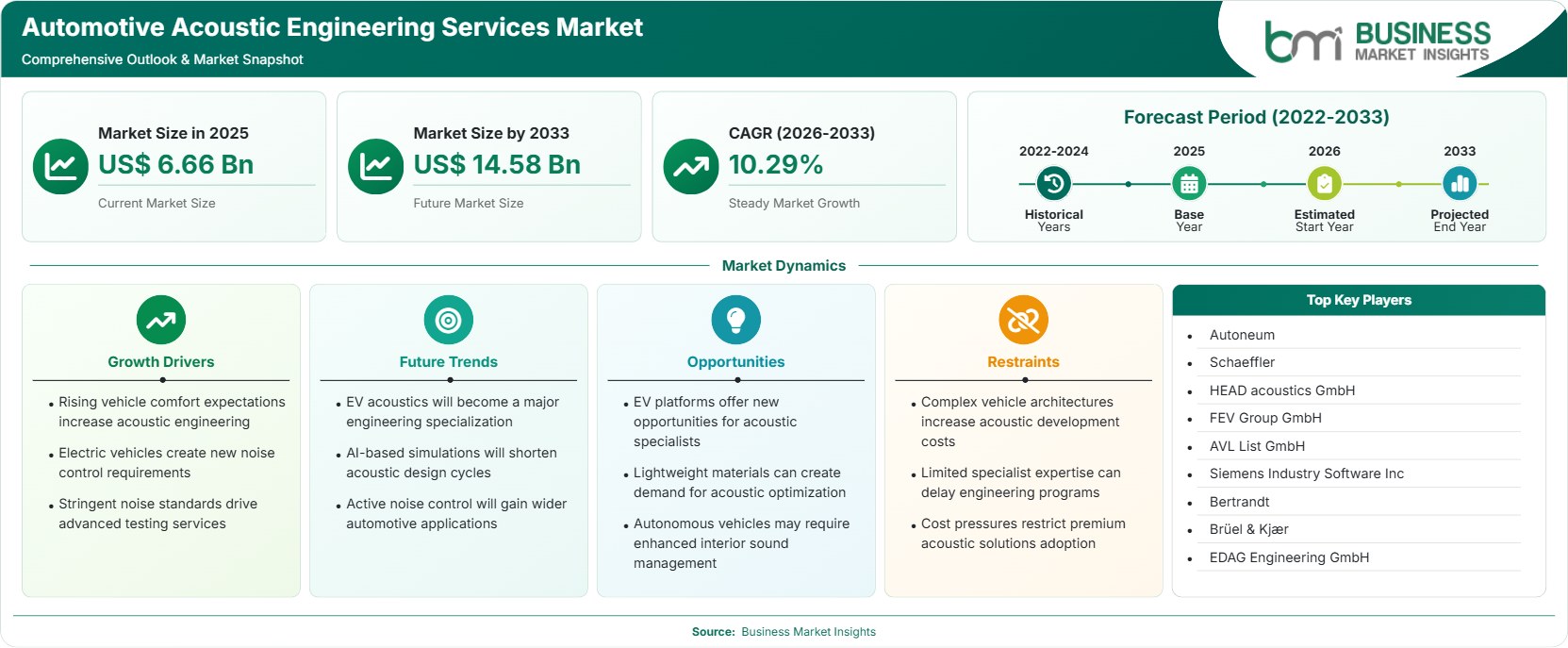
The Automotive Acoustic Engineering Services Market size was valued at US$ 6.66 billion in 2025 and is projected to reach US$ 14.58 billion by 2033, growing at a CAGR of 10.29% during 2026–2033, driven by vehicle comfort expectations, EV noise-control requirements, stringent standards, virtual testing, lightweighting, and advanced interior sound management.

Report Coverage
  • System Type: Physical Testing, Virtual Testing
  • Application Type: Interior, Drivetrain, Powertrain, Body
  • Vehicle Type: Passenger Cars, Commercial Vehicles
US$ 6.66 Bn Market size in 2025
US$ 14.58 Bn Market Size by 2033
10.29% CAGR, 2026 - 2033
2026-2033 Forecast Period

01 AI Overview

Automotive Acoustic Engineering Services Market Summary

  • North America Region: North America holds a 25%–28% share in 2025, with 9.6%–10.0% CAGR during 2026–2033, supported by EV development, acoustic compliance, virtual engineering, premium vehicles, and advanced testing. The U.S. represents 90%–93% of regional demand, growing at 9.7%–10.1% CAGR through 2033.
  • Fastest Growing Region: Asia Pacific holds a 27%–30% share in 2025, with 11.2%–11.7% CAGR through 2033, driven by EV adoption, vehicle production, engineering localization, digital simulation, acoustic testing, and rising cabin-comfort requirements.
  • Leading Segment: Physical Testing holds a 55%–59% share in 2025, with 9.4%–9.9% CAGR through 2033, supported by vehicle validation, regulatory requirements, prototype assessment, acoustic measurement, and sound-quality evaluation.
  • High Growth Segment: Virtual Testing holds a 41%–45% share in 2025, with 11.8%–12.3% CAGR through 2033, supported by simulation-led development, faster validation, reduced prototype dependence, EV acoustic modeling, and digital engineering.
  • Key Market Opportunity: EV platforms, lightweight materials, autonomous interiors, virtual simulation, and integrated sound management create opportunities for specialized acoustic engineering providers across vehicle development programs.
  • Major Market Players: Autoneum; Schaeffler; HEAD acoustics GmbH; FEV Group GmbH; AVL List GmbH; Siemens Industry Software Inc.; Bertrandt; Brüel & Kjær; EDAG Engineering GmbH; Continental AG.
02 Strategic Insights

Automotive Acoustic Engineering Services Market: Strategic Insights

Automotive Acoustic Engineering Services Market Strategic Framework
FREE PDF
Request your free sample
Request free sample
03 Stakeholder View

Key Takeaways

  • Acoustic development is moving toward earlier design integration, increasing demand for simulation and predictive engineering before physical validation.
  • EV platforms offer strong upside because quieter propulsion changes the balance of vehicle noise sources and increases acoustic-development requirements.
  • Virtual Testing is becoming strategically important because simulation can identify acoustic issues before extensive prototype testing.
  • Asia Pacific provides a strong opportunity through EV development, vehicle engineering expansion, and increasing localization of technical capabilities.
  • Competitive differentiation increasingly depends on combining testing, simulation, acoustic materials expertise, vehicle integration, and specialist engineering.
04 Geographic Outlook

Automotive Acoustic Engineering Services Market Regional Highlights

North America Automotive Acoustic Engineering Services Market

North America holds a 25%–28% share in 2025 and is projected to grow at a 9.6%–10.0% CAGR through 2033. The region benefits from EV development, premium vehicles, advanced testing, simulation, and acoustic compliance. Established engineering capabilities support demand across interior, drivetrain, powertrain, and body applications. The Automotive Acoustic Engineering Services Market share reflects strong demand for vehicle-level acoustic optimization and specialized engineering services. U.S. programs remain the primary regional demand source.

  • EV development is increasing demand for specialized acoustic analysis as reduced propulsion masking exposes additional noise sources.
  • Virtual simulation supports earlier acoustic assessment and complements physical validation throughout vehicle development.
  • Premium vehicle programs emphasize cabin comfort, sound quality, and refined acoustic characteristics.
  • Commercial vehicles create additional requirements for powertrain, drivetrain, body, and interior acoustic optimization.

US Automotive Acoustic Engineering Services Market

The U.S. represents 90%–93% of North American demand in 2025 and is projected to grow at a 9.7%–10.1% CAGR through 2033. Demand is supported by EV programs, premium vehicle development, advanced simulation, acoustic testing, and vehicle refinement. Manufacturers increasingly require specialized capabilities for EV sound management and cabin optimization. The U.S. provides a broad service opportunity across testing, modeling, sound-quality assessment, validation, and engineering consultancy.

  • EV platforms require new approaches to identify motor, inverter, tire, aerodynamic, and structural acoustic sources.
  • Virtual development can evaluate acoustic behavior before full physical prototypes are available.
  • Specialized providers can support OEMs through testing, simulation, validation, and vehicle-level acoustic engineering.

Europe Automotive Acoustic Engineering Services Market

Europe holds a 32%–35% share in 2025 and is projected to grow at a 9.8%–10.3% CAGR through 2033. Germany, France, Italy, and the United Kingdom represent leading markets, while Central European automotive locations provide high-growth opportunities. Demand is supported by premium vehicles, EV development, engineering specialization, acoustic testing, and simulation. Germany provides a strong engineering base, while France and Italy offer opportunities across passenger vehicles, powertrain, body, and interior applications.

  • Germany remains an important center for vehicle testing, simulation, NVH development, and acoustic engineering.
  • France provides opportunities through passenger vehicles, EV programs, interior comfort, and acoustic optimization.
  • Italy supports vehicle development, powertrain engineering, lightweighting, and acoustic refinement.
  • Central European locations offer opportunities as automotive engineering and production capabilities expand.

Asia Pacific Automotive Acoustic Engineering Services Market

Asia Pacific holds a 27%–30% share in 2025 and is projected to achieve an 11.2%–11.7% CAGR through 2033. China, Japan, South Korea, and India are leading markets, with China and India offering strong growth opportunities. EV adoption, expanding vehicle programs, engineering localization, digital simulation, and cabin-comfort requirements support demand. The regional Automotive Acoustic Engineering Services Market growth outlook is strengthened by increasing demand for local testing and engineering capabilities.

  • China offers substantial opportunities through EV development, acoustic testing, simulation, and localized vehicle engineering.
  • Japan supports advanced acoustic requirements across passenger vehicles, powertrains, interiors, and sound-quality development.
  • India provides high-growth potential as automotive engineering and EV programs continue expanding.
  • South Korea offers opportunities through advanced vehicle platforms, EV engineering, testing, and interior sound optimization.

Rest of World Automotive Acoustic Engineering Services Market

South and Central America provide emerging opportunities through passenger vehicles, commercial vehicles, manufacturing, and localized engineering. Brazil offers a notable opportunity, while Mexico provides an established vehicle-development base. Middle Eastern markets offer specialized opportunities in premium vehicles, commercial fleets, and advanced mobility. Demand remains dependent on vehicle production, EV penetration, engineering localization, testing infrastructure, and OEM development requirements. These factors support a smaller but developing regional service market.

The combined Rest of World region holds a 10%–13% share in 2025 and is projected to grow at an 8.5%–9.1% CAGR through 2033. International engineering partnerships, localized testing, and specialized acoustic services can support market expansion.

  • Brazil offers opportunities across passenger vehicles, commercial vehicles, engineering services, and acoustic optimization.
  • Mexico provides opportunities through vehicle manufacturing, engineering support, component integration, and testing.
  • Middle Eastern premium vehicle markets can support specialized interior sound-quality and comfort engineering.
  • Regional adoption depends on engineering localization, EV penetration, testing infrastructure, and OEM requirements.
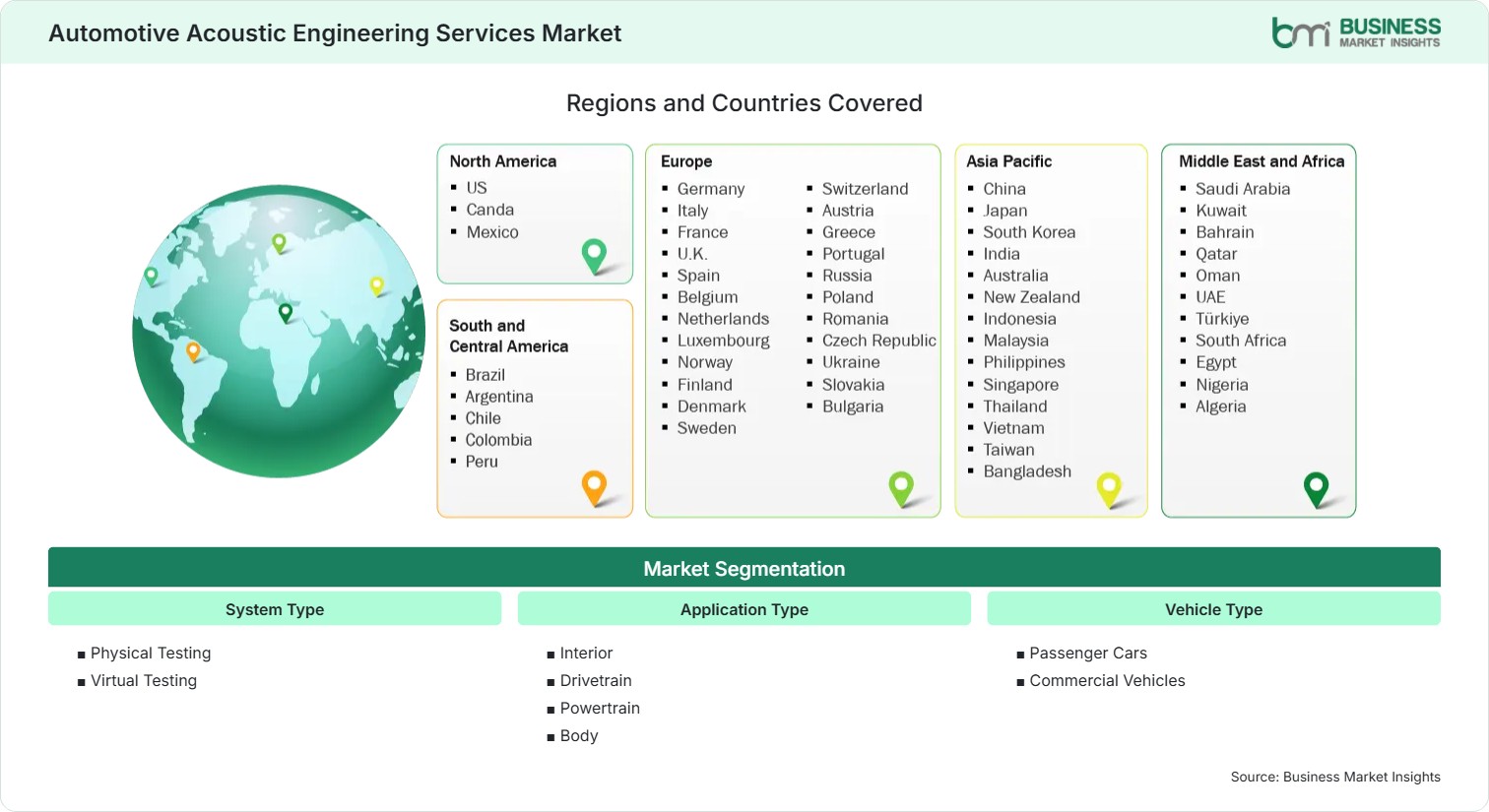
Global Market Geography
FREE PDF
Request your free sample
Request free sample
05 Segment Analysis

Automotive Acoustic Engineering Services Market Segmentation

System Type

Physical Testing leads the System Type segment with a 55%–59% share in 2025 and a 9.4%–9.9% CAGR through 2034. Physical validation remains essential for measuring actual vehicle behavior, while Virtual Testing is gaining importance as simulation improves development speed, supports EV acoustic modeling, and reduces prototype dependence.

  • Physical Testing: Physical Testing validates vehicle acoustic performance through measurement, prototype evaluation, source identification, component assessment, and final vehicle-level acoustic verification.
  • Virtual Testing: Virtual Testing supports acoustic prediction, design comparison, EV noise modeling, digital development, and faster engineering iterations with fewer physical prototypes.

Application Type

Interior leads the Application Type segment with a 34%–38% share in 2025 and a 10.2%–10.7% CAGR through 2034. Cabin comfort remains central to vehicle differentiation, while drivetrain, powertrain, and body applications require integrated NVH analysis. The Automotive Acoustic Engineering Services Market trends increasingly favor cross-system optimization as electrification and lightweight architectures change vehicle acoustic behavior.

  • Interior: Interior applications address cabin sound quality, occupant comfort, speech clarity, unwanted noise reduction, and acoustic tuning.
  • Drivetrain: Drivetrain applications address vibration and noise from transmissions, shafts, gears, bearings, and related systems.
  • Powertrain: Powertrain acoustic engineering addresses engine, motor, inverter, auxiliary, and associated noise sources across vehicle architectures.
  • Body: Body applications address structural noise, panel vibration, airflow effects, sealing, damping, and material integration.

Vehicle Type

Passenger Cars lead the Vehicle Type segment with a 76%–80% share in 2025 and a 10.4%–10.8% CAGR through 2034. Passenger vehicles emphasize cabin comfort, sound quality, EV refinement, and acoustic differentiation. Commercial Vehicles provide additional demand through powertrain, drivetrain, cabin, body, durability, and fleet-oriented noise-management requirements.

  • Passenger Cars: Passenger cars generate strong demand because cabin comfort, sound quality, EV refinement, and acoustic differentiation influence vehicle development.
  • Commercial Vehicles: Commercial vehicles require acoustic optimization for driver comfort, powertrain noise, drivetrain vibration, body structure, durability, and long-duration operation.
06 Market Forces

Automotive Acoustic Engineering Services Market Dynamics

Key Market Drivers

Rising vehicle comfort expectations increase acoustic engineering

Rising vehicle comfort expectations are increasing demand for cabin refinement, sound-quality assessment, vibration control, and vehicle-level acoustic optimization. Premiumization and quieter vehicle architectures make unwanted noise more noticeable, strengthening demand for specialized testing and engineering. The Automotive Acoustic Engineering Services Market growth is supported by increasing integration of acoustic considerations during vehicle development. Market trends are moving towards early acoustic validation, combining simulations with physical testing to identify noise sources at an early stage of the car development process. Engineering service providers having multidisciplinary abilities can help in the development process of OEMs.

Electric vehicles create new noise control requirements

Electric vehicles introduce different acoustic challenges because reduced conventional powertrain noise exposes motor, inverter, tire, aerodynamic, and structural sounds. This will increase the need for specific source identification, sound quality analysis, simulation, and validation. The EV platforms also present the challenge of managing deliberate sound generation along with unwanted noise. This would give the service providers an opportunity to evolve from performing NVH testing to acoustic development of EVs. This is especially true for those companies which combine physical, virtual, material, and vehicle-level testing.

Stringent noise standards drive advanced testing services

Increasing acoustic requirements create demand for accurate measurement, validation, documentation, and compliance-oriented engineering. Testing facilities can help automotive companies to pinpoint the source of noise, evaluate the effectiveness of measures that can be put in place, and assess the performance of a particular vehicle. Physical testing is critical because the actual acoustic performance will depend on the interaction between different elements of the system. Organizations with specific equipment and skilled engineers can provide this service for car manufacturers.

Key Market Opportunities

EV platforms offer new opportunities for acoustic specialists

The development of EVs brings new demands for analyzing drive-train noise, assessing cabin sound quality, assessing tire noise, and separating acoustic sources. Experts can help automakers at the conception, simulation, prototype, and even validation phases. Those that have unique approaches to working with EVs can differentiate themselves by offering both integrated testing and virtual development solutions.

Lightweight materials can create demand for acoustic optimization

Lightweighting can significantly alter vibration transmission, damping behavior, structural stiffness, and sound insulation performance, making acoustic optimization increasingly important for modern vehicle development. As manufacturers continue to reduce vehicle mass to improve fuel efficiency, extend electric vehicle range, and meet stringent sustainability requirements, acoustic engineers must carefully optimize material combinations without compromising passenger comfort or overall sound quality. This trend is creating new opportunities for advanced simulation, material characterization, component-level testing, and vehicle-level acoustic validation. These developments are expected to support the growth outlined in the Automotive Acoustic Engineering Services Market forecast, as manufacturers increasingly rely on specialized engineering expertise to address complex NVH challenges. Service providers can help auto manufacturers in this regard by assessing alternative lighter materials, identifying the potential acoustic trade-offs involved, conducting performance evaluations, and developing an engineering solution that balances weight, structural performance, cost-effectiveness, durability, and acoustics. As vehicle designs continue to change and new materials are developed, there will be greater need for acoustic engineering services in the automotive industry.

Autonomous vehicles may require enhanced interior sound management

Autonomous and increasingly automated vehicles may change how occupants use cabin space, increasing emphasis on communication, entertainment, privacy, and overall sound quality. Acoustic specialists can develop interior environments that manage external noise while supporting clearer speech and controlled cabin sound. Opportunities may include spatial acoustic modeling, interior sound optimization, active noise control, and occupant-focused sound-quality engineering. These applications could broaden service requirements beyond traditional vehicle NVH development.

Market Restraints and Challenges

Complex vehicle architectures increase acoustic development costs

Factor: electrified powertrains, lightweight structures, advanced electronics, and integrated vehicle systems create more interacting acoustic sources. Impact: The engineers have to undertake further simulation, testing, measurement, and validation to identify problems and develop solutions for solving them. These demands will incur extra expenses and burden on the engineering tasks. In some cases, acoustic problems may arise not from the specific sources but from interactions between parts. This means that service providers have to bring in interdisciplinary teams.

Limited specialist expertise can delay engineering programs

Factor: acoustic engineering requires specialized knowledge spanning NVH, simulation, instrumentation, sound quality, materials, and vehicle integration. Impact: The scarcity of experienced specialists may lead to extended development timelines and increased reliance on third-party engineering companies. Additionally, training multidisciplinary engineers takes time and effort. Due to the increasing complexity of vehicle architectures, knowledge should include not only traditional architecture but also hybrid and electric architectures. It is clear that third-party companies with a dedicated team of specialists will have an edge over other parties.

07 Company Analysis

Competitive Landscape

The Automotive Acoustic Engineering Services Market analysis indicates a competitive environment combining acoustic specialists, automotive engineering companies, component manufacturers, simulation providers, and testing-technology companies. Competitive differentiation centers on testing depth, simulation capability, vehicle integration, acoustic materials expertise, software tools, specialist expertise, and end-to-end engineering support.

Company Name

Overview

Products and Services relevant to this market

Autoneum

Automotive supplier specializing in acoustic and thermal management solutions.

Acoustic materials, sound insulation, lightweight solutions, NVH optimization, testing, and engineering support.

Schaeffler

Automotive technology company with drivetrain, powertrain, vibration, and NVH engineering capabilities.

Acoustic engineering, NVH analysis, drivetrain optimization, powertrain acoustics, testing, and simulation.

HEAD acoustics GmbH

Specialist provider focused on acoustic measurement, sound quality, and NVH engineering.

Acoustic testing, sound-quality analysis, NVH measurement, simulation, psychoacoustic assessment, and engineering.

FEV Group GmbH

Engineering company providing vehicle development, powertrain, simulation, testing, and acoustic capabilities.

NVH testing, acoustic simulation, powertrain acoustics, vehicle testing, and engineering consultancy.

AVL List GmbH

Engineering company providing simulation, testing, vehicle development, and acoustic services.

NVH engineering, acoustic testing, simulation, powertrain development, validation, and consultancy.

Siemens Industry Software Inc.

Software provider supporting digital simulation, testing, and virtual vehicle development.

Acoustic simulation, NVH analysis, virtual testing, digital engineering, and model-based development.

Bertrandt

Automotive engineering service provider supporting vehicle development and validation.

Acoustic testing, NVH development, simulation, sound-quality engineering, and engineering consultancy.

Brüel & Kjær

Measurement technology provider specializing in noise and vibration applications.

NVH instrumentation, acoustic measurement, vibration testing, sound-quality analysis, and testing systems.

EDAG Engineering GmbH

Vehicle engineering company supporting multidisciplinary development and acoustic optimization.

Vehicle acoustics, NVH simulation, testing, body optimization, interior acoustics, and validation.

Continental AG

Automotive technology company supporting integrated vehicle systems and acoustic applications.

Acoustic systems, NVH engineering, vehicle sound management, component optimization, testing, and integration.

10 Trust & Transparency

Research Methodology

The market analysis combines proprietary research with secondary data from government agencies, company disclosures, regulatory filings, industry databases and expert interviews. Market estimates are validated through data triangulation, cross-market benchmarking and analyst review.

View Full Research Methodology

11 Questions Answered

Frequently Asked Questions

What does the Automotive Acoustic Engineering Services Market Report cover?

The report covers system type, application type, vehicle type, regional dynamics, competitive positioning, drivers, opportunities, restraints, and Forecasts.

Why is Virtual Testing gaining importance?

Virtual Testing enables earlier acoustic assessment, design comparison, source prediction, and reduced prototype dependence during vehicle development.

Which application has the strongest position?

Interior applications lead because cabin comfort, sound quality, speech clarity, and refined acoustic experiences remain important vehicle-development priorities.

Why are EVs important for acoustic engineering?

EVs reduce conventional powertrain masking, making motor, inverter, tire, aerodynamic, and structural sounds more prominent and increasing the need for specialized acoustic development.

Which system type leads the market?

Physical Testing leads the System Type segment because physical validation remains necessary for confirming vehicle-level acoustic behavior and validating engineering solutions.

Access the Full Automotive Acoustic Engineering Services Market Report

Get segment-level forecasts, regional estimates, competitive benchmarking, company profiles and downloadable Excel datasets.

Access the full Automotive Acoustic Engineering Services Market Report
350 pages PDF & Excel | 2026-08-19