Market Summary
Executive Summary and Global Market Analysis
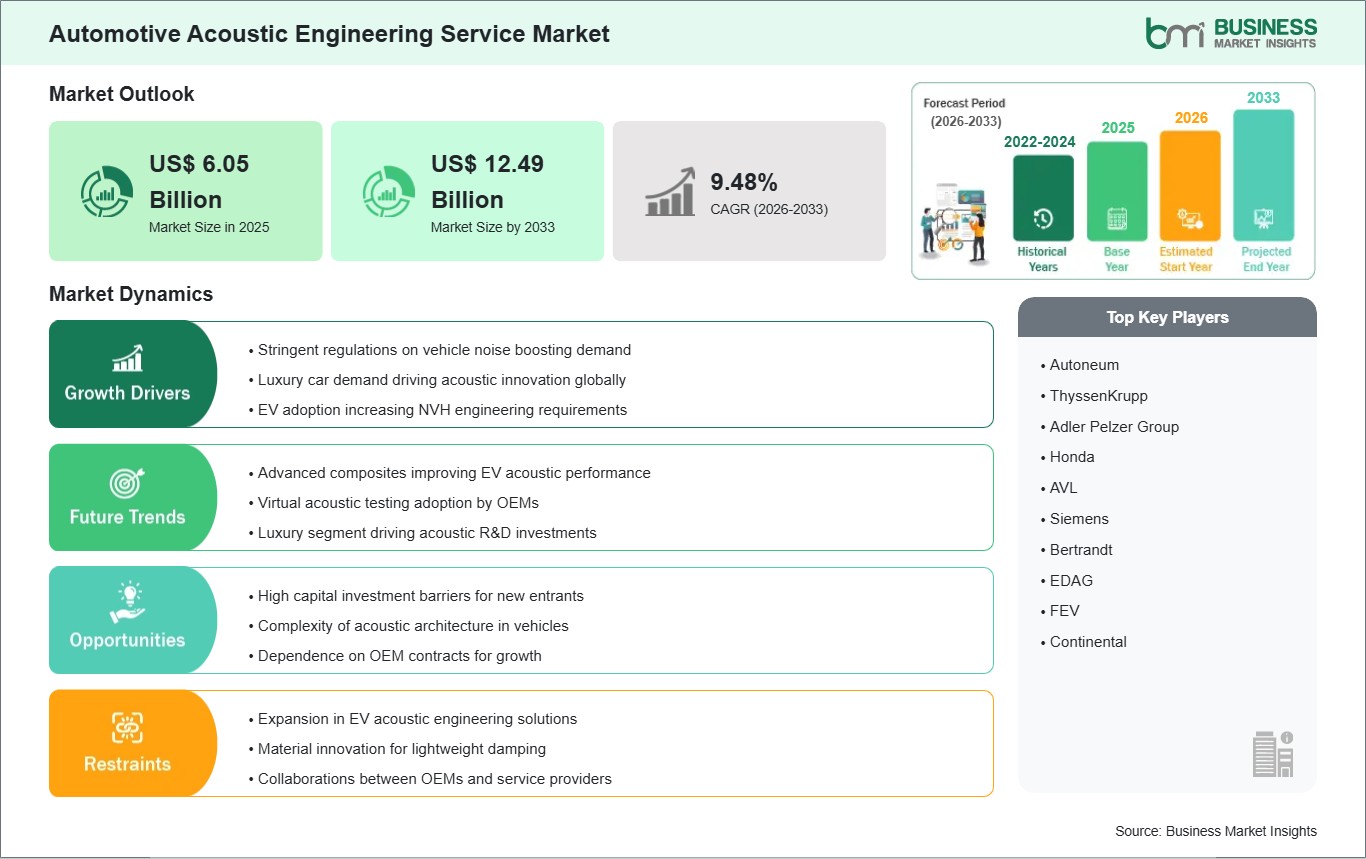
Automotive Acoustic Engineering Service refers to specialized engineering services focused on analyzing, designing, and optimizing noise, vibration, and harshness (NVH) performance in vehicles through simulation, development, and testing across systems such as interiors, powertrain, drivetrain, and body structures. These services help improve cabin comfort, reduce unwanted sound, and enhance overall vehicle quality. The market is growing due to rising demand for quieter mobility experiences, increasing adoption of electric vehicles, and the integration of advanced digital engineering tools in automotive development processes.
There are some challenges that could slow market growth. High complexity in NVH integration across multi-platform vehicle architectures increases development time and requires advanced expertise and tools. The shift toward electric vehicles also introduces new acoustic challenges, as the absence of engine noise makes tire, wind, and structural sounds more noticeable. Additionally, high costs of simulation software and testing infrastructure limit adoption among smaller engineering service providers. These factors can impact project scalability and increase overall development effort in automotive programs.
Even with these challenges, the market is expected to grow steadily as manufacturers move toward virtual engineering and predictive acoustic validation. Opportunities are emerging through advanced simulation platforms, digital twin integration, and AI-based sound modeling tools. Electric and autonomous vehicles are creating strong demand for refined cabin acoustics and optimized NVH performance. Automotive OEMs and suppliers are increasingly collaborating with specialized engineering service providers to achieve higher efficiency and faster development cycles. This is shaping a strong future outlook for the Automotive Acoustic Engineering Service market.
Segment Analysis
Automotive Acoustic Engineering Service Market Segmentation
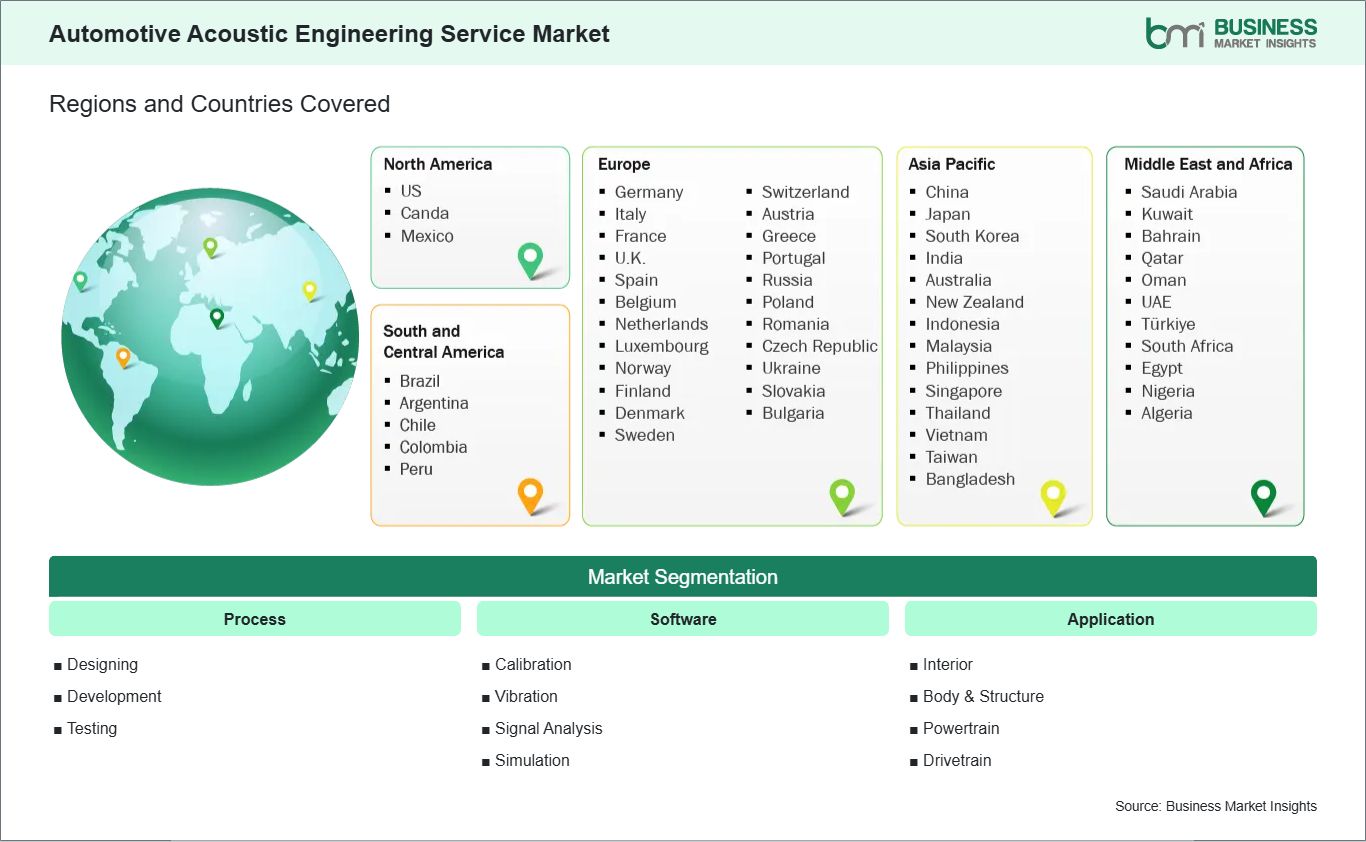
The Automotive Acoustic Engineering Service market is segmented based on process, software, and application, reflecting different stages of vehicle acoustic development and optimization.
By Process
- Designing: Focuses on early-stage NVH planning and acoustic architecture development for improved vehicle comfort
- Development: Involves iterative engineering and refinement of acoustic performance across vehicle systems
- Testing: Includes physical and virtual validation of noise and vibration levels to ensure compliance and performance standards
By Software
- Calibration: Used to fine-tune acoustic responses and optimize system-level NVH performance
- Vibration: Focuses on identifying and reducing structural vibrations across vehicle components
- Signal Analysis: Enables detailed interpretation of sound data for performance improvement
- Simulation: Provides virtual modeling of acoustic behavior to reduce dependency on physical prototypes
By Application
- Interior: Focuses on cabin noise reduction and passenger comfort enhancement
- Body & Structure: Targets vibration and structural noise control in vehicle frameworks
- Powertrain: Optimizes acoustic output from engines or electric drivetrains
- Drivetrain: Reduces mechanical noise transmission and improves smooth operation
Market Forces
Automotive Acoustic Engineering Service Market Drivers and Opportunities
Rising Demand for NVH Optimization in Modern Vehicles
The demand for Automotive Acoustic Engineering Service is increasing due to the growing importance of NVH optimization in passenger and commercial vehicles. Consumers are placing higher value on cabin comfort, leading manufacturers to invest in advanced acoustic engineering across vehicle development stages. Regulatory frameworks related to vehicle noise emissions are also encouraging OEMs to adopt stricter NVH standards.
In electric vehicles, this demand is even more critical because the absence of internal combustion engine noise makes external and structural sounds more noticeable. Automotive companies are integrating acoustic engineering early in the design phase to reduce costly redesigns and improve product quality. The increasing complexity of vehicle architectures is further driving reliance on simulation-based acoustic analysis and testing services.
Expansion of Simulation-Driven and Digital Engineering Solutions
The Automotive Acoustic Engineering Service market is experiencing strong growth due to the expansion of simulation-driven engineering and digital validation tools. Automotive developers are increasingly using virtual testing environments to evaluate acoustic performance before physical prototyping, which reduces time and development costs. Digital twin technologies and advanced NVH simulation platforms are improving prediction accuracy and enabling better optimization of vehicle acoustics.
The integration of AI-based modeling and cloud computing is further enhancing engineering efficiency. As vehicles become more software-defined and electrified, the demand for precise acoustic modeling and predictive analysis is increasing. This is creating new opportunities for service providers specializing in digital acoustic engineering solutions.
Size and Share Analysis
Automotive Acoustic Engineering Service Market Size and Share Analysis
The Automotive Acoustic Engineering Service market is projected to grow from US$ 6.05 billion in 2025 to US$ 12.49 billion by 2033, registering a CAGR of 9.48% from 2026 to 2033.
By process, development accounts for a significant share due to its critical role in integrating NVH optimization across vehicle platforms during the engineering lifecycle. Testing is also a major contributor as manufacturers increasingly rely on both physical and virtual validation to ensure compliance and performance standards, while designing continues to grow with rising emphasis on early-stage acoustic optimization in vehicle architecture planning.
By application, interior dominates the market owing to strong demand for enhanced cabin comfort and premium driving experience across passenger and electric vehicles. Powertrain continues to expand with increasing focus on optimizing noise characteristics in both internal combustion and electric drivetrains, while body & structure and drivetrain applications are witnessing steady adoption driven by structural vibration control and improved vehicle refinement requirements.
Report Coverage
Automotive Acoustic Engineering Service Market Report Coverage and Deliverables
The "Automotive Acoustic Engineering Service Market Size and Forecast (2022-2033)" report provides a detailed analysis of the market covering below areas:
- Market size and forecast at global, regional, and country levels for all market segments covered under the scope
- Market trends, as well as drivers, restraints, and opportunities
- Market analysis covering key trends, global and regional framework, major players, regulations, and recent developments
- Industry landscape and competition analysis covering market concentration, heat map analysis, prominent players, and recent developments for the market
- Detailed company profiles, including SWOT analysis
Geographic Insights
Automotive Acoustic Engineering Service Market Geographic Insights
The Automotive Acoustic Engineering Service Market shows diverse regional adoption patterns influenced by automotive production ecosystems, technological advancement, and electrification trends.
North America is a mature market driven by strong automotive R&D infrastructure and high adoption of advanced engineering services. The United States and Canada are key contributors, with widespread use of NVH testing facilities and simulation-based acoustic engineering tools. The region emphasizes premium vehicle comfort and regulatory compliance related to noise control. Automotive OEMs in this region are increasingly investing in virtual engineering platforms and digital validation tools to improve development efficiency and reduce prototyping costs.
Asia Pacific is a high-growth region supported by large-scale automotive manufacturing hubs and rapid EV adoption. Countries such as China, Japan, South Korea, and India are expanding their automotive engineering capabilities with strong focus on electrification and localization of R&D activities. China leads in electric vehicle production, increasing demand for advanced acoustic optimization in EV platforms. Japan and South Korea focus on precision engineering and high-end simulation tools, while India is emerging as a cost-efficient engineering services hub. This combination of manufacturing scale and technological adoption is driving strong regional growth.
Both regions are contributing significantly to the expansion of the Automotive Acoustic Engineering Service market through increased adoption of advanced NVH engineering solutions and digital simulation technologies.
Industry Activity
Recent Developments
The Automotive Acoustic Engineering Service Market is analyzed using a mix of primary and secondary research sources, including corporate publications, industry associations, and verified databases. This approach ensures accurate tracking of innovation trends and strategic developments influencing the market.
- In May 2025, Siemens Digital Industries Software introduced updates to its Simcenter portfolio aimed at enhancing NVH simulation and acoustic engineering workflows for automotive applications. The update focuses on improving virtual testing accuracy and reducing reliance on physical prototypes in vehicle development processes.
- In April 2025, AVL introduced advancements in its NVH testing and measurement solutions to support electric vehicle development programs. These enhancements improve integration between simulation and testing systems, enabling more accurate acoustic performance evaluation across drivetrain architectures.
Trust & Transparency
Research Methodology
The market analysis combines proprietary research with secondary data from government agencies, company disclosures, regulatory filings, industry databases and expert interviews. Market estimates are validated through data triangulation, cross-market benchmarking and analyst
review.
View Full Research Methodology
Key Sources Referred:
World Bank - Global Trade IndicatorsWorld Trade Organization (WTO)International Monetary Fund (IMF)International Trade Administration (ITA)Company WebsitesCompany Annual ReportsCompany Investor Presentations