
Artillery Ammunition Market Outlook: Size, Share, Trends, Growth Analysis, Competitive Landscape & Forecast, 2026-2033

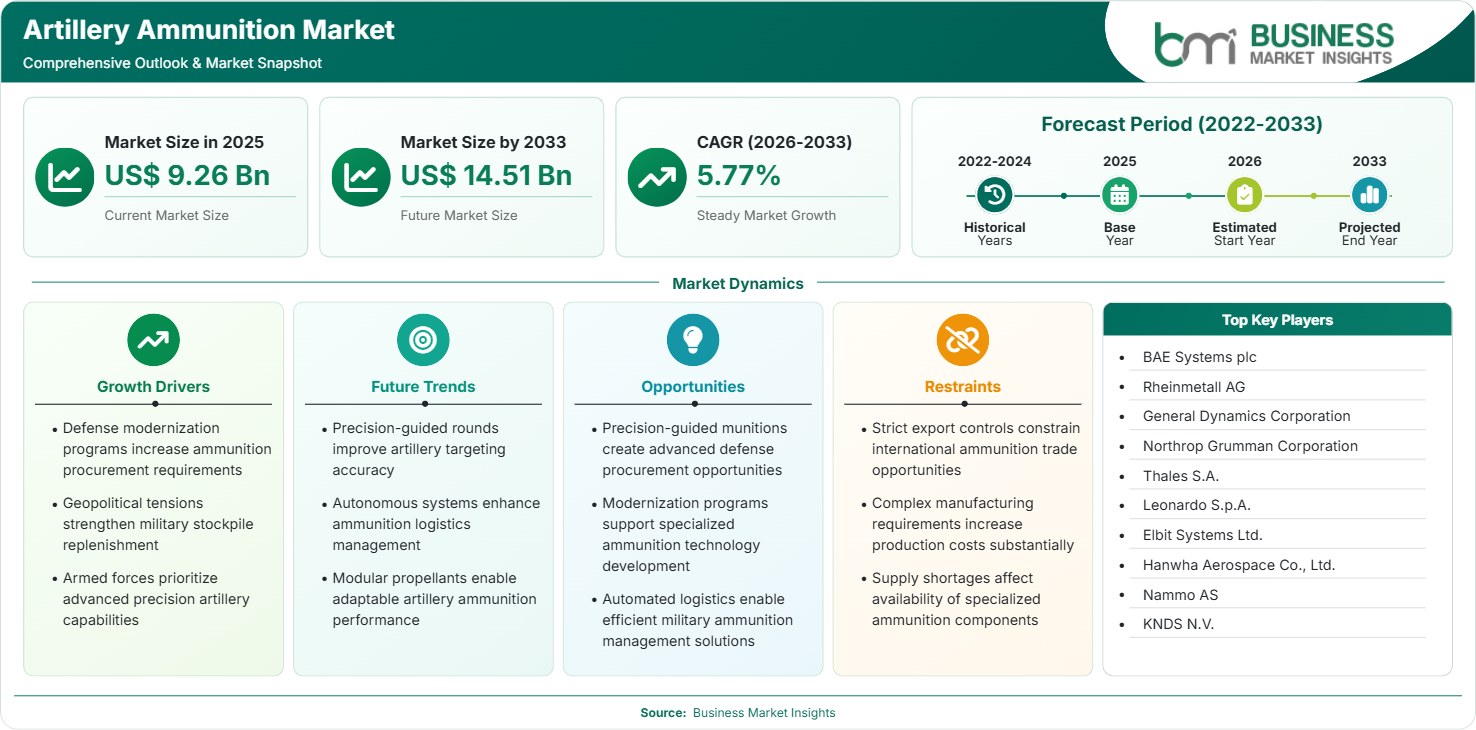
The Artillery Ammunition Market size was valued at US$ 9.26 Billion in 2025 and is projected to reach US$ 14.51 Billion by 2033, growing at a CAGR of 5.77% during 2026–2033, driven by stockpile replenishment, modernization, precision fires, localization, and extended-range requirements.

Report Coverage
  • Munitions Technology: Conventional Munitions, Precision-Guided Munitions, Smart Munitions, Extended-Range Munitions
  • Munitions Type: High-Explosive, Armor-Piercing, Cluster Munitions, Smoke/Illumination/Incendiary, Precision-Guided Munitions
  • Caliber: Small, Medium, Large
  • Artillery System: Howitzers, Mortars, Rocket Artillery, Naval Artillery
  • Operational Range: Short-Range, Medium Range, Long Range
US$ 9.26 Bn Market size in 2025
US$ 14.51 Bn Market Size by 2033
5.77% CAGR, 2026 - 2033
2026-2033 Forecast Period

AI Overview

Artillery Ammunition Market Summary

  • North America Region: North America holds a 35%–38% Artillery Ammunition Market share in 2025, growing at a 5.2%–5.8% CAGR during 2026–2033, supported by stockpile replenishment, modernization, domestic capacity expansion, precision fires, and resilient supply chains. The US remains the principal market, with procurement focused on 155mm ammunition, industrial-base expansion, precision systems, and extended-range capabilities, supporting a 5.3%–5.9% CAGR during 2026–2033.
  • Fastest Growing Region: Asia Pacific holds a 21%–24% share in 2025 and records a 6.8%–7.5% CAGR during 2026–2033, supported by indigenous manufacturing, border-security requirements, artillery modernization, localized supply chains, and procurement across India, South Korea, Japan, and Australia.
  • Leading Segment: High-Explosive (HE) munitions hold a 45%–49% share in 2025 and advance at a 5.0%–5.6% CAGR during 2026–2033, supported by broad platform compatibility, replenishment requirements, mature production, standardized logistics, and sustained conventional indirect-fire applications.
  • High Growth Segment: Precision-Guided Munitions (PGMs) hold a 12%–15% Artillery Ammunition Market share in 2025 and expand at an 8.0%–9.0% CAGR during 2026–2033, supported by improved accuracy, networked targeting, extended-range requirements, lower ammunition expenditure, and controlled target effects.
  • Key Market Opportunity: Domestic production, automated manufacturing, advanced fuzing, modular propellants, and precision-guidance integration are creating investment opportunities as governments prioritize sovereign supply and replenishment resilience.
  • Major Market Players: BAE Systems plc, Rheinmetall AG, General Dynamics Corporation, Northrop Grumman Corporation, Thales S.A., Leonardo S.p.A., Elbit Systems Ltd., Hanwha Aerospace Co., Ltd., Nammo AS, and KNDS N.V.
Strategic Insights

Artillery Ammunition Market: Strategic Insights

Artillery Ammunition Market Strategic Framework
FREE PDF
Request your free sample
Request free sample
Stakeholder View

Key Takeaways

  • Supply-chain competitiveness increasingly depends on access to steel, energetics, propellants, primers, fuzes, guidance electronics, testing facilities, and automated production equipment. Upstream constraints can limit finished-round output despite available assembly capacity.
  • Precision-guided and extended-range ammunition offers strong incremental opportunity because military users increasingly seek greater accuracy, deeper engagement capability, and improved effects per round.
  • Product development is moving toward modular architectures involving programmable fuzes, base-bleed technologies, rocket assistance, improved aerodynamics, insensitive explosives, and multi-mode guidance.
  • Europe offers substantial capacity-localization potential as governments combine artillery modernization, stockpile replenishment, domestic production, and multinational procurement.
  • Investment is increasingly targeting production capacity, automation, energetics, and supply-chain resilience rather than finished ammunition alone, encouraging partnerships between defense primes and specialized industrial suppliers.
  • NATO-standard calibers and interoperable ammunition architectures are widening the potential customer base for manufacturers able to satisfy common qualification, ballistic, safety, and logistics requirements.
Geographic Outlook

Artillery Ammunition Market Regional Highlights

North America Artillery Ammunition Market

North America accounted for a 35%–38% share in 2025 and is projected to register a 5.2%–5.8% CAGR through 2033. The region benefits from established manufacturing, large artillery inventories, high defense procurement, and modernization programs. The US remains the primary demand center, while Canada contributes through allied interoperability and replenishment. Procurement priorities emphasize production throughput, precision fires, resilient domestic sourcing, and advanced energetics. These factors support sustained capacity investment across projectile manufacturing, propellants, fuzes, and complete ammunition assembly.

  • US procurement programs support demand for 155mm projectiles, energetics, fuzes, complete rounds, and industrial-base expansion.
  • Canada supports NATO interoperability through standardized ammunition requirements and modernization of compatible artillery capabilities.
  • Domestic production investment is reducing exposure to overseas component shortages and improving response to multi-year procurement commitments.
  • Precision and extended-range programs are increasing demand for advanced fuzing, guidance, propulsion, and aerodynamic technologies.

US Artillery Ammunition Market

The US represents approximately 78%–82% of North American demand in 2025 and is projected to grow at a 5.3%–5.9% CAGR through 2033. Procurement is shaped by Army replenishment, modernization, extended-range fires, and industrial-base initiatives. Domestic production programs are expanding projectile and ammunition capacity, making manufacturing resilience a central consideration. The Artillery Ammunition Market share within North America is therefore closely connected to US procurement cycles, stockpile requirements, production contracts, and investment in advanced ammunition technologies.

  • Procurement increasingly emphasizes surge capacity, production scalability, quality assurance, and reliable delivery for large-volume government requirements.
  • Precision-fire programs are broadening demand beyond conventional projectiles toward guided ammunition, advanced fuzing, and extended-range designs.
  • Investments in energetics, machining, projectile production, and filling facilities are strengthening long-term domestic supply continuity.

Europe Artillery Ammunition Market

Europe held a 27%–30% share in 2025 and is estimated to expand at a 6.2%–6.9% CAGR through 2033. Germany, France, the United Kingdom, Poland, and Nordic countries represent important procurement centers, with Poland developing strong industrial momentum. European procurement combines stockpile replenishment with domestic capacity expansion and multinational cooperation. The Artillery Ammunition Market growth outlook is supported by NATO interoperability, ammunition standardization, technology transfer, and industrial investment. High-growth opportunities are concentrated in countries expanding production infrastructure and artillery inventories.

  • Germany remains a major demand center, supported by fleet modernization, replenishment, and European industrial cooperation.
  • Poland is developing rapidly as a production geography through new manufacturing partnerships and 155mm ammunition investments.
  • The United Kingdom is expanding munitions production through automation, energetics investment, and modernization of 155mm manufacturing facilities.
  • Nordic countries are strengthening regional production and procurement, supporting standardized ammunition and propelling-charge demand.
  • France combines domestic manufacturing with multinational systems integration, supporting precision and extended-range ammunition development.

Asia Pacific Artillery Ammunition Market

Asia Pacific represented a 21%–24% share in 2025 and is projected to achieve a 6.8%–7.5% CAGR through 2033. India, South Korea, Japan, and Australia are major demand centers, while India and South Korea offer strong localization opportunities. Rising defense expenditure, artillery modernization, domestic production policies, and strategic stockpile requirements support the regional outlook. The Artillery Ammunition Market share is also influenced by technology-transfer agreements and growing indigenous manufacturing capabilities across major defense-producing economies.

  • India is a high-growth geography supported by domestic manufacturing, artillery modernization, localization policies, and expanding defense-export ambitions.
  • South Korea combines extensive artillery inventories with advanced manufacturing capabilities, supporting conventional, extended-range, and precision ammunition.
  • Japan is increasing modernization activity, creating opportunities for compatible ammunition, improved storage resilience, and precision-fire capabilities.
  • Australia is strengthening long-range strike and ammunition resilience through domestic and allied industrial partnerships.

Rest of World Artillery Ammunition Market

South and Central America were estimated to account for around 5%-7% of the world's Artillery Ammunition Market requirement in 2025, with the Middle East and Africa each accounting for around 8%-10%. Brazil and Chile dominate market demand in South America, whereas Saudi Arabia, the UAE, Egypt, and South Africa are important countries in the Middle East and Africa. Procurement depends on defense budgets, operational needs, the level of industrial development, and local production targets.

  • Brazil remains an important South American market, combining domestic defense manufacturing with artillery modernization and ammunition replenishment requirements.
  • Saudi Arabia and the UAE offer opportunities in modern artillery fleets, precision ammunition, and localized defense production.
  • South Africa remains a specialist manufacturing base with established ammunition engineering and export-oriented capabilities.
  • Egypt and North African markets provide opportunities for standardized ammunition compatible with established Western artillery platforms.
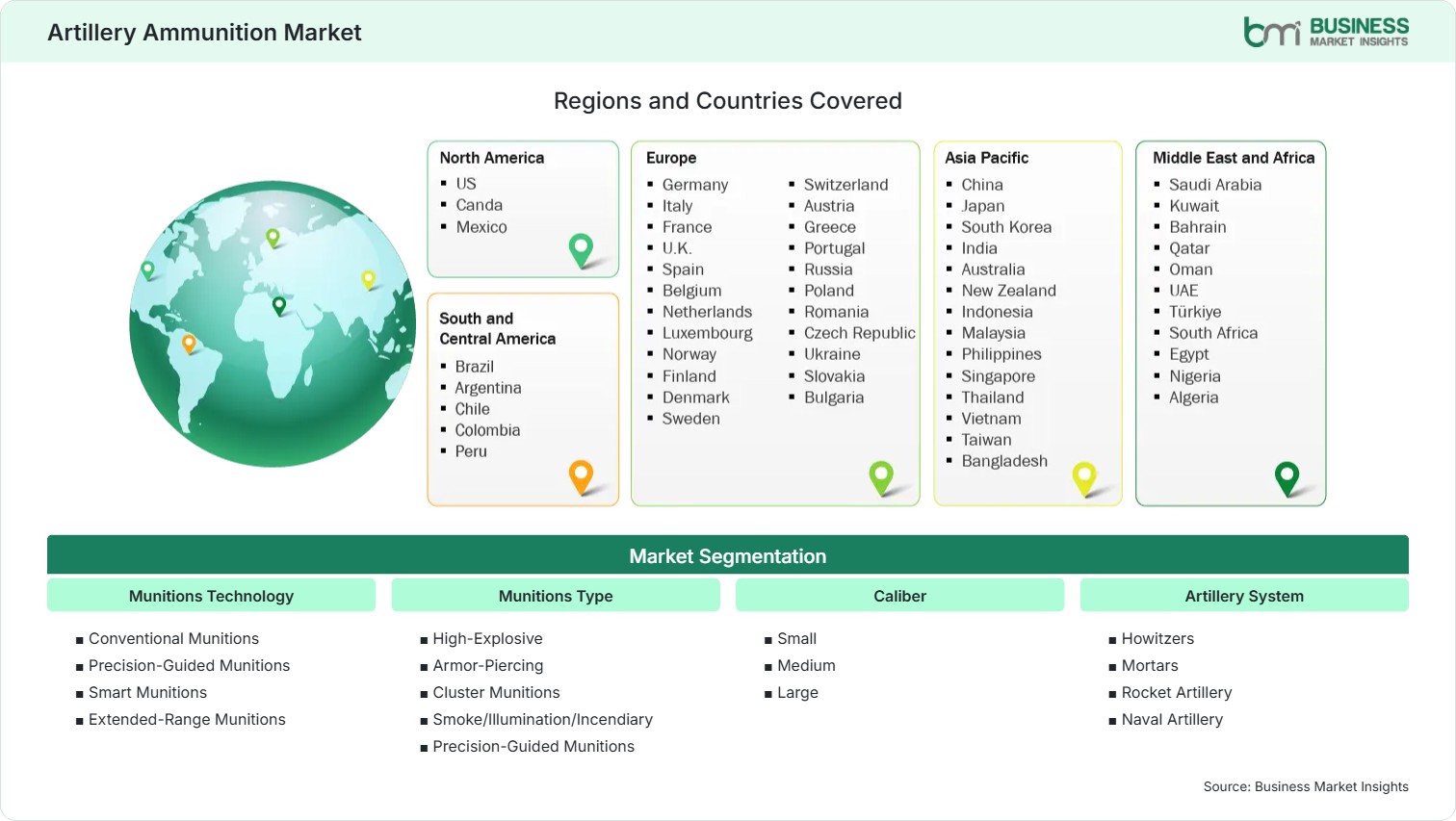
Global Market Geography
FREE PDF
Request your free sample
Request free sample
Segment Analysis

Artillery Ammunition Market Segmentation

Munitions Technology

The Munitions Technology is expected to be wide-ranging in 2025, with conventional offerings driving the greatest installed-base demand, while innovations such as precision, intelligent, and extended-range munitions are being adopted. In terms of scope, the Artillery Ammunition Market is expected to grow by a CAGR of 5.4%-6.2% through 2033 on the basis of balancing cost and distance.

  • Conventional Munitions: Remain foundational because established production, broad compatibility, lower complexity, and large stockpile requirements sustain recurring procurement across artillery fleets.
  • Precision-Guided Munitions (PGMs): Gain adoption where improved accuracy, reduced ammunition expenditure, and greater first-round effectiveness justify higher acquisition and integration requirements.
  • Smart Munitions: Incorporate sensing, programmable effects, or advanced engagement functions, improving effectiveness against specialized targets and supporting mission-specific applications.
  • Extended-Range Munitions: Use aerodynamic improvements, base bleed, rocket assistance, or advanced propulsion to increase engagement distance while retaining artillery compatibility.

Munitions Type

The munitions type remains critical because there should be a match between ammunition effects and the target's needs and doctrine. It is expected to grow at a CAGR of 5.1%–6.1% until 2033. High-explosive ammunition continues to have an extensive installed base, whereas guided ammunition becomes more attractive in terms of technological development.

  • High-Explosive (HE): Provide general-purpose effects against soft, light-armored, and semi-hard targets, sustaining broad replenishment demand across artillery fleets.
  • Armor-Piercing (AP): Support specialized anti-armor missions and remain relevant where artillery forces require capabilities against protected targets.
  • Cluster Munitions: Represent a specialized category influenced by national policy, international commitments, inventory restrictions, and alternative area-effect technologies.
  • Smoke/Illumination/Incendiary: Support battlefield screening, signaling, illumination, and specialized missions, retaining niche demand across land and naval applications.
  • Precision-Guided Munitions (PGMs): Address high-value targets requiring improved accuracy and range, supported by networked targeting and advanced guidance systems.

Caliber

Caliber segmentation depends on fleet mix, logistics, and interoperability. Large-caliber ammunition remains the most prominent value pool, as 155mm ammunition is used by many NATO and partner countries. Caliber segments are forecasted to grow at 5.3%–6.0% CAGR until 2033. Economies of scale in production can be achieved through standardization, but small calibers remain valid in special cases.

  • Small: Serve lighter artillery and specialized systems where mobility, handling, and lower logistical requirements are important.
  • Medium: Address mortar and intermediate artillery applications, balancing portability, range, payload, and tactical flexibility.
  • Large: Dominate modern tube-artillery procurement, particularly 155mm systems, supported by interoperability, extended-range development, and multinational sourcing.

Artillery System

The demand for Artillery Systems will be driven by their platform upgradability, mobility, and tactical use in warfare. The industry is estimated to grow at a CAGR of 5.5%- 6.3% through 2033. Howitzer artillery systems remain the primary consumers of ammunition. Rockets and naval artillery have more specialized functions.

  • Howitzers: Represent the principal artillery ammunition application across towed and self-propelled systems, increasingly emphasizing range, accuracy, and rapid deployment.
  • Mortars: Require compact, high-volume ammunition optimized for indirect fire, close support, rapid deployment, and terrain-specific operations.
  • Rocket Artillery: Uses guided and unguided rockets to deliver longer-range effects, increasing demand for propulsion, navigation, and advanced warhead technologies.
  • Naval Artillery: Requires ammunition engineered for maritime environments, storage stability, shipboard handling, and specialized naval fire-support requirements.

Operational Range

Operational Range segmentation is gaining importance as artillery fleets move toward deeper engagement capability. The segment is projected to advance at a 5.8%–6.7% CAGR through 2033. Extended-range demand benefits from improved projectile aerodynamics, propulsion, guidance, and fire-control systems. Greater range also increases requirements for accurate target intelligence and coordinated sensor-to-shooter architectures, supporting technology investment throughout the value chain.

  • Short-Range: Remains relevant for close-support missions where rapid response, ammunition availability, and lower logistical complexity are prioritized.
  • Medium Range: Balances reach, payload, accuracy, platform compatibility, and cost across conventional artillery missions and remains a major operational category.
  • Long Range: Captures investment in extended-range projectiles, guided ammunition, improved propellants, and advanced targeting systems for deep-fire applications.

Propulsion Type

Propulsion Type affects ballistic capabilities, range, storage needs, and platform compatibility. This market segment is expected to have a CAGR of 5.2%-6.4% from 2022 through 2033, driven by increased adoption of modular charges and advanced propulsion systems. Modular charges enhance logistics flexibility, and rocket assistance enables extended range without changing the entire artillery platform.

  • Modular Propellant: Enables adjustable charge configurations for different ranges while improving ammunition handling, logistics, and operational standardization.
  • Rocket-Assisted: Extends projectile range by providing additional propulsion during flight, supporting long-range missions where conventional ballistic performance is insufficient.
Market Forces

Artillery Ammunition Market Dynamics

Key Market Drivers

Defense Stockpile Replenishment and Production Expansion

Military spending worldwide is estimated at around US$2.9 trillion in 2025 and is driving government demand for readiness, replenishment, modernization, and production capabilities. Procurement needs will drive demand for artillery ammunition, especially in areas where inventory needs replenishment. Market growth has increasingly been driven by procurement visibility over multiple years and production capabilities. Manufacturers that can offer capacity, secure energy, and quality will be well-positioned to meet government needs. Artillery Ammunition Market growth has thus been pointing towards capacity and product innovation.

Standardization and Interoperability Across Allied Forces

NATO standardization of artillery and ammunition specifications leads to a large, interoperable customer base, especially for 155mm artillery. Standardized structures enable ammunition manufacturers to support various artillery systems while requiring minimal qualification effort. Interoperability makes it desirable to have common projectile sizes, modular charges, common fuzing, and ballistic performance. Differences between manufacturers could be in terms of accuracy, range, lethality, safety, and efficient production without compromising on the set standards. This helps to facilitate multinational purchasing and long-term replenishment plans. Companies capable of qualifying ammunition in various configurations benefit.

Shift Toward Precision and Extended-Range Fires

Contemporary procurement focuses more on range and accuracy than on projectile numbers only. High-technology 155 mm rounds could integrate satellite navigation, inertial navigation, terminal navigation, better aerodynamics, and propulsion. Extended-range projectiles can hit targets beyond 40 km in appropriate configurations. Such trends will promote development by enhancing the importance of guidance electronics, improved fuzing systems, precision manufacturing, and propulsion systems. It is increasingly common for artillery ammunition market trends to favor rounds capable of engaging deep targets without requiring many projectiles.

Key Market Opportunities

Localization of Ammunition Manufacturing

Now, more countries are also funding the manufacture of ammunition within their own territories to ensure supply and reduce their dependence on overseas production. Government-sponsored industrial endeavors in Europe are currently receiving substantial taxpayer money to build ammunition manufacturing capacity and to encourage investment in private companies in the same field. Older facilities can likewise be upgraded with automation and optimization measures. Firms that offer production engineering, technology transfer, quality management systems, equipment, and lifecycle support can monetize such projects without themselves being involved in ammunition manufacturing.

Automation and Resilient Energetics Supply Chains

Ammunition manufacturing relies on specialized energetic materials, propellants, primers, and processes such as loading, machining, inspection, and testing. Automation can alleviate any bottlenecks while increasing consistency and output. Production facilities are being expanded in projectile manufacturing, energetics, propellants, and integrated ammunition manufacturing. Industrial automation, equipment suppliers, material suppliers, and engineering services stand to benefit from this development. Advanced inspection, robotic material handling, automated machining, process control, and quality systems can be employed to increase capacity while maintaining strict requirements. The most attractive investment opportunity exists where the government has procurement visibility spanning many years.

Integration of Guidance, Fuzing, and Networked Targeting

An emerging opportunity involves combining ammunition with sensors, control systems, and digital fire-control systems. It is possible to enhance artillery performance through precision munitions without completely replacing existing systems. The importance of guidance components, programmable fuzes, navigation systems, terminal sensors, and mission planning software is increasing. There will be room for manufacturers to distinguish themselves through modular systems that retain compatibility with current artillery systems. Opportunities exist not only for retrofit systems but also for software-driven fire-control systems. With the integration of reconnaissance equipment and artillery systems, ammunition can become part of an integrated sensing-and-shooting system.

Market Restraints and Challenges

Energetics and Critical-Input Bottlenecks

Factor: Artillery ammunition Market forecast, production depends on specialized energetics, propellant chemicals, primers, explosives, high-grade steel, and qualified suppliers with demanding safety requirements. Impact: Round output may still fall short of procurement objectives despite an increase in the capacity to assemble projectiles in completed rounds. Shortages at the upper level will lead to delivery delays, higher capital requirements, higher inventory levels, and greater dependence on suppliers. Increased capacity will also necessitate specific facilities, environmental conditions, test equipment, and specialized staff. It is therefore important for manufacturers to pursue diversification, inventory buffering, higher levels of investment, and supplier contracts.

High Qualification, Safety, and Compliance Requirements

Factor: Ammunition must meet rigorous standards for ballistics, environmental conditions, storage, transportation, safety, interoperability, and reliability prior to use by the armed forces. Impact: There is potential for new products and manufacturing lines to undergo lengthy qualification periods, comprehensive testing, and development costs. Precision-guided ammunition adds another layer of complexity because of electronics, navigation, sensing, programming, and fuzing. These factors pose significant barriers to entry, favoring manufacturers that already have facilities and qualification experience. Differences in regulations across countries may also limit manufacturing mobility.

Company Analysis

Competitive Landscape

The Artillery Ammunition Market analysis reflects competition among diversified defense primes, specialist ammunition manufacturers, propulsion specialists, and precision-technology suppliers. Competitive differentiation increasingly depends on manufacturing scale, qualification status, range, precision, supply-chain resilience, and localized production capability.

Company Name

Overview

Products and Services relevant to this market

BAE Systems plc

UK defense manufacturer with established land-systems and munitions capabilities and expanding production infrastructure.

155mm ammunition, BONUS, extended-range projectiles, energetics, propellants, fuzes, manufacturing technology, and support.

Rheinmetall AG

German defense group with a major ammunition business and multinational production network.

155mm projectiles, Assegai ammunition, propelling charges, production facilities, and lifecycle support.

General Dynamics Corporation

US defense group supplying ammunition, projectile components, combat systems, and government customers.

155mm projectile metal parts, artillery ammunition, ordnance manufacturing, precision fires, and production services.

Northrop Grumman Corporation

US defense technology company supporting propulsion, precision weapons, energetics, and military manufacturing programs.

Propulsion technologies, energetics, ammunition components, precision systems, and defense manufacturing.

Thales S.A.

Multinational defense technology company active in electronics, guidance, precision systems, and military solutions.

Guidance technologies, fuzing, fire-control electronics, precision systems, and artillery integration.

Leonardo S.p.A.

Italian aerospace and defense company serving guided ammunition and advanced weapons programs.

Vulcano 155mm guided ammunition, precision guidance, fuzing, warhead technologies, and weapons integration.

Elbit Systems Ltd.

Israeli defense technology company with ammunition manufacturing and precision-fire capabilities.

Artillery ammunition, 155mm shells, precision fires, rocket artillery, guidance, and manufacturing facilities.

Hanwha Aerospace Co., Ltd.

South Korean defense manufacturer with strong artillery-system and ammunition capabilities.

155mm ammunition, modular charges, artillery systems, propellants, testing, and production technology.

Nammo AS

Nordic aerospace and defense company specializing in ammunition, propellants, rocket motors, and manufacturing expansion.

155mm HE and extended-range ammunition, rocket-assisted rounds, propellants, primers, and infrastructure.

KNDS N.V.

European land-systems group providing ammunition across multiple calibers and advanced artillery platforms.

155mm ammunition families, BONUS, KATANA precision ammunition, modular charges, naval ammunition, and support.

Trust & Transparency

Research Methodology

The market analysis combines proprietary research with secondary data from government agencies, company disclosures, regulatory filings, industry databases and expert interviews. Market estimates are validated through data triangulation, cross-market benchmarking and analyst review.

View Full Research Methodology

Questions Answered

Frequently Asked Questions

What does the Artillery Ammunition Market Report help procurement teams evaluate?

The Market Report helps evaluate technology segments, ammunition types, calibers, artillery systems, operational ranges, propulsion architectures, regional demand, competitive capabilities, production investments, and strategic opportunities through the forecast period.

What technologies are changing artillery ammunition design?

Programmable fuzes, inertial and satellite navigation, terminal guidance, base bleed, rocket assistance, insensitive explosives, modular charges, improved aerodynamics, and digital fire-control integration are changing modern ammunition performance.

How are governments reducing ammunition supply-chain vulnerability?

Governments are supporting domestic factories, regional production partnerships, technology transfers, multi-year contracts, and investments in energetics and propellant capacity. These initiatives address upstream bottlenecks as well as finished-round production constraints.

Why is 155mm ammunition strategically important to manufacturers?

The 155mm caliber is widely used across NATO and partner artillery fleets, creating a large interoperable customer base. Standardization supports manufacturing scale, multinational procurement, cross-platform compatibility, and development of specialized precision and extended-range variants.

What is driving demand for artillery ammunition beyond conventional stockpile replenishment?

Precision fires, extended-range engagement, interoperability, domestic manufacturing policies, and artillery modernization are broadening demand. Governments increasingly seek ammunition that improves accuracy, range, reliability, and logistical flexibility while remaining compatible with existing artillery systems.

Access the Full Artillery Ammunition Market Report

Get segment-level forecasts, regional estimates, competitive benchmarking, company profiles and downloadable Excel datasets.

Access the full Artillery Ammunition Market Report
350 pages PDF & Excel | 2026-09-28
Similar Research

Related Market Reports