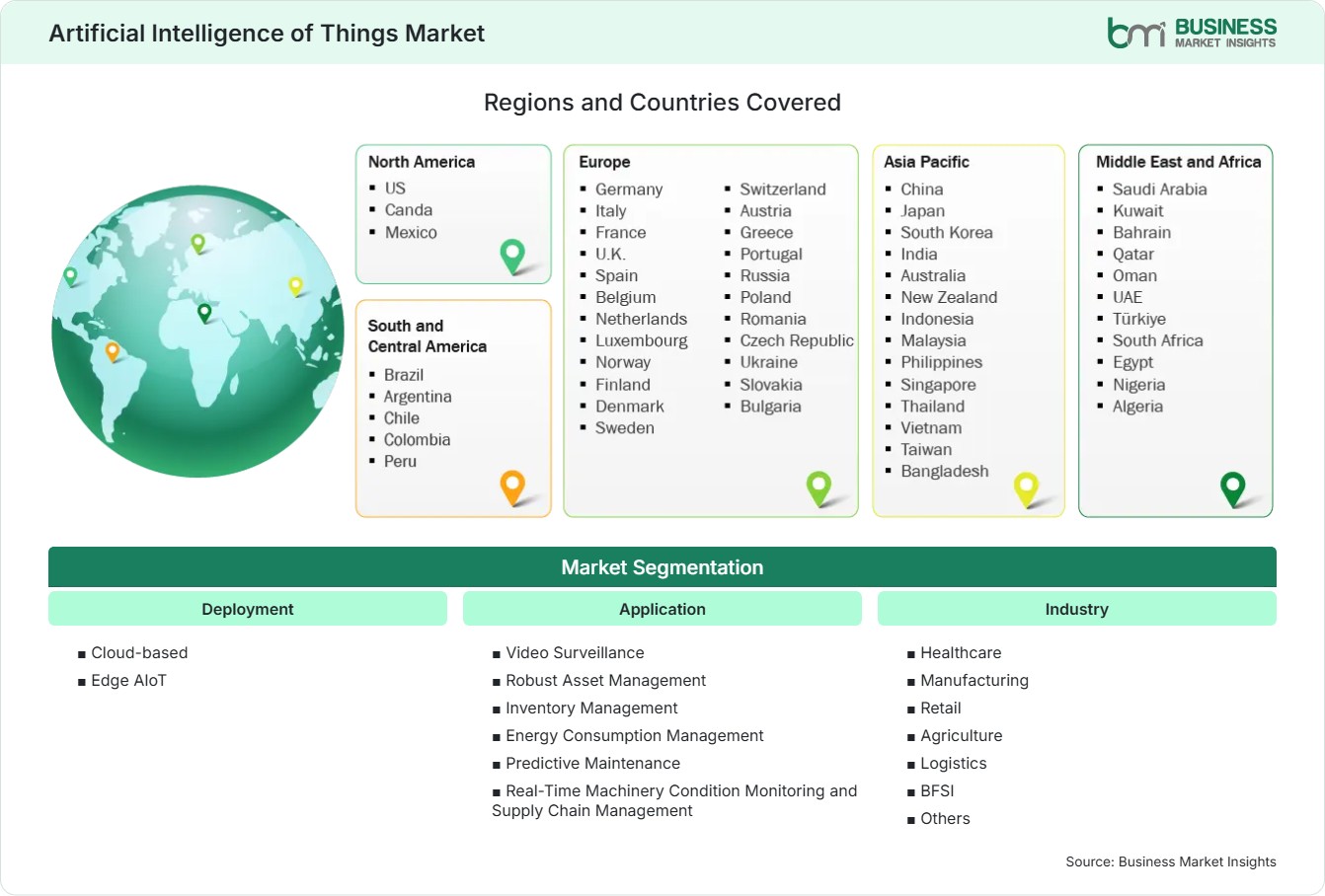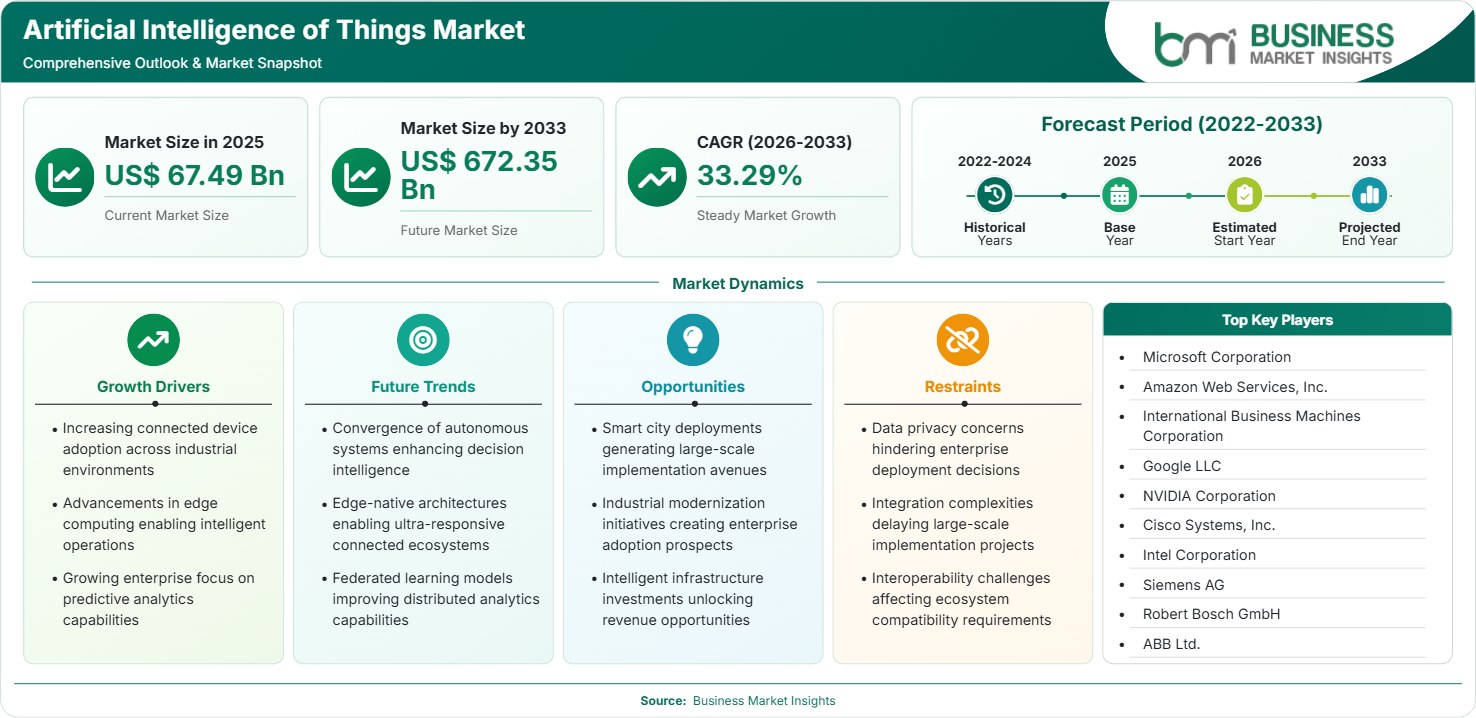
Artificial Intelligence of Things Market Regional Highlights
North America Artificial Intelligence of Things Market
The North American market accounted for 35%-38% of revenue in 2025 and is projected to grow at a CAGR of 31%-34% during the forecast period. North America has mature cloud infrastructure, high enterprise AI adoption, advanced semiconductor technology, and an existing industrial automation ecosystem. The US is the major demand hub, fueled by hyperscalers and technology companies. Canada’s contribution comes from industrial analytics, connected infrastructure, and automation in the resources sector. The regional Artificial Intelligence of Things Market share is due to high enterprise readiness and technology investment.
- US manufacturers are increasing AI-enabled monitoring and predictive workflows as cloud, edge, robotics, and industrial software platforms become increasingly interoperable across production environments.
- Technology providers benefit from established hyperscaler infrastructure and enterprise software ecosystems, enabling faster deployment of connected intelligence across healthcare, retail, logistics, manufacturing, and financial services.
- Industrial companies increasingly prioritize localized inference for operational resilience, cybersecurity, and lower latency, strengthening demand for AI accelerators, intelligent gateways, and edge-native applications.
- North American investment remains concentrated around AI infrastructure, data centers, networking, and industrial automation, creating adjacent opportunities for AIoT platform and systems integrators.
US Artificial Intelligence of Things Market
The US represented approximately 29%–32% of global revenue in 2025 and is projected to expand at a 31%–34% CAGR through 2033. Strong hyperscaler infrastructure, advanced AI research, venture investment, semiconductor development, and industrial automation support adoption. Large enterprises increasingly deploy connected intelligence for asset optimization, logistics, healthcare operations, and security. The US Artificial Intelligence of Things Market growth is also reinforced by expanding AI infrastructure spending and increasingly sophisticated enterprise cloud strategies.
- Manufacturing and logistics operators are deploying computer vision, digital twins, predictive analytics, and autonomous systems to improve throughput, reduce downtime, and strengthen operational visibility.
- Cloud providers increasingly combine IoT connectivity with AI model services, creating standardized development environments that shorten deployment cycles and support scalable enterprise adoption.
- US technology investment is broadening beyond centralized AI toward networking, accelerators, edge devices, and software capable of operating across distributed industrial environments.
Europe Artificial Intelligence of Things Market
The Europe segment had a 23%-26% market share in 2025 and is projected to experience a 30%-33% CAGR through 2033. Germany is the dominant market region owing to its industrial automation infrastructure, while France, the UK, and Italy drive AIOT acceptance in manufacturing, logistics, healthcare, and energy. The German market is forecast to achieve a 29%-32% CAGR, whereas Spain is a high-growth market with a 33%-36% CAGR in the Artificial Intelligence of Things Market. EU data governance and industrial sustainability priorities reinforce demand for controlled AI deployment.
- Germany's industrial base supports AI-enabled production, digital twins, robotics, quality inspection, and predictive maintenance, creating a strong ecosystem for connected industrial intelligence.
- European enterprises increasingly emphasize privacy, explainability, cybersecurity, and data governance, encouraging architectures that distribute processing between devices, edge infrastructure, and trusted cloud environments.
- Sustainability objectives are expanding AIoT use in energy management, building optimization, manufacturing efficiency, fleet monitoring, and resource-intensive industrial operations.
- Industrial technology partnerships are accelerating deployment by combining automation expertise with AI compute and software, reducing barriers associated with fragmented operational technology environments.
Asia Pacific Artificial Intelligence of Things Market
The Asia Pacific is expected to account for 27%–30% of the total in 2025 and register a 35%–38% CAGR until 2033. China, Japan, South Korea, and India are major demand generators in the region. China is the leading country in connected manufacturing and electronics, Japan in robots and industrial automation, and South Korea in semiconductor-based industrial intelligence. India is an example of a high-growth market with a CAGR of 38%–41%, facilitated by digitization, manufacturing growth, logistics development, and connectivity.
- China's electronics and industrial ecosystems provide a strong foundation for connected factories, intelligent cameras, robotics, warehouse automation, and AI-enabled equipment management.
- Japan combines sophisticated robotics with mature manufacturing expertise, supporting AIoT applications for machine vision, predictive maintenance, autonomous production, and industrial quality management.
- South Korea's semiconductor capabilities and manufacturing base support edge computing, intelligent production lines, connected equipment, and AI-enabled supply chain optimization.
- India offers substantial long-term opportunity as manufacturers, logistics providers, retailers, and infrastructure operators adopt connected systems alongside broader digital transformation initiatives.
Rest of World Artificial Intelligence of Things Market
Rest of World had a share of 2%–15% of the market and is expected to grow at a CAGR of 32%–35% in the Artificial Intelligence of Things Market between 2023 and 2033. South and Central America are using AIoT in agriculture, logistics, retail, and security, while the Middle East and Africa focus on smart infrastructure, energy efficiency, facility connectivity, and surveillance. Brazil remains the dominant market in South America, while the UAE and Saudi Arabia are emerging as high-growth markets in the Middle East owing to their digital transformation initiatives.
Latin America is driven by increased demand for connected agriculture, fleet management, warehouse management, and retail analytics solutions. In the Middle East, investments are being made in smart city applications, intelligent buildings, energy management, and public safety.
- Brazil's agricultural and logistics ecosystems create demand for connected equipment, remote monitoring, predictive analytics, and intelligent fleet-management systems.
- Gulf economies are investing in smart-city infrastructure and connected facilities, supporting AI-enabled surveillance, energy optimization, traffic management, and automated public services.
- Africa provides emerging opportunities in agriculture, logistics, telecommunications, and distributed infrastructure where edge processing can reduce dependence on continuous high-bandwidth connectivity.
- Regional adoption increasingly depends on scalable deployment models, local systems integrators, financing availability, cybersecurity capabilities, and compatibility with existing infrastructure.