
API Security Market Outlook: Size, Share, Trends, Growth Analysis, Competitive Landscape & Forecast, 2026-2033

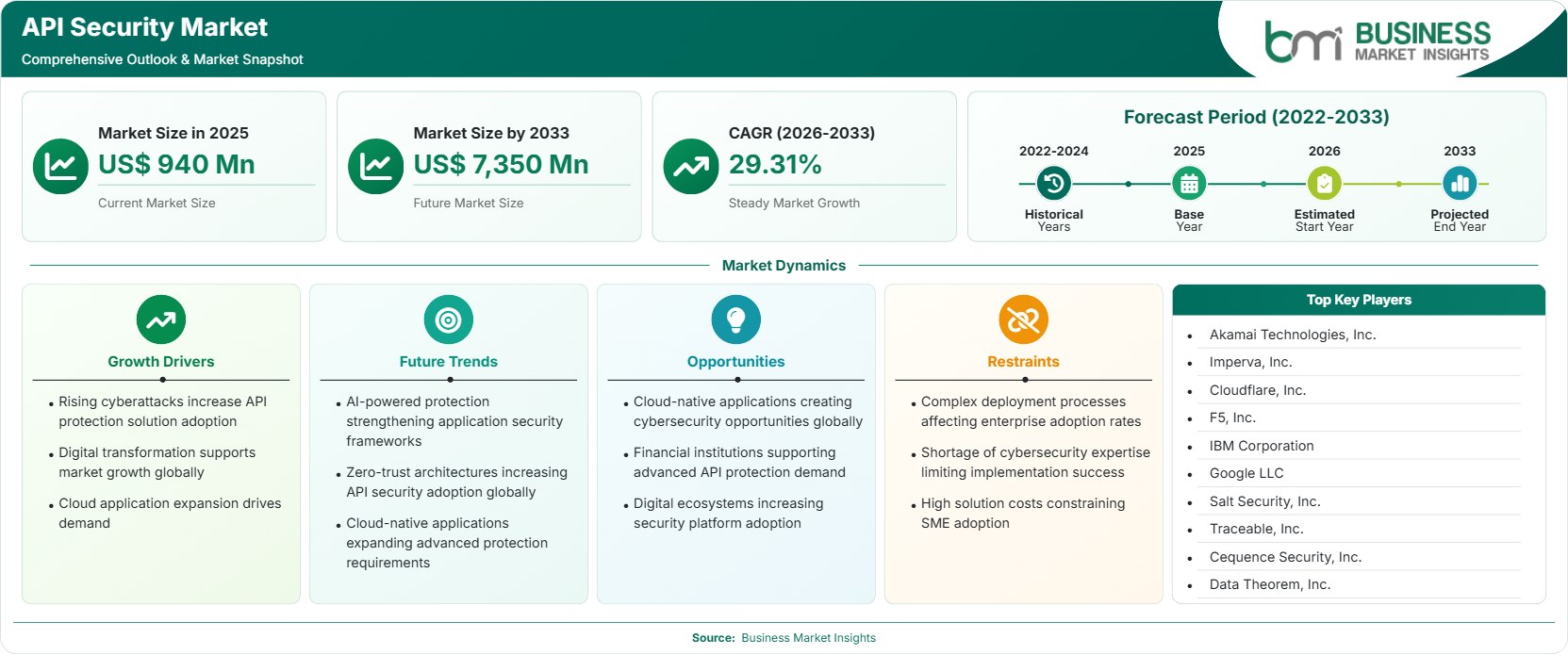
The API Security Market size was valued at US$ 940 million in 2025 and is projected to reach US$ 7,350 Million by 2033, growing at a CAGR of 29.31% during 2026–2033. Rising API proliferation, expanding cloud-native applications, increasing cyberattacks targeting APIs, and stricter data protection regulations are creating strong growth opportunities across industries globally.

Report Coverage
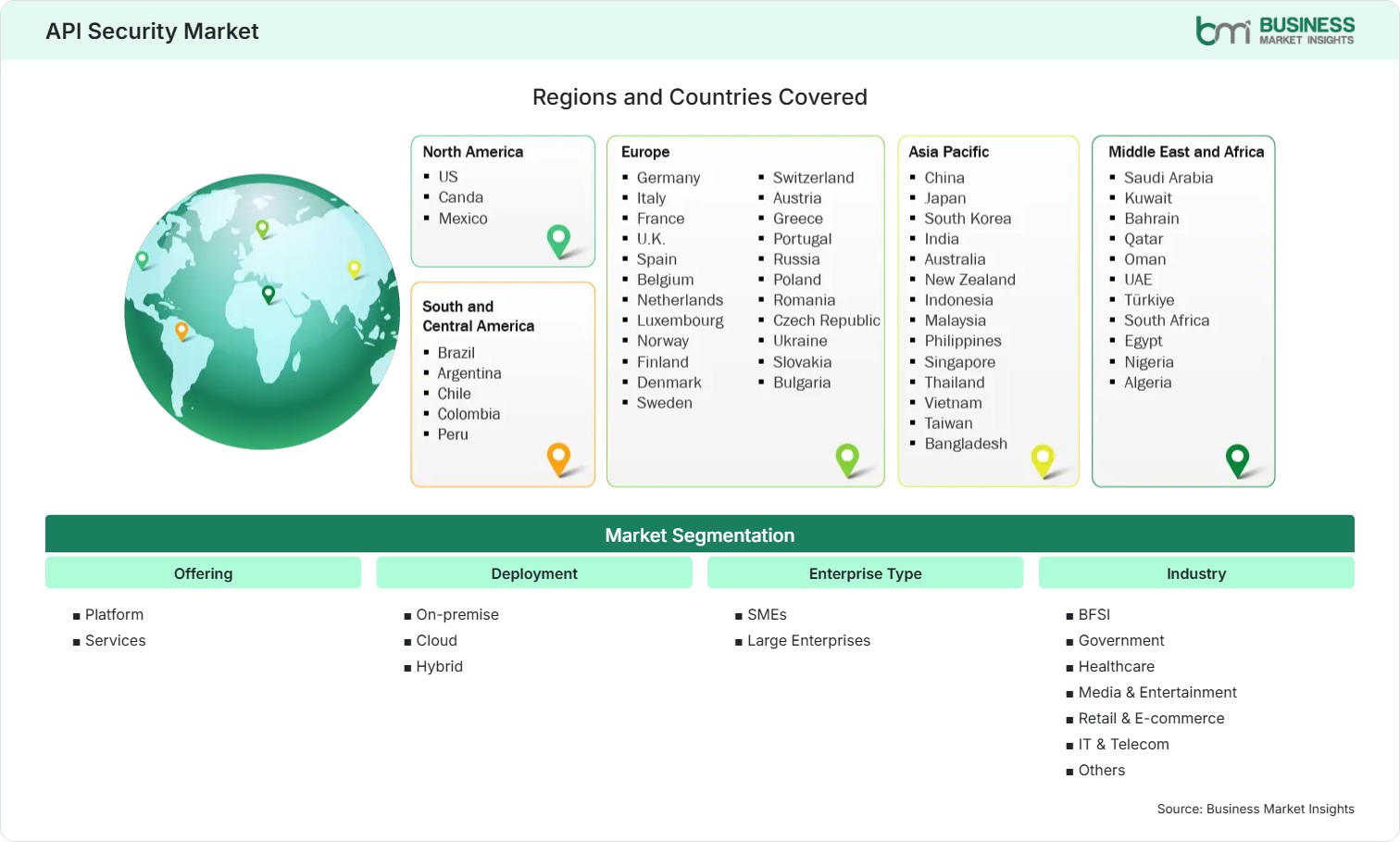
  • Offering: Platform, Services
  • Deployment: On-premise, Cloud, Hybrid
  • Enterprise Type: SMEs, Large Enterprises
  • Industry: BFSI, Government, Healthcare, Media & Entertainment, Retail & E-commerce, IT & Telecom, Others
US$ 940 Mn Market size in 2025
US$ 7,350 Mn Market Size by 2033
29.31% CAGR, 2026 - 2033
2026-2033 Forecast Period

AI Overview

API Security Market Summary

  • North America Region: North America holds a market share of 38%–41% in 2025, growing at a CAGR of 27%–29% during 2026–2033. API-first digital architectures, advanced cybersecurity spending, zero-trust adoption, financial sector modernization, and growing regulatory scrutiny accelerate enterprise demand for runtime protection, discovery, and threat intelligence solutions. US market benefits from large enterprise cybersecurity budgets and is expected to expand at a CAGR of 28%–30% through 2033.
  • Fastest Growing Region: Asia Pacific accounts for 24%–27% share in 2025 and advances at a CAGR of 32%–34%. Rapid digitization, fintech expansion, cloud migration, government cybersecurity mandates, mobile application growth, and increasing API traffic volumes continue strengthening security investment priorities across industries.
  • Leading Segment: Platform represents 68%–71% of market revenue in 2025 and grows at a CAGR of 30%–32%. Organizations increasingly prioritize automated discovery, behavioral analytics, runtime protection, vulnerability assessment, and integrated governance capabilities to secure expanding API ecosystems.
  • High Growth Segment: Cloud deployment captures 46%–49% API Security Market share in 2025 and records a CAGR of 31%–33%. Multi-cloud environments, DevSecOps integration, scalability requirements, and accelerated SaaS adoption drive enterprise preference for flexible security architectures.
  • Key Market Opportunity: AI-driven threat detection enables enterprises to identify anomalous API behavior, reduce response times, strengthen governance, improve compliance outcomes, and secure rapidly growing machine-to-machine communications across digital ecosystems.
  • Major Market Players: Akamai Technologies, Inc.; Imperva, Inc.; Cloudflare, Inc.; F5, Inc.; IBM Corporation; Google LLC; Salt Security, Inc.; Traceable, Inc.; Cequence Security, Inc.; Data Theorem, Inc.
Strategic Insights

API Security Market: Strategic Insights

API Security Market Strategic Framework
FREE PDF
Request your free sample
Request free sample
Stakeholder View

Key Takeaways

  • The value chain is moving from individual web application firewalls to integrated platforms that provide API discovery, testing, posture management, and runtime security, and thus enable the securing of complex multi-cloud environments.
  • The greatest revenue opportunities are to be found in cloud-native deployments and large-scale digital banking projects since these environments involve a high volume of API transactions and have to meet higher compliance requirements.
  • More emphasis is now being placed on behavioral analytics, the use of AI for detecting anomalies, automated inventory management, and the ability to identify attacks in real time across REST, GraphQL, and other emerging API frameworks.
  • The Asia Pacific region has one of the most attractive investment opportunities, due to the growth of digital payments, government cybersecurity initiatives, and enterprise cloud modernization projects.
  • Strategic acquisitions are still altering the competitive landscape, as major cybersecurity companies are incorporating specialized API security features into their wider application security offerings.
  • Companies are now requiring integrated platforms that combine governance, testing, vulnerability assessment, and operational monitoring to enhance security visibility and decrease management complexity.
Geographic Outlook

API Security Market Regional Highlights

North America API Security Market

North America represents the largest regional market with a 38%–41% API Security Market share in 2025. The region is expected to grow at a CAGR of 27%–29% during 2026–2033. Strong cybersecurity spending, extensive public cloud adoption, stringent compliance requirements, mature digital ecosystems, and widespread implementation of API-driven business models support sustained demand. Financial services, technology companies, healthcare networks, and federal agencies remain key adopters of advanced security platforms.

  • Companies are now increasingly using API discovery and runtime monitoring tools to manage their complex hybrid-cloud environments and comply with changing cybersecurity requirements.
  • The BFSI sector is the leading spender because of the growth of digital payment ecosystems and its greater exposure to fraud attempts that are based on APIs.
  • Government agencies and operators of critical infrastructure are seeing an increase in the adoption of platform-based systems as a result of zero-trust security programs.
  • The ongoing shortage of cybersecurity professionals is leading companies to make increased investments in automation and the use of AI for threat detection.

US API Security Market

The United States contributes 78%–82% of North American API Security Market revenue and expands at a CAGR of 28%–30% through 2033. Strong technology innovation, advanced cloud adoption, regulatory requirements, and extensive enterprise digitalization support market expansion. Organizations increasingly prioritize API governance and continuous risk monitoring.

  • The higher the number of cloud providers and software developers, the greater the demand for lifecycle API security features.
  • Financial institutions are still investing in advanced protection systems to meet the security requirements associated with open banking.
  • The push to modernize healthcare leads to greater spending on security within patient data exchange environments.
  • Large companies are still among the first to adopt AI-based behavioral analytics solutions.

Europe API Security Market

Europe accounts for 26%–29% of the API Security Market share in 2025 and is projected to grow at a CAGR of 28%–30%. Data privacy regulations, digital sovereignty initiatives, and enterprise cloud migration projects drive adoption. Germany maintains leadership, while the United Kingdom exhibits one of the strongest growth trajectories at approximately 30%–32% CAGR.

  • The need to comply with the GDPR is still leading to extensive investments in both API visibility and security governance.
  • Financial services organizations are increasingly using advanced monitoring technologies to safeguard open banking ecosystems.
  • The development of digitization strategies is leading to greater use of APIs in industrial settings.
  • The money that the government spends on cybersecurity is aimed at promoting wider adoption throughout the critical digital infrastructure.
  • Initiatives involving the exchange of data across borders increase the demand for unified security frameworks.

Asia Pacific API Security Market

Asia Pacific holds 24%–27% API Security Market share in 2025 and records the highest regional CAGR of 32%–34%. Rapid digital transformation, growing fintech ecosystems, cloud-service expansion, and increasing cyber threats support robust adoption. China leads regional revenue, while India demonstrates the strongest momentum with CAGR levels ranging between 34%–36%.

  • The expansion of digital payments greatly raises the number of API transactions and the security requirements.
  • National cybersecurity strategies promote businesses' investment in advanced protection platforms.
  • Telecom providers are now increasingly using API management and threat detection solutions.
  • The growth of startup ecosystems leads to faster development of applications on an API-first basis and results in higher spending on the associated security.
  • The expansion of cloud migration initiatives across different industries is still increasing the range of deployment options.

Rest of World API Security Market

Rest of World represents 9%–12% of global API Security Market revenue and expands at a CAGR of 29%–31%. South & Central America benefit from fintech growth and banking modernization initiatives. Middle East & Africa gain momentum through smart-city projects, cloud infrastructure investments, and cybersecurity policy development. Brazil remains the principal regional contributor, while Saudi Arabia records among the fastest growth rates between 31%–33%.

  • In Latin America, initiatives promoting open finance are enhancing investments in cybersecurity.
  • The demand for API protection is increasing across all organizations in the public sector through digital government initiatives.
  • The use of cloud services is being rapidly expanded throughout the Gulf Cooperation Council countries.
  • The need for advanced security monitoring capabilities is still being driven by the ongoing digitization of the telecom sector.
  • The increasing frequency of cyberattacks is leading to a greater awareness of the need for risk management measures that are specific to APIs.
Global Market Geography
FREE PDF
Request your free sample
Request free sample
Segment Analysis

API Security Market Segmentation

Offering

Offering remains a critical segment, with Platform accounting for the largest revenue contribution. The segment benefits from increasing enterprise requirements for discovery, testing, runtime monitoring, and governance capabilities. The API Security Market scope continues expanding as organizations seek unified protection frameworks. The offering segment holds approximately a 68%–71% share in 2025 and grows at a 29%–31% CAGR.

  • Platform: Integrated security capabilities enable continuous visibility, threat monitoring, governance enforcement, and automated protection across enterprise API environments and cloud-native application ecosystems.
  • Services: Consulting, implementation, training, and managed security services support deployment optimization, compliance readiness, threat assessment, and ongoing operational efficiency improvements.

Deployment

Deployment preferences are evolving as enterprises modernize cybersecurity architectures. Cloud environments drive rapid adoption through scalability and simplified management. This segment records 46%–49% API Security Market share for cloud deployments during 2025 and expands at a 31%–33% CAGR through the forecast period.

  • On-premise: Preferred by organizations handling highly sensitive information requiring direct infrastructure control, custom configurations, and strict regulatory compliance management.
  • Cloud: Supports flexible scalability, centralized management, DevSecOps integration, and continuous security monitoring across distributed digital ecosystems.
  • Hybrid: Combines operational flexibility with governance controls, enabling enterprises to balance legacy infrastructure protection and cloud modernization objectives.

Enterprise Type

Enterprise adoption patterns differ according to security budgets, operational complexity, and compliance requirements. Large enterprises currently dominate spending, capturing 63%–66% share in 2025 and growing at 28%–30% CAGR.

  • SMEs: Increasing cyber risks, affordable cloud services, and managed security offerings enhance adoption among resource-constrained organizations.
  • Large Enterprises: Extensive digital ecosystems, regulatory obligations, and high API transaction volumes drive substantial investments in advanced protection technologies.

Industry

Industry demand reflects varying cybersecurity requirements and digital transformation maturity. BFSI remains the largest adopter with approximately 23%–26% market share in 2025 and CAGR ranging from 30%–32% owing to secure transaction requirements.

  • BFSI: Open banking initiatives, digital payments, and fraud prevention programs make API protection a strategic cybersecurity priority.
  • Government: Digital public services and citizen data protection requirements support sustained solution deployment.
  • Healthcare: Connected health platforms and electronic record interoperability drive higher security investments.
  • Media & Entertainment: Streaming services and digital content distribution increasingly rely on secure API infrastructures.
  • Retail & e-commerce: Omnichannel commerce expansion generates growing requirements for transaction and consumer data protection.
  • IT & Telecom: High API volumes, network virtualization, and cloud services sustain strong adoption momentum.
Market Forces

API Security Market Dynamics

Key Market Drivers

Expansion of API-Connected Digital Services

Organizations increasingly use APIs to connect mobile applications, cloud workloads, enterprise systems, payment services, and external partners. This architecture improves software reuse and accelerates product delivery, but it also creates dependencies between services that may be owned by different teams. Traditional perimeter controls cannot always identify whether an authenticated request is authorized to access a particular record or perform a sensitive business action. Continuous discovery and runtime inspection therefore address a distinct security requirement. The 2026 Akamai security research identifies APIs as a major attack surface as organizations expand AI adoption. This reinforces the need to monitor application behavior and permissions rather than relying exclusively on network filtering. API Security Market trends increasingly favor controls that connect technical findings with business context, application ownership, and remediation workflows.

Increasing Exposure to API-Specific Attacks

API attacks may take advantage of poor object authorization, overexposure of data, weak authentication, and logic flaws that regular traffic filters cannot catch. The use of legitimate endpoints with correct credentials by the attackers makes it necessary to understand the context of the behavior and the authorization tests. In its September 2026 report, Akamai revealed that 87 percent of those who participated in their poll experienced a security breach involving APIs in 2025. Though it is not a universal number for all organizations, it shows that API exposure is an actual problem for many of the participants. The resulting demand supports API Security Market growth through stronger discovery, continuous testing, and runtime protection. Providers that reduce false positives and prioritize exploitable weaknesses can offer greater operational value than tools that simply generate large volumes of alerts.

Integration of Security Into Software Delivery

Because new endpoints, authentication methods, and data flows can be introduced by frequent application releases faster than periodic audits are able to evaluate them, it is useful to incorporate API testing into development pipelines so that insecure configurations and authorization flaws can be detected before the applications are deployed. Runtime monitoring adds to this by spotting the differences between the documented interfaces and what is actually happening in production. Security teams can link their findings to the developers, the source code, and the remediation tickets, thus enhancing accountability. This method is particularly appropriate in the case of microservices, since in such environments multiple teams look after separate services and have their own release schedules. Automated testing also helps to carry out the assessments again following changes to the applications, thereby decreasing the need for manual reviews. Vendors who support widely used development environments and give clear advice on how to make remediations can boost adoption. The operational benefit is not just earlier detection; it is that the process becomes more repeatable when it comes to keeping the software protected.

Key Market Opportunities

Security for AI Agents and Machine-Accessible Interfaces

AI assistants and autonomous agents are now becoming more frequently involved in accessing enterprise data and software via APIs and other newly developing machine-to-machine interfaces. This situation offers security providers the chance to broaden their traditional endpoint discovery to include agent identity, the permissions assigned to tools, the monitoring of actions, and the imposition of restrictions on sensitive operations. It has become necessary for organizations to establish which agents are allowed to access particular services, what information they are permitted to retrieve, and whether any action goes beyond the approved scope. Security tools that link API inventories with identity governance and AI management can help meet these requirements. The commercial potential is in enforcing policies across both standard applications and AI-powered workflows, not in viewing each new interface as a separate control issue. Customers will prefer solutions that offer explainable decisions, adhere to the principle of least privilege, and integrate with current governance programs.

Managed Protection for Resource-Constrained Organizations

A large number of small businesses and mid-sized companies do not have dedicated experts to look after their API inventories, examine alerts, carry out security tests, and arrange the necessary corrections. Managed services are able to offer these capabilities on a regular basis, thus eliminating the need to set up a full internal department. The service providers can combine continuous monitoring, periodic testing, configuration reviews, and incident support using cloud-based platforms. This approach also provides chances for regional service providers and well-established managed security firms to expand their range of application protection services. For such services to be successful, it is necessary to have clear service level agreements, well-defined escalation procedures, and reports that show the difference between vulnerabilities that can be exploited and those that are of low priority. Further assistance can be provided by offering flexible pricing and integrating with a wide variety of development tools to reduce the difficulties involved in implementing the solution. The opportunity is greatest in cases where customers require continuous expertise but are unable to afford a large team of specialists.

Unified Security Across Hybrid and Partner Ecosystems

Organizations may run interfaces within their private data centers, in the public cloud, using SaaS applications and from partner-managed infrastructures. Independent solutions may create holes in the inventory process, inconsistent access policies, and disparate incident reports. Vendors may solve this issue by integrating their discovery and identity context functionality, runtime monitoring, and reporting capabilities for distributed infrastructure. Integration with API gateways, native cloud controls, web application firewalls, and security information and event management systems would increase the solution's value to the buyer. Implementation services for legacy applications that are not able to undergo redesign might be in demand from buyers as well. API Security Market Forecasts are therefore closely linked to the ability to secure increasingly distributed applications without imposing unnecessary complexity on software delivery.

Market Restraints and Challenges

Complexity of Complete API Discovery

Factor: Large firms have APIs that are documented, undocumented, obsolete, managed by partners, and created dynamically in various environments. The inventory becomes out-of-date when developers create new services or modify application settings.

Impact: Lack of a complete inventory can result in misperceptions about coverage and vulnerabilities that will not get tested. There is also a possibility of duplicate inventories and lack of ownership information, thus taking more time to investigate. Efficient implementation demands reconciliation of run-time observation, API specification, gateway, cloud configuration, and code repository.

Integration Costs and Shortage of Specialized Skills

Factor: API security implementations may require coordination among application developers, infrastructure teams, identity administrators, compliance personnel, and security operations. Legacy systems can use inconsistent authentication models, while different business units may apply separate policies and release procedures.

Impact: Integration projects can extend deployment timelines and increase the total cost of ownership beyond software licensing. Poorly tuned controls may disrupt legitimate traffic, generate excessive alerts, or delay application releases. Organizations may respond by limiting coverage to critical applications, leaving other interfaces less protected.

Company Analysis

Competitive Landscape

The competitive environment remains highly dynamic, with vendors expanding functionality across discovery, governance, runtime protection, and analytics. Continuous product innovation and strategic acquisitions are shaping the API Security Market analysis landscape.

Company Name

Overview

Products and Services relevant to this market

Akamai Technologies, Inc.

Global cybersecurity and cloud services provider with strong API protection capabilities.

API Security, API discovery, runtime protection, threat intelligence, edge security services.

Imperva, Inc.

Application security specialist serving enterprises across regulated industries.

API security, WAF solutions, bot management, data protection services.

Cloudflare, Inc.

Cloud connectivity and cybersecurity company supporting large API traffic environments.

API Shield, zero-trust services, DDoS protection, traffic monitoring.

F5, Inc.

Enterprise application delivery and security vendor.

Distributed Cloud API Security, application security and threat protection.

IBM Corporation

Technology and cybersecurity solutions provider with global presence.

API management, security analytics, governance and compliance services.

Google LLC

Major cloud infrastructure and API management provider.

Apigee API management, security monitoring, governance tools.

Salt Security, Inc.

Specialized API security company focused on behavioral intelligence.

API discovery, posture governance, runtime attack prevention capabilities.

Traceable, Inc.

Dedicated API protection vendor serving cloud-native environments.

Runtime protection, posture management, API testing and analytics.

Cequence Security, Inc.

Cybersecurity provider focusing on API and bot threat defense.

API protection, fraud prevention, bot management technologies.

Data Theorem, Inc.

Application and API security platform provider.

API risk management, testing, monitoring, compliance solutions.

Trust & Transparency

Research Methodology

The market analysis combines proprietary research with secondary data from government agencies, company disclosures, regulatory filings, industry databases and expert interviews. Market estimates are validated through data triangulation, cross-market benchmarking and analyst review.

View Full Research Methodology

Questions Answered

Frequently Asked Questions

How does AI improve API protection effectiveness?

AI enhances anomaly detection, behavioral analysis, threat prioritization, automated monitoring, and incident response, allowing organizations to identify suspicious activity more efficiently.

What does an API Security Market Report typically evaluate?

It generally assesses market size, technology adoption, competitive positioning, deployment trends, industry demand patterns, cybersecurity drivers, regional opportunities, and forecast outlooks.

Why are cloud deployments gaining traction?

Cloud deployments provide scalability, centralized visibility, faster integration with DevSecOps workflows, and support for distributed digital environments, making them attractive for modern enterprises.

Which industry generates the highest demand for API security platforms?

BFSI remains the leading adopter because financial institutions operate large digital transaction environments and face strict security, fraud prevention, and regulatory compliance requirements.

What is driving demand for API security solutions?

Growing API traffic, cloud-native applications, third-party integrations, digital banking initiatives, and increasing cyberattacks targeting APIs are pushing organizations toward advanced security and governance investments.

Access the Full API Security Market Report

Get segment-level forecasts, regional estimates, competitive benchmarking, company profiles and downloadable Excel datasets.

Access the full API Security Market Report
350 pages PDF & Excel | 2026-11-03
Similar Research

Related Market Reports