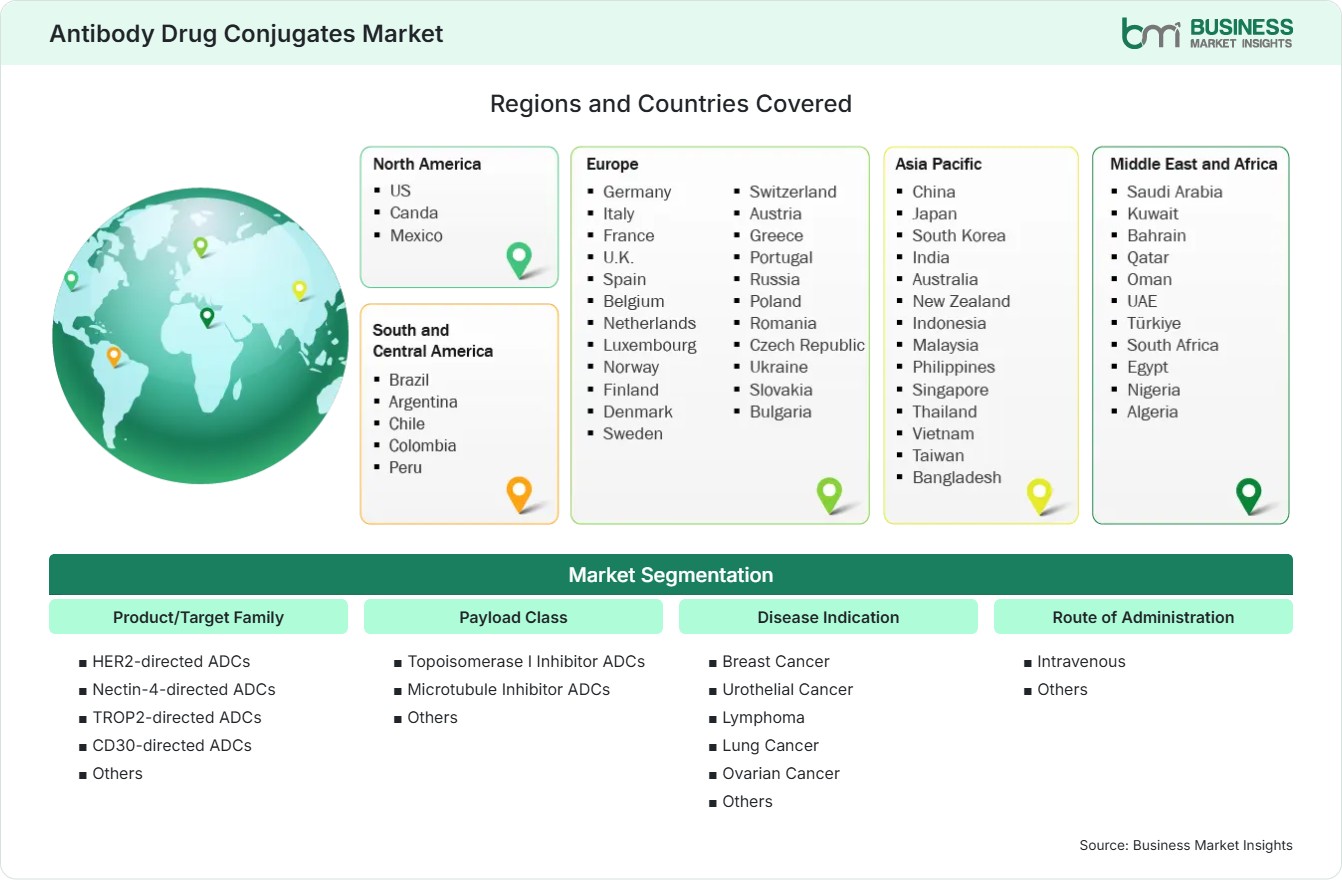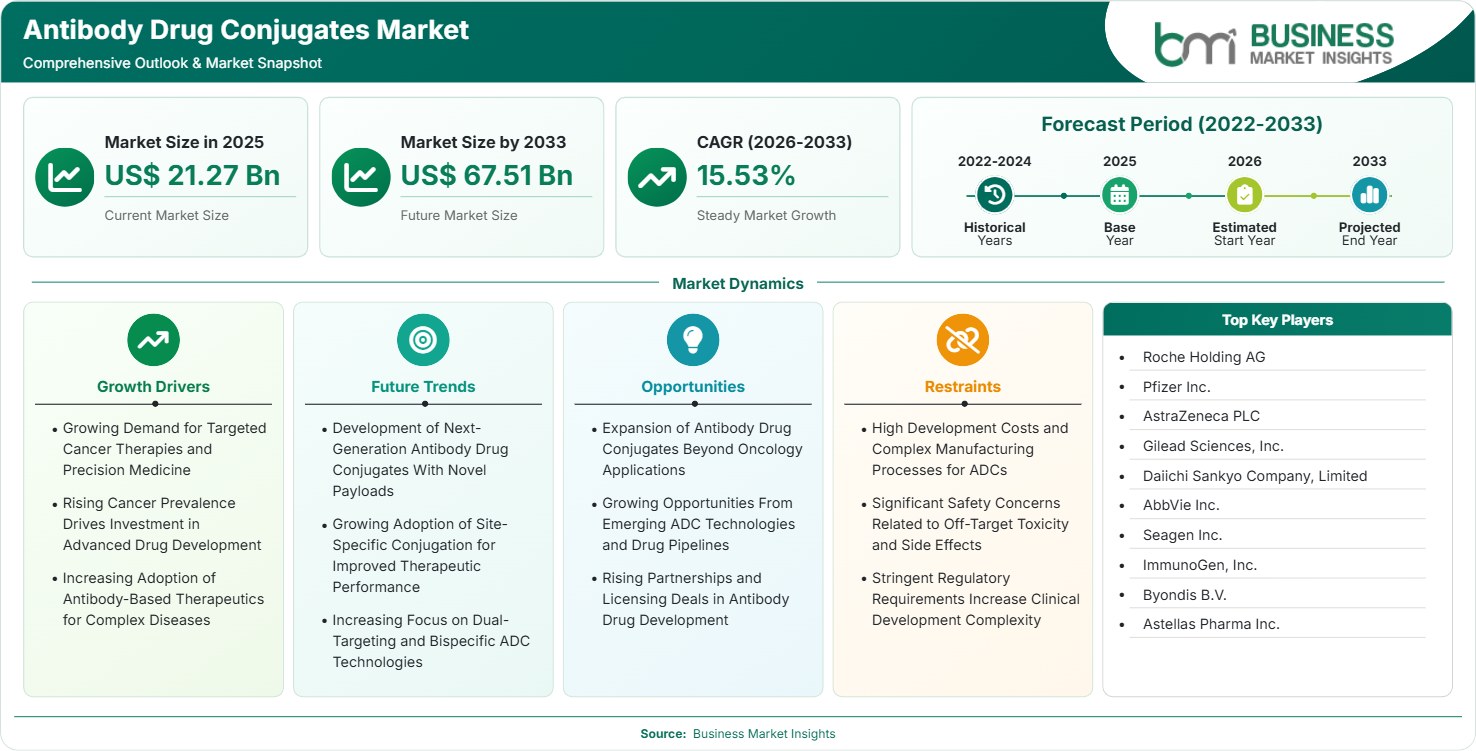
Antibody Drug Conjugates Market Regional Highlights
North America Antibody Drug Conjugates Market
North America represents an share of 42%–46% in 2025 and North America antibody drug conjugates market forecast to grow CAGR of 14.5%–15.5% during 2026–2033. The region benefits from advanced oncology research infrastructure, substantial pharmaceutical investment, specialized cancer centers, and established biologics manufacturing capabilities. The US dominates regional demand and innovation, while Canada contributes through clinical research and biotechnology development.
- The US remains the regional innovation center, supported by extensive oncology clinical trials, pharmaceutical R&D investment, specialist cancer centers, and established regulatory pathways for innovative therapies.
- Biopharmaceutical companies are increasing investment in next-generation ADC platforms to improve target specificity, payload delivery, therapeutic index, and clinical outcomes across difficult-to-treat cancers.
- Academic research centers are strengthening collaborations with pharmaceutical developers, supporting target discovery, biomarker identification, translational research, and early-stage ADC development.
- Contract development and manufacturing organizations are expanding specialized capabilities to address complex conjugation, containment, analytical testing, and commercial-scale production requirements.
US Antibody Drug Conjugates Market
The US accounts for an Antibody Drug Conjugates Market share of 37%–41% in 2025 and records a CAGR of 14.8%–15.8% through 2033. The market benefits from strong pharmaceutical R&D, extensive clinical trial infrastructure, specialist oncology centers, and a mature biotechnology ecosystem. Increasing precision medicine adoption is also encouraging biomarker-led development and patient stratification.
- Pharmaceutical developers continue expanding ADC pipelines across breast, lung, urothelial, ovarian, and hematological malignancies to diversify commercial opportunities.
- Cancer specialty centers support clinical development by providing access to complex patient populations and advanced oncology expertise for evaluating emerging ADC candidates.
- The biotechnology ecosystem is encouraging innovation in antibody engineering, linker chemistry, payload development, and site-specific conjugation technologies.
Europe Antibody Drug Conjugates Market
Europe represents a share of 24%–28% in 2025 and records a CAGR of 13.5%–14.5% through 2033. Germany, the UK, France, and Switzerland represent leading markets, while Italy and Spain provide additional growth opportunities. The region benefits from strong pharmaceutical research, academic oncology networks, and established biologics capabilities. Germany provides a CAGR of 13.0%–14.0%, while the UK records a CAGR of 14.0%–15.0%, supported by biotechnology investment and clinical research activity.
- Germany remains a leading market due to its strong pharmaceutical ecosystem, specialized oncology infrastructure, clinical research capabilities, and growing adoption of precision cancer treatment.
- The UK provides a CAGR of 14.0%–15.0%, supported by biotechnology innovation, academic research, clinical trial activity, and collaborations between pharmaceutical developers and research institutions.
- France benefits from established oncology treatment infrastructure and pharmaceutical research capabilities, supporting clinical development and adoption of innovative targeted therapies.
- Switzerland maintains strategic importance through its concentration of global pharmaceutical companies, biotechnology expertise, and investment in innovative oncology drug development.
Asia Pacific Antibody Drug Conjugates Market
Asia Pacific accounts for a market share of 20%–24% in 2025 and achieves a CAGR of 17.0%–18.0% through 2033. China, Japan, South Korea, and Australia represent leading markets, while India and Southeast Asia provide high-growth opportunities. Japan provides a CAGR of 16.0%–17.0%, while China records a CAGR of 18.0%–19.0%, reflecting strong biopharmaceutical investment and growing ADC development capabilities.
- China offers a CAGR of 18.0%–19.0%, supported by expanding oncology research, domestic pharmaceutical innovation, clinical trial activity, and increasing development of locally originated ADC candidates.
- Japan remains a leading market with a CAGR of 16.0%–17.0%, supported by advanced pharmaceutical research, oncology expertise, and established capabilities in antibody and conjugate technologies.
- South Korea is strengthening its position through biopharmaceutical manufacturing, clinical research, and investment in innovative biologic drug development platforms.
- India provides growth opportunities through expanding pharmaceutical capabilities, increasing oncology demand, and development of cost-efficient manufacturing and clinical research infrastructure.
Rest of World Antibody Drug Conjugates Market
South and Central America represent approximately 4%–7% of global demand in 2025 and record a CAGR of 12.0%–14.0%. Brazil and Mexico lead regional activity as oncology infrastructure and access to advanced therapies improve. Pharmaceutical partnerships can support market expansion. The Middle East and Africa represent approximately 3%–5% share in 2025 and achieve a CAGR of 13.0%–15.0%.
- Brazil remains a leading Latin American market as oncology treatment infrastructure expands and pharmaceutical companies increase access to innovative cancer therapies.
- Mexico provides opportunities through improving specialty care capabilities, increasing cancer treatment demand, and greater adoption of advanced oncology medicines.
- Saudi Arabia offers a CAGR of 14.0%–16.0%, supported by healthcare modernization, investment in specialized cancer services, and increasing access to innovative treatments.
- The UAE provides a CAGR of 14.0%–16.0%, driven by healthcare infrastructure investment, medical tourism, oncology specialization, and growing interest in advanced biologic therapies.