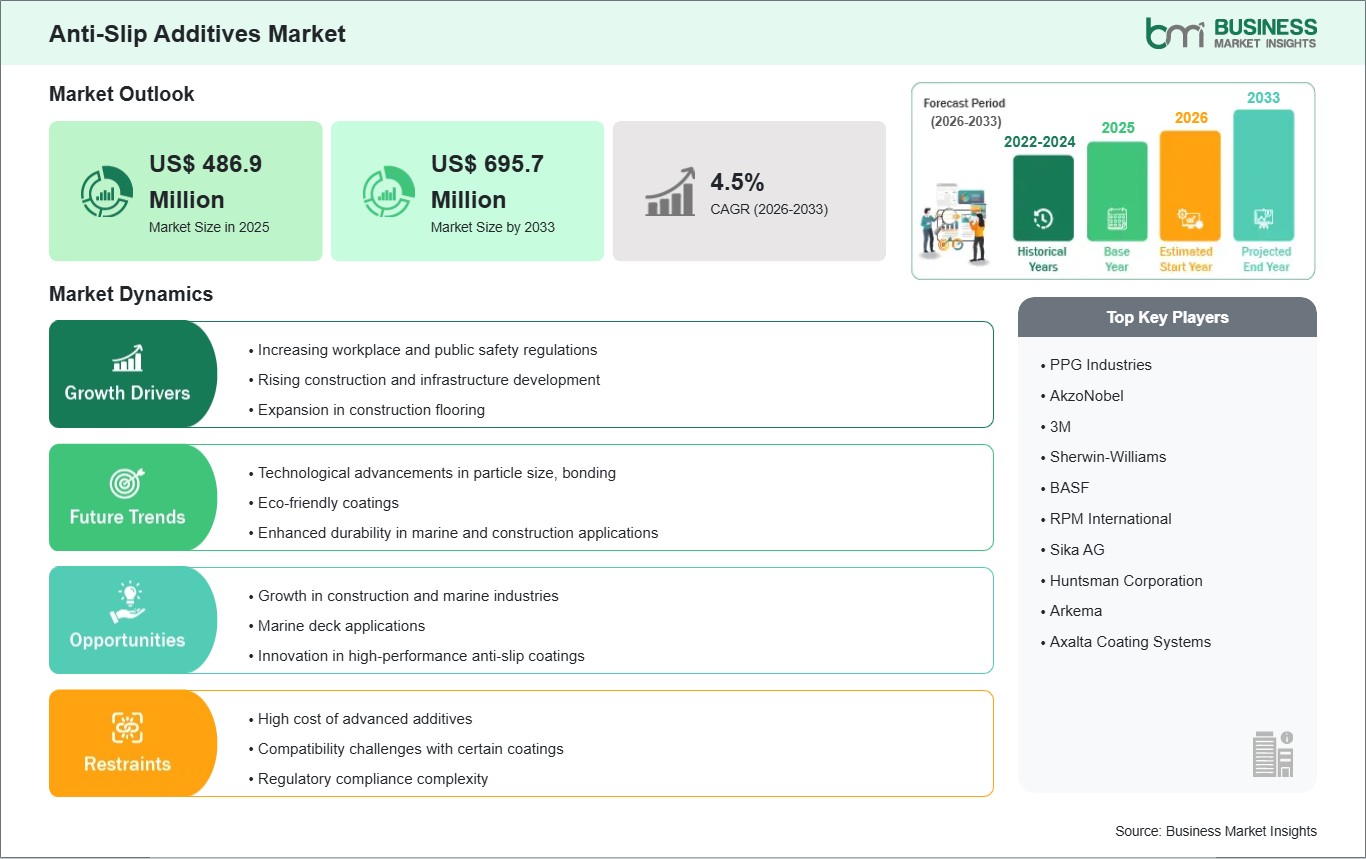
The Anti-Slip Additives Market size is expected to reach US$ 695.7 Million by 2033 from US$ 486.9 Million in 2025 .The market is estimated to record a CAGR of 4.5% from 2026 to 2033.
The global anti-slip additives market continues to grow as a result of increased focus on safety, regulatory compliance, and performance improvement. Anti-slip additives refer to materials added to coatings, paints, sealants and flooring systems to improve traction and reduce the risk of slipping or falling. These anti-slip additives are typically comprised of aluminum oxide (Al203), silica, or other polymer-based materials; therefore, these additives are being used extensively by both individuals and businesses. The use of anti-slip additives will help provide a durable surface while enhancing the visual appeal of a surface, which is why anti-slip additives have become a preferred option for the majority of new infrastructure projects today.
In addition to being used to improve the safety and performance of new construction, the anti-slip (or ‘traction’) additive industry is benefiting from the emergence of stricter workplace safety regulations and building codes that require that slip-resistant surfaces be installed in areas with high-risk of slipping or falling, such as walkways, ramps, industrial floors, and marine decks. Furthermore, anti-slip (or traction) additive manufacturers are developing enhanced formulations of additive products that offer improved dispersion, transparency, and compatibility with various types of coatings.

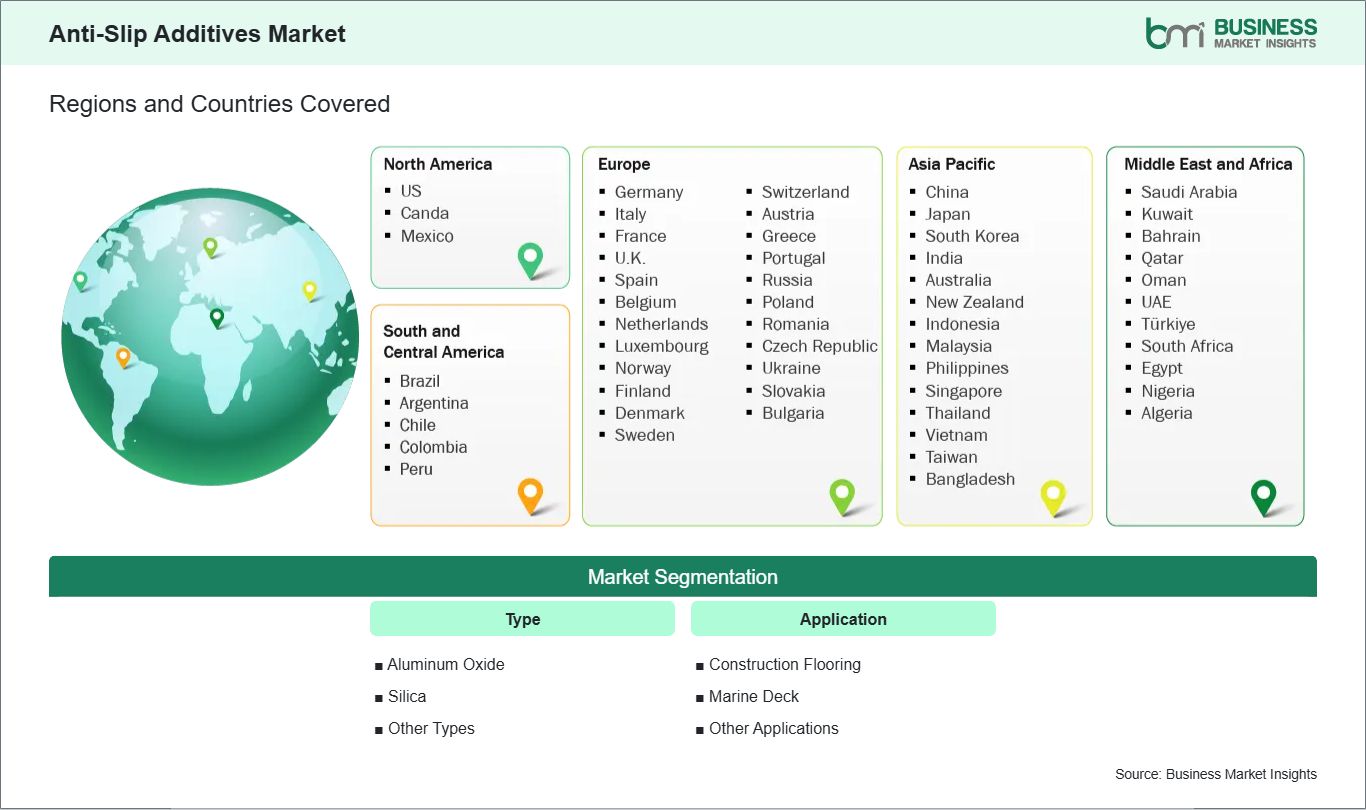
Key segments that contributed to the derivation of the anti-slip additives market analysis are type and application.
Due to the continuing increased focus on both workplace safety and public safety, there is now a greater need than ever for anti-slip additives. Many governments and regulatory bodies throughout the world have started enforcing stricter safety regulations that require slip-resistant surfaces for commercial, industrial, and public infrastructure. The goal is to minimize accidents, provide improved access to all, and comply with occupational health and safety standards. As a result, companies are increasingly adopting anti-slip solutions in order to comply with requirements set forth by legislation and meet customer demand for a safer environment.
Currently, anti-slip additives are widely used in the production of floors, steps, inclines, and walkways to help prevent slips and falls. Their use is especially prevalent in high-traffic industries such as construction, manufacturing, healthcare, and hospitality, where safety is of utmost importance. For instance, hospitals and care facilities utilize anti-slip flooring to protect both patients and employees, while factories and distribution centers use anti-slip products to protect employees from injuries that may occur while working in physically demanding areas. The trend continues to be seen in public infrastructure projects where municipalities are providing investment into safer roadways and transit terminals.
The global construction sector is experiencing robust growth, and this expansion is directly fueling demand for anti‑slip additives. In residential, commercial, and industrial projects, flooring safety has become a priority, not only to comply with regulations but also to meet consumer expectations for durable and secure surfaces. Anti‑slip additives are widely used in concrete, tiles, and coatings to enhance traction, reduce accidents, and extend the lifespan of flooring systems. As urbanization accelerates and infrastructure investments rise, the construction industry is increasingly integrating these solutions into new builds and renovation projects.
The marine industry represents another critical growth area. Ships, docks, and offshore platforms are constantly exposed to wet and harsh conditions, making slip resistance essential for safety. Anti‑slip coatings are applied to decks, ramps, and walkways to protect crew members and passengers, ensuring operational efficiency and compliance with maritime safety standards. The rising demand for marine infrastructure, coupled with the growth of recreational boating and cruise tourism, is further boosting adoption.
Technological advancements are also reshaping the market. Innovations in particle size distribution, bonding properties, and compatibility with eco‑friendly coatings are enabling manufacturers to deliver high‑performance solutions tailored to specific industry needs. For instance, additives designed for marine environments now offer enhanced durability against saltwater corrosion, while construction applications benefit from improved integration with sustainable building materials.
Together, the expansion of construction and marine industries, combined with ongoing technological progress, is creating strong momentum for the anti‑slip additives market, positioning it as a vital enabler of safety and durability across diverse applications.

The Anti-Slip Additives Market demonstrates steady growth, with size and share analysis highlighting evolving trends and competitive dynamics among key players. The report examines subsegments categorized within type and application, offering insights into their contribution to overall market performance.
By type, the silica subsegment dominated the market in 2025, driven by its affordability and effectiveness in providing slip resistance.
In terms of application, the construction flooring subsegment dominated the market in 2025, driven by increasing infrastructure development and safety requirements.
| Report Attribute | Details |
|---|---|
| Market size in 2025 | US$ 486.9 Million |
| Market Size by 2033 | US$ 695.7 Million |
| Global CAGR (2026 - 2033) | 4.5% |
| Historical Data | 2022-2024 |
| Forecast period | 2026-2033 |
| Segments Covered | By Type
|
|
Regions and Countries Covered
| |
| North America | US, Canada, Mexico |
| Europe | Belgium, Austria, Finland, Denmark, Greece, Poland, Romania, Russia, Ukraine, Czech Republic, Slovakia, Bulgaria, Italy, Luxembourg, Germany, Switzerland, France, Netherlands, Norway, Portugal, Spain, Sweden, United Kingdom |
| Asia-Pacific | Australia, China, India, Japan, South Korea, Indonesia, Malaysia, Philippines, Singapore, Thailand, Vietnam, Bangladesh, New Zealand, Taiwan |
| South and Central America | Brazil, Argentina, Peru, Chile, Colombia |
| Middle East and Africa | Bahrain, Kuwait, Oman, Qatar, Saudi Arabia, United Arab Emirates, Turkiye, South Africa, Egypt, Algeria, Nigeria |
| Market leaders and key company profiles |
|
The "Anti-Slip Additives Market Size and Forecast (2022 - 2033)" report provides a detailed analysis of the market covering below areas:
The geographical scope of the Anti-Slip Additives Market report is divided into North America, Asia Pacific, Europe, Middle East & Africa, and South & Central America. North America held the largest share in 2025.
North America and Europe are characterized by stringent safety regulations and high adoption of advanced coating technologies. These regions emphasize compliance with occupational safety standards, driving consistent demand for anti-slip additives.
Asia Pacific market is growing due to rapid urbanization, infrastructure development, and increasing construction activities in countries such as China and India. Growing awareness of safety standards and rising industrialization are further driving demand in the region.
The Middle East & Africa and South & Central America are witnessing gradual growth, supported by infrastructure development and increased focus on workplace safety. Across all regions, regulatory frameworks and construction trends play a key role in shaping market demand.

The Anti-Slip Additives Market is evaluated by gathering qualitative and quantitative data post primary and secondary research, which includes important corporate publications, association data, and databases. A few of the key developments in the anti-slip additives market are:
The Anti-Slip Additives Market is valued at US$ 486.9 Million in 2025, it is projected to reach US$ 695.7 Million by 2033.
As per our report Anti-Slip Additives Market, the market size is valued at US$ 486.9 Million in 2025, projecting it to reach US$ 695.7 Million by 2033. This translates to a CAGR of approximately 4.5% during the forecast period.
The Anti-Slip Additives Market report typically cover these key segments-
The historic period, base year, and forecast period can vary slightly depending on the specific market research report. However, for the Anti-Slip Additives Market report:
The Anti-Slip Additives Market is populated by several key players, each contributing to its growth and innovation. Some of the major players include:
The Anti-Slip Additives Market report is valuable for diverse stakeholders, including:
Essentially, anyone involved in or considering involvement in the Anti-Slip Additives Market value chain can benefit from the information contained in a comprehensive market report.
Please tell us your area of interest
(Market Segments/ Regions and Countries/ Companies)