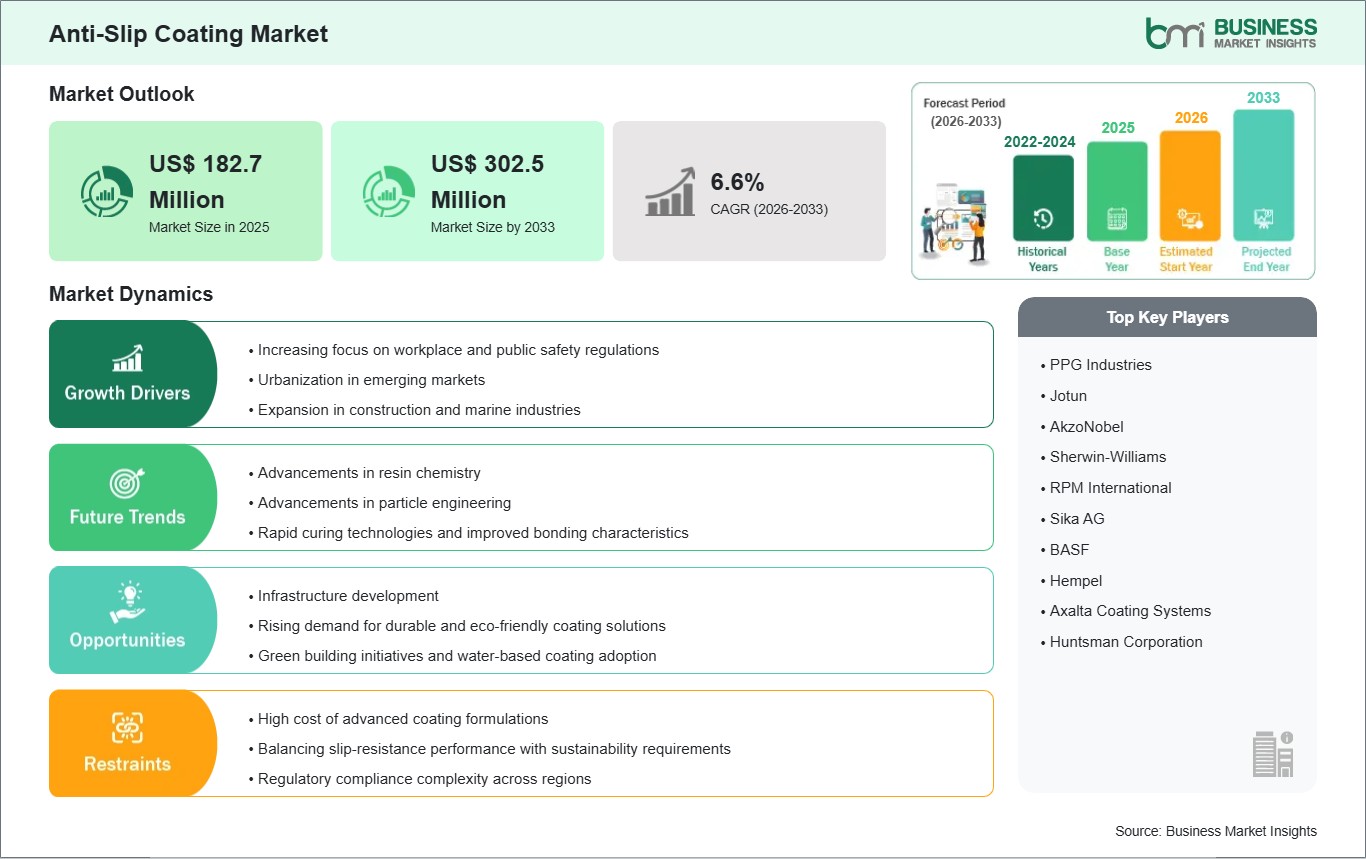
The Anti-Slip Coating Market size is expected to reach US$ 302.5 Million by 2033 from US$ 182.7 Million in 2025 .The market is estimated to record a CAGR of 6.6% from 2026 to 2033.
The global anti-slip coating market is growing rapidly. The world-wide anti-skid coating marketplace continues to develop at a rapid pace due to growing demand for safer surfaces across residential, commercial and industrial applications. Anti-slip coatings are used on many different types of surfaces to provide traction and diminish the risk of slip and fall accidents. Typically, these surfaces have been exposed to water, chemicals or foot traffic.
Anti-slip coatings have been adopted in applications such as flooring, boat decks, manufacturing facilities and other public infrastructure. The ability of anti-slip coatings to create safer environments while providing a high degree of durability and aesthetic appeal have made them integral to today`s construction industry.
With advances in coating technology, high performance coating systems such as epoxy, polyurethane and polyaspartic have been developed that provide enhanced adhesion, chemical resistance and longevity. Furthermore, the upward trend towards the use of environmentally safe formulations (i.e., water-based coatings) is growing as a result of increasing environmental regulations and focus on sustainability.

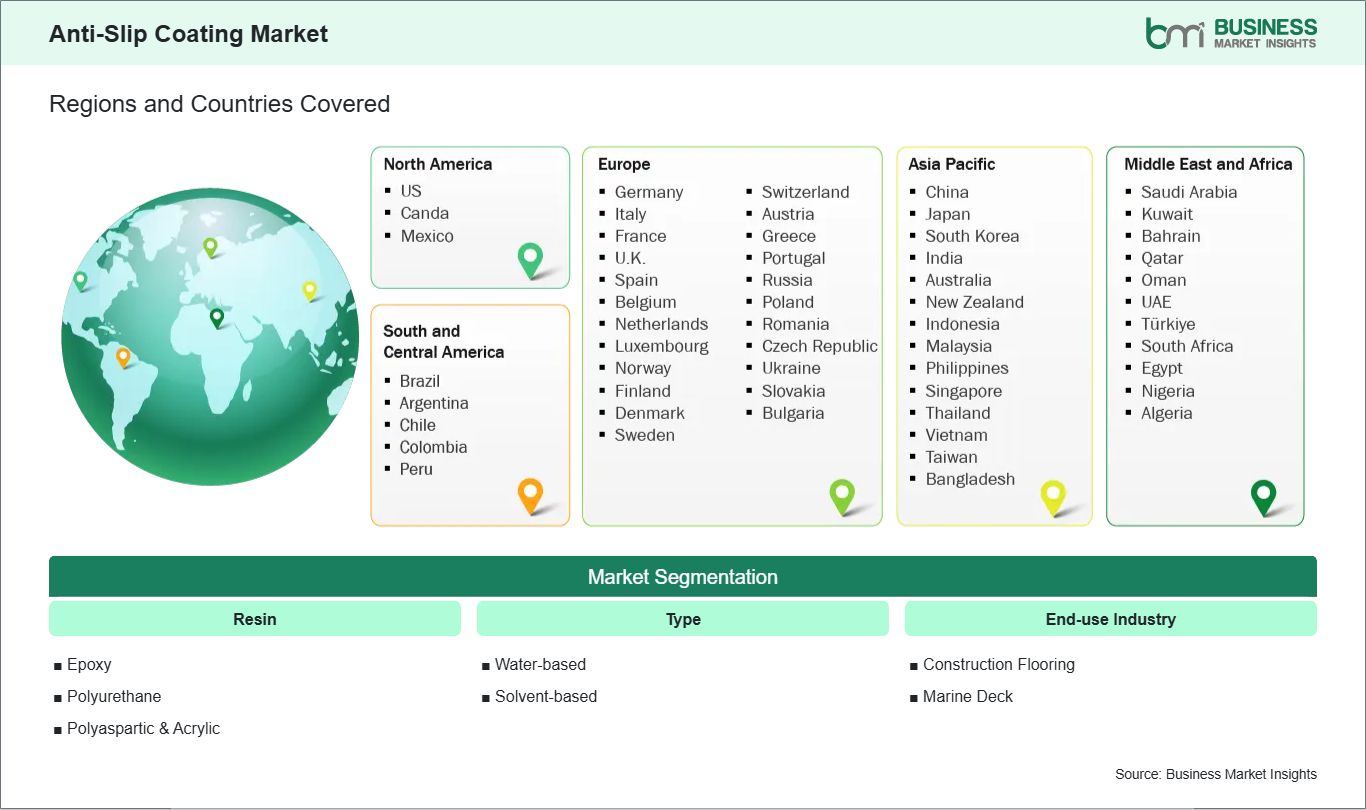
Key segments that contributed to the derivation of the anti-slip coating market analysis are resin, type, and end-use industry.
The rising emphasis on workplace and public safety has become a central driver of demand for anti‑slip coatings. Governments and regulatory bodies worldwide are tightening safety standards to reduce accidents and ensure compliance in commercial buildings, industrial facilities, and public infrastructure. These regulations mandate slip‑resistant surfaces in high‑risk areas, compelling industries to adopt advanced coating solutions. As awareness of occupational hazards grows, companies are increasingly proactive in implementing safety measures, not only to meet legal requirements but also to protect employees, customers, and the public.
Anti‑slip coatings are widely applied to walkways, ramps, staircases, and factory floors, where the risk of slips and falls is highest. Their adoption is particularly strong in construction, manufacturing, healthcare, and hospitality—sectors where safety lapses can have severe consequences. Hospitals and care facilities rely on slip‑resistant flooring to safeguard patients and staff, while factories and warehouses use them to protect workers in demanding environments. Public infrastructure projects, such as transit stations and municipal walkways, also integrate anti‑slip coatings to enhance accessibility and safety.
Beyond compliance, businesses recognize that investing in safety reduces liability costs and enhances brand reputation. This dual benefit is accelerating adoption across industries. With innovations in coating formulations—such as eco‑friendly options and improved bonding technologies—the market is poised for sustained growth. The convergence of regulatory pressure, heightened safety awareness, and technological progress ensures that anti‑slip coatings will remain a critical component of modern infrastructure and industrial design.
are not only more resistant to wear and tear than ever before, but they also provide greater protection from chemicals and extreme temperatures. Polyurethane-based anti-slip coatings are becoming increasingly popular as they provide excellent protection from environmental challenges, allowing for longer lasting performance in the toughest situations. In addition, because of their ability to retain their slip resistance for long periods of time, polyurethane-based anti-slip coatings have become a necessity in areas where dependability and safety are considered vital.
In conjunction with these trends, there is a worldwide trend toward the use of eco-friendly products in the coatings industry. Strong governmental regulations and increasing consumer demand for environmentally sound products have caused a rapid increase in the development and use of water-based coatings that emit low VOC emissions. These environmentally friendly coatings are designed to reduce the amount of harmful chemicals released into the environment, and they are also much safer to use due to the lack of harmful fumes when applied. Because of the difficulty in balancing performance with sustainability concerns, companies are investing heavily in R&D to develop products that provide both high levels of slip resistance and meet the requirements for green building certification.
Finally, technological advances in both the field of particle engineering and resin chemistry are continuing to expand the capabilities of anti-slip coatings. More rapid curing times, improved bonding characteristics, and higher quality surface finishes are all a result of these advances. Together, new products created using these technologies will continue to improve the performance and longevity of anti-slip coatings.

The Anti-Slip Coating Market demonstrates steady growth, with size and share analysis highlighting evolving trends and competitive dynamics among key players. The report examines subsegments categorized within resin, type, and end-use industry, offering insights into their contribution to overall market performance.
By resin, the epoxy subsegment dominated the market in 2025, driven by its widespread use in industrial and commercial flooring applications.
Based on type, the water-based subsegment dominated the market in 2025, driven by increasing environmental regulations and demand for sustainable solutions.
In terms of end-use industry, the construction flooring subsegment dominated the market in 2025, driven by rapid infrastructure development and safety requirements.
| Report Attribute | Details |
|---|---|
| Market size in 2025 | US$ 182.7 Million |
| Market Size by 2033 | US$ 302.5 Million |
| Global CAGR (2026 - 2033) | 6.6% |
| Historical Data | 2022-2024 |
| Forecast period | 2026-2033 |
| Segments Covered | By Resin
|
|
Regions and Countries Covered
| |
| North America | US, Canada, Mexico |
| Europe | Belgium, Austria, Finland, Denmark, Greece, Poland, Romania, Russia, Ukraine, Czech Republic, Slovakia, Bulgaria, Italy, Luxembourg, Germany, Switzerland, France, Netherlands, Norway, Portugal, Spain, Sweden, United Kingdom |
| Asia-Pacific | Australia, China, India, Japan, South Korea, Indonesia, Malaysia, Philippines, Singapore, Thailand, Vietnam, Bangladesh, New Zealand, Taiwan |
| South and Central America | Brazil, Argentina, Peru, Chile, Colombia |
| Middle East and Africa | Bahrain, Kuwait, Oman, Qatar, Saudi Arabia, United Arab Emirates, Turkiye, South Africa, Egypt, Algeria, Nigeria |
| Market leaders and key company profiles |
|
The "Anti-Slip Coating Market Size and Forecast (2022 - 2033)" report provides a detailed analysis of the market covering below areas:
The geographical scope of the Anti-Slip Coating Market report is divided into North America, Asia Pacific, Europe, Middle East & Africa, and South & Central America. North America held the largest share in 2025.
North America and Europe are characterized by stringent safety regulations and high adoption of advanced coating technologies. These regions emphasize compliance with occupational safety standards and environmental regulations, driving demand for eco-friendly anti-slip coatings.
Asia Pacific market is growing due to rapid urbanization, increasing construction activities, and growing awareness of safety standards in countries such as China and India. Infrastructure development and industrial expansion are key drivers in the region.
The Middle East & Africa and South & Central America are witnessing gradual growth, supported by infrastructure investments and rising industrial activities. Across all regions, regulatory frameworks and construction trends significantly influence market dynamics.

The Anti-Slip Coating Market is evaluated by gathering qualitative and quantitative data post primary and secondary research, which includes important corporate publications, association data, and databases. A few of the key developments in the anti-slip coating market are:
The Anti-Slip Coating Market is valued at US$ 182.7 Million in 2025, it is projected to reach US$ 302.5 Million by 2033.
As per our report Anti-Slip Coating Market, the market size is valued at US$ 182.7 Million in 2025, projecting it to reach US$ 302.5 Million by 2033. This translates to a CAGR of approximately 6.6% during the forecast period.
The Anti-Slip Coating Market report typically cover these key segments-
The historic period, base year, and forecast period can vary slightly depending on the specific market research report. However, for the Anti-Slip Coating Market report:
The Anti-Slip Coating Market is populated by several key players, each contributing to its growth and innovation. Some of the major players include:
The Anti-Slip Coating Market report is valuable for diverse stakeholders, including:
Essentially, anyone involved in or considering involvement in the Anti-Slip Coating Market value chain can benefit from the information contained in a comprehensive market report.
Please tell us your area of interest
(Market Segments/ Regions and Countries/ Companies)