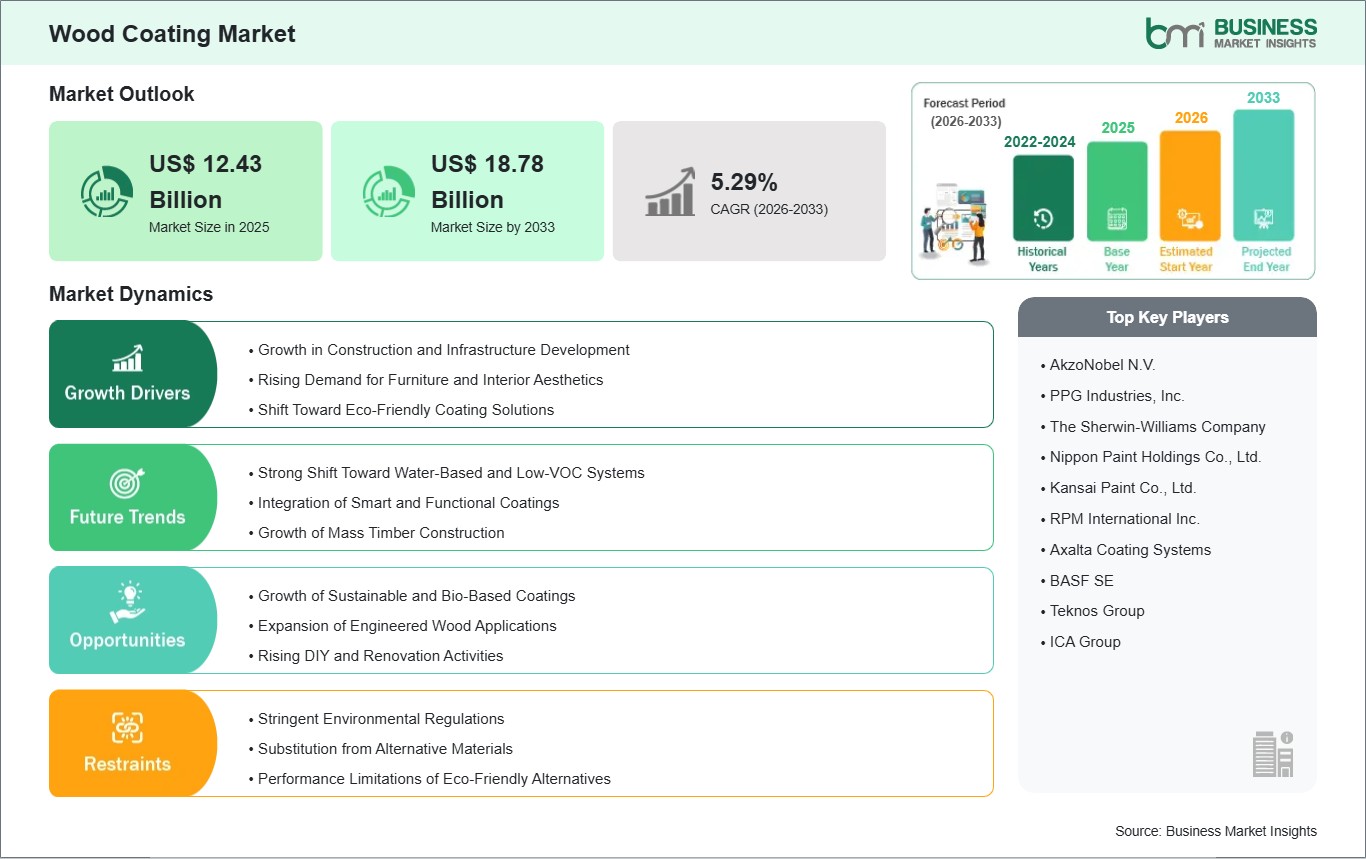
The Wood Coating Market size is expected to reach US$ 18.78 billion by 2033 from US$ 12.43 billion in 2025. The market is estimated to record a CAGR of 5.29% from 2026 to 2033.
The global wood coatings market is influenced by the extensive use of wood in furniture, flooring, cabinetry, and construction, where coatings provide both protection and aesthetic enhancement. These coatings preserve the natural appearance of wood and protect it from environmental factors such as moisture, temperature fluctuations, and surface abrasion. Market growth is driven by increasing demand for visually appealing interiors, higher living standards, and a greater consumer preference for customized and premium furniture finishes. Ongoing urbanization and infrastructure development in both developed and emerging economies sustain steady demand for wood coatings in residential and commercial sectors. Sustainability is a key factor shaping market trends. Manufacturers are increasingly adopting environmentally compliant solutions, such as water-based, powder-based, and radiation-cured coatings, in response to stricter environmental regulations and heightened awareness of indoor air quality. At the same time, innovation is focused on improving scratch resistance, chemical resistance, and application efficiency to address evolving end-user requirements.
The market faces some challenges, such as unstable raw material supply chains and the technical limits of some eco-friendly coatings compared to traditional solvent-based options. The slow shift toward engineered wood and non-wood materials in certain uses could also slow demand growth. Even so, the market stays strong thanks to ongoing improvements in coating technology and the lasting popularity of wood as a high-quality, flexible material.

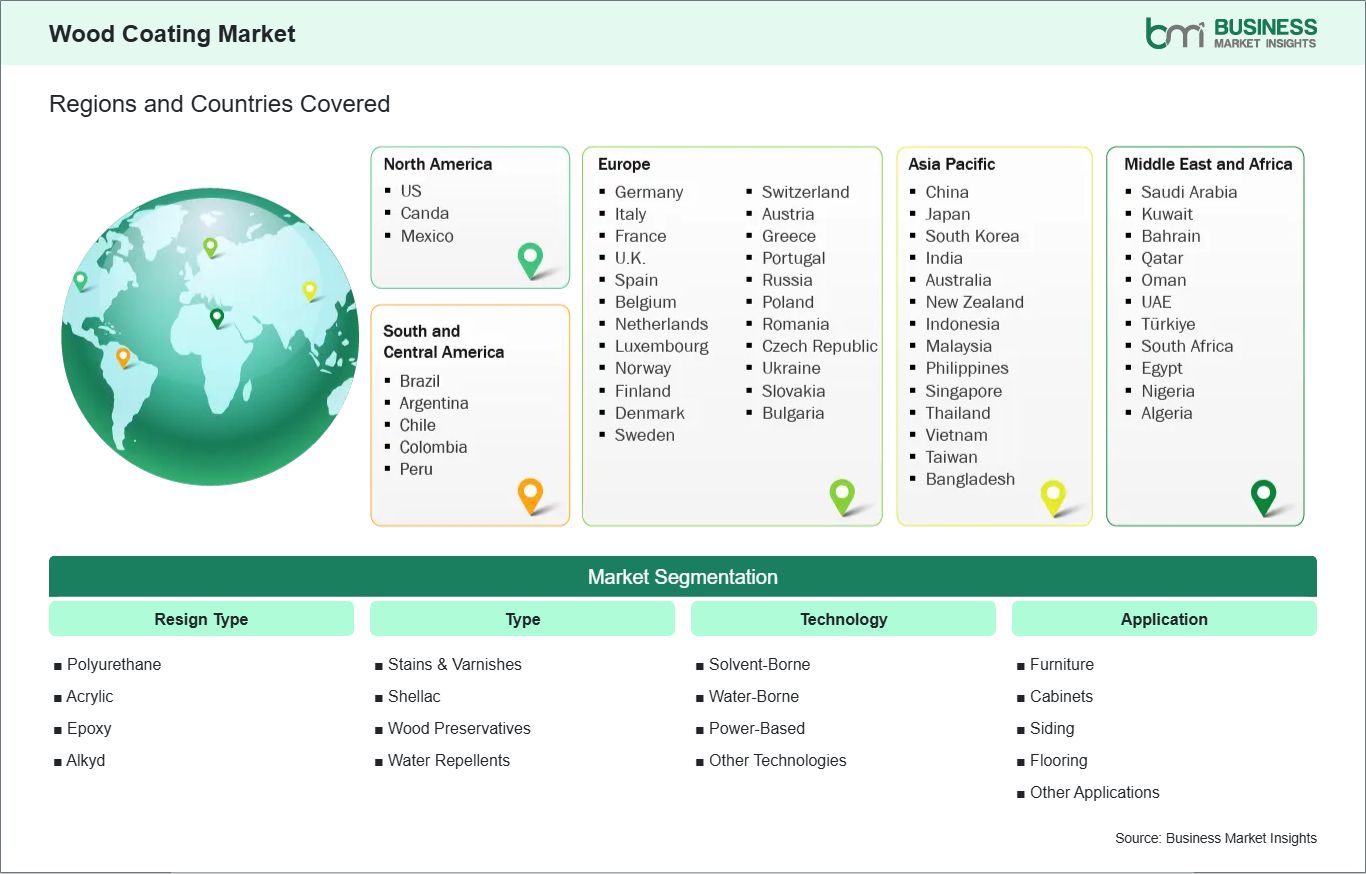
Key segments that contributed to the derivation of the Wood coating market analysis are resign type, type, technology and application
The expansion of construction and infrastructure development in global markets significantly increases demand for wood coatings, as wood remains a preferred material for both structural and decorative purposes. In residential construction, wood is commonly utilized in flooring, doors, window frames, cabinetry, and wall panelling due to its aesthetic qualities and versatility. In commercial and institutional settings, including offices, hotels, and retail spaces, wood is used to create high-end interiors and enhance visual appeal. However, untreated wood is susceptible to environmental factors such as moisture, temperature changes, ultraviolet radiation, and physical wear. Therefore, the application of coatings is essential to preserve wood's integrity and extend its service life.
The growth of construction activities, especially in rapidly urbanizing regions, has led to increased demand for coatings that offer long-term protection while maintaining the natural appearance of wood. Infrastructure projects, such as public buildings and transportation hubs, further drive this demand, as they require durable and low-maintenance materials. Furthermore, contemporary architectural trends prioritize high-quality finishes and sustainable materials, reinforcing the adoption of coated wood. The ongoing use of wood in construction applications sustains a consistent and expanding global need for advanced wood coating solutions.
As more industries focus on sustainability, the wood coatings market has a real chance to innovate, especially by creating products that are better for the environment and use resources more efficiently. Concerns about air quality, environmental impact, and health are pushing the industry away from traditional solvent-based coatings and toward low-emission options. Because of this, more customers want coatings that keep volatile organic compound (VOC) emissions low but still offer strong durability, good finish, and reliable protection. Along with low-VOC formulas, more companies are turning to renewable and bio-based materials. Manufacturers are looking at plant-based resins, natural oils, and other sustainable ingredients to rely less on petrochemicals. This shift helps the environment and fits with the wider move toward circular economic practices and responsible sourcing.
Regulations in many regions are getting stricter, so companies are moving toward greener technologies and updating their product lines. At the same time, both industrial users and individual consumers are choosing sustainable products that help create healthier indoor spaces. With both regulations and consumer demand driving change, research and development in green coatings is becoming a major way for companies to stand out and grow in the global wood coatings market.

The global Wood coating market is experiencing steady growth, with market size and share analysis reflecting evolving treatment preferences and competitive dynamics among key players. The report evaluates important subsegments categorized within resign type, type, technology and application highlighting their respective contributions to overall market performance.
By resign type, the polyurethane subsegment dominated the market in 2025 due to its due to its superior performance characteristics and wide applicability across end-use industries. It is highly preferred in furniture, flooring, and cabinetry applications because of its excellent durability, abrasion resistance, and ability to withstand moisture and chemicals.
By type, the stains & varnishes segment subsegment dominated the market in 2025 due to their dual functionality of enhancing wood appearance while providing surface protection. These coatings are extensively used across furniture, flooring, and decorative wood applications where preserving the natural grain and texture of wood is essential.
By technology, the solvent-borne subsegment dominated the market in 2025 due to its long-standing use and superior performance attributes. These coatings are widely favored for their strong adhesion, faster drying times, and ability to deliver a smooth and durable finish, especially in industrial and large-scale manufacturing settings.
By application, the furniture subsegment dominated the market in 2025 because of rapid growth in strong global demand for both residential and commercial furnishings. Wood coatings are extensively used in furniture manufacturing to enhance visual appeal, improve surface smoothness, and provide protection against scratches, stains, and environmental damage.
| Report Attribute | Details |
|---|---|
| Market size in 2025 | US$ 12.43 Billion |
| Market Size by 2033 | US$ 18.78 Billion |
| Global CAGR (2026 - 2033) | 5.29% |
| Historical Data | 2022-2024 |
| Forecast period | 2026-2033 |
| Segments Covered | By Resign Type
|
|
Regions and Countries Covered
| |
| North America | US, Canada, Mexico |
| Europe | Belgium, Austria, Finland, Denmark, Greece, Poland, Romania, Russia, Ukraine, Czech Republic, Slovakia, Bulgaria, Italy, Luxembourg, Germany, Switzerland, France, Netherlands, Norway, Portugal, Spain, Sweden, United Kingdom |
| Asia-Pacific | Australia, China, India, Japan, South Korea, Indonesia, Malaysia, Philippines, Singapore, Thailand, Vietnam, Bangladesh, New Zealand, Taiwan |
| South and Central America | Brazil, Argentina, Peru, Chile, Colombia |
| Middle East and Africa | Bahrain, Kuwait, Oman, Qatar, Saudi Arabia, United Arab Emirates, Turkiye, South Africa, Egypt, Algeria, Nigeria |
| Market leaders and key company profiles |
|
The "Wood Coating Market Size and Forecast (2022 - 2033)" report provides a detailed analysis of the market covering below areas:
The geographical scope of the Wood coating market report is divided into: North America, Asia Pacific, Europe, Middle East & Africa, and South & Central America. North America held the largest share in 2025.
North America holds a dominant position in the global wood coatings market, supported by a well-established ecosystem of furniture manufacturing, construction activities, and home improvement culture. The region demonstrates strong demand for wood coatings due to the widespread use of wood in residential interiors, particularly in flooring, cabinetry, and decorative applications. A key factor driving the market is the high level of renovation and remodeling activity, where consumers prioritize premium finishes and long-lasting surface protection.
The market in North America is characterized by a strong emphasis on product quality and compliance with environmental standards. Regulatory frameworks have encouraged the adoption of eco-friendly coating technologies, leading to a higher penetration of water-based and low-emission products. This has prompted manufacturers to continuously innovate and align their offerings with sustainability expectations while maintaining performance efficiency. Additionally, the presence of advanced manufacturing capabilities and a strong distribution network contributes to market stability. The commercial sector, including offices, hospitality, and retail spaces, also supports demand using high-quality wood finishes. While the market is relatively mature, it remains highly competitive and innovation-driven, with a clear focus on sustainability and product differentiation.

The wood coating market is evaluated by gathering qualitative and quantitative data post primary and secondary research, which includes important corporate publications, association data, and databases. A few of the key developments in the Wood coating market are:
The Wood Coating Market is valued at US$ 12.43 Billion in 2025, it is projected to reach US$ 18.78 Billion by 2033.
As per our report Wood Coating Market, the market size is valued at US$ 12.43 Billion in 2025, projecting it to reach US$ 18.78 Billion by 2033. This translates to a CAGR of approximately 5.29% during the forecast period.
The Wood Coating Market report typically cover these key segments-
The historic period, base year, and forecast period can vary slightly depending on the specific market research report. However, for the Wood Coating Market report:
The Wood Coating Market is populated by several key players, each contributing to its growth and innovation. Some of the major players include:
The Wood Coating Market report is valuable for diverse stakeholders, including:
Essentially, anyone involved in or considering involvement in the Wood Coating Market value chain can benefit from the information contained in a comprehensive market report.
Please tell us your area of interest
(Market Segments/ Regions and Countries/ Companies)