Wood Preservatives Market Outlook (2022-2033)

Historic Data: 2022-2024   |   Base Year: 2025   |   Forecast Period: 2026-2033
Report Content: Market Scope, Market Segmentation, Market Dynamics, and Competitive Analysis

Report Coverage:
  • Formulation (Water-Based, Solvent-Based, Oil-Based, Other Formulation Types)
  • Application (Residential, Commercial, Industrial, Other Application Types)

No. of Pages: 400
Report Code: BMIPUB00034650
Category: Chemicals and Materials
Wood Preservatives Market

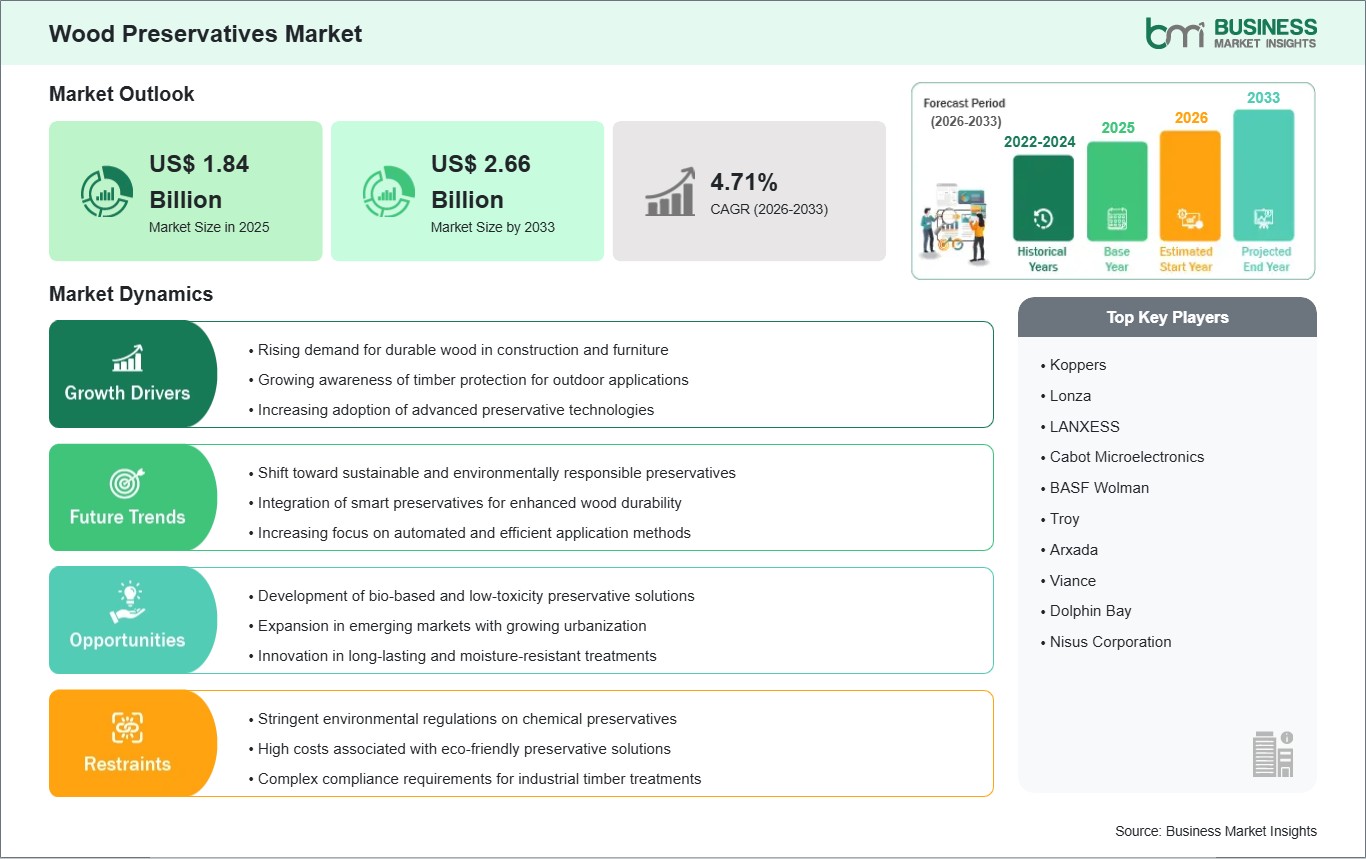
The Wood Preservatives Market size is expected to reach US$ 2.66 billion by 2033 from US$ 1.84 billion in 2025. The market is estimated to record a CAGR of 4.71% from 2026 to 2033.

Executive Summary and Global Market Analysis:

The global wood preservatives market exists to protect wood materials and wood-based products from biological agents, environmental elements and from aging too soon. Wood preservatives involve chemical treatments that wood products need to stop fungi, insects, termites and marine borers from destroying their timber and lumber, engineered wood and poles and railway ties. The products work to extend equipment lifespan while protecting structural stability and decreasing maintenance expenses for various applications which include residential building and outdoor decking and utility poles and forestry and infrastructure development. The market expansion results from rising demand for wood materials used in building construction, landscaping, outdoor furniture and infrastructure development, which requires long-lasting and safe solutions.

The demand for effective preservation technologies continues to grow because builders, architects and property owners now understand wood protection and lifecycle performance better than before. North America and Europe require advanced preservative solutions that provide effective results while maintaining eco-friendly standards because these regions use timber extensively and have active outdoor spaces. The emerging economies, which currently face rapid urban growth and infrastructure expansion, are now using wood preservatives more frequently to enhance wood product performance and durability across different climate environments. The wood preservatives market experiences significant limitations because of environmental regulations and their accompanying regulatory requirements. Certain preservative chemistries have historically generated human exposure risks and ecosystem damage because they contain heavy metals and persistent organic compounds.

The situation has led to more stringent regulations that forbid specific legacy treatments and force manufacturers to follow stricter disposal requirements and leaching controls. The evolving environmental standards create compliance challenges for manufacturers and end-users because they need to develop more expensive products that require special formulations. The market dynamics are affected by supply chain difficulties, which hinder access to high-performance preservative chemicals that meet environmental standards.

The market maintains its strength because of two factors: the development of safer, sustainable preservative technologies and the increasing demand for environmentally friendly wood protection methods. The industry adopts new organic biocide systems through its implementation of microemulsion delivery technologies and preservative systems, which use lower leaching potential. The global wood preservatives market requires this strategic shift to provide both protection and performance while meeting environmental and regulatory requirements, which differ among various regions.

Wood Preservatives Market - Strategic Insights:

global-market-strategic-framework
Get more information on this report

Wood Preservatives Market Segmentation Analysis:

Key segments that contributed to the derivation of the wood preservatives market analysis are formulation and application.

  • By formulation, the wood preservatives market is segmented into water‑based, solvent‑based, oil‑based, other formulation types. The water‑based segment dominated the market in 2025.
  • Based on application, the wood preservatives market is categorized into residential, commercial, industrial, other application types. The residential segment dominated the market in 2025.

Wood Preservatives Market Drivers and Opportunities:

Rising demand for durable wood in construction and furniture

The global wood preservatives market shows increasing growth because construction, furniture, and outdoor applications require wood materials that can endure through time. Wood preservatives create essential protection for timber because they stop fungal decay, termite damage and other pest attacks while also increasing wood resistance against moisture, ultraviolet light and environmental pressures. North America demonstrates a strong demand for treated wood used in residential construction and decking, fencing and utility pole installation, which requires permanent wood protection solutions that can fulfill both structural performance needs and government standards.

Europe operates as an established market where preservative formulation and usage are controlled through strict environmental rules. The U.K., Germany and France focus on developing environmentally friendly solutions that provide durability while reducing chemical leaching and ecological damage. Advanced wood preservatives are also adopted in heritage restoration projects and premium furniture manufacturing, reflecting high consumer expectations for long-lasting, safe timber products.

The Asia Pacific region experiences fast growth of wood preservatives because cities expand, infrastructure projects progress and middle-class people start to consume more products. The regions of China, India and Southeast Asia require cost-effective solutions to preserve plywood and engineered wood and outdoor furniture against high humidity and diverse climate conditions. The combination of performance standards, compliance requirements, and regional adaptability establishes durable wood protection as the main factor driving global market expansion.

Development of bio-based and low-toxicity preservative solutions

Bio-based and low-toxicity wood preservatives represent a significant global growth opportunity as environmental awareness and regulatory pressure intensify. These solutions reduce the use of heavy metals and harmful organics while maintaining performance, aligning with sustainability objectives and consumer preference for safer timber products. In North America, manufacturers are innovating waterborne and organic preservatives to meet strict EPA regulations and public demand for environmentally responsible treatments.

Europe is a leading adopter of eco-optimized preservatives, driven by EU chemical safety directives and growing demand for sustainable building materials. Furniture, decking, and construction sectors are increasingly selecting low-toxicity treatments to achieve certifications and compliance while ensuring product longevity. This trend also encourages cross-industry collaboration between chemical formulators and timber manufacturers to develop next-generation preservative systems.

Emerging markets in Asia Pacific and South America provide opportunities for wider adoption of bio-based preservatives, where rapid urbanization and construction growth intersect with environmental initiatives. Waterborne, copper-free, and biodegradable preservative technologies are gaining traction, helping manufacturers meet regulatory standards and consumer expectations. By integrating environmental responsibility with performance, bio-based and low-toxicity preservatives are set to reshape global wood protection strategies.

Wood Preservatives Market Size and Share Analysis:

The wood preservatives market demonstrates steady growth, with size and share analysis highlighting evolving trends and competitive dynamics among key players. The report examines subsegments categorized within formulation and application, offering insights into their contribution to overall market performance.

By formulation, the water‑based subsegment dominated the market in 2025, driven by its eco-friendly properties, ease of application, and compliance with stringent environmental regulations.

In terms of application, the residential subsegment dominated the market in 2025, driven by high consumption of treated wood in homes for structural and decorative applications.

Wood Preservatives Market Report Highlights:

Report Attribute Details
Market size in 2025 US$ 1.84 Billion
Market Size by 2033 US$ 2.66 Billion
Global CAGR (2026 - 2033)4.71%
Historical Data 2022-2024
Forecast period 2026-2033
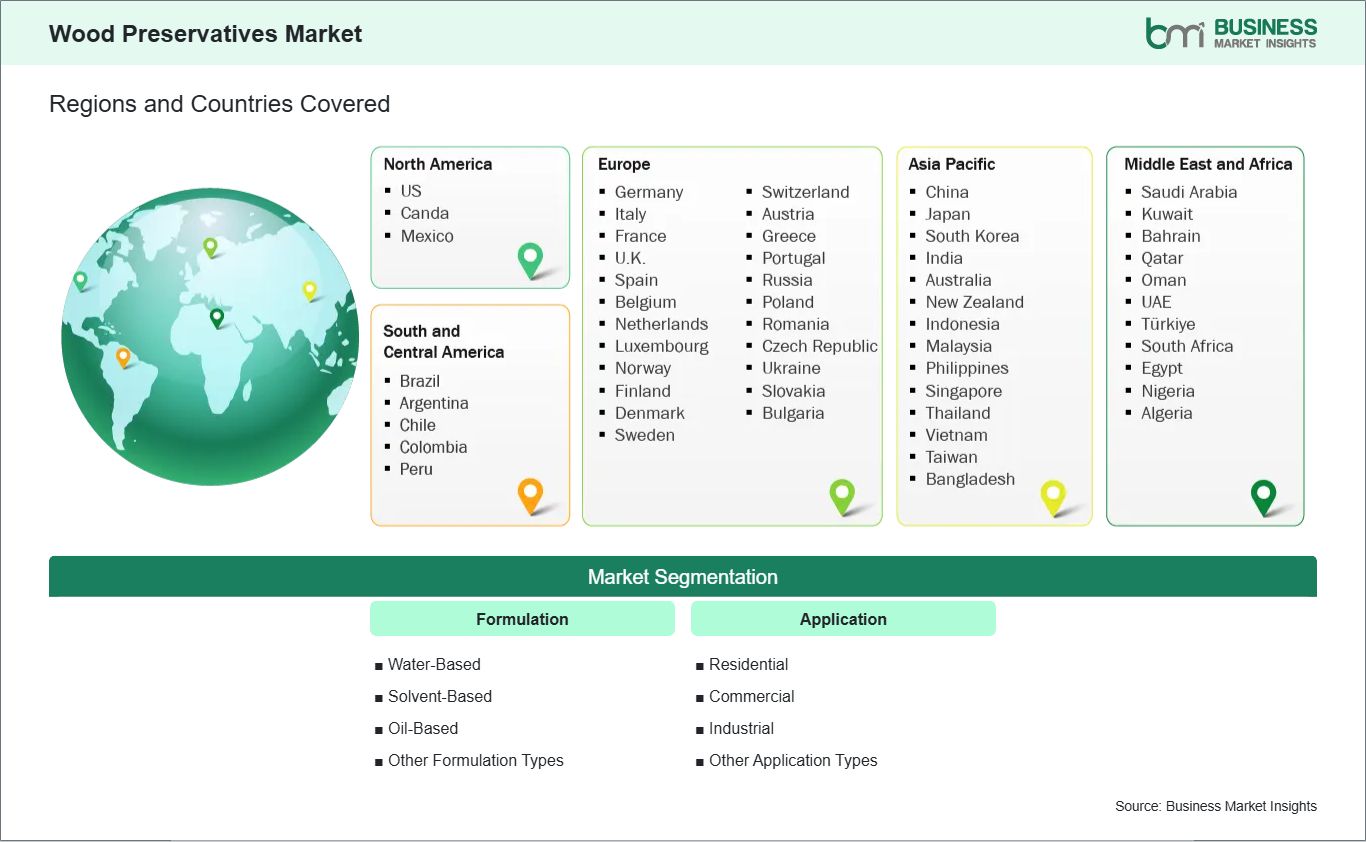
Segments Covered By Formulation
  • Water-Based
  • Solvent-Based
  • Oil-Based
  • Other Formulation Types
By Application
  • Residential
  • Commercial
  • Industrial
  • Other Application Types
Regions and Countries Covered
North America US, Canada, Mexico
Europe Belgium, Austria, Finland, Denmark, Greece, Poland, Romania, Russia, Ukraine, Czech Republic, Slovakia, Bulgaria, Italy, Luxembourg, Germany, Switzerland, France, Netherlands, Norway, Portugal, Spain, Sweden, United Kingdom
Asia-Pacific Australia, China, India, Japan, South Korea, Indonesia, Malaysia, Philippines, Singapore, Thailand, Vietnam, Bangladesh, New Zealand, Taiwan
South and Central America Brazil, Argentina, Peru, Chile, Colombia
Middle East and Africa Bahrain, Kuwait, Oman, Qatar, Saudi Arabia, United Arab Emirates, Turkiye, South Africa, Egypt, Algeria, Nigeria
Market leaders and key company profiles
  • Koppers
  • Lonza
  • LANXESS
  • Cabot Microelectronics
  • BASF Wolman
  • Troy
  • Arxada
  • Viance
  • Dolphin Bay
  • Nisus Corporation
Get more information on this report

Wood Preservatives Market Report Coverage and Deliverables:

The "Wood Preservatives Market Size and Forecast (2022 - 2033)" report provides a detailed analysis of the market covering below areas:

  • Wood Preservatives Market size and forecast at global, regional, and country levels for all the key market segments covered under the scope
  • Wood Preservatives Market trends, as well as drivers, restraints, and opportunities
  • Wood Preservatives Market analysis covering key trends, global and regional framework, major players, regulations, and recent developments
  • Industry landscape and competition analysis covering market concentration, heat map analysis, prominent players, and recent developments for the Wood Preservatives Market
  • Detailed company profiles, including SWOT analysis

Wood Preservatives Market Geographic Insights:

The geographical scope of the Wood Preservatives Market report is divided into North America, Asia Pacific, Europe, Middle East & Africa, and South & Central America. North America held the largest share in 2025.

North America controls the international wood preservatives market because its construction industry has reached maturity, its outdoor timber operations are extensive, and its environmental and safety regulations are strict. The United States and Canada require high-performance preservative solutions for their residential and commercial construction needs, as well as utility poles, decking, fencing and marine timber, which must provide long-lasting protection against moisture and insects and meet all regulatory requirements. The region adopts innovative preservative formulations that contain low leach potential and environmentally responsible chemistries because it aims to achieve sustainable performance standards.

The European market operates through advanced technology, which enables Germany, France and the U.K. to enforce strict EU chemical safety regulations and emission control laws that create a market need for environmentally safe non-toxic preservatives used in industrial and residential settings. European furniture, flooring and timber construction projects demand advanced protective formulations that deliver decay and termite protection while reducing environmental harm.

Urbanization, infrastructure development and rising timber demand in China, India and Southeast Asian countries drive the rapid growth of the Asia Pacific region. The area needs preservation methods that deliver affordable results yet maintain their effectiveness under different weather conditions, high moisture levels and intense usage. The Middle East and Africa market experiences development through rising infrastructure projects and industrial timber usage, which drives wood preservative imports from the UAE, Saudi Arabia and South Africa to protect against extreme weather conditions despite weaker regulations compared to North America and Europe. T

he South and Central American region, which includes Brazil, Mexico and Argentina, experiences economic growth through its expansion of residential construction and commercial building projects and its development of forestry and furniture manufacturing sectors, which choose domestic affordable preservation products that provide necessary protection and reasonable costs. The North American market achieves superiority in regulatory compliance and technological advancements and high-performance solutions, while other regions experience industrial growth, urban expansion and increasing wood durability knowledge, which together create a global demand for environmentally friendly high-quality wood preservation methods.

global-market-geography
Get more information on this report

Wood Preservatives Market Research Report Guidance:

  • The report includes qualitative and quantitative data in the Wood Preservatives Market across formulation, application, and geography.
  • The report starts with the key takeaways (chapter 2), highlighting key trends and outlook of the Wood Preservatives Market.
  • Chapter 3 focuses on the research methodology of the study.
  • Chapter 4 includes ecosystem analysis.
  • Chapter 5 highlights the major industry dynamics in the Wood Preservatives Market, including factors that are driving the market, prevailing deterrents, potential opportunities, as well as future trends. Impact analysis of these drivers and restraints is also covered in this section.
  • Chapter 6 discusses the Wood Preservatives Market scenario, in terms of historical market revenues, and forecast till the year 2033.
  • Chapters 7 to 9 cover Wood Preservatives Market segments by formulation,  application, and geography across North America, Asia Pacific, Europe, Middle East & Africa, and South & Central America. They cover the market revenue forecast and factors driving the market.
  • Chapter 10 describes the competitive analysis along with the heat map analysis for the key players operating in the market.
  • Chapter 11 describes the industry landscape analysis. It provides detailed descriptions of business activities such as market initiatives, new developments, mergers, and joint ventures globally, along with a competitive landscape.
  • Chapter 12 provides detailed profiles of the major companies operating in the Wood Preservatives Market. Companies have been profiled on the basis of their key facts, business descriptions, products, financial overview, SWOT analysis, and key developments.
  • Chapter 13, i.e., the appendix, is inclusive of a brief overview of the company, a list of abbreviations, and a disclaimer.

Wood Preservatives Market News and Key Development:

The Wood Preservatives Market is evaluated by gathering qualitative and quantitative data post primary and secondary research, which includes important corporate publications, association data, and databases. A few of the key developments in the wood preservatives market are:

  • In November 2024, Woodsafe Timber Protection announced that it launched a study to conduct long‑term testing of fire‑retardant treated wood in its new research laboratory to strengthen its product performance and safety for timber protection, showcasing ongoing innovation in treated wood and preservative testing methods.
  • In April 2024, Koppers Holdings Inc. announced that its wholly owned subsidiary completed the acquisition of substantially all the assets of Brown Wood Preserving Company, expanding its treated wood and preservatives portfolio and strengthening its utility pole treatment business footprint in North America and beyond.

Key Sources Referred:

  • World Health Organization (WHO)
  • Organisation for Economic Cooperation and Development (OECD)
  • The World Bank Group
  • Worldometer
  • The Lancet
  • International Bar Association
  • International Trade Administration
The List of Companies - Wood Preservatives Market
  • Koppers
  • Lonza
  • LANXESS
  • Cabot Microelectronics
  • BASF Wolman
  • Troy
  • Arxada
  • Viance
  • Dolphin Bay
  • Nisus Corporation
Frequently Asked Questions
How big is the Wood Preservatives Market?

The Wood Preservatives Market is valued at US$ 1.84 Billion in 2025, it is projected to reach US$ 2.66 Billion by 2033.

What is the CAGR for Wood Preservatives Market by (2026 - 2033)?

As per our report Wood Preservatives Market, the market size is valued at US$ 1.84 Billion in 2025, projecting it to reach US$ 2.66 Billion by 2033. This translates to a CAGR of approximately 4.71% during the forecast period.

What segments are covered in this report?

The Wood Preservatives Market report typically cover these key segments-

  • Formulation (Water-Based, Solvent-Based, Oil-Based, Other Formulation Types)
  • Application (Residential, Commercial, Industrial, Other Application Types)

What is the historic period, base year, and forecast period taken for Wood Preservatives Market?

The historic period, base year, and forecast period can vary slightly depending on the specific market research report. However, for the Wood Preservatives Market report:

  • Historic Period : 2022-2024
  • Base Year : 2025
  • Forecast Period : 2026-2033
  • Who are the major players in Wood Preservatives Market?

    The Wood Preservatives Market is populated by several key players, each contributing to its growth and innovation. Some of the major players include:

  • Koppers
  • Lonza
  • LANXESS
  • Cabot Microelectronics
  • BASF Wolman
  • Troy
  • Arxada
  • Viance
  • Dolphin Bay
  • Nisus Corporation
  • Who should buy this report?

    The Wood Preservatives Market report is valuable for diverse stakeholders, including:

    • Investors: Provides insights for investment decisions pertaining to market growth, companies, or industry insights. Helps assess market attractiveness and potential returns.
    • Industry Players: Offers competitive intelligence, market sizing, and trend analysis to inform strategic planning, product development, and sales strategies.
    • Suppliers and Manufacturers: Helps understand market demand for components, materials, and services related to concerned industry.
    • Researchers and Consultants: Provides data and analysis for academic research, consulting projects, and market studies.
    • Financial Institutions: Helps assess risks and opportunities associated with financing or investing in the concerned market.

    Essentially, anyone involved in or considering involvement in the Wood Preservatives Market value chain can benefit from the information contained in a comprehensive market report.

    Available Report Formats

    pdf-format excel-format pptx-format
    Buy Now
    Sales Assistance
    +1 646 791 7070 (US & UK)
    Customization Form

    Please tell us your area of interest
    (Market Segments/ Regions and Countries/ Companies)