Market Summary
Executive Summary and Global Market Analysis
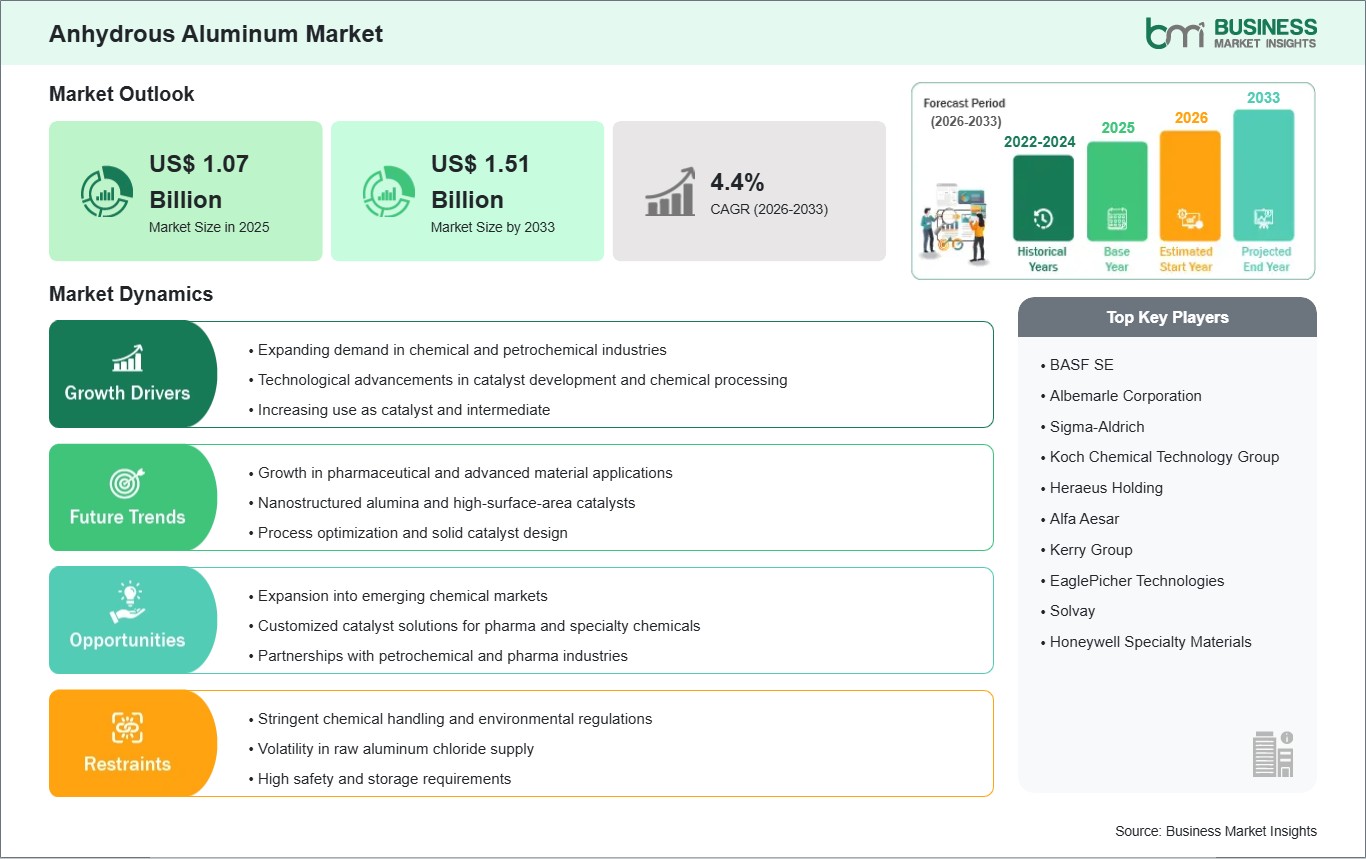
The global anhydrous aluminum market, primarily represented by anhydrous aluminum compounds such as aluminum chloride, is witnessing steady growth due to its extensive use as a catalyst and intermediate in chemical processing industries. These materials are valued for their high reactivity, strong Lewis acid properties, and effectiveness in facilitating complex chemical reactions across diverse industrial applications.
Anhydrous aluminum plays a critical role in the production of dyes, pigments, pharmaceuticals, and petrochemical derivatives. Its function as a catalyst in Friedel–Crafts reactions and other synthesis processes makes it indispensable in chemical manufacturing. The market is also influenced by increasing demand from end-use sectors such as textiles, paints and coatings, plastics, and specialty chemicals.
From a competitive standpoint, manufacturers are focusing on improving production efficiency, ensuring consistent purity levels, and enhancing supply chain reliability. Additionally, regulatory compliance related to handling and storage of reactive chemicals is shaping operational strategies. Companies are also investing in advanced catalytic applications and process optimization to strengthen their market position.
Segment Analysis
Anhydrous Aluminum Market Segmentation
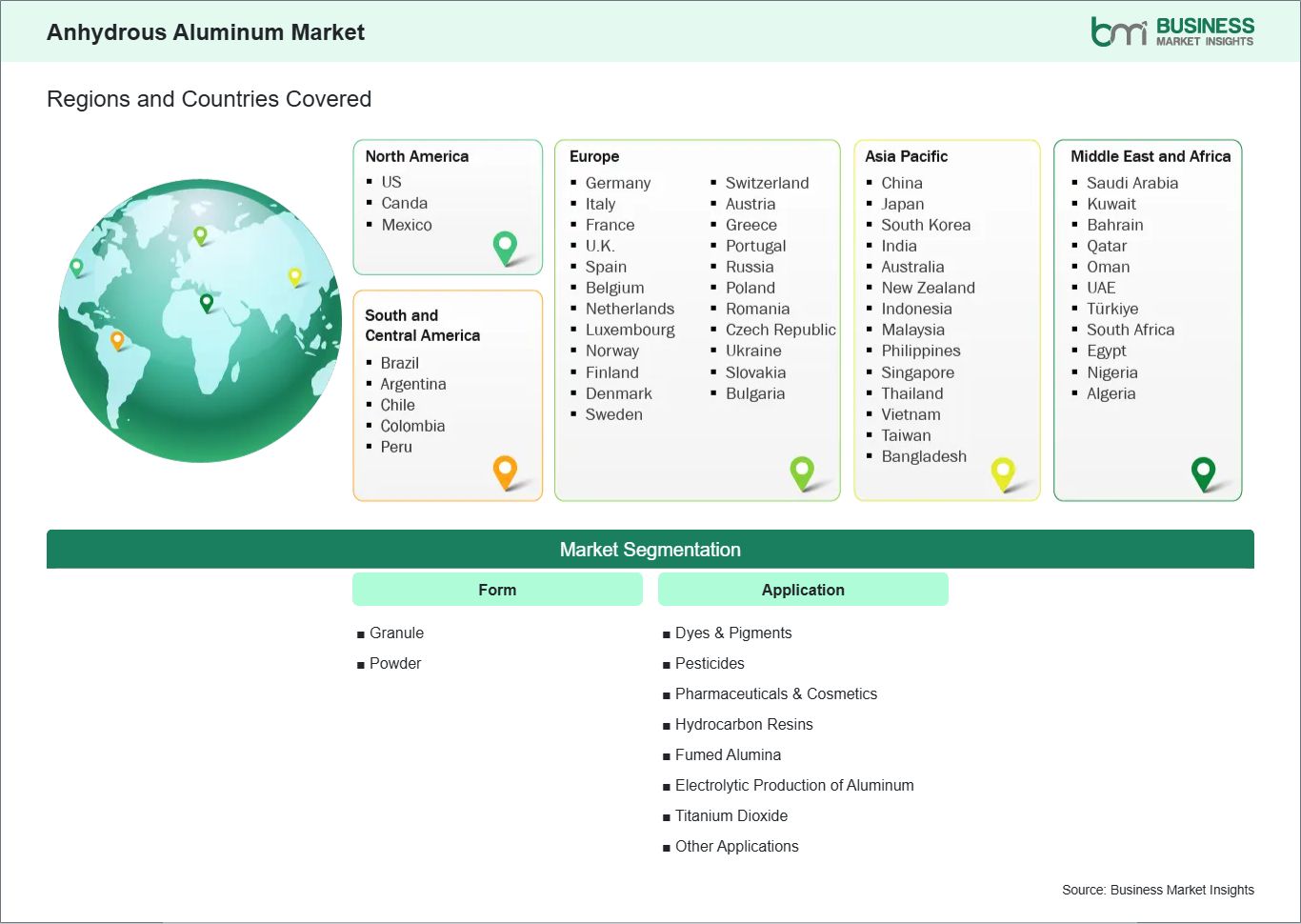
Key segments that contributed to the derivation of the anhydrous aluminum market analysis are form and application.
- By form, the anhydrous aluminum market is segmented into granule and powder. The granule segment dominated the market in 2025.
- In terms of application, the anhydrous aluminum market is segmented into dyes & pigments, pesticides, pharmaceuticals & cosmetics, hydrocarbon resins, fumed alumina, electrolytic production of aluminum, titanium dioxide, and other applications. The dyes & pigments segment dominated the market in 2025.
Market Forces
Anhydrous Aluminum Market Drivers and Opportunities
Expanding Demand in Chemical and Petrochemical Industries
Aluminum compounds without water in them are used in chemical and petroleum processing for a wide variety of applications including synthesis reactions where such compounds are used as catalysts; for example, aluminum catalysts will help manufacturers produce specialty chemicals, colors (pigments), and hydrocarbon resins. In addition, the aluminum catalyst will not only improve the efficiency of arranging the products together but will also maximize the overall yield because they are added in relatively small quantities compared to the size of an entire batch production. The increase in demands for specialty chemical products and coatings and plastic materials has reinforced the use of aluminum compounds without water in them as manufacturers look for ways to increase the quality of their final product while reducing manufacturing costs.
In the case of petroleum processing, aluminum catalysts without water in them are used during petroleum refining operations as well as during polymer* production operations where they provide improved overall throughput and better control of the characteristics of the final products. The global demand for energy continues to increase as a result of the growing world economy, therefore, every day petrochemical companies are focusing more and more on refining processes using the latest advanced refining technologies, which not only provide the petrochemical industry with new opportunities to work with catalyst suppliers but also help support the need for cleaner burning fuels and more sustainable chemical production, which highly depends on the use of highly efficient catalytic materials such as aluminum compounds without water in them. As a result of their various chemical applications, the demand for aluminum compounds without water in them will experience continued steady growth, due to the rapid expansion in new applications for them as well as rapid advancements being made in the areas of catalytic material design and chemical engineering.
Growth in Pharmaceutical and Advanced Material Applications
Anhydrous aluminum compounds are increasingly popular due to their ability to act as catalysts for synthesizing drugs and producing intermediates in the pharmaceutical industry. They are used extensively to manufacture active pharmaceutical ingredients (APIs) and also make an essential contribution to ensuring both purity and efficiency in complex chemical processes. In addition to pharmaceuticals, anhydrous aluminum is utilized for producing fumed alumina, which is used primarily in advanced materials as a reinforcing agent and for producing titanium dioxide, where it serves as a nucleating agent and increases performance in pigments and coatings.
Rising demand for high-performance materials, advanced coatings, and specialty chemicals creates new opportunities for the market. The aerospace, automotive, and electronics industries increasingly need materials with enhanced durability, thermal stability, and resistance to wear, all of which can be achieved using anhydrous aluminum compounds. Advances in technology related to catalyst development and chemical processing techniques are making these compounds even more versatile by providing customized solutions for specific needs. Nanostructured alumina and high-surface-area catalysts provide improved efficiencies in drug synthesis and process efficiency.
As global healthcare requirements continue growing and high-performance materials become more widely used in high-tech industries, the projected use of anhydrous aluminum compounds will be predominantly upward because of their extensive use in pharmaceuticals, coatings, and many other applications.
Size and Share Analysis
Anhydrous Aluminum Market Size and Share Analysis
The Anhydrous Aluminum Market demonstrates steady growth, with size and share analysis highlighting evolving trends and competitive dynamics among key players. The report examines subsegments categorized within form and application, offering insights into their contribution to overall market performance.
By form, the granule subsegment dominated the market in 2025, driven by its operational advantages in industrial handling and processing.
In terms of application, the dyes & pigments subsegment dominated the market in 2025, driven by strong demand from textile, coatings, and printing industries.
Report Coverage
Anhydrous Aluminum Market Report Coverage and Deliverables
The "Anhydrous Aluminum Market Size and Forecast (2022 - 2033)" report provides a detailed analysis of the market covering below areas:
- Anhydrous Aluminum Market size and forecast at global, regional, and country levels for all the key market segments covered under the scope
- Anhydrous Aluminum Market trends, as well as drivers, restraints, and opportunities
- Anhydrous Aluminum Market analysis covering key trends, global and regional framework, major players, regulations, and recent developments
- Industry landscape and competition analysis covering market concentration, heat map analysis, prominent players, and recent developments for the Anhydrous Aluminum Market
- Detailed company profiles, including SWOT analysis
Geographic Insights
Anhydrous Aluminum Market Geographic Insights
The geographical scope of the Anhydrous Aluminum Market report is divided into North America, Asia Pacific, Europe, Middle East & Africa, and South & Central America. North America held the largest share in 2025.
North America and Europe are characterized by advanced chemical processing industries and stringent regulatory frameworks governing chemical handling and environmental impact.
Asia Pacific market is growing due to strong growth in chemical manufacturing, pharmaceuticals, and textile industries. Countries such as China and India are major consumers, driven by increasing industrialization and demand for dyes and pigments.
The Middle East & Africa and South & Central America are experiencing moderate growth, supported by expanding petrochemical industries and industrial development. Across all regions, demand is influenced by industrial activity, regulatory compliance, and technological advancements.
Industry Activity
Recent Developments
The Anhydrous Aluminum Market is evaluated by gathering qualitative and quantitative data post primary and secondary research, which includes important corporate publications, association data, and databases. A few of the key developments in the anhydrous aluminum market are:
- In March 2025, BASF SE announced the launch of an advanced catalyst development facility at its Ludwigshafen site in Germany, specifically aimed at driving innovation in aluminum chloride catalysts. This facility represents a strategic investment to strengthen BASF’s leadership in chemical catalysts, which are critical for applications in petrochemicals, pharmaceuticals, and specialty chemicals.
- In February 2025, BASF SE inaugurated a new catalyst development and solids processing center at its Ludwigshafen headquarters, further reinforcing its global catalyst innovation capabilities. This facility complements BASF’s existing R&D infrastructure and focuses on the design, testing, and scale‑up of solid catalysts, including aluminum chloride and other advanced materials.
Trust & Transparency
Research Methodology
The market analysis combines proprietary research with secondary data from government agencies, company disclosures, regulatory filings, industry databases and expert interviews. Market estimates are validated through data triangulation, cross-market benchmarking and analyst
review.
View Full Research Methodology
Key Sources Referred:
Ministry of Mines, Government of IndiaGeological Survey of India (GSI)Indian Bureau of Mines (IBM)Central Pollution Control Board (CPCB, India)Bureau of Energy Efficiency (BEE, India)International Organization for Standardization (ISO)European Chemicals Agency (ECHA)U.S. Environmental Protection Agency (EPA)International Trade Administration