
Aluminum Oxide Market Outlook: Size, Share, Trends, Growth Analysis, Competitive Landscape & Forecast, 2026-2033

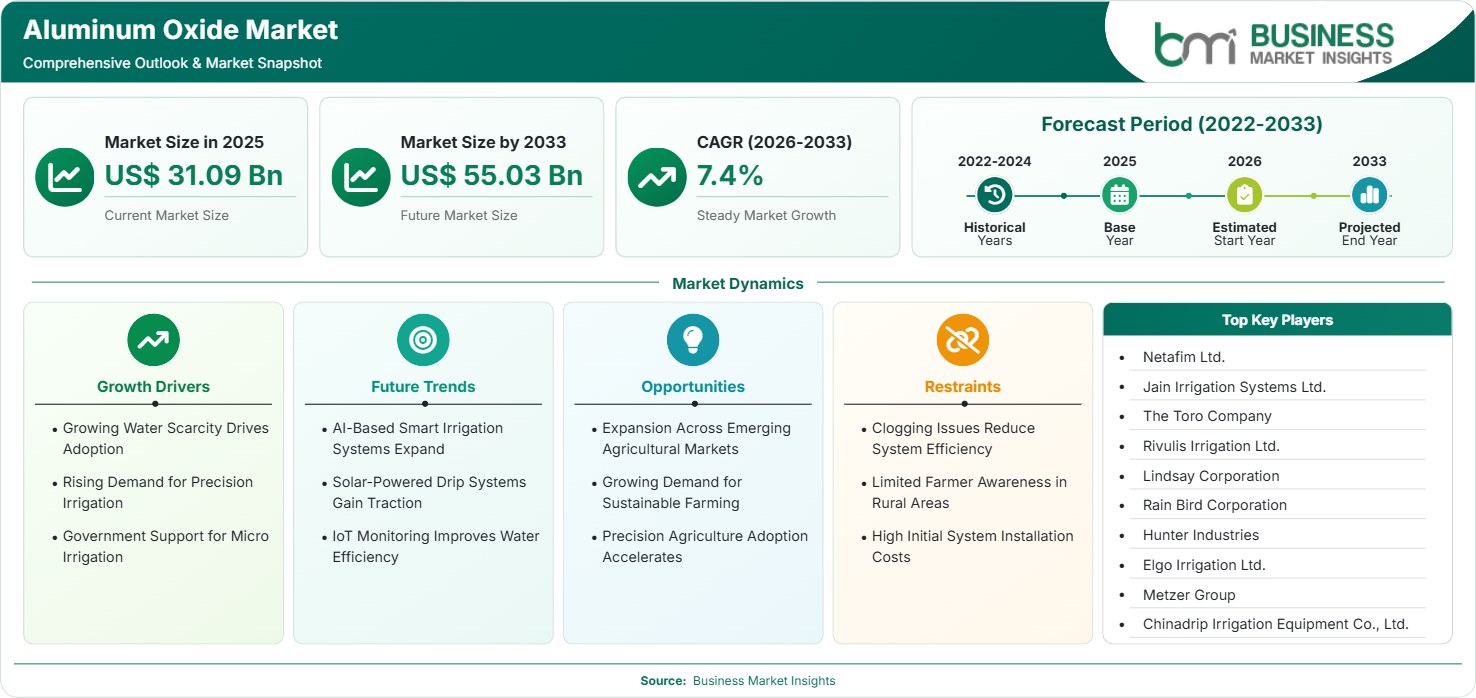
The Aluminum Oxide Market size was valued at US$ 31.09 billion in 2025 and is projected to reach US$ 55.03 billion by 2033, growing at a CAGR of 7.4% from 2026 to 2033, driven by aluminum production expansion, rising demand for high-performance abrasives, refractory applications, advanced ceramics manufacturing, and increasing industrial material requirements.

Report Coverage
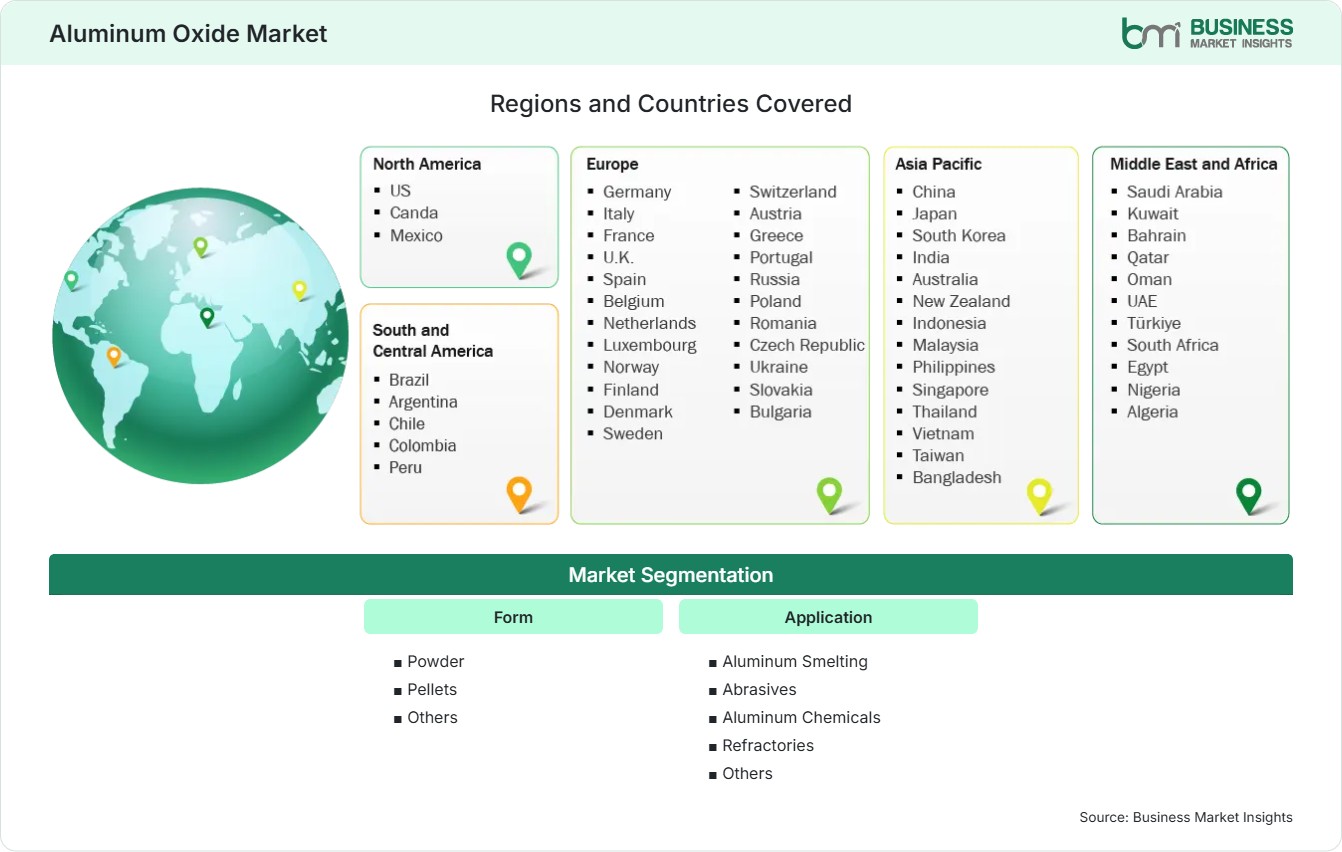
  • Form: Powder, Pellets, Others
  • Application: Aluminum Smelting, Abrasives, Aluminum Chemicals, Refractories, Others
US$ 31.09 Bn Market size in 2025
US$ 55.03 Bn Market Size by 2033
7.4% CAGR, 2026 - 2033
2026-2033 Forecast Period

01 AI Overview

Aluminum Oxide Market Summary

  • North America Region: North America holds 19%–22% share in 2025, growing with a CAGR of 6.8%–7.4% influenced by aluminum industry modernization, aerospace material demand, advanced ceramics adoption, and industrial manufacturing expansion. The US market analysis shows growth with a CAGR of 6.9%–7.5% from 2026–2033, supported by domestic aluminum production, infrastructure development, and demand for specialty alumina applications.
  • Fastest Growing Region: Asia Pacific holds 52%–55% share in 2025, expanding with a CAGR of 8.0%–8.7% due to increasing aluminum production capacity, infrastructure investments, industrialization, automotive manufacturing growth, and rising consumption of advanced materials.
  • Leading Segment: Aluminum Smelting holds 58%–62% aluminum oxide market share in 2025, growing with a CAGR of 7.2%–7.8% supported by increasing primary aluminum production, transportation demand, renewable energy infrastructure, and expanding industrial applications.
  • High Growth Segment: Refractories hold 12%–15% share in 2025, expanding with a CAGR of 8.1%–8.8% due to steel industry growth, high-temperature applications, furnace modernization, and demand for durable heat-resistant materials.
  • Key Market Opportunity: Growing adoption of lightweight materials, advanced ceramics, sustainable aluminum production technologies, and emerging industrial applications is creating opportunities for aluminum oxide manufacturers globally.
  • Major Market Players: Alcoa Corporation, Rio Tinto plc, Norsk Hydro ASA, RUSAL, Vedanta Limited, Sumitomo Chemical Co., Ltd., Almatis GmbH, Imerys S.A., Hindalco Industries Limited, and Washington Mills.
02 Strategic Insights

Aluminum Oxide Market: Strategic Insights

Aluminum Oxide Market Strategic Framework
FREE PDF
Request your free sample
Request free sample
03 Stakeholder View

Key Takeaways

  • The value chain includes bauxite mining companies, alumina refiners, aluminum producers, specialty alumina manufacturers, distributors, and end-use industries requiring high-performance materials.
  • Growth opportunities are concentrated in aluminum smelting, refractory products, advanced ceramics, and specialty abrasive applications driven by industrial expansion and material innovation.
  • Technology development is focusing on high-purity alumina production, energy-efficient refining processes, improved particle engineering, and sustainable manufacturing techniques.
  • Asia Pacific offers strong investment potential due to expanding aluminum production capacity, infrastructure development, automotive manufacturing, and industrialization across major economies.
  • Industry consolidation is supported by strategic partnerships, capacity expansions, technology investments, and companies strengthening their positions in specialty alumina applications.
  • Future competitiveness will depend on production efficiency, sustainable sourcing, supply chain resilience, and the ability to meet growing demand for advanced industrial materials.
04 Geographic Outlook

Aluminum Oxide Market Regional Highlights

North America Aluminum Oxide Market

North America accounted for 19%–22% share in 2025 and is projected to grow at a CAGR of 6.8%–7.4% from 2026–2033. The region benefits from aerospace manufacturing, automotive lightweighting, industrial modernization, and demand for specialty materials. The United States represents the primary contributor due to established aluminum processing capabilities, infrastructure investments, and increasing demand for advanced ceramics and refractory applications.

  • The US aluminum industry is investing in domestic production capabilities and supply chain resilience to support industrial material demand.
  • Aerospace and defense applications are increasing consumption of high-performance aluminum oxide materials for specialized components.
  • Advanced ceramics manufacturers are adopting high-purity alumina for electronic and technical applications.
  • Industrial modernization programs are supporting demand for refractory materials and abrasive products.

US Aluminum Oxide Market

The US market represented 16%–19% share in 2025 and is expected to expand at a CAGR of 6.9%–7.5% from 2026–2033. Growth is supported by aluminum processing activities, aerospace demand, infrastructure development, and increasing adoption of specialty alumina products. Domestic manufacturers are focusing on supply chain stability and advanced material production to address industrial requirements across multiple sectors.

  • Domestic aluminum production investments are strengthening demand for alumina-based raw materials and processing technologies.
  • Aerospace manufacturers are increasing utilization of lightweight and durable aluminum oxide-related materials.
  • Electronics and technical ceramic industries are supporting demand for high-purity alumina applications.
  • Infrastructure projects are contributing to broader industrial material consumption.

Europe Aluminum Oxide Market

Europe accounted for 17%–20% share in 2025 and is projected to grow at a CAGR of 6.5%–7.2% from 2026–2033. The region is supported by automotive manufacturing, renewable energy infrastructure, advanced ceramics production, and sustainable industrial practices. Germany, France, Italy, and Norway represent key markets due to established manufacturing ecosystems, aluminum processing capabilities, and increasing demand for energy-efficient materials.

  • Germany is strengthening aluminum oxide demand through automotive lightweighting, industrial manufacturing, and advanced engineering material applications.
  • France is supporting market growth through aerospace production, technical ceramics adoption, and industrial modernization initiatives.
  • Norway benefits from aluminum production capabilities and renewable energy availability supporting sustainable alumina processing operations.
  • Italy contributes through automotive components, ceramics manufacturing, and industrial applications requiring durable materials.
  • European industries are increasingly focusing on low-carbon aluminum production and efficient material processing technologies.

Asia Pacific Aluminum Oxide Market

Asia Pacific represented 52%–55% share in 2025, and APAC aluminum oxide market forecast to register a CAGR of 8.0%–8.7% from 2026–2033, making it the fastest-growing region. The region benefits from large-scale aluminum production, infrastructure expansion, automotive manufacturing growth, and increasing industrialization. China, India, Japan, South Korea, and Southeast Asian economies are major contributors due to rising consumption of aluminum-based materials and advanced industrial products.

  • China dominates regional aluminum oxide consumption through extensive refining capacity, aluminum production, and industrial manufacturing expansion.
  • India is experiencing rising demand through infrastructure development, automotive growth, and expansion of domestic aluminum production facilities.
  • Japan supports specialty alumina demand through electronics manufacturing, advanced ceramics, and high-performance material applications.
  • South Korea contributes through semiconductor, electronics, and industrial applications requiring high-purity aluminum oxide products.
  • Southeast Asian countries are attracting manufacturing investments supporting long-term demand for industrial materials.

Rest of World Aluminum Oxide Market

Rest of World accounted for 6%–9% share in 2025 and is expected to grow at a CAGR of 7.0%–7.7% from 2026–2033. The region includes Latin America, the Middle East, and Africa, where mining activities, industrial development, and infrastructure investments influence demand. Brazil, Saudi Arabia, the United Arab Emirates, and South Africa represent important markets due to resource availability and industrial expansion.

Latin American markets are supported by mining activities and aluminum-related industries, while Middle Eastern countries are investing in industrial diversification and downstream manufacturing capabilities. African markets are gradually expanding through mineral resource development and infrastructure growth.

  • Brazil supports regional demand through bauxite resources, aluminum production activities, and industrial material applications.
  • Saudi Arabia is expanding industrial capabilities through mining investments and downstream aluminum industry development.
  • United Arab Emirates contributes through aluminum production infrastructure and export-oriented industrial operations.
  • South Africa supports demand through mining activities and industrial manufacturing requirements.
  • Regional investments in processing facilities are improving availability of alumina-based materials.
Global Market Geography
FREE PDF
Request your free sample
Request free sample
05 Segment Analysis

Aluminum Oxide Market Segmentation

Form

Form segmentation represents the physical characteristics and commercial applications of aluminum oxide products across industrial sectors. The segment accounted for 100% share in 2025 and is projected to grow at a CAGR of 7.4% from 2026–2033. Product form selection depends on application requirements, processing methods, particle size, purity levels, and end-use performance requirements across manufacturing industries.

  • Powder: Powder-form aluminum oxide is widely used due to controlled particle size, high surface area, and suitability for ceramics, abrasives, polishing, and industrial applications.
  • Pellets: Pellet-form aluminum oxide supports industrial processing requirements through improved handling, reduced dust generation, and applications in specialized manufacturing processes.
  • Others: Other forms include granules and customized products designed for specific industrial requirements requiring different physical characteristics and performance properties.

Application

Application segmentation reflects diverse industrial utilization of aluminum oxide across metal production, abrasive manufacturing, chemical processing, and high-temperature applications. The segment accounted for 100% share in 2025 and is expected to grow at a CAGR of 7.4% from 2026–2033. Increasing industrial production, infrastructure development, and advanced material adoption continue supporting demand across major application areas.

  • Aluminum Smelting: Aluminum smelting remains the primary application due to alumina’s essential role as a raw material for primary aluminum production and global metal demand.
  • Abrasives: Abrasive applications are expanding through demand for grinding, polishing, surface finishing, and precision manufacturing processes across industrial sectors.
  • Aluminum Chemicals: Aluminum chemical applications are growing through demand for specialty compounds, water treatment materials, catalysts, and industrial chemical production.
  • Refractories: Refractory applications are increasing due to aluminum oxide’s high-temperature resistance, durability, and suitability for furnaces, kilns, and industrial heat-processing environments.
  • Others: Other applications include ceramics, electronics, coatings, and specialized materials requiring hardness, thermal stability, and chemical resistance.
06 Market Forces

Aluminum Oxide Market Dynamics

Key Market Drivers

Growing Water Scarcity Drives Adoption

Growing Water Scarcity Drives Adoption is influencing demand for efficient industrial processes and advanced material solutions that support sustainable manufacturing practices. Aluminum oxide contributes to water treatment applications through its use in filtration media, adsorbents, and specialized chemical processes. Increasing pressure on industries to improve resource efficiency is encouraging adoption of durable materials with high chemical stability. This trend is supporting Aluminum Oxide Market growth by expanding demand beyond traditional aluminum production and creating opportunities in environmental applications. Industrial users are increasingly evaluating high-performance alumina-based materials for applications requiring corrosion resistance, durability, and operational reliability.

Rising Demand for Precision Irrigation

Rising Demand for Precision Irrigation is indirectly supporting aluminum oxide consumption through agricultural technology equipment requiring durable ceramic components, electronic systems, and advanced material parts. Precision agriculture solutions increasingly rely on components manufactured with high-performance materials that provide wear resistance, thermal stability, and extended operational life. Although aluminum smelting remains the primary consumption area, specialized alumina applications are expanding across equipment manufacturing sectors. This trend is contributing to Aluminum Oxide Market trends by encouraging diversification into engineered ceramics and technical material applications. Manufacturers are exploring opportunities in sectors requiring reliable materials for demanding industrial environments.

Government Support for Micro Irrigation

Government Support for Micro Irrigation is creating indirect opportunities for aluminum oxide suppliers through increasing demand for durable agricultural equipment components and industrial materials used in irrigation technologies. Public investments supporting agricultural modernization are encouraging equipment manufacturers to improve product efficiency and reliability. Aluminum oxide-based ceramics and components offer advantages including hardness, corrosion resistance, and long service life in demanding environments. These applications are contributing to broader material adoption trends, although core demand continues to originate from aluminum smelting, abrasives, and refractory industries. Companies are increasingly exploring cross-industry applications to strengthen market resilience.

Key Market Opportunities

Expansion Across Emerging Agricultural Markets

Opportunities from Expansion into New Agricultural Markets involve the growing industrialization, modernization of agricultural machinery, and the need for high-quality material solutions in these markets. The emerging markets are making investments in their infrastructure, industrial capacity building, and resource-efficient technologies that rely on advanced materials. Aluminum oxide suppliers will gain from designing products specific to applications in industrial machinery, ceramics, and special components. Economic growth in the Asia Pacific region, Latin America, and Africa will result in new sales channels. Aluminum oxide suppliers that focus on local production and customization of alumina products have the potential to capitalize on new opportunities in these emerging markets.

Growing Demand for Sustainable Farming

Growing Demand for Sustainable Farming is encouraging the adoption of efficient agricultural technologies and supporting demand for durable components used in modern farming equipment. As a result of aluminum oxide's chemical stability, wear resistance, and thermal properties, this material is well-suited for specific industrial applications in sustainable technologies. As resource efficiency and longer product lifespans become priorities across industries, advanced materials are increasingly important. This creates an opportunity to expand the range of applications of aluminum oxide into industries beyond traditional ones.

Precision Agriculture Adoption Accelerates

Precision Agriculture Adoption Accelerates is creating opportunities for advanced material suppliers as agricultural technologies increasingly integrate sensors, electronic components, and automated systems. This substance is important in technical ceramics and electronic substrates for its insulating properties, hardness, and heat resistance. As the demand for innovative technologies in smart farming grows, the likelihood of increasing demand for aluminum oxide components becomes possible. Companies that manufacture high-purity aluminum oxides will have an improved chance of benefiting from the current trend towards the adoption of electronics and sensors in the agricultural technology industry. This is in line with the overall industrial trends toward automation and material innovation.

Market Restraints and Challenges

Clogging Issues Reduce System Efficiency

Factor: Clogging Issues Reduce System Efficiency represents a challenge in specific aluminum oxide-related filtration and material applications where particle control and processing precision are critical. Improper particle sizing, contamination, and inefficient handling processes can affect performance consistency in specialized alumina applications. Impact: Reduced operational efficiency, increased maintenance requirements, and additional processing costs can limit adoption in certain industrial uses. Manufacturers are addressing these concerns through improved quality control, advanced processing technologies, and optimized product specifications. However, the impact remains application-specific and does not significantly affect major aluminum smelting demand.

Limited Farmer Awareness in Rural Areas

Factor: Limited Farmer Awareness in Rural Areas creates indirect challenges for aluminum oxide suppliers targeting agriculture-linked applications involving advanced materials. Low awareness of advanced agricultural technologies and limited access to modern equipment can restrict adoption of specialized components in rural markets. Impact: Slower technology penetration may reduce opportunities for alumina-based solutions used in agricultural equipment and related applications. Companies are addressing this challenge through education initiatives, technology partnerships, and broader distribution networks. The restraint mainly influences emerging application areas rather than core aluminum oxide consumption industries such as smelting, abrasives, and refractories.

07 Company Analysis

Competitive Landscape

The Aluminum Oxide Market analysis highlights a competitive landscape shaped by global alumina producers, integrated aluminum companies, specialty alumina manufacturers, and industrial material suppliers. Leading companies are focusing on expanding production capacity, developing sustainable refining technologies, advancing high-purity alumina development, and innovating application-specific products. Competitive strategies include vertical integration, supply chain optimization, strategic partnerships, and investments in advanced materials to address increasing demand from aluminum production, abrasives, refractories, ceramics, and electronic applications.

Company Name

Overview

Products and Services relevant to this market

Alcoa Corporation

Global aluminum producer with integrated alumina refining and processing capabilities.

Alumina products, smelter-grade alumina, refining solutions, and aluminum production materials.

Rio Tinto plc

Mining and metals company operating large-scale bauxite and alumina businesses.

Alumina production, bauxite resources, aluminum supply chain solutions, and industrial materials.

Norsk Hydro ASA

Integrated aluminum company focused on sustainable production and advanced materials.

Alumina-related products, aluminum solutions, recycling services, and industrial material technologies.

RUSAL

Global aluminum producer with significant alumina refining operations.

Smelter-grade alumina, aluminum production materials, and industrial supply solutions.

Vedanta Limited

Diversified metals company with aluminum production and refining operations.

Alumina, aluminum products, refining operations, and industrial material solutions.

Sumitomo Chemical Co., Ltd.

Chemical manufacturer producing advanced materials and specialty products.

High-purity alumina, functional materials, chemical products, and specialty applications.

Almatis GmbH

Specialty alumina producer serving high-performance industrial applications.

Calcined alumina, tabular alumina, reactive alumina, and refractory materials.

Imerys S.A.

Industrial minerals company supplying engineered mineral solutions.

Specialty alumina materials, mineral products, ceramics, and industrial applications.

Hindalco Industries Limited

Indian aluminum producer with integrated bauxite, alumina, and aluminum operations.

Alumina refining, aluminum products, industrial materials, and downstream solutions.

Washington Mills

Manufacturer specializing in fused mineral and abrasive materials.

Fused aluminum oxide, abrasive grains, and engineered material products.

08 Industry Activity

Recent Developments

July 2026

Hydro and Nexans entered into a long‑term supply agreement to strengthen Europe’s electricity grid with low‑carbon aluminium. The agreement supports grid modernization and decarbonization with material produced using renewable energy in Norway.

January 2026

Hindalco Industries Limited announced a major expansion of its aluminium operations in Odisha. The company flagged a 3.6 lakh-tonne-per-annum smelter expansion at its Aditya Aluminium complex in Sambalpur.

June 2025

Hindalco Industries Ltd. announced the acquisition of U.S. based AluChem Companies, Inc. for US$125 million, marking Hindalco's entry into the specialty alumina market and expanding its portfolio of high-purity and tabular alumina products for advanced industrial applications.

March 2025

Sumitomo Chemical Co., Ltd. launched its Three-Year Corporate Business Plan (FY2025–2027), identifying advanced inorganic materials, including high-purity alumina, as a strategic growth area supported by increased R&D and investment for semiconductor applications.

10 Trust & Transparency

Research Methodology

The market analysis combines proprietary research with secondary data from government agencies, company disclosures, regulatory filings, industry databases and expert interviews. Market estimates are validated through data triangulation, cross-market benchmarking and analyst review.

View Full Research Methodology

11 Questions Answered

Frequently Asked Questions

What does the market report provide?

The Aluminum Oxide Market Report provides insights into market size, segmentation, regional trends, competitive developments, growth drivers, opportunities, restraints, and industry strategies through 2033.

How are manufacturers improving aluminum oxide production sustainability?

Companies are investing in energy-efficient refining processes, renewable energy integration, waste reduction technologies, and improved resource management to reduce environmental impact.

Why is Asia Pacific the largest regional Aluminum Oxide Market?

Asia Pacific leads due to large-scale aluminum production capacity, rapid industrialization, infrastructure development, automotive manufacturing expansion, and increasing consumption of aluminum-based products.

Which application segment dominates aluminum oxide consumption?

Aluminum smelting remains the leading application because aluminum oxide is the primary raw material required for producing primary aluminum through electrolytic processing.

What factors are driving Aluminum Oxide Market growth from 2026 to 2033?

Growth is driven by increasing aluminum production, rising demand for abrasives, expansion of refractory applications, advanced ceramics adoption, infrastructure development, and growing industrial material requirements.

Access the Full Aluminum Oxide Market Report

Get segment-level forecasts, regional estimates, competitive benchmarking, company profiles and downloadable Excel datasets.

Access the full Aluminum Oxide Market Report
350 pages PDF & Excel | 2026-07-31