
Aluminum Forging Market Outlook: Size, Share, Trends, Growth Analysis, Competitive Landscape & Forecast, 2026-2033

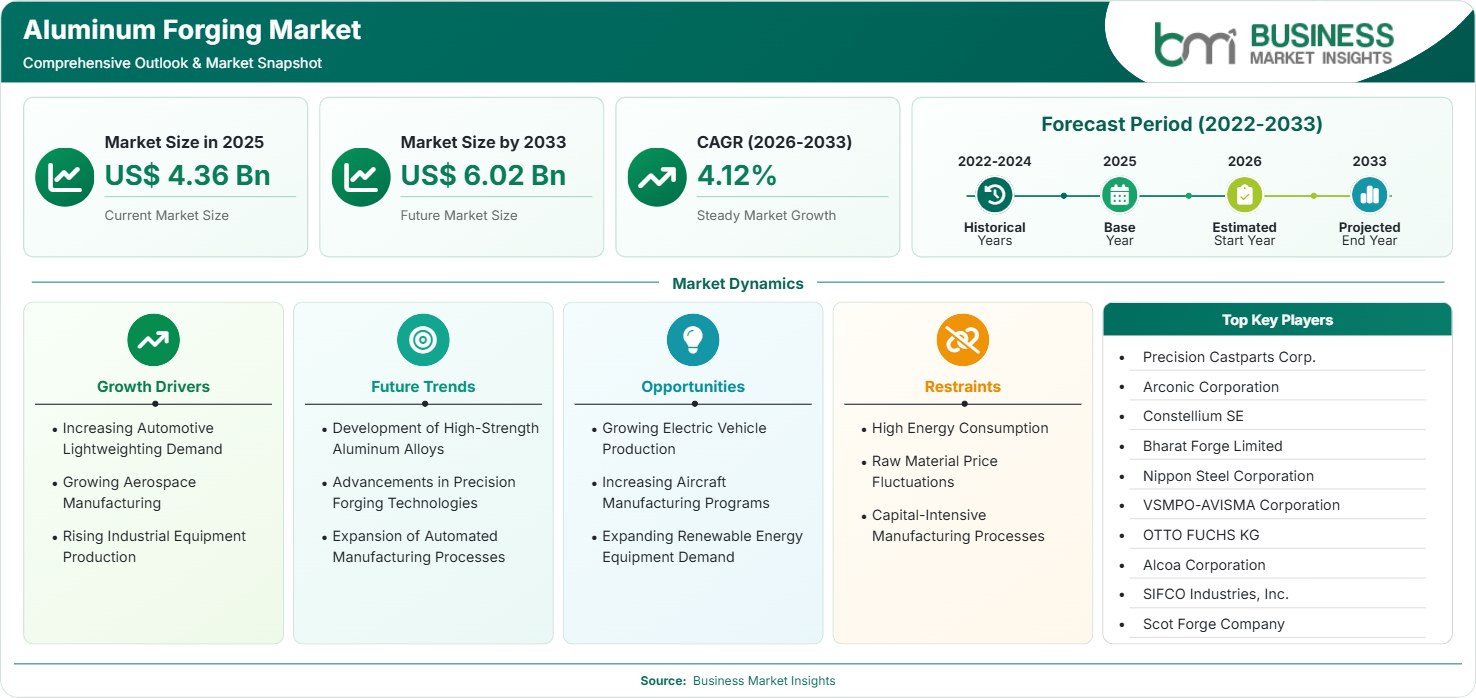
The Aluminum Forging Market size was valued at US$ 4.36 Billion in 2025 and is projected to reach US$ 6.02 Billion by 2033, growing at a CAGR of 4.12% during 2026–2033, driven by lightweight material demand, automotive electrification, aerospace expansion, industrial modernization, and increasing adoption of high-strength aluminum components.

Report Coverage
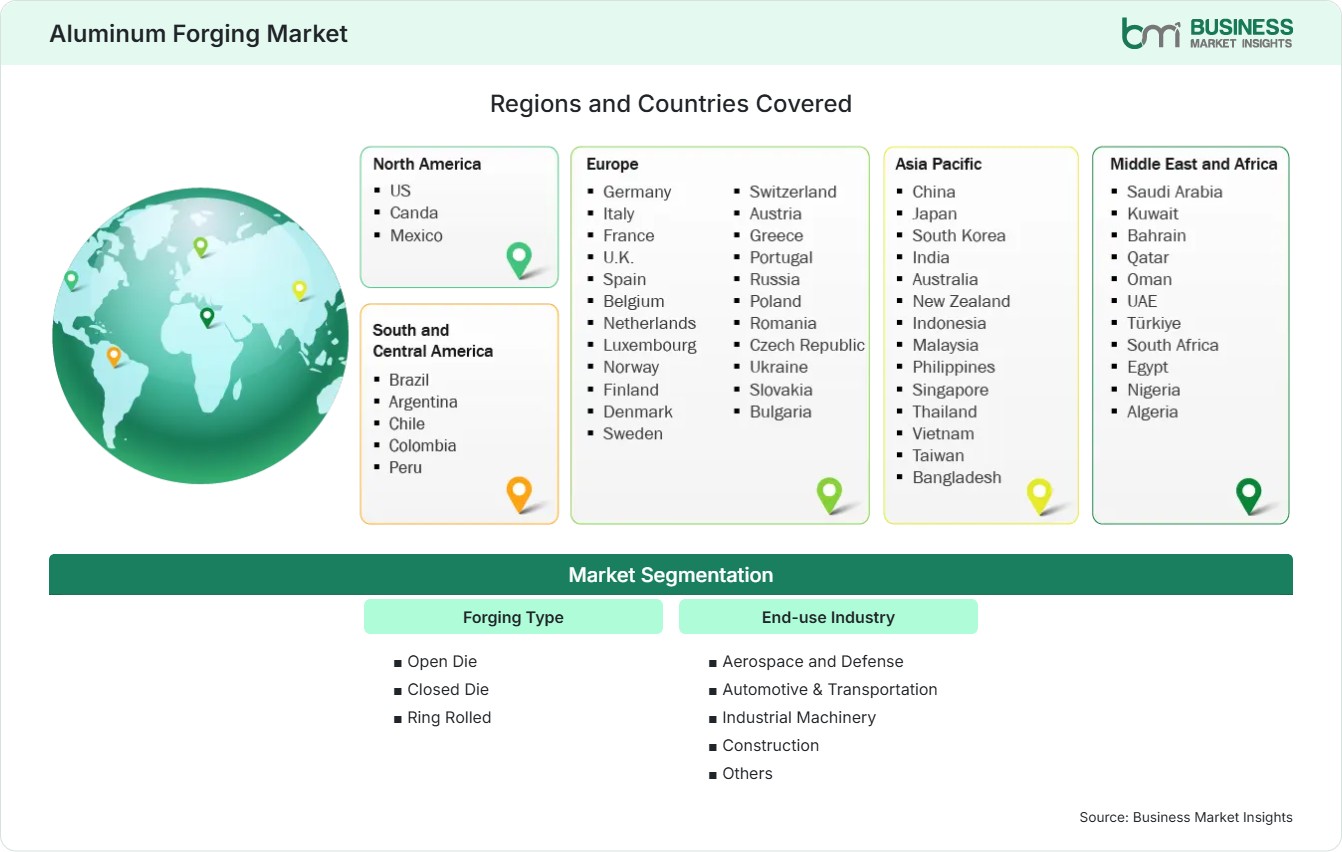
  • Forging Type: Open Die, Closed Die, Ring Rolled
  • End-use Industry: Aerospace and Defense, Automotive & Transportation, Industrial Machinery, Construction, Others
US$ 4.36 Bn Market size in 2025
US$ 6.02 Bn Market Size by 2033
4.12% CAGR, 2026 - 2033
2026-2033 Forecast Period

01 AI Overview

Aluminum Forging Market Summary

  • North America Region: North America held 32%–35% share in 2025, growing at a CAGR of 3.8%–4.3% during 2026–2033, supported by aerospace manufacturing, automotive lightweighting, defense applications, advanced forging technologies, and industrial investments. The U.S. market analysis shows steady expansion at a CAGR of 4.0%–4.4% through 2033 due to aircraft production, electric vehicle manufacturing, and transportation component demand.
  • Fastest Growing Region: Asia Pacific accounted for 36%–39% share in 2025 and is projected to grow at a CAGR of 4.6%–5.1% during 2026–2033, supported by automotive production growth, aerospace investments, industrial development, expanding manufacturing capabilities, and rising demand for lightweight engineered components.
  • Leading Segment: Closed Die forging represented 42%–46% share in 2025 and is expected to expand at a CAGR of 4.2%–4.6% during 2026–2033, driven by precision requirements, automotive applications, aerospace components, improved mechanical properties, and demand for complex-shaped aluminum parts.
  • High Growth Segment: Aerospace and Defense application segment is expected to record 4.8%–5.3% CAGR during 2026–2033, supported by aircraft production programs, defense modernization, weight reduction initiatives, fuel efficiency targets, and increasing utilization of forged aluminum structures.
  • Key Market Opportunity: Rising electric vehicle production, lightweight transportation requirements, aerospace fleet expansion, and renewable energy equipment demand are creating opportunities for manufacturers developing durable, efficient, and high-performance aluminum forging solutions.
  • Major Market Players: Precision Castparts Corp., Arconic Corporation, Constellium SE, Bharat Forge Limited, Nippon Steel Corporation, VSMPO-AVISMA Corporation, OTTO FUCHS KG, Alcoa Corporation, SIFCO Industries, Inc., Scot Forge Company.
02 Strategic Insights

Aluminum Forging Market: Strategic Insights

Aluminum Forging Market Strategic Framework
FREE PDF
Request your free sample
Request free sample
03 Stakeholder View

Key Takeaways

  • Aluminum forging value chains are becoming more integrated as producers, alloy suppliers, and component manufacturers collaborate to improve material performance, production efficiency, and supply reliability across automotive, aerospace, and industrial applications.
  • Electrification of cars represents a big chance for business because manufacturers of electric vehicles need lightweight structures in order to make battery use more efficient, resulting in an increase in the demand for aluminum forging.
  • Modern innovations in manufacturing will help to change the production process using computer-aided simulating, automated forging machines, and heat treatment methods.
  • Asia Pacific offers a strong investment opportunity due to expanding vehicle manufacturing capacity, aerospace development programs, industrial growth, and increasing adoption of advanced manufacturing processes across China, India, and Southeast Asian economies.
  • Strategic investments, partnerships, and capacity expansions among major aluminum producers and forging companies are strengthening competitive positioning while supporting technological advancement and market diversification.
  • Sustainability considerations are influencing production strategies as manufacturers focus on energy-efficient processes, recyclable aluminum usage, and reduced environmental impact throughout forging operations.
04 Geographic Outlook

Aluminum Forging Market Regional Highlights

North America Aluminum Forging Market

North America represented 32%–35% share in 2025 and is projected to grow at a CAGR of 3.8%–4.3% during 2026–2033. The region maintains a strong position due to aerospace manufacturing, automotive lightweighting, defense programs, and advanced industrial production capabilities. The Aluminum Forging Market share is supported by rising demand for durable components, fuel-efficient vehicles, and high-performance aerospace structures. The United States dominates regional consumption, while Canada contributes through automotive manufacturing and industrial applications.

  • Aerospace manufacturers are increasing aluminum forged component adoption to reduce aircraft weight, improve fuel efficiency, and meet performance requirements across commercial and defense aviation programs.
  • Automotive companies are integrating lightweight aluminum parts into vehicle platforms to support electrification strategies, improve efficiency, and enhance structural performance in passenger and commercial vehicles.
  • Advanced forging facilities are adopting automation, simulation technologies, and precision manufacturing systems to improve production consistency and meet strict quality standards across industries.
  • Defense modernization programs are creating demand for specialized aluminum components used in military vehicles, aircraft structures, and high-performance equipment requiring strength and reliability.

US Aluminum Forging Market

The United States accounted for 82%–85% of North American revenue in 2025 and is expected to expand at a CAGR of 4.0%–4.4% through 2033. Strong aerospace production, electric vehicle investments, defense spending, and advanced manufacturing infrastructure support market expansion. The country benefits from established forging capabilities, research-driven material development, and increasing demand for lightweight components across transportation and industrial applications.

  • Aircraft manufacturers continue expanding aluminum component sourcing due to increasing commercial aircraft production and replacement programs requiring lightweight, durable, and corrosion-resistant forged structures.
  • Automotive suppliers are investing in aluminum forging technologies to support electric vehicle platforms, improve vehicle efficiency, and meet evolving performance requirements from manufacturers.
  • Industrial equipment producers are adopting forged aluminum components for machinery applications where strength, reduced weight, and operational reliability are critical factors.

Europe Aluminum Forging Market

Europe accounted for 25%–28% Aluminum Forging Market share in 2025 and is forecast to expand at a CAGR of 3.9%–4.4% during 2026–2033. The region benefits from advanced automotive manufacturing, aerospace expertise, sustainability initiatives, and strong engineering capabilities. Germany leads regional adoption, while France, Italy, and the United Kingdom demonstrate increasing demand through transportation modernization, aircraft manufacturing, and industrial equipment development.

  • Germany maintains leadership through automotive innovation, premium vehicle production, and strong supplier networks supporting lightweight component manufacturing and advanced forging applications.
  • France demonstrates growth through aerospace manufacturing programs, aircraft component production, and investments in high-performance aluminum materials for aviation applications.
  • Italy benefits from automotive component manufacturing, industrial machinery production, and increasing adoption of engineered aluminum solutions across manufacturing sectors.
  • The United Kingdom supports demand through aerospace activities, defense programs, and technology-focused manufacturing initiatives requiring specialized forged components.

Asia Pacific Aluminum Forging Market

Asia Pacific accounted for 36%–39% share in 2025 and is projected to register the fastest CAGR of 4.6%–5.1% during 2026–2033. Rapid automotive production, expanding aerospace industries, industrial development, and manufacturing investments are accelerating regional demand. China represents the largest market, while India, Japan, and South Korea provide significant growth opportunities through vehicle production expansion and advanced manufacturing adoption.

  • China leads regional consumption through extensive automotive manufacturing, industrial production capacity, and increasing investment in lightweight materials for transportation applications.
  • India demonstrates strong growth potential due to expanding vehicle manufacturing, defense production initiatives, infrastructure development, and increasing adoption of advanced manufacturing technologies.
  • Japan continues investing in precision engineering, automotive innovation, and aerospace component production, supporting demand for high-quality aluminum forged products.
  • South Korea is increasing aluminum forging adoption through automotive exports, electronics manufacturing support systems, and industrial equipment development programs.

Rest of World Aluminum Forging Market

The Rest of World region represented 7%–10% Aluminum Forging Market share in 2025 and is anticipated to grow at a CAGR of 3.5%–4.0% through 2033. South and Central America are experiencing rising demand through automotive production and industrial expansion. Middle East and Africa markets are developing through infrastructure investments, aerospace activities, and manufacturing diversification. Brazil, Saudi Arabia, and the UAE represent emerging opportunities.

Brazil is expanding aluminum forging utilization through automotive manufacturing growth, industrial development, and increasing demand for lightweight engineered components.

Middle Eastern countries are investing in aerospace, defense, and industrial projects that require advanced aluminum materials for efficient and durable applications.

South Africa demonstrates increasing adoption through mining equipment modernization, transportation development, and industrial manufacturing activities.

  • Regional manufacturers are improving forging capabilities through technology partnerships, equipment upgrades, and investments in advanced production systems.
  • Infrastructure development projects are increasing demand for durable aluminum components across construction equipment and industrial applications.
  • Aerospace expansion initiatives in emerging economies are creating opportunities for specialized aluminum forging suppliers.
  • Automotive manufacturing growth across developing markets is encouraging localized production of lightweight forged components.
  • Government-supported industrialization programs are improving manufacturing ecosystems and strengthening regional supply chains.
Global Market Geography
FREE PDF
Request your free sample
Request free sample
05 Segment Analysis

Aluminum Forging Market Segmentation

Forging Type

Forging Type segmentation demonstrates varied adoption based on component complexity, strength requirements, and end-use applications. The segment accounted for 2025 share distribution led by Closed Die forging with 42%–46% share and is projected to grow at a CAGR of 4.2%–4.6% during 2026–2033. The Aluminum Forging Market scope expands through increasing demand for precision-engineered lightweight components across transportation, aerospace, and industrial sectors.

  • Open Die: Open Die forging supports large aluminum component production requiring flexibility, durability, and customized designs. It is widely used for industrial machinery, aerospace structures, and heavy-duty applications requiring enhanced mechanical performance.
  • Closed Die: Closed Die forging enables high-precision manufacturing of complex-shaped components with improved strength-to-weight ratios. Automotive, aerospace, and defense industries increasingly adopt this process for critical structural applications.
  • Ring Rolled: Ring Rolled forging provides seamless circular components with superior fatigue resistance and dimensional accuracy. It is primarily utilized in aerospace engines, industrial equipment, and applications requiring rotational strength.

End-use Industry

End-use Industry segmentation reflects growing adoption across transportation, aerospace, industrial equipment, and infrastructure applications. Aerospace and Defense represented the leading application category with 30%–34% share in 2025, while expanding electric vehicle production supports future demand. The Aluminum Forging Market trends indicate increasing preference for lightweight, corrosion-resistant, and high-strength materials across multiple industrial ecosystems.

  • Aerospace and Defense: Aerospace and Defense applications utilize forged aluminum components for aircraft structures, engine parts, and defense equipment requiring lightweight performance, reliability, and resistance under demanding operating conditions.
  • Automotive & Transportation: Automotive & Transportation industries adopt aluminum forgings for vehicle structures, suspension systems, and lightweight components supporting fuel efficiency, electrification, and improved vehicle performance.
  • Industrial Machinery: Industrial Machinery applications use aluminum forged components in equipment systems requiring strength, precision, reduced weight, and long operational durability across manufacturing environments.
  • Construction: Construction applications utilize aluminum forging solutions for structural components, machinery parts, and equipment systems requiring corrosion resistance, strength, and long-term performance in challenging environments.
06 Market Forces

Aluminum Forging Market Dynamics

Key Market Drivers

Increasing Automotive Lightweighting Demand

The automotive industry is increasing aluminum adoption as manufacturers focus on reducing vehicle weight, improving efficiency, and supporting electric vehicle performance. Based on industry experts, energy efficiency will be greatly improved through lightweighting, thus, making the use of aluminum forging components advantageous in the current vehicle systems. The factors driving the Aluminum Forging Market include investment in electric mobility, emission regulations, and structural component durability. According to the market trends, there will be an increasing use of aluminum forging components in chassis, suspension, and powertrain applications.

Growing Aerospace Manufacturing

The rise in the use of forged parts made of aluminum is mainly due to its strength-to-weight ratio and ability to withstand corrosion. The global aerospace industry is witnessing a revival in terms of manufacturing and increase in the number of fleets, which is driving the market for advanced forged materials. The need for aircraft parts that can meet safety and performance standards is prompting investment in advanced forging techniques.

Rising Industrial Equipment Production

The forging of aluminum solution by equipment manufacturers is being done in order to increase the performance of the machines, reduce their weight and increase their efficiency. Increased manufacturing operations, automation investments and infrastructure growth are leading to an increased need for durable parts. Forging aluminum parts offers better mechanical properties than conventional methods and thus they can be used in machinery that needs reliability and precision.

Key Market Opportunities

Growing Electric Vehicle Production

Electric vehicle expansion creates significant opportunities for aluminum forging manufacturers as automakers seek lightweight components to compensate for battery weight and improve driving range. Battery-operated vehicles need better designs of structures, and the need for forged aluminum parts is on the rise for their use in chassis, suspensions, and other safety-critical components. The Aluminum Forging Market Forecast includes forecasts in terms of opportunities arising from collaboration between aluminum suppliers, forging firms, and car makers working on future electric cars.

Increasing Aircraft Manufacturing Programs

Expanding aircraft manufacturing projects offer a chance for the forging industry to produce high-quality aluminum parts characterized by increased strength, durability, and lightness. Aviation industry recovery, defense spending, and efforts to upgrade existing fleets increase the need for precisely forged parts. Manufacturers specializing in aerospace alloys and advanced production methods are well positioned to capitalize on the opportunities arising. Expansion of aircraft manufacturing projects guarantees continuous demand for suppliers who guarantee performance excellence and adherence to aerospace standards.

Expanding Renewable Energy Equipment Demand

Renewable energy infrastructure development is creating new applications for aluminum forged components in equipment systems requiring corrosion resistance and mechanical reliability. Wind energy, solar infrastructure, and energy storage projects require lightweight yet durable materials for various assemblies. Forging manufacturers can expand into renewable applications by developing specialized components and improving production flexibility. Increasing global investments in clean energy infrastructure provide opportunities for suppliers capable of supporting large-scale equipment manufacturing requirements.

Market Restraints and Challenges

High Energy Consumption

Factor: Aluminum forging requires substantial energy input during heating, shaping, and processing operations, increasing production costs for manufacturers. Impact: Increased energy costs may impact the profit margins and encourage businesses to use energy efficient technologies. The manufacturing plants that work in the areas where electricity costs are high will have to cope with increased costs, which will have an impact on their competitiveness. Firms are now using process optimization, better heating technologies, and renewable energy sources to control costs. Energy efficiency is critical to keep the business sustainable.

Raw Material Price Fluctuations

Factor: Aluminum price volatility caused by supply chain disruptions, energy costs, and global commodity market changes affects production planning. Impact: Volatile cost of raw materials can raise the cost of parts and cause uncertainty among both producers and consumers. There is a need for forging businesses to come up with effective sourcing, develop strong supplier relations, and have proper inventory management to lower risks. Effective recycling of materials has become an increasingly vital method of cost control. Consistent aluminum availability is crucial for consistent production.

07 Company Analysis

Competitive Landscape

The Aluminum Forging Market analysis indicates a competitive environment shaped by established forging manufacturers, aluminum producers, aerospace suppliers, and automotive component specialists. Companies are focusing on production expansion, advanced alloy development, precision manufacturing capabilities, and strategic collaborations to strengthen their market positions. Major participants compete through technological expertise, quality certifications, global manufacturing networks, and customized solutions for transportation, aerospace, defense, and industrial applications.

Company Name

Overview

Products and Services relevant to this market

Precision Castparts Corp.

Precision Castparts Corp. is a major aerospace and industrial component manufacturer providing engineered metal solutions for demanding applications worldwide.

Produces forged aluminum components, aerospace structures, industrial parts, and precision-engineered components for aviation and energy sectors.

Arconic Corporation

Arconic Corporation specializes in advanced aluminum products and lightweight engineered solutions serving aerospace, automotive, and industrial customers.

Provides aluminum forgings, aerospace components, structural products, and advanced manufacturing solutions for transportation applications.

Constellium SE

Constellium SE develops innovative aluminum products with strong capabilities across aerospace, automotive, and industrial markets.

Supplies aluminum alloys, structural components, aerospace products, and lightweight automotive solutions using advanced processing technologies.

Bharat Forge Limited

Bharat Forge Limited is a global forging company offering engineered components for automotive, aerospace, energy, and industrial sectors.

Manufactures forged aluminum components, precision-engineered parts, and customized solutions for transportation and industrial applications.

Nippon Steel Corporation

Nippon Steel Corporation provides advanced metal solutions with capabilities supporting automotive, machinery, and industrial applications.

Offers aluminum-related engineering solutions, lightweight material technologies, and specialized metal products for industrial customers.

VSMPO-AVISMA Corporation

VSMPO-AVISMA Corporation is a major titanium and specialty material supplier serving aerospace and industrial sectors.

Provides advanced forged components, aerospace materials, and engineered solutions for aviation and defense applications.

OTTO FUCHS KG

OTTO FUCHS KG specializes in high-performance forged metal products for aerospace, automotive, and industrial markets.

Produces lightweight forged components, aerospace structures, automotive parts, and specialized aluminum solutions.

Alcoa Corporation

Alcoa Corporation is a leading aluminum producer supporting global industries through integrated aluminum production and processing capabilities.

Supplies aluminum materials, engineered products, and lightweight solutions for aerospace, transportation, and industrial applications.

SIFCO Industries, Inc.

SIFCO Industries, Inc. provides specialized forging solutions focused on aerospace, energy, and industrial component manufacturing.

Manufactures forged aluminum components, aerospace parts, and customized metal solutions using advanced forging processes.

Scot Forge Company

Scot Forge Company is a custom forging manufacturer serving aerospace, industrial, and transportation markets.

Provides open die forgings, custom aluminum components, and engineered forging solutions for specialized applications.

10 Trust & Transparency

Research Methodology

The market analysis combines proprietary research with secondary data from government agencies, company disclosures, regulatory filings, industry databases and expert interviews. Market estimates are validated through data triangulation, cross-market benchmarking and analyst review.

View Full Research Methodology

11 Questions Answered

Frequently Asked Questions

Where can companies find detailed industry insights and forecasts?

The Aluminum Forging Market Report provides analysis of market dynamics, segmentation trends, competitive developments, regional opportunities, and future growth factors influencing industry participants.

What role does sustainability play in aluminum forging?

Sustainability is influencing manufacturers through recycling initiatives, energy-efficient production methods, and improved material utilization strategies that reduce environmental impact while maintaining component performance.

Which industries are the largest users of aluminum forged products?

Aerospace, automotive, transportation, industrial machinery, and defense sectors represent major application areas due to their requirement for lightweight, strong, and corrosion-resistant components.

How does aluminum forging support electric vehicle development?

Aluminum forging helps electric vehicle manufacturers reduce structural weight while maintaining strength and safety performance. Forged components are increasingly used in chassis, suspension, and structural applications to improve vehicle efficiency.

What factors are influencing demand for forged aluminum components?

Demand is influenced by automotive lightweighting, aerospace expansion, electric vehicle production, industrial automation, and the requirement for durable components with improved strength-to-weight ratios across multiple industries.

Access the Full Aluminum Forging Market Report

Get segment-level forecasts, regional estimates, competitive benchmarking, company profiles and downloadable Excel datasets.

Access the full Aluminum Forging Market Report
350 pages PDF & Excel | 2026-08-12