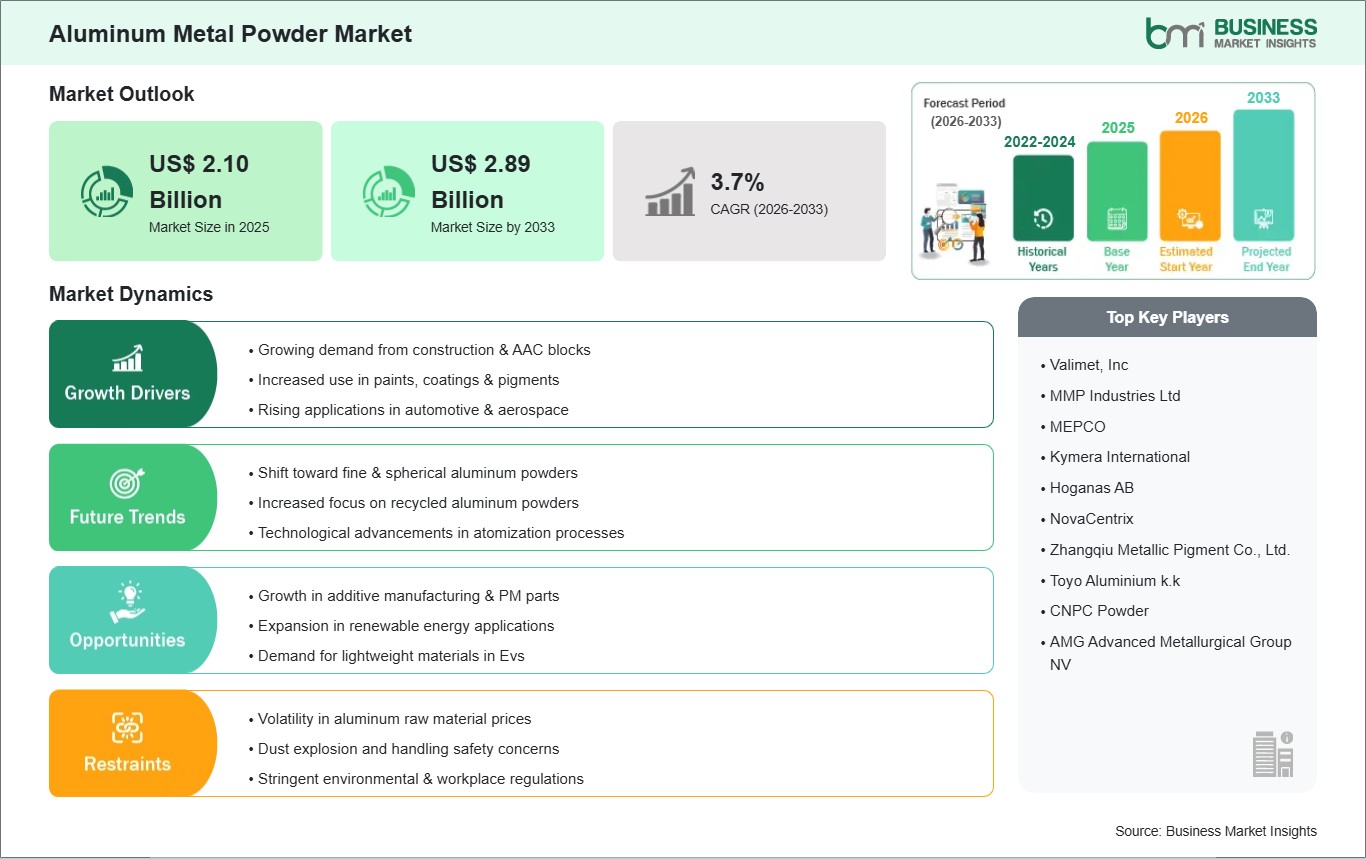
The aluminum metal powder market size is expected to reach US$ 2.89 billion by 2033 from US$ 2.10 billion in 2025. The market is estimated to record a CAGR of 3.7% from 2026 to 2033.
Aluminum powder is valued for its high reactivity, excellent thermal conductivity, and strong corrosion resistance, making it a critical material across a wide range of industries. It is widely used in paints and coatings, explosives and pyrotechnics, construction and infrastructure, industrial manufacturing, electronics, automotive and transportation, aerospace and defense, as well as various specialized applications.
The market is segmented by product form (powder and flakes), production process (atomization, comminution, and electrolysis), and purity levels (92–98%, 98–99%, and above 99%). High-purity aluminum powder, primarily produced through atomization and electrolysis, is essential for high-performance applications such as aerospace components, advanced electronics, and specialty coatings, where precision and material consistency are critical. In contrast, lower-purity and cost-effective grades are predominantly used in industrial, construction, and bulk manufacturing applications.
Market demand is being driven by accelerating urbanization, large-scale infrastructure investments, rising automotive production, and the continued expansion of the global electronics sector. Technological advancements focused on achieving uniform particle size distribution, enhanced surface characteristics, and improved safety in handling and storage are further expanding the performance capabilities and application scope of aluminum powder.
Sustainability considerations are also shaping market dynamics, with aluminum’s high recyclability aligning well with global environmental and circular economy initiatives. While the industry faces challenges such as volatility in raw material prices and increasingly stringent regulatory frameworks, the aluminum powder market is expected to experience steady and sustained growth across diverse end-use industries worldwide.

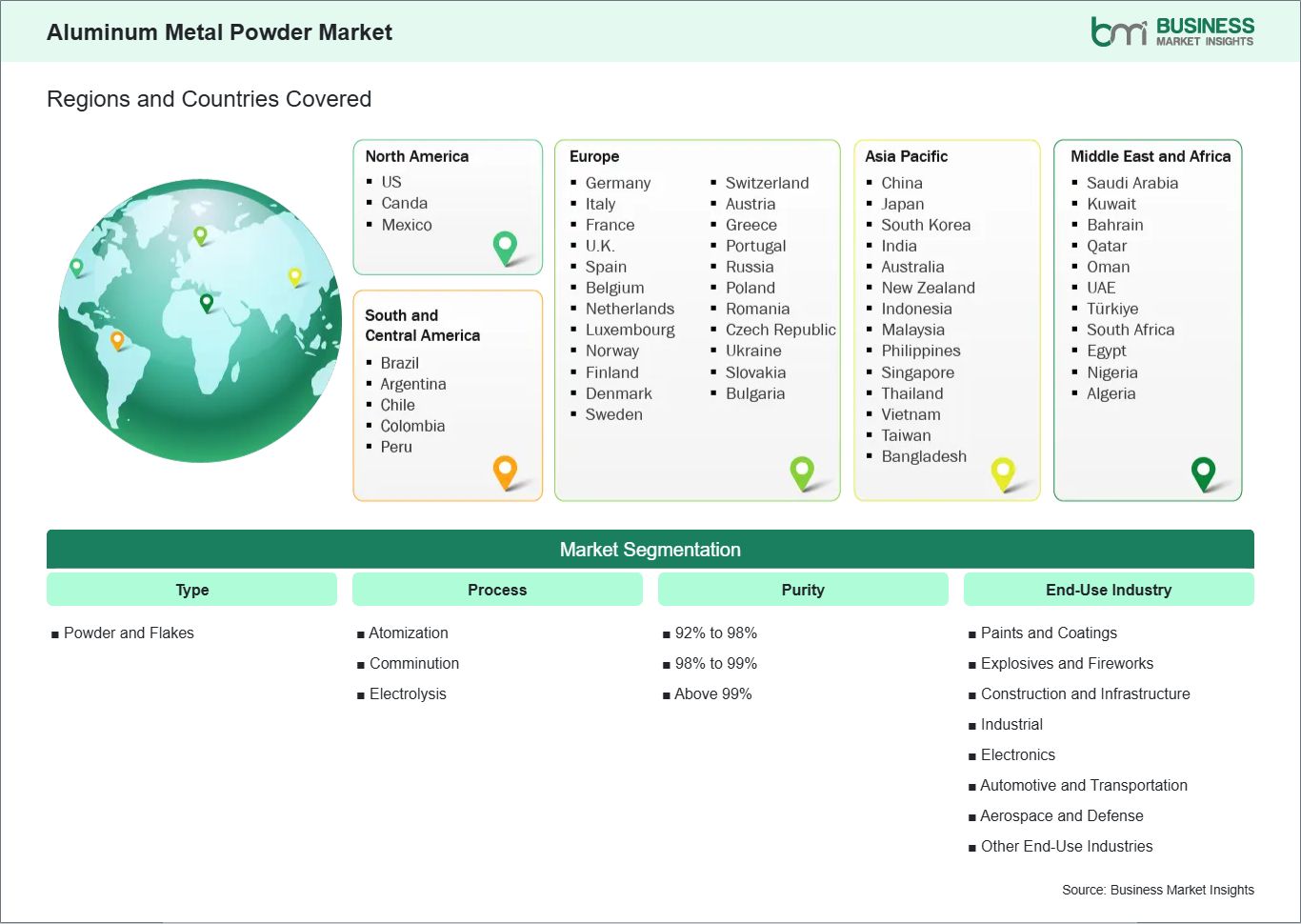
Key segments that contributed to the derivation of the aluminum metal powder market analysis are type, process, purity, and end-use industry.
Aluminum powder is lightweight, resistant to corrosion, and conducts considerable heat. These properties are vital for automotive parts like heat exchangers, structural reinforcements, and lightweight alloys. Its shiny and metallic look makes it important for decorative and protective coatings in buildings, industrial setups, and consumer goods. Rapid industrial growth and urban developments are increasing the construction sector's need for aluminum-based fireproof coatings, thermal insulation, and finishing materials. In the automotive industry, the shift to electric vehicles and stricter fuel efficiency rules pushes for lighter materials, which boosts the demand for aluminum metal powder.
The explosive and pyrotechnics industry also depends on aluminum metal powder for generating energy and controlled reactions, creating a steady demand across different sectors. Improvements in powder particle uniformity, shape, and surface treatment enhance performance in high-end applications, further encouraging its use. Along with trends in sustainability that favor recyclable materials, these factors contribute to steady growth in the global aluminum metal powder market, prompting manufacturers to increase production capacity and invest in technological advancements.
Aluminum powders with controlled particle size, shape, and high purity (over 99%) are crucial for making complex, lightweight components with improved mechanical and thermal properties. In aerospace and automotive additive manufacturing, aluminum powders allow for precise, high-strength parts that reduce weight and improve fuel efficiency. In electronics, fine aluminum powders are used in conductive pastes, EMI shielding, and thermal interface materials.
This supports the rising demand from the consumer electronics and renewable energy sectors. High-purity powders also play a role in advanced applications like thermal spray coatings, specialty alloys, and precision engineering components. New techniques in atomization, grinding, and surface treatment are making powder consistency, safety, and performance better, which encourages wider industrial use. Additionally, emerging markets with growing high-tech manufacturing capabilities and expanding infrastructure offer more chances for using aluminum powder. These trends establish aluminum powder as a key material for next-generation manufacturing, industrial innovation, and high-performance applications, which drives long-term market growth.

The aluminum metal powder market demonstrates steady growth, with size and share analysis revealing evolving trends and competitive positioning among key players. The report examines subsegments categorized within type, process, purity, and end-use industry, offering insights into their contribution to overall market performance. By 2025, the atomization segment holds the largest market share. Atomization processes create aluminum powder with better particle size distribution, sphericity, and surface properties, making it suitable for high-performance applications in paints and coatings, thermal spray processes, and automotive and aerospace components. Atomized aluminum powder offers better dispersibility, consistent combustion behavior in pyrotechnics, and improved mechanical properties in metal matrix composites. This segment's growth is driven by the increasing demand for precision and reliability in coatings, additive manufacturing, and engineering applications. Furthermore, atomized powders meet the strict quality standards needed by electronics and defense industries. Improvements in atomization equipment, process control, and safety protocols are boosting production capabilities.
| Report Attribute | Details |
|---|---|
| Market size in 2025 | US$ 2.10 Billion |
| Market Size by 2033 | US$ 2.89 Billion |
| Global CAGR (2026 - 2033) | 3.7% |
| Historical Data | 2022-2024 |
| Forecast period | 2026-2033 |
| Segments Covered | By Type
|
|
Regions and Countries Covered
| |
| North America | US, Canada, Mexico |
| Europe | Belgium, Austria, Finland, Denmark, Greece, Poland, Romania, Russia, Ukraine, Czech Republic, Slovakia, Bulgaria, Italy, Luxembourg, Germany, Switzerland, France, Netherlands, Norway, Portugal, Spain, Sweden, United Kingdom |
| Asia-Pacific | Australia, China, India, Japan, South Korea, Indonesia, Malaysia, Philippines, Singapore, Thailand, Vietnam, Bangladesh, New Zealand, Taiwan |
| South and Central America | Brazil, Argentina, Peru, Chile, Colombia |
| Middle East and Africa | Bahrain, Kuwait, Oman, Qatar, Saudi Arabia, United Arab Emirates, Turkiye, South Africa, Egypt, Algeria, Nigeria |
| Market leaders and key company profiles |
|
The " Aluminum Metal Powder Market Size and Forecast (2022–2033)" report provides a detailed analysis of the market covering below areas:
The geographical scope of the aluminum metal powder market report is divided into five regions: North America, Asia Pacific, Europe, the Middle East & Africa, and South & Central America. The aluminum metal powder market in Asia Pacific is expected to grow significantly during the forecast period. The market growth in the Asia Pacific is predominantly due to strong manufacturing infrastructure, a huge supply of raw materials, and fast-growing end-use industries. China, India, Japan, and South Korea are major producers and consumers. They are seeing increased demand in paints and coatings, automotive manufacturing, construction, and electronics. Rapid industrialization, urban growth, and infrastructure investment drive the need for aluminum powders in protective coatings, fire-resistant materials, and lightweight parts.
North America and Europe are also significant markets because of their aerospace, defense, and automotive sectors, which need high-performance aluminum powders that meet strict quality standards. These regions are investing in research and development to improve powder properties and sustainable production methods. Emerging markets in South & Central America, the Middle East, and Africa are growing steadily as construction activities rise and industries turn to aluminum powder for industrial and commercial uses. Overall, Asia Pacific's mix of production scale, demand from end users, and investment in processing technologies makes it the largest and fastest-growing region in the global aluminum powder market.

The aluminum metal powder market is evaluated by gathering qualitative and quantitative data post-primary and secondary research, which includes important corporate publications, association data, and databases. A few of the key developments in the aluminum metal powder market are:
The Aluminum Metal Powder Market is valued at US$ 2.10 Billion in 2025, it is projected to reach US$ 2.89 Billion by 2033.
As per our report Aluminum Metal Powder Market, the market size is valued at US$ 2.10 Billion in 2025, projecting it to reach US$ 2.89 Billion by 2033. This translates to a CAGR of approximately 3.7% during the forecast period.
The Aluminum Metal Powder Market report typically cover these key segments-
The historic period, base year, and forecast period can vary slightly depending on the specific market research report. However, for the Aluminum Metal Powder Market report:
The Aluminum Metal Powder Market is populated by several key players, each contributing to its growth and innovation. Some of the major players include:
The Aluminum Metal Powder Market report is valuable for diverse stakeholders, including:
Essentially, anyone involved in or considering involvement in the Aluminum Metal Powder Market value chain can benefit from the information contained in a comprehensive market report.
Please tell us your area of interest
(Market Segments/ Regions and Countries/ Companies)