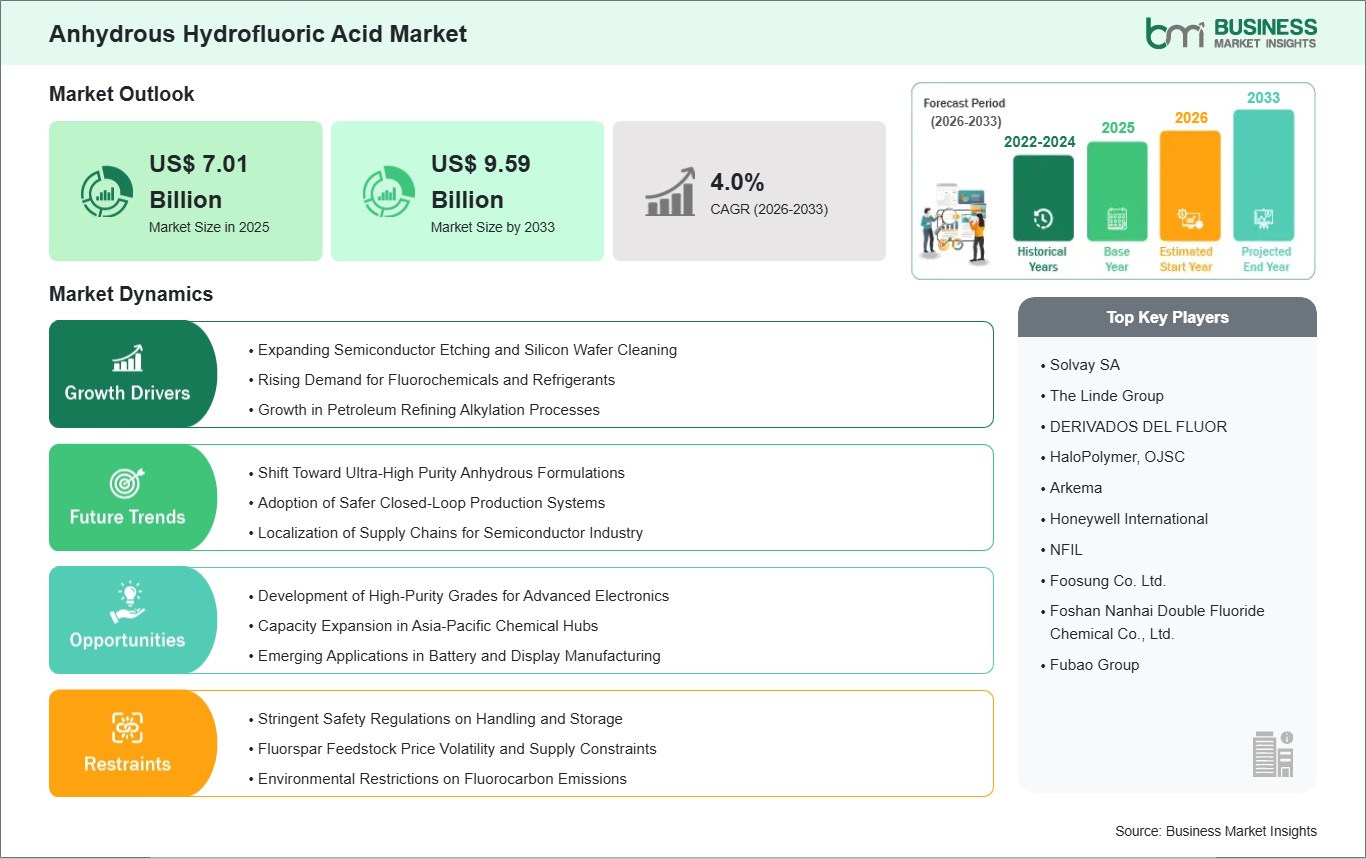
The Anhydrous Hydrofluoric Acid market size is expected to reach US$ 9.59 billion by 2033 from US$ 7.01 billion in 2025. The market is estimated to record a CAGR of 4.0% from 2026 to 2033.
Anhydrous hydrofluoric acid (AHF) is a versatile inorganic chemical valued mainly for its role as a key raw material in producing fluorine-containing compounds. It is widely used to make refrigerants, pharmaceuticals, specialty chemicals, high-performance polymers, and fluoropolymers. AHF is also essential in glass etching, metal surface treatment, and aluminum processing, where it improves product quality, process efficiency, and chemical stability. Its strong reactivity and high purity make it a crucial input in industrial, chemical, and manufacturing sectors. Demand for anhydrous hydrofluoric acid is rising in both mature and emerging markets due to industrialization, growth in the electronics and automotive sectors, and increasing applications of fluorochemicals. The growing need for high-performance plastics, refrigerants, and pharmaceutical intermediates, along with expanding chemical processing activities, drives the demand for AHF. Regulatory emphasis on process safety, environmental compliance, and controlled handling encourages manufacturers to adopt safer production and storage practices, which supports long-term market growth. Producers are focusing on high-quality AHF with controlled concentrations and consistent purity, ensuring it is compatible with downstream applications.
Technological improvements in production, storage, and transportation, along with safety-focused innovations, are boosting operational efficiency and reducing environmental impact. The market is also supported by recovering by-products from related chemical processes, which helps keep the supply stable and costs low. Improvements in production methods, purification technologies, and safe handling protocols are enhancing product reliability, storage stability, and industrial usability. Despite challenges such as strict regulatory standards, high production costs, and handling hazards, the market is expected to grow steadily, mainly due to expanding industrial applications, rising demand for fluorochemicals, and ongoing innovation in process safety and efficiency.

Key segments that contributed to the derivation of the Anhydrous Hydrofluoric Acid market analysis are type and application.
The global anhydrous hydrofluoric acid (AHF) market is driven by its essential role as a raw material for fluorochemicals and specialty chemicals. AHF is crucial for making hydrofluorocarbons (HFCs), fluoropolymers, refrigerants, and high-performance plastics. These materials are widely used in automotive, electronics, construction, and industrial applications. Rapid industrial growth, especially in developing countries, has increased the demand for these products, leading to a higher need for AHF. The growing electronics and semiconductor industries also accelerate the demand for high-purity AHF, which plays a crucial role in etching and cleaning. The pharmaceutical industry adds to this demand as AHF is used to synthesize fluorine-containing intermediates and active pharmaceutical ingredients (APIs). AHF's versatility in producing specialty chemicals, along with the rising use of high-performance polymers and refrigerants, makes it a key input for various industrial sectors. Increased production capacities and investments in downstream fluorochemical manufacturing are likely to continue supporting the global AHF market growth.
AHF is widely used in aluminum processing, metal surface treatment, glass etching, and chemical synthesis. Its strong reactivity and high purity enable precise and efficient high-quality outputs. As industries focus on optimizing processes, improving product quality, and enhancing energy efficiency, AHF's role as a reliable and versatile chemical becomes clearer. It is also vital for environmental control measures, such as recovering fluorine-containing by-products, which adds to its industrial importance. Increasing demand in the automotive, aerospace, electronics, and construction sectors is broadening its application. Technological advances in safe storage, handling, and production are improving operational efficiency. Stricter safety and environmental regulations are pushing manufacturers to opt for high-purity, consistent AHF products, ensuring stable supply and optimized usage in various industrial processes. This combined demand from both traditional and emerging applications is expected to support long-term growth in the global anhydrous hydrofluoric acid market.
The anhydrous hydrofluoric acid market demonstrates steady growth, with size and share analysis revealing evolving trends and competitive positioning among key players. The report further examines subsegments categorized within type and application, offering insights into their contribution to overall market performance. By type, the fluorite-based subsegment holds a larger share of the market because fluorite is a key raw material that enables cost-effectiveness and large-scale production of high-purity AHF. Its wide availability and steady supply make it the top choice for industrial manufacturers in chemical and downstream applications.
In terms of application, the fluorocarbons subsegment dominates the market due to the increasing demand for refrigerants, HFCs, and specialty fluoropolymers in industries like HVAC, automotive, and electronics. AHF plays a vital role in creating these fluorocarbons, supporting efficient production and meeting the growing global demand from both industries and consumers.
| Report Attribute | Details |
|---|---|
| Market size in 2025 | US$ 7.01 Billion |
| Market Size by 2033 | US$ 9.59 Billion |
| Global CAGR (2026 - 2033) | 4.0% |
| Historical Data | 2022-2024 |
| Forecast period | 2026-2033 |
| Segments Covered | By Type
|
|
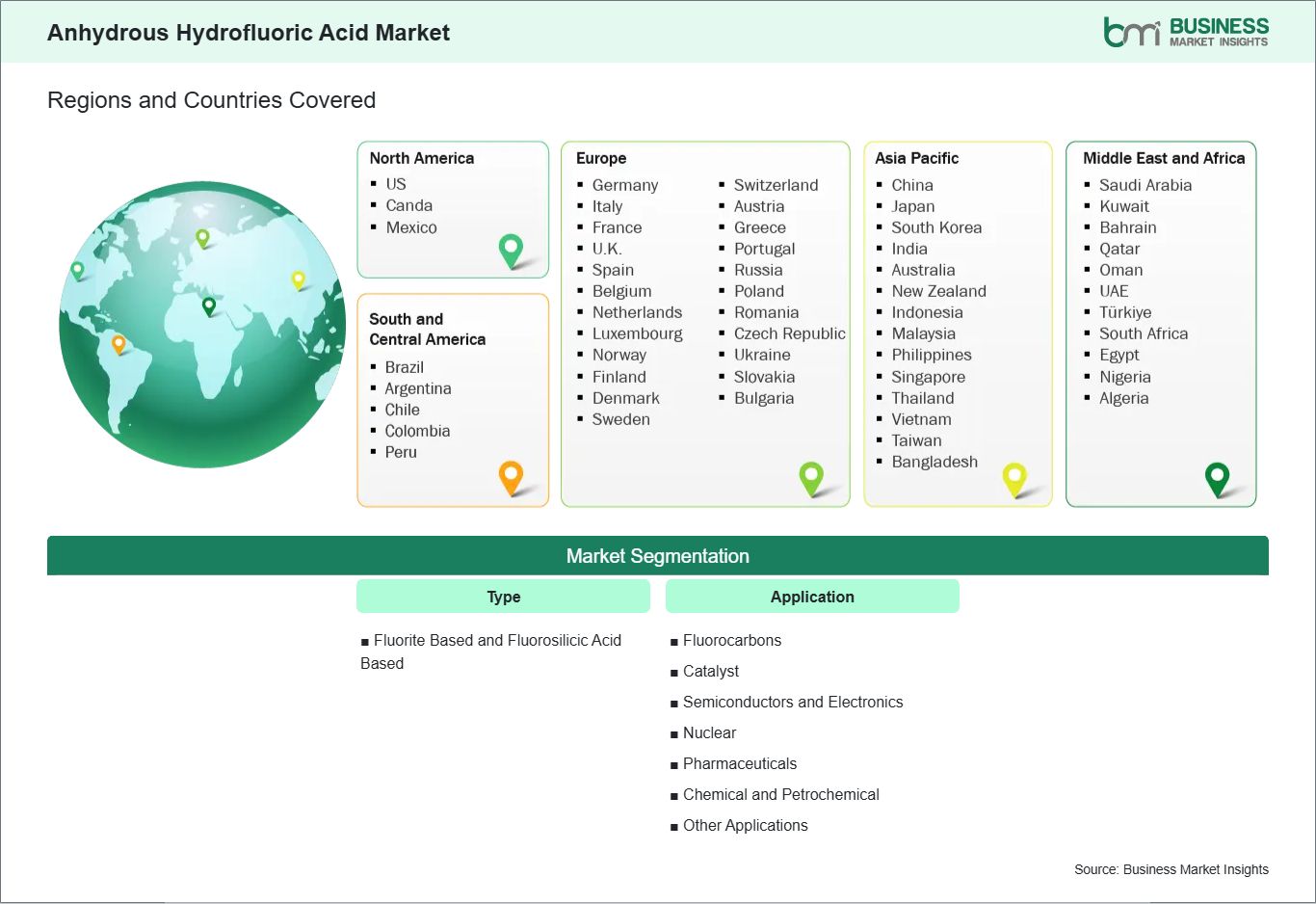
Regions and Countries Covered
| |
| North America | US, Canada, Mexico |
| Europe | Belgium, Austria, Finland, Denmark, Greece, Poland, Romania, Russia, Ukraine, Czech Republic, Slovakia, Bulgaria, Italy, Luxembourg, Germany, Switzerland, France, Netherlands, Norway, Portugal, Spain, Sweden, United Kingdom |
| Asia-Pacific | Australia, China, India, Japan, South Korea, Indonesia, Malaysia, Philippines, Singapore, Thailand, Vietnam, Bangladesh, New Zealand, Taiwan |
| South and Central America | Brazil, Argentina, Peru, Chile, Colombia |
| Middle East and Africa | Bahrain, Kuwait, Oman, Qatar, Saudi Arabia, United Arab Emirates, Turkiye, South Africa, Egypt, Algeria, Nigeria |
| Market leaders and key company profiles |
|
The "Anhydrous Hydrofluoric Acid Market Size and Forecast (2022–2033)" report provides a detailed analysis of the market covering the below areas:
The geographical scope of the Anhydrous Hydrofluoric Acid market report is divided into five regions: North America, Asia Pacific, Europe, Middle East & Africa, and South & Central America. The Anhydrous Hydrofluoric Acid market in Asia Pacific is expected to grow significantly during the forecast period.
The Asia Pacific Anhydrous Hydrofluoric Acid market is segmented into China, Japan, South Korea, India, Australia, New Zealand, Indonesia, Malaysia, the Philippines, Singapore, Thailand, Vietnam, Taiwan, Bangladesh, and the Rest of Asia Pacific.
The Anhydrous hydrofluoric acid market in Asia Pacific is growing steadily. This growth stems from rapid industrialization, higher demand from chemical manufacturing, and increased production of fluorochemicals and specialty materials in the region. Key players in this market are China, Japan, South Korea, and India. These countries are investing significantly in chemical production, electronics manufacturing, aluminum processing, and the pharmaceutical industry. Rising industrial activity, expanding end-use sectors, and growing technology adoption are driving the demand for high-purity AHF throughout the region. Another important trend is the development of new AHF production and handling methods. Manufacturers are concentrating on creating high-purity, stable, and consistent-grade AHF that meets the strict needs of downstream industries. These include refrigerants, fluoropolymers, pharmaceuticals, and high-performance chemicals. Safe storage, improved handling practices, and innovations in process efficiency are becoming more common.
These improvements boost operational performance while reducing environmental and safety risks. Establishing local production facilities and forming partnerships with downstream chemical makers are lowering reliance on imports and ensuring a steady supply of certified high-quality AHF. Moreover, increasing investments in sustainable chemical production, energy-efficient manufacturing processes, and adherence to environmental and safety laws are positioning Asia Pacific as a key center for AHF production, innovation, and use. Supportive government policies, industrial growth, and rising demand from electronics, automotive, aerospace, and specialty chemical sectors are further solidifying the region’s long-term market outlook.

The Anhydrous Hydrofluoric Acid market is evaluated by gathering qualitative and quantitative data post primary and secondary research, which includes important corporate publications, association data, and databases. A few of the key developments in the Anhydrous Hydrofluoric Acid market are:
The Anhydrous Hydrofluoric Acid Market is valued at US$ 7.01 Billion in 2025, it is projected to reach US$ 9.59 Billion by 2033.
As per our report Anhydrous Hydrofluoric Acid Market, the market size is valued at US$ 7.01 Billion in 2025, projecting it to reach US$ 9.59 Billion by 2033. This translates to a CAGR of approximately 4.0% during the forecast period.
The Anhydrous Hydrofluoric Acid Market report typically cover these key segments-
The historic period, base year, and forecast period can vary slightly depending on the specific market research report. However, for the Anhydrous Hydrofluoric Acid Market report:
The Anhydrous Hydrofluoric Acid Market is populated by several key players, each contributing to its growth and innovation. Some of the major players include:
The Anhydrous Hydrofluoric Acid Market report is valuable for diverse stakeholders, including:
Essentially, anyone involved in or considering involvement in the Anhydrous Hydrofluoric Acid Market value chain can benefit from the information contained in a comprehensive market report.
Please tell us your area of interest
(Market Segments/ Regions and Countries/ Companies)