Levulinic Acid Market Outlook (2022-2033)

Historic Data: 2022-2024   |   Base Year: 2025   |   Forecast Period: 2026-2033
Report Content: Market Scope, Market Segmentation, Market Dynamics, and Competitive Analysis

Report Coverage:
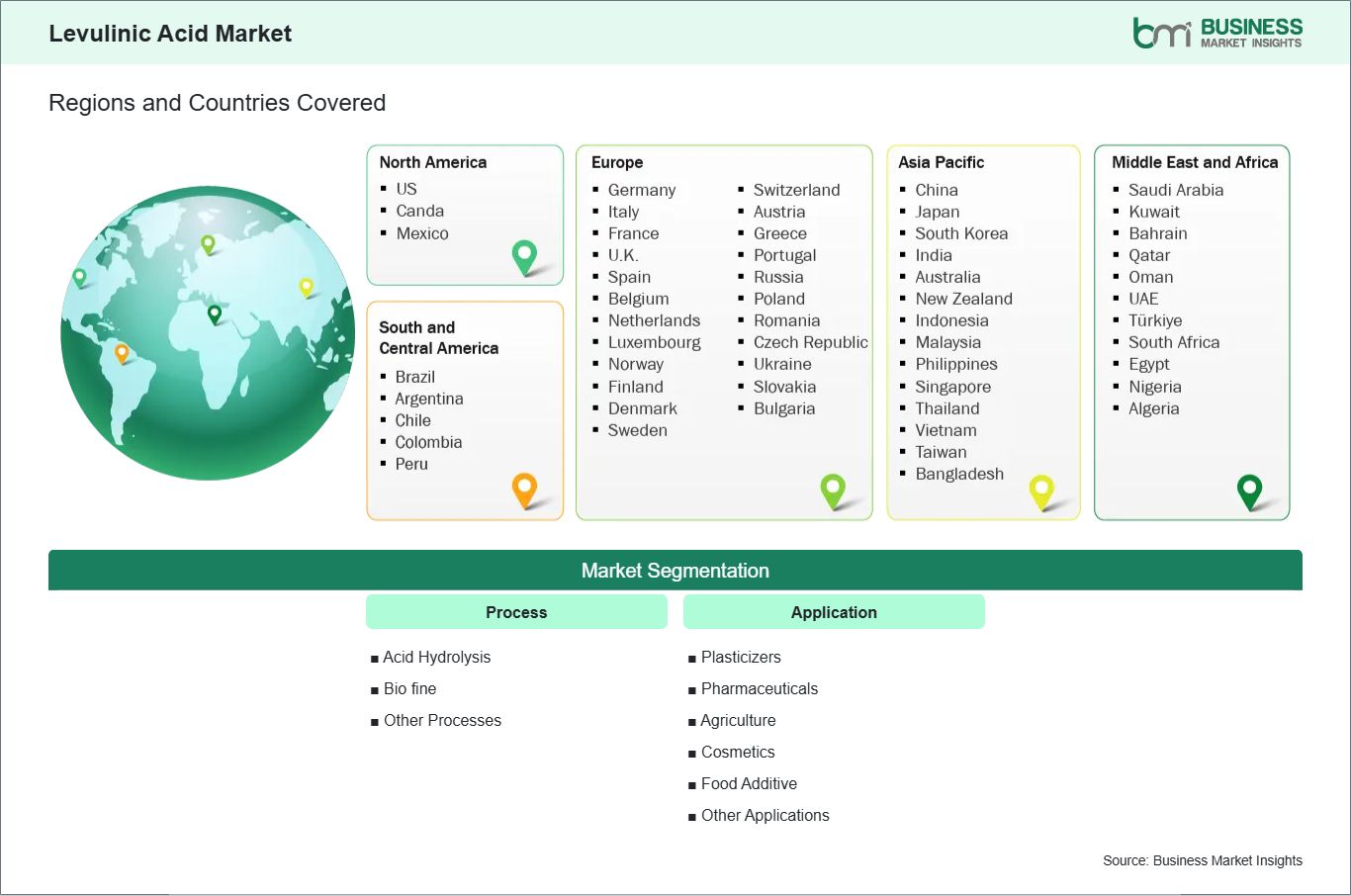
  • Process (Acid Hydrolysis, Bio fine, Other Processes)
  • Application (Plasticizers, Pharmaceuticals, Agriculture, Cosmetics, Food Additive, Other Applications)

No. of Pages: 397
Report Code: BMIPUB00034006
Category: Chemicals and Materials
Levulinic Acid Market

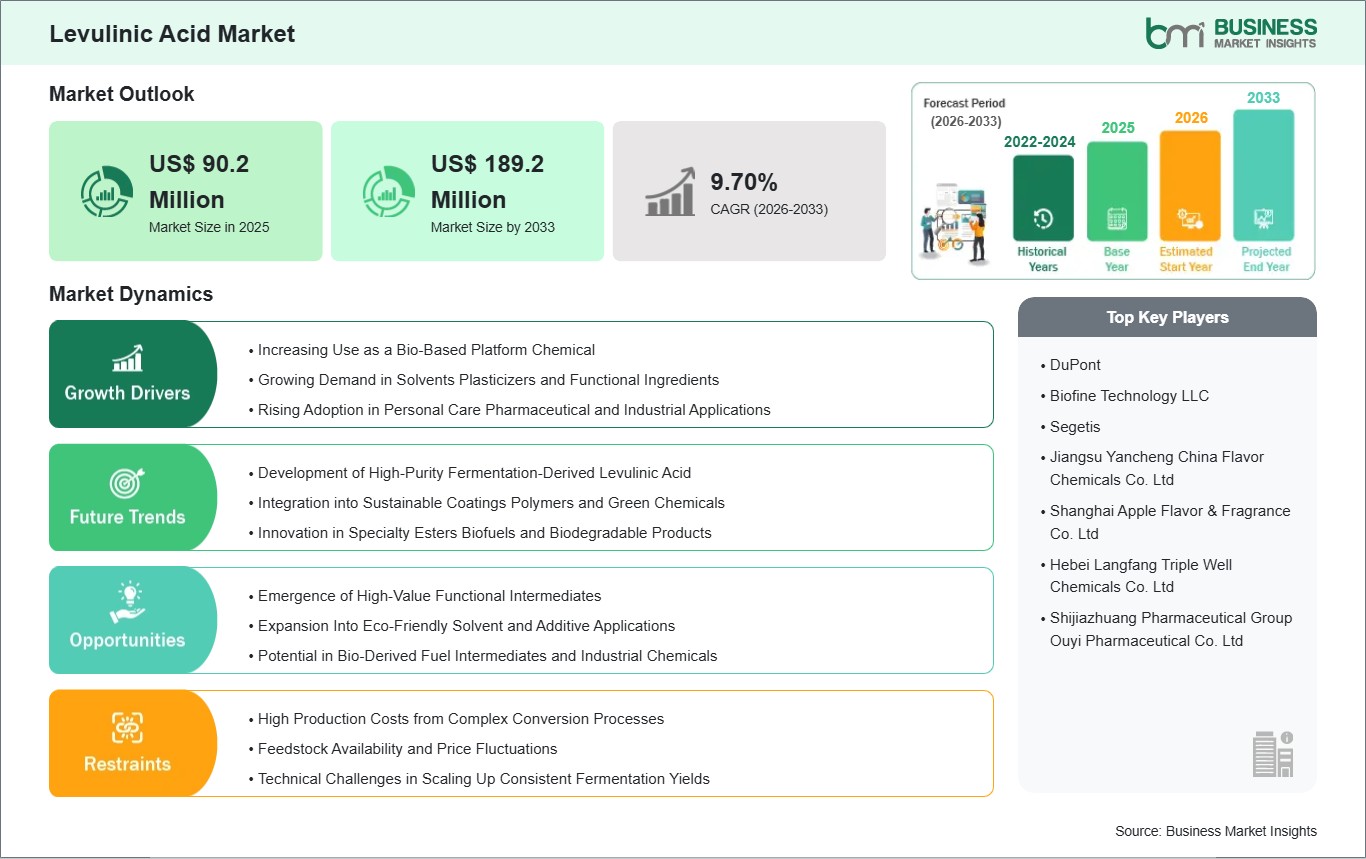
The Levulinic Acid Market size is expected to reach US$ 189.2 Million by 2033 from US$ 90.2 Million in 2025. The market is estimated to record a CAGR of 9.70% from 2026 to 2033.

Executive Summary and Global Market Analysis:

The global levulinic acid market is developing into one of the most important markets in the bio-based chemicals sector, owing to the increasing interest in green and renewable chemicals. Levulinic acid, which is obtained from biomass sources such as agricultural waste materials, is believed to be one of the most important bio-based chemicals that are used in the production of various value-added chemicals. The ability of the compound to be used in the production of various chemicals in different ways has made it popular among those sectors that are looking for alternatives to the various petrochemical-based compounds. The introduction of the green chemistry concept has led to the increasing adoption of levulinic acid in the various sectors of the industry, which is helping the sectors to meet the regulations and sustainability criteria in the production of products with the required criteria.

The growth of the market is mainly due to the increasing demand for the various bio-based chemicals that are used in the production of various materials such as coatings, adhesives, and fuels. The sectors are making use of the levulinic acid compound in the production of various eco-friendly products that meet the requirements of consumers and regulatory bodies. However, there are a number of challenges that affect the growth of this market. The costs of producing levulinic acid and the complexities involved in sourcing biomass-based raw materials are a few of the challenges that affect the growth of this market, especially in regions where there are no proper infrastructures for large-scale biorefineries. In addition, there are challenges from conventional petrochemical-based products, especially where cost sensitivity is a key factor.

Levulinic Acid Market - Strategic Insights:

global-market-strategic-framework
Get more information on this report

Levulinic Acid Market Segmentation Analysis:

Key segments that contributed to the derivation of the levulinic acid market analysis are process and application.

  • By process, the levulinic acid market is segmented into acid hydrolysis, bio fine, and other processes. The acid hydrolysis subsegment dominated the market in 2025.
  • Based on application, the levulinic acid market is classified into plasticizers, pharmaceuticals, agriculture, cosmetics, food additive, and other applications. The food additive subsegment dominated the market in 2025.

Levulinic Acid Market Drivers and Opportunities:

Increasing Use as a Bio-Based Platform Chemical

The market for levulinic acid on a global level is currently undergoing significant growth due to the increasing adoption of the compound as a versatile bio-based platform chemical. Levulinic acid, which is derived from renewable biomass sources such as agricultural residues, can be used as a sustainable alternative to petroleum-derived feedstocks in various chemical processes. The compound, due to its chemical structure, can be used as a building block for the production of various bio-based solvents, plasticizers, and resins, making it an extremely attractive option for various industries. For companies in countries with a strong emphasis on sustainable industrial practices, the use of levulinic acid in the production of green chemicals can be a significant advantage in reducing their dependence on fossil fuels.

Beyond environmental benefits, levulinic acid provides functional advantages that support high-performance applications across diverse industrial sectors. In the coatings, adhesives, and polymers industries, it is used to create materials with enhanced thermal and chemical stability. Its incorporation into bio-based formulations enables manufacturers to achieve the desired mechanical properties while maintaining renewable content, aligning with the growing demand for sustainable and high-quality end products. The combination of eco-friendliness and technical performance positions levulinic acid as a core chemical for companies pursuing cleaner, next-generation manufacturing processes.

Moreover, the adoption of levulinic acid as a platform chemical is being fueled by increasing interest in circular economy models and green chemistry. Industries across the globe are prioritizing the conversion of biomass into value-added chemicals that minimize waste and environmental impact. The scalability of levulinic acid production and its compatibility with existing chemical processes make it a strategic ingredient for producing a wide range of bio-based chemicals. As sustainability continues to drive industrial innovation, levulinic acid is expected to maintain strong growth as a key bio-based platform chemical in the global chemical landscape.

Emergence of High-Value Functional Intermediates

The global market for levulinic acid is further expanding due to its use in producing high-value functional intermediates. These derivatives, including esters, ketones, and specialized acids, serve as critical components in bio-based solvents, coatings, pharmaceuticals, and agrochemicals. Industries are increasingly leveraging levulinic acid to create intermediates that provide superior performance characteristics such as biodegradability, chemical stability, and thermal resistance. The flexibility of levulinic acid enables the formulation of tailor-made chemicals that can replace traditional petrochemical-based intermediates, offering both environmental and technical advantages in diverse applications.

In specialty chemicals, levulinic acid-based intermediate products are becoming increasingly popular, especially for their multifunctionality. Bio-based plasticizers, polymer additives, and surfactants derived from levulinic acid are offering improved processing characteristics, compatibility with water-based systems, and improved durability of final products. Such intermediate products are enabling formulators to create coatings, adhesives, and polymers that meet very high performance demands while ensuring sustainability. In consumer products like personal care, cleaners, and household products, levulinic acid-based intermediate products are supporting the creation of products that offer a balance of performance and eco-friendly characteristics.

The emergence of high-value functional intermediates is also facilitated by advances in bio-refinery and catalytic conversion technologies. Efficient processes allow levulinic acid to be transformed into a wide array of chemicals with minimal waste, making it economically viable for both large-scale and niche applications. This trend has encouraged research and development in developing innovative derivatives tailored for specific end-use industries, further expanding the market potential. As the demand for sustainable and high-performance chemicals grows globally, levulinic acid is expected to play an increasingly central role in producing high-value functional intermediates, driving long-term growth across industrial, specialty, and consumer applications.

Levulinic Acid Market Size and Share Analysis:

The levulinic acid market is experiencing steady growth, with market size and share analysis reflecting evolving treatment preferences and competitive dynamics among key players. The report evaluates important subsegments categorized within process and application, highlighting their respective contributions to overall market performance.

By process, the acid hydrolysis subsegment dominated the levulinic acid market in 2025. Acid hydrolysis offers high efficiency, scalability, and cost-effectiveness, driving its widespread adoption in levulinic acid production.

Based on application, the food additive subsegment dominated the levulinic acid market in 2025. Food additive applications benefit from levulinic acid’s natural preservative and flavor-enhancing properties, supporting strong demand in the food industry.

Levulinic Acid Market Report Highlights:

Report Attribute Details
Market size in 2025 US$ 90.2 Million
Market Size by 2033 US$ 189.2 Million
Global CAGR (2026 - 2033)9.70%
Historical Data 2022-2024
Forecast period 2026-2033
Segments Covered By Process
  • Acid Hydrolysis
  • Bio fine
  • Other Processes
By Application
  • Plasticizers
  • Pharmaceuticals
  • Agriculture
  • Cosmetics
  • Food Additive
  • Other Applications
Regions and Countries Covered
North America US, Canada, Mexico
Europe Belgium, Austria, Finland, Denmark, Greece, Poland, Romania, Russia, Ukraine, Czech Republic, Slovakia, Bulgaria, Italy, Luxembourg, Germany, Switzerland, France, Netherlands, Norway, Portugal, Spain, Sweden, United Kingdom
Asia-Pacific Australia, China, India, Japan, South Korea, Indonesia, Malaysia, Philippines, Singapore, Thailand, Vietnam, Bangladesh, New Zealand, Taiwan
South and Central America Brazil, Argentina, Peru, Chile, Colombia
Middle East and Africa Bahrain, Kuwait, Oman, Qatar, Saudi Arabia, United Arab Emirates, Turkiye, South Africa, Egypt, Algeria, Nigeria
Market leaders and key company profiles
  • DuPont
  • Biofine Technology LLC
  • Segetis
  • Jiangsu Yancheng China Flavor Chemicals Co. Ltd
  • Shanghai Apple Flavor & Fragrance Co. Ltd
  • Hebei Langfang Triple Well Chemicals Co. Ltd
  • Shijiazhuang Pharmaceutical Group Ouyi Pharmaceutical Co. Ltd
Get more information on this report

Levulinic Acid Market Report Coverage and Deliverables:

The "Levulinic Acid Market Size and Forecast (2022 - 2033)" report provides a detailed analysis of the market covering below areas:

  • Levulinic Acid market size and forecast at global, regional, and country levels for all the key market segments covered under the scope
  • Levulinic Acid market trends, as well as drivers, restraints, and opportunities
  • Levulinic Acid market analysis covering key trends, regional framework, major players, regulations, and recent developments
  • Industry landscape and competition analysis covering market concentration, heat map analysis, prominent players, and recent developments for the Levulinic Acid market
  • Detailed company profiles, including SWOT analysis

Levulinic Acid Market Geographic Insights:

The geographical scope of the Levulinic Acid market report is divided into five regions: North America, Asia Pacific, Europe, Middle East & Africa, and South & Central America. The Levulinic Acid market in North America is expected to grow during the forecast period.

North America dominates the global levulinic acid market, driven by a combination of mature industrial infrastructure, strong demand for bio-based chemicals, and regulatory support for environmentally friendly solutions. The United States and Canada lead the adoption of levulinic acid across multiple industries, particularly in coatings, adhesives, pharmaceuticals, and specialty chemicals. In coatings and adhesives, levulinic acid is increasingly used as a building block for eco-friendly resins, plasticizers, and solvents, offering a balance of performance and sustainability. The region’s industrial and chemical manufacturers have been shifting focus towards harnessing bio-based materials in order to minimize their dependency on fossil-based materials. This makes levulinic acid an integral part of the green chemistry movement.

The market dominance of North America is further strengthened by the high levels of R&D in the region. The chemical producers in North America have been working closely with users in order to improve production efficiency, develop new uses, and ensure quality. The environmental focus on reducing impacts and using renewable materials has created an environment that is conducive to the development of products that feature levulinic acid. Moreover, there is access to bio-based materials in North America, which is provided by the biorefinery infrastructure. Together, these factors enable North America to not only lead in the production and consumption of levulinic acid but also to set global trends in bio-based chemical innovation, influencing adoption patterns and sustainability standards in other regions.

global-market-geography
Get more information on this report

Levulinic Acid Market Research Report Guidance:

  • The report includes qualitative and quantitative data in the Levulinic Acid market across process, application, and geography.
  • The report starts with the key takeaways (chapter 2), highlighting the key trends and outlook of the Levulinic Acid market.
  • Chapter 3 focuses on the research methodology of the study.
  • Chapter 4 includes ecosystem analysis.
  • Chapter 5 highlights the major industry dynamics in the Levulinic Acid market, including factors that are driving the market, prevailing deterrents, potential opportunities, as well as future trends. Impact analysis of these drivers and restraints is also covered in this section.
  • Chapter 6 discusses the Levulinic Acid market scenario, in terms of historical market revenues, and forecast till the year 2033.
  • Chapters 7 to 9 cover the Levulinic Acid market segments by process, application, and geography across North America, Europe, Asia Pacific, Middle East and Africa, and South and Central America. They cover the market volume, revenue forecast, and factors driving the market.
  • Chapter 10 describes the competitive analysis with the heat map analysis for the key players operating in the market.
  • Chapter 11 describes the industry landscape analysis. It provides detailed descriptions of business activities such as market initiatives, new developments, mergers, and joint ventures globally, along with a competitive landscape.
  • Chapter 12 provides detailed profiles of the major companies operating in the Levulinic Acid market. Companies have been profiled on the basis of their key facts, business descriptions, products, financial overview, SWOT analysis, and key developments.
  • Chapter 13, i.e., the appendix, is inclusive of a brief overview of the company, list of abbreviations, and disclaimer.

Levulinic Acid Market News and Key Development:

The levulinic acid market is evaluated by gathering qualitative and quantitative data post primary and secondary research, which includes important corporate publications, association data, and databases. A few of the key developments in the levulinic acid market are:

  • In February 2025, Biofine Technology, LLC was granted multiple U.S. patents for systems and methods for the production of levulinic acid, furfural, and formic acid (filed 2023 - 2024) representing a key intellectual property milestone for advanced biomass‑to‑platform chemical manufacturing and potentially enhancing its competitive stance in commercial levulinic acid supply.
  • In May 2022, NXTLEVVEL Biochem and BTC Europe GmbH announced a strategic distribution agreement in Europe to expand the availability of biobased and biodegradable levulinate‑derived solvents (produced from levulinic acid) across European markets. Through this collaboration, NXTLEVVEL’s sustainable levulinate solvent solutions gained broader European distribution via BTC Europe’s established network, strengthening commercial access for biomass‑based chemicals.

Key Sources Referred:

  • International Organization for Standardization (ISO)
  • American Society for Testing and Materials (ASTM International)
  • Bureau of Indian Standards (BIS)
  • Environmental Protection Agency (EPA), USA
  • European Chemicals Agency (ECHA)
  • Central Pollution Control Board (CPCB), India
  • Ministry of Chemicals and Fertilizers, India
  • American Chemistry Council (ACC)
  • Indian Chemical Council (ICC)
  • European Chemical Industry Council (Cefic)
  • Specialty Chemical Association of India (SCAI)
  • Company Websites
  • Company Annual Reports
  • Company Investor Presentations
The List of Companies - Levulinic Acid Market
  • DuPont
  • Biofine Technology LLC
  • Segetis
  • Jiangsu Yancheng China Flavor Chemicals Co. Ltd
  • Shanghai Apple Flavor & Fragrance Co. Ltd
  • Hebei Langfang Triple Well Chemicals Co. Ltd
  • Shijiazhuang Pharmaceutical Group Ouyi Pharmaceutical Co. Ltd
Frequently Asked Questions
How big is the Levulinic Acid Market?

The Levulinic Acid Market is valued at US$ 90.2 Million in 2025, it is projected to reach US$ 189.2 Million by 2033.

What is the CAGR for Levulinic Acid Market by (2026 - 2033)?

As per our report Levulinic Acid Market, the market size is valued at US$ 90.2 Million in 2025, projecting it to reach US$ 189.2 Million by 2033. This translates to a CAGR of approximately 9.70% during the forecast period.

What segments are covered in this report?

The Levulinic Acid Market report typically cover these key segments-

  • Process (Acid Hydrolysis, Bio fine, Other Processes)
  • Application (Plasticizers, Pharmaceuticals, Agriculture, Cosmetics, Food Additive, Other Applications)

What is the historic period, base year, and forecast period taken for Levulinic Acid Market?

The historic period, base year, and forecast period can vary slightly depending on the specific market research report. However, for the Levulinic Acid Market report:

  • Historic Period : 2022-2024
  • Base Year : 2025
  • Forecast Period : 2026-2033
  • Who are the major players in Levulinic Acid Market?

    The Levulinic Acid Market is populated by several key players, each contributing to its growth and innovation. Some of the major players include:

  • DuPont
  • Biofine Technology LLC
  • Segetis
  • Jiangsu Yancheng China Flavor Chemicals Co. Ltd
  • Shanghai Apple Flavor & Fragrance Co. Ltd
  • Hebei Langfang Triple Well Chemicals Co. Ltd
  • Shijiazhuang Pharmaceutical Group Ouyi Pharmaceutical Co. Ltd
  • Who should buy this report?

    The Levulinic Acid Market report is valuable for diverse stakeholders, including:

    • Investors: Provides insights for investment decisions pertaining to market growth, companies, or industry insights. Helps assess market attractiveness and potential returns.
    • Industry Players: Offers competitive intelligence, market sizing, and trend analysis to inform strategic planning, product development, and sales strategies.
    • Suppliers and Manufacturers: Helps understand market demand for components, materials, and services related to concerned industry.
    • Researchers and Consultants: Provides data and analysis for academic research, consulting projects, and market studies.
    • Financial Institutions: Helps assess risks and opportunities associated with financing or investing in the concerned market.

    Essentially, anyone involved in or considering involvement in the Levulinic Acid Market value chain can benefit from the information contained in a comprehensive market report.

    Available Report Formats

    pdf-format excel-format pptx-format
    Buy Now
    Sales Assistance
    +1 646 791 7070 (US & UK)
    Customization Form

    Please tell us your area of interest
    (Market Segments/ Regions and Countries/ Companies)