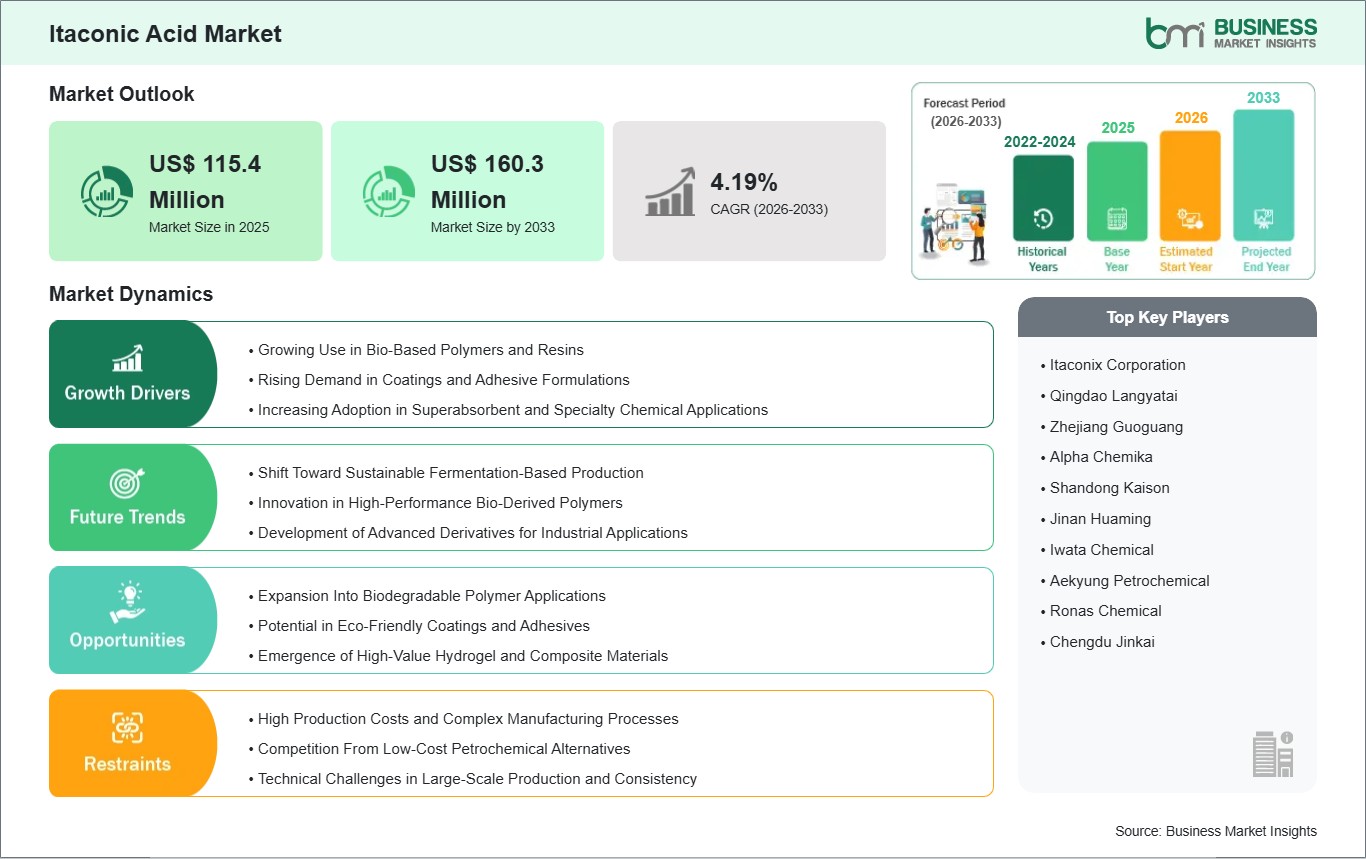
The Itaconic Acid Market size is expected to reach US$ 160.3 Million by 2033 from US$ 115.4 Million in 2025. The market is estimated to record a CAGR of 4.19% from 2026 to 2033.
The global itaconic acid market is defined as an organic bio-based compound that is highly valuable due to its ability to perform in various applications. The compound is derived through the fermentation of carbohydrates. The compound is special in that it has a unique chemical composition that allows it to perform tasks such as polymerization, cross-linking, and modification of viscosities. These abilities make itaconic acid an extremely valuable compound in applications such as adhesives, sealants, coatings, superabsorbents, textiles, plastic production, and biodegradable polymers. The compound has traditionally been replaced by petrochemical-derived organic acids. However, due to increased environmental concerns and the need for sustainability in almost every industry in the world, there is an increased need for organic compounds that are environmentally friendly.
The use of itaconic acid in applications is special in that it enhances mechanical and adhesive qualities, making it a competitive option. The growth of the market is also influenced by the advancement of green chemistry and the recognition of bio-based intermediates in industrial chains. Many industries in the market are actively searching for green alternatives to traditional materials used in their processes, which has led to more research and development of bio-based acids. Moreover, there is an increasing demand for green products from consumers, which has encouraged brands to incorporate green materials such as itaconic acid in their products. The government is also implementing regulations to reduce carbon emissions in the atmosphere, which is further fueling the market. However, despite the numerous benefits of itaconic acid, there are challenges that affect the market’s growth. The differences in feedstock composition and quality affect the consistency of the production process. The complexity and costs of expanding the manufacturing process are also challenges to the market’s growth. The lack of infrastructure in some regions to produce bio-based chemicals also makes the market more expensive than it should be. The established supply chain of petrochemical alternatives is also a challenge to the market’s growth.

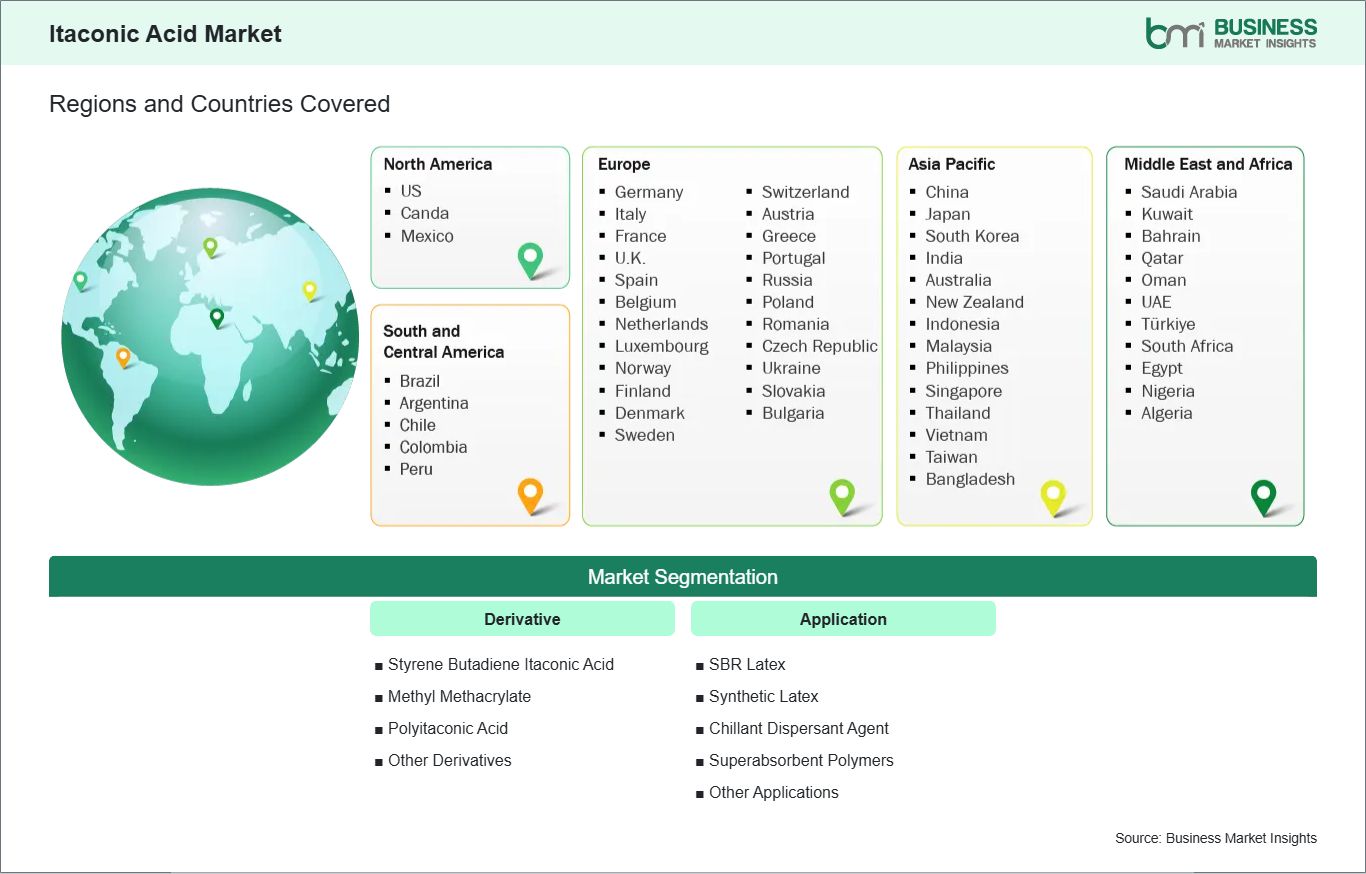
Key segments that contributed to the derivation of the itaconic acid market analysis are derivative and application.
The global itaconic acid market has been expanding steadily due to its increasing adoption in bio-based polymers and resins, driven by the demand for sustainable alternatives to petrochemical-derived materials. Itaconic acid is a versatile building block for producing environmentally friendly polyesters, coatings, and adhesives. In regions with mature industrial sectors, manufacturers are using itaconic acid to formulate water-based resins and binders that reduce reliance on traditional synthetic monomers while maintaining high performance. Its functional properties, including acid functionality and polymerizable double bonds, make it an ideal choice for producing durable, high-quality coatings with improved adhesion, flexibility, and chemical resistance.
Industrial adoption of itaconic acid in resin and polymer production is further fueled by the global push for sustainable and low-emission solutions. Its integration into alkyd resins, acrylic polymers, and unsaturated polyesters enhances environmental compliance by reducing VOC content and providing renewable content in final products. Construction, automotive, and furniture industries, in particular, are incorporating bio-based resins that utilize itaconic acid to replace petroleum-derived chemicals, which contributes to overall sustainability goals and enhances the appeal of finished products to eco-conscious consumers. The growing emphasis on green manufacturing practices ensures that itaconic acid remains a key raw material for the development of high-performance, bio-based polymer solutions.
The versatility of itaconic acid has also spurred studies on specialty resins that have unique thermal, mechanical, and chemical properties. Companies have been working on developing specialty resins that utilize the reactive sites of itaconic acid for creating copolymers that have crosslinking properties. Such specialty polymers not only have positive environmental impacts but also meet the high-performance demands of modern industrial processes. As industries continue to push for more sustainable products with high-performance demands, the utilization of itaconic acid in bio-based polymers and specialty resins is set to rise steadily, further cementing its role in the development of more environmentally friendly chemical solutions worldwide.
The global market for itaconic acid is also benefiting from its increasing incorporation into biodegradable polymer applications. Itaconic acid’s functional groups allow it to be polymerized into environmentally friendly plastics and elastomers, which can decompose naturally under appropriate conditions. This property has made it particularly valuable for packaging materials, agricultural films, and disposable items, where reducing plastic pollution is a top priority. Manufacturers are leveraging itaconic acid to create polymers that maintain strength and durability during use but degrade efficiently after disposal, aligning with global efforts to reduce plastic waste and improve circularity in polymer applications.
Besides packaging, the biomedical and specialty materials markets are also exploring itaconic acid in the development of biodegradable polymers. The biocompatibility and chemical versatility of itaconic acid make it an excellent compound in the development of biodegradable polymers that can be used in drug delivery systems, tissue engineering scaffolds, and medical devices that can degrade in a controlled fashion. The drug delivery system and other applications of biodegradable polymers benefit from the functionalized polymers that can degrade in a controlled fashion, which can be tailored according to the requirements of the application. The expansion of biodegradable polymer research and commercialization has opened up opportunities for the itaconic acid market in other areas besides traditional polymers.
The sustainable materials shift is also having an impact on consumer goods sectors that are embracing biodegradable plastics in various consumer products, such as disposable utensils and household items. Itaconic acid is used in the production of sustainable materials that allow these biodegradable plastics to meet the required standards. The emergence of regulations globally that promote the use of biodegradable materials and discourage the use of non-degradable materials will boost the growth of itaconic acid-based polymers. This trend not only supports environmental objectives but also fosters innovation, driving the global itaconic acid market into new sectors and applications that prioritize sustainability, functionality, and market differentiation.

The itaconic acid market is experiencing steady growth, with market size and share analysis reflecting evolving treatment preferences and competitive dynamics among key players. The report evaluates important subsegments categorized within derivative and application, highlighting their respective contributions to overall market performance.
By derivative, the styrene butadiene itaconic acid subsegment dominated the itaconic acid market in 2025. Styrene butadiene itaconic acid offers excellent performance in improving polymer properties, enhancing durability and flexibility, which drives its widespread adoption.
Based on application, the SBR latex subsegment dominated the itaconic acid market in 2025. SBR latex applications benefit from enhanced film formation, adhesion, and mechanical strength, supporting strong demand in coatings, adhesives, and rubber products.
| Report Attribute | Details |
|---|---|
| Market size in 2025 | US$ 115.4 Million |
| Market Size by 2033 | US$ 160.3 Million |
| Global CAGR (2026 - 2033) | 4.19% |
| Historical Data | 2022-2024 |
| Forecast period | 2026-2033 |
| Segments Covered | By Derivative
|
|
Regions and Countries Covered
| |
| North America | US, Canada, Mexico |
| Europe | Belgium, Austria, Finland, Denmark, Greece, Poland, Romania, Russia, Ukraine, Czech Republic, Slovakia, Bulgaria, Italy, Luxembourg, Germany, Switzerland, France, Netherlands, Norway, Portugal, Spain, Sweden, United Kingdom |
| Asia-Pacific | Australia, China, India, Japan, South Korea, Indonesia, Malaysia, Philippines, Singapore, Thailand, Vietnam, Bangladesh, New Zealand, Taiwan |
| South and Central America | Brazil, Argentina, Peru, Chile, Colombia |
| Middle East and Africa | Bahrain, Kuwait, Oman, Qatar, Saudi Arabia, United Arab Emirates, Turkiye, South Africa, Egypt, Algeria, Nigeria |
| Market leaders and key company profiles |
|
The "Itaconic Acid Market Size and Forecast (2022 - 2033)" report provides a detailed analysis of the market covering below areas:
The geographical scope of the Itaconic Acid market report is divided into five regions: North America, Asia Pacific, Europe, Middle East & Africa, and South & Central America. The Itaconic Acid market in North America is expected to grow during the forecast period.
North America emerges as the dominant regional market for itaconic acid, owing to a convergence of advanced industrial capabilities, strong research and development ecosystems, and significant end‑use demand across sectors such as coatings, adhesives, biodegradable polymers, and specialty chemicals. The United States and Canada have a well-established industry for the manufacturing of chemicals, where companies are keenly looking for sustainable raw materials and are exploring new and unique bio-based intermediate materials that not only help them differentiate products but are also eco-friendly. In coatings and construction industry products, itaconic acid is used for the formulation of coatings that are polymerizable, resulting in products that are long-lasting and resistant to weathering. In the adhesives and sealants industry, itaconic acid is highly sought after for the enhancement of bonding properties, especially in products where long-lasting performance is required.
North America’s increased emphasis on eco-friendly and biodegradable chemicals has also sparked increased demand for itaconic acid as a precursor for developing innovative polymers and bio-resins. The companies that focus on developing eco-friendly and biodegradable polymers and bio-resins utilize itaconic acid as a precursor for developing molecular structures that provide enhanced mechanical properties. The collaborative approach towards developing innovative processing techniques and expanding the scope for potential applications also adds to North America’s innovation orientation, which is further strengthened by regulatory policies that focus on developing products with minimal environmental footprint and promote the use of renewable resources, which is in line with the sustainability story presented by bio-derived chemicals.
However, like other markets, North America also faces challenges in terms of production scale and feedstock, which is addressed through strategic partnerships and innovative production techniques. The sophisticated end-use demand, innovation orientation, and sustainability focus in North America make it a key player in driving itaconic acid demand and setting trends for other markets.

The itaconic acid market is evaluated by gathering qualitative and quantitative data post primary and secondary research, which includes important corporate publications, association data, and databases. A few of the key developments in the itaconic acid market are:
The Itaconic Acid Market is valued at US$ 115.4 Million in 2025, it is projected to reach US$ 160.3 Million by 2033.
As per our report Itaconic Acid Market, the market size is valued at US$ 115.4 Million in 2025, projecting it to reach US$ 160.3 Million by 2033. This translates to a CAGR of approximately 4.19% during the forecast period.
The Itaconic Acid Market report typically cover these key segments-
The historic period, base year, and forecast period can vary slightly depending on the specific market research report. However, for the Itaconic Acid Market report:
The Itaconic Acid Market is populated by several key players, each contributing to its growth and innovation. Some of the major players include:
The Itaconic Acid Market report is valuable for diverse stakeholders, including:
Essentially, anyone involved in or considering involvement in the Itaconic Acid Market value chain can benefit from the information contained in a comprehensive market report.
Please tell us your area of interest
(Market Segments/ Regions and Countries/ Companies)